
Written by: Anish Rao, Head of Growth, Listen Labs
Key Takeaways
- Match your pricing question to a specific methodology before you choose any vendor.
- Use Van Westendorp to set acceptable price ranges and Gabor-Granger to find revenue-maximizing price points inside that range.
- Use choice-based conjoint for feature-level willingness to pay and price-pack architecture for SKU and pack-size decisions.
- Enterprise firms like Ipsos and Kantar fit large budgets that need retail data, while self-serve platforms trade sample control for speed.
- Listen Labs runs conversational Gabor-Granger price ladders with qualitative reasoning behind each price point and delivers results in less than 24 hours.
Which Pricing Methodology Should You Use?
Each pricing method answers a specific question, and the method must match that question. Using the wrong method produces data that looks precise but cannot support a pricing decision.
Van Westendorp (Price Sensitivity Meter) answers “what price range will the market tolerate?” Four questions about too cheap, a bargain, expensive but acceptable, and too expensive produce a range of acceptable prices with four landmarks inside it: the point of marginal cheapness, the indifference price, the optimal price point, and the point of marginal expensiveness. It works best when you enter a new market with no price anchor and when the team needs a defensible range before committing to specific price points.
Gabor-Granger answers “what price maximizes revenue?” The method presents specific price points and asks yes or no purchase intent at each. That sequence builds a demand curve and locates the revenue-maximizing price. It requires predefined price points, so it works best after Van Westendorp has already established the acceptable range.
Choice-based conjoint answers “how do features and bundles change willingness to pay?” Price appears as one attribute alongside product features. The method produces willingness-to-pay estimates per feature plus a market simulator. It is generally the most accurate method for pricing decisions that depend on feature configuration, though its accuracy can be diluted if price is just one of many attributes. It is also the only method here that predicts how price changes affect competitive share.
Price-pack architecture answers “which pack sizes and price tiers should we sell?” It tests how pack, price, and promotion interact at the SKU level. This method fits decisions that involve multiple sizes, formats, or promotional overlays rather than a single product price.
Elasticity modeling answers how much quantity demanded or supplied changes when price changes. It measures how demand responds to price shifts, including cross-elasticity between products. Elasticity is not a single number and differs within the same brand, format by format. This method requires retail data and behavioral choice data rather than survey responses alone.
Teams often pair Van Westendorp and Gabor-Granger. Van Westendorp first establishes the acceptable range, then Gabor-Granger finds the revenue-maximizing point inside that range. For teams with no existing price anchor, this sequential approach answers both questions in one program without a full conjoint design.
Once you know which methodology your question requires, the next step is finding a vendor that can execute it. For CPG-specific price testing guidance, see Top Price Testing Companies For CPG Brands: A Buyer’s Guide. For UX teams evaluating pricing research tools, see Best Pricing Research Tools for UX Teams in 2026.
Best Consumer Research Companies For Price Testing
The vendors below fall into three tiers: enterprise full-service firms with retail data and simulated-shopping environments, boutique specialists with deep pricing expertise, and self-serve platforms that favor speed over sample control. Each entry covers what the firm is best for, the pricing methodology it uses, and the kind of data it brings.
Enterprise Full-Service Tier
- Ipsos — best for simulated-shopping price elasticity in large enterprise contexts
- Kantar — best for pricing integrated with brand equity measurement
- NIQ — best for SKU-level price-pack architecture grounded in retail data
- Circana — best for price and promotion analytics tied to audited category performance
Ipsos is best for brands that need a simulated-shopping price test with cross-elasticity modeling across a competitive set. Its InnoPrice suite includes three modules scaled to different complexity levels. The Simstore InnoPrice module uses Ipsos’s proprietary virtual shopping environment to reproduce a realistic purchasing experience, where consumers repeatedly make choices on shelves with different prices, displays, and assortments. The full InnoPrice module handles unlimited SKUs and price ranges and produces a simulator that supports price and gross margin simulations. Ipsos conducts over 300 price optimization studies annually across more than 90 countries. The tradeoff is timeline and cost, because Ipsos engagements target large enterprise budgets and multi-week delivery cycles.
Kantar is best for pricing decisions that sit inside brand equity questions. Its pricing work integrates brand perception data with price sensitivity analysis. This combination fits questions about how brand position affects what buyers will pay. Kantar operates one of the world’s largest continuous syndicated consumer panels, a 30,000-household UK sample, and also builds custom client proprietary panels.
NIQ is best for price-pack architecture decisions in CPG and retail. Its Line & Price Optimizer uses a predictive-choice methodology grounded in real purchase behavior and retail data to define a representative SKU list that typically covers at least 70% of in-market volume. Respondents complete 12 to 16 realistic virtual shopping trips as price, pack, and promotion vary. The output is a reusable simulator the client team keeps after the engagement. NIQ also offers an AI-enabled Price & Promo Optimizer platform that uses store-level data to support scenario simulation for day-to-day commercial decisions.
Circana is best for price and promotion analytics tied to audited category performance. Its standout capability is linking custom shopper inquiry to audited category performance, so teams can test hypotheses against measured results rather than only stated intent. Circana fits retailers or suppliers with a recurring planning cadence who need research they can repeat for new launches, rebuys, and promotional calendars.
Boutique Pricing Specialists
- SKIM — best boutique for conjoint trade-off analysis and revenue management
- Starlight Analytics — best boutique for direct pricing research and willingness-to-pay metrics
- AMC Global — best boutique for launch pricing and product strategy
SKIM is best for conjoint trade-off analysis and revenue management. It specializes in choice-based conjoint designs that model how buyers trade off features against price. Its work performs well in categories where packaging and tiering decisions matter as much as the headline price.
Starlight Analytics is best for direct pricing research and willingness-to-pay metrics. It focuses on quantifying the price thresholds that matter most to a specific buyer segment. Deliverables emphasize actionable price recommendations over broad market context.
AMC Global is best for launch pricing and product strategy. It combines pricing research with go-to-market context. This approach fits teams that need a pricing recommendation integrated with a broader launch plan rather than a standalone demand curve.
Self-Service Platforms
- Qualtrics — best self-serve platform for conjoint and Van Westendorp with panel access
- SurveyMonkey — best self-serve for fast pricing validation surveys
- Attest — best self-serve for quick consumer-facing pricing surveys
- Horizon — best self-serve for live multivariate landing page and ad tests at different price points
Qualtrics supports conjoint and Van Westendorp tooling with panel access. It is the strongest self-serve option for teams with internal research expertise who want methodology depth without a full-service agency. It offers a wide array of advanced research methodologies, including conjoint analysis, and supports complex studies with large sample sizes.
SurveyMonkey is best for fast pricing validation surveys when the team needs directional input quickly. It has limited native support for complex pricing models like full conjoint analysis, so it does not fit revenue-curve modeling or feature-level willingness-to-pay estimation. For a detailed comparison, see Companies Like SurveyMonkey for Pricing Research.
Attest is best for quick consumer-facing pricing surveys where speed and simplicity matter more than methodological depth. It provides panel access and a clean survey interface but does not support full conjoint or simulated-shopping studies.
Horizon is best for live multivariate landing page and ad tests that measure purchase intent at different price points. It operates in the revealed-preference space rather than the stated-preference space. That position makes it a complement to survey-based methods rather than a replacement.
Among these options, one platform combines the speed of self-serve tools with the qualitative depth of full-service research.
Listen Labs: The Recommended First Choice
Listen Labs leads this list because it is the only platform that pairs a conversational Gabor-Granger price ladder with the qualitative reasoning behind every price point, inside studies teams already field, with results in less than 24 hours.
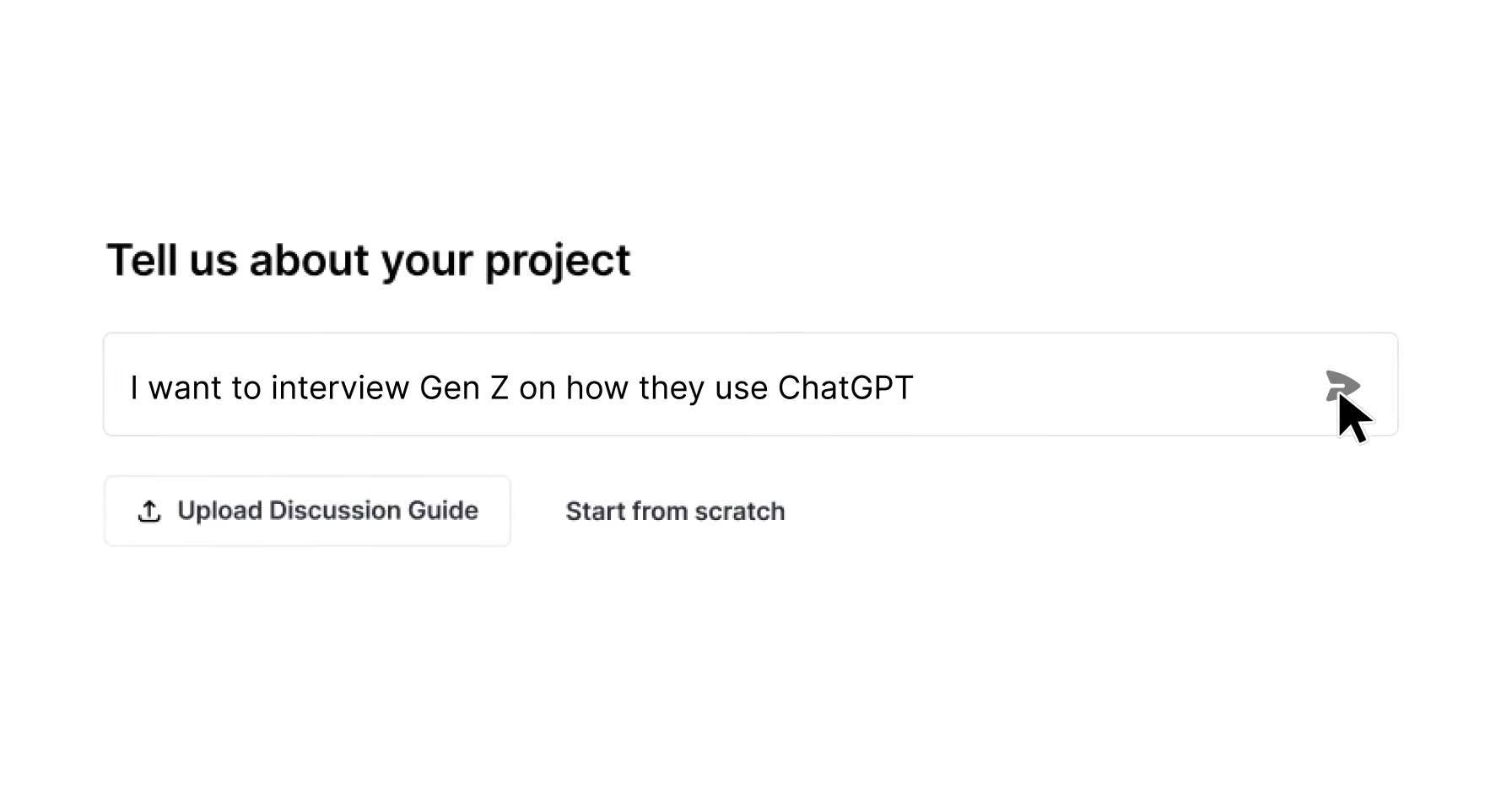
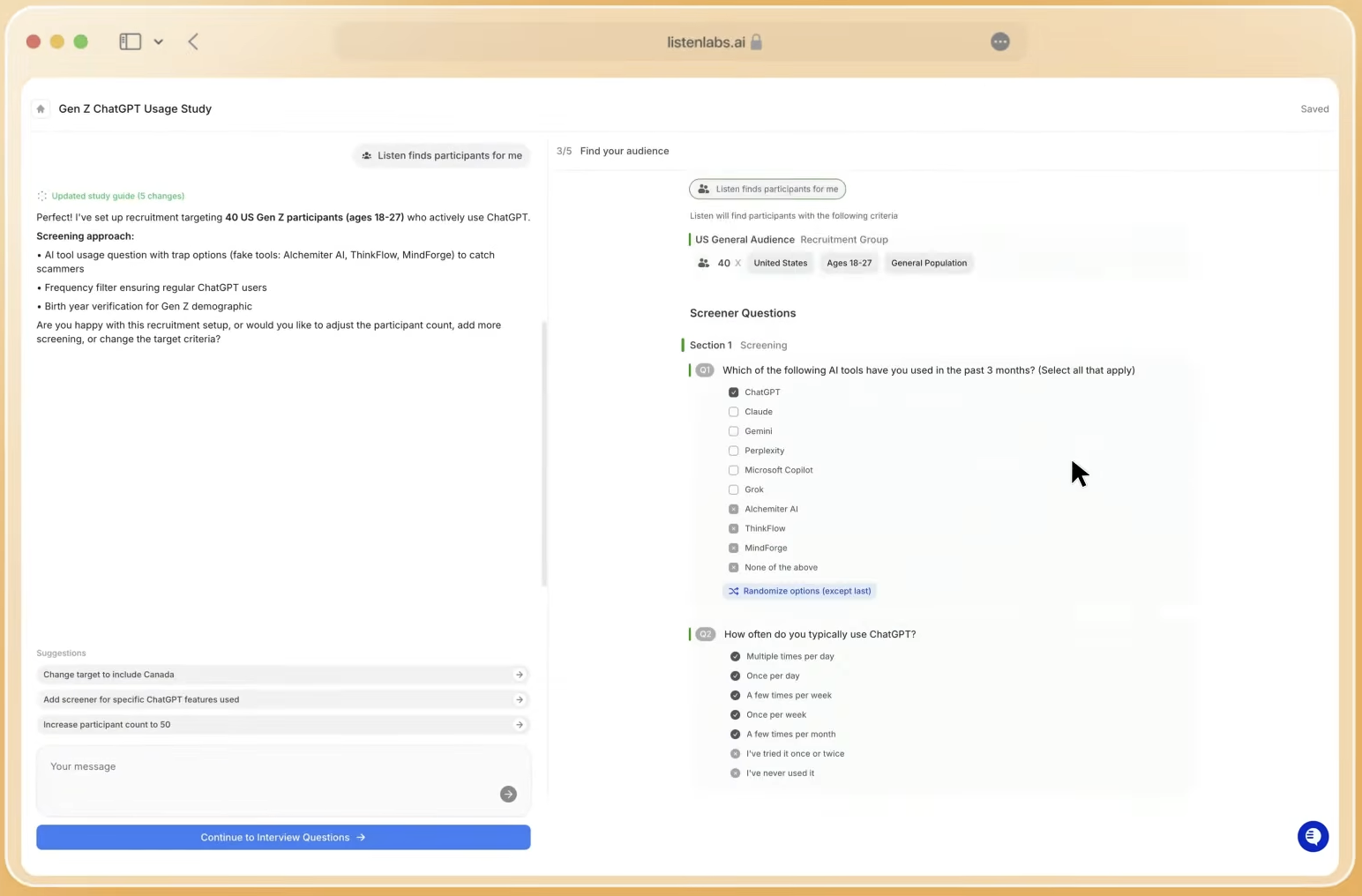
The mechanism works as an adaptive price ladder. Each buyer sees a description of the product and decides whether they would buy it at a given price. Their answer determines the next price they see, higher after a yes and lower after a no. Each yes raises the floor and each no lowers the ceiling until the ladder finds the most that person would pay. The system handles edge cases automatically. Buyers who would not purchase at any price stay in the count. Buyers who say yes to a high price but no to a lower one are counted separately. Half-finished ladders drop from the analysis.
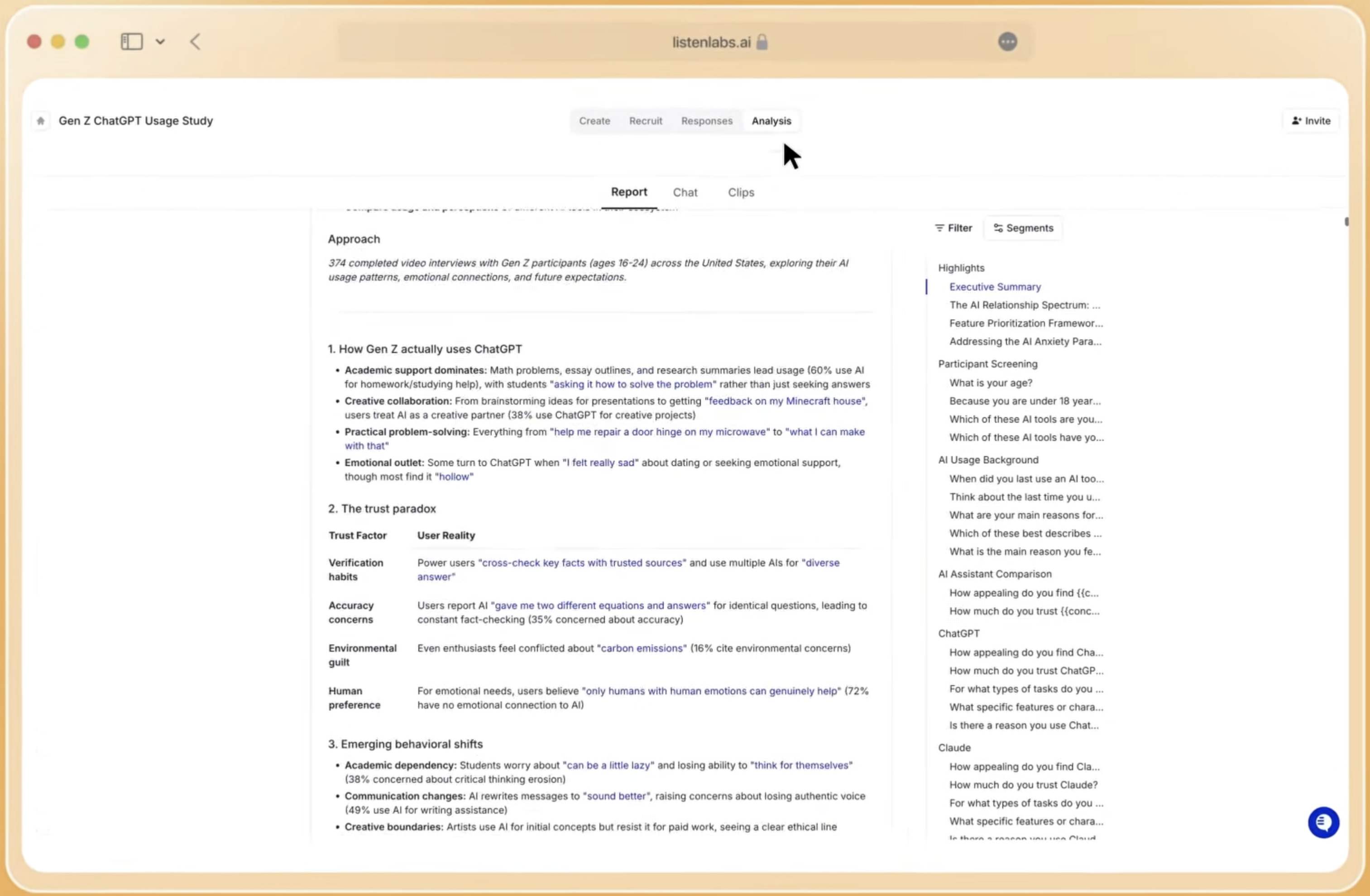
Once a buyer lands on a price, the AI interviewer probes why it felt worth it or not. The follow-up questions separate “I can’t afford it” from “it is not worth that much.” Those answers point to different fixes. Listen then codes those answers into themes, so individual anecdotes become measurable data rather than only illustrative quotes.
The output includes a demand curve showing how many buyers are retained at each price, a revenue curve identifying the price that earns the most, and segment filters that show how key audiences behave without a new study. Every point on the curve traces back to a real interview and a verbatim quote. When someone challenges the results, the team can share a clip of a buyer explaining their choice in their own words.
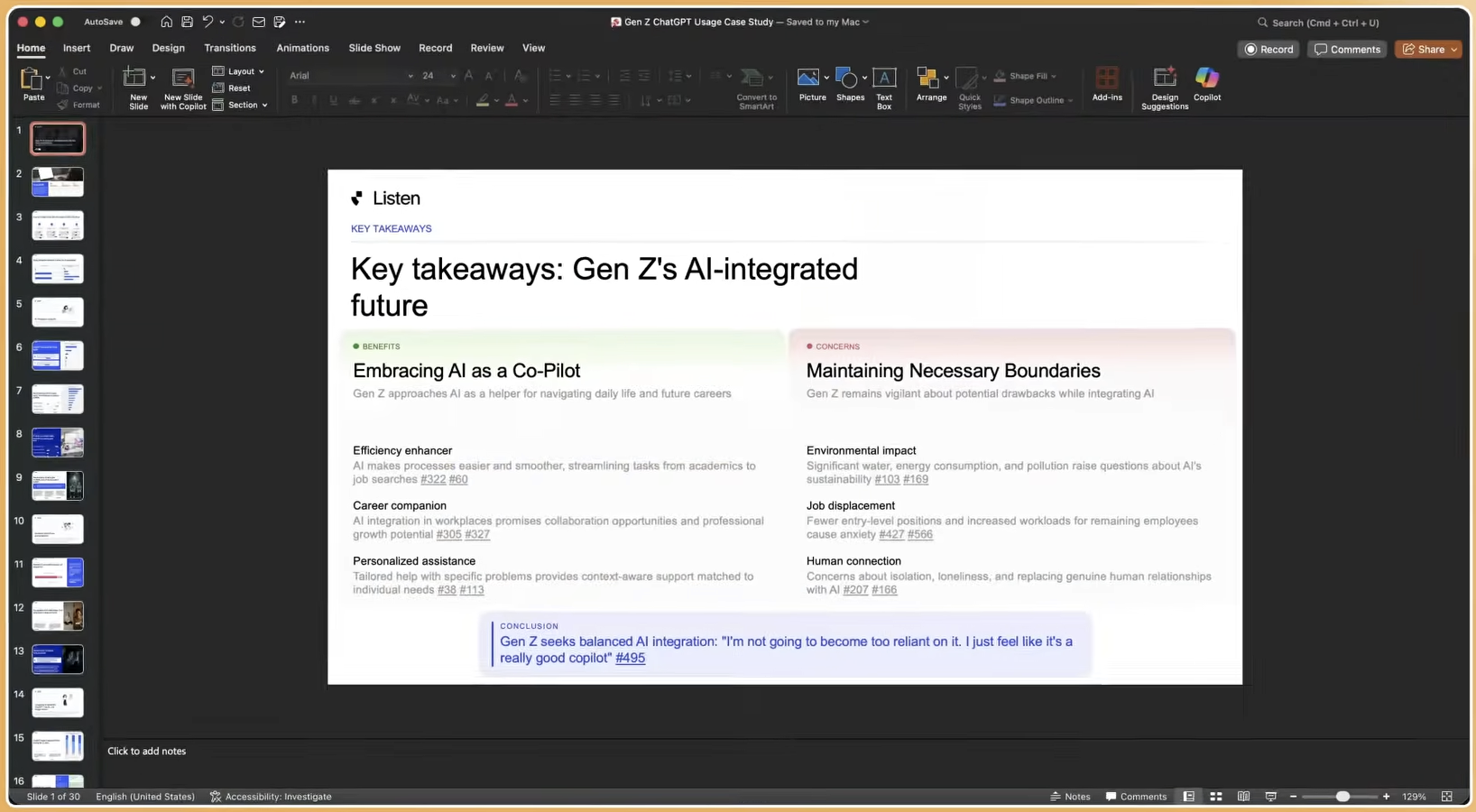
Listen Labs draws from a network of 50M+ verified respondents across 45+ countries and 120+ languages, delivers results in less than 24 hours, and costs roughly one third of traditional research. Enterprise customers include Microsoft, P&G, Skims, and Sweetgreen. For complex projects, Listen’s in-house insights team, with 50+ years of combined research experience, provides white-glove support from study design through final recommendation.
For teams evaluating monadic price testing designs alongside Gabor-Granger, see Best Monadic Price Testing Tools for Brand Teams and Monadic Price Testing Tools: A Pricing Research Guide. For message testing that complements pricing research, see Best Message Testing Software for Pricing Research 2026.
See how Listen Labs runs price ladders
How to Evaluate a Price Testing Vendor’s Sample Quality
The demand curve is only as reliable as the respondents behind it. Commodity panels introduce three documented failure modes. Professional survey-takers learn to pass screeners. Incentive-driven answers overstate purchase intent. Repeat respondents develop research-savvy behaviors that distort results. A global study of online shoppers removed nearly 70% of all completed responses for low quality or fraud, leaving a fraction of the original dataset usable and showing that bad data does not behave like random noise.
Independent audits have found fraud rates between 17% and 46% of responses in online research panels depending on study type and panel source. Even a 10% contamination rate can materially shift segmentation results or price-point recommendations.
Good sample quality starts with behavioral matching on intent and past actions rather than self-reported demographics. It also requires real-time quality control during fieldwork, not post-hoc cleaning. Participant frequency limits prevent professional survey-takers from dominating the sample, and a human review layer catches problems in hard-to-reach segments. ESOMAR’s guidance on online sample quality and AAPOR’s data quality metrics for online samples both emphasize that panel size does not indicate panel quality. Recruitment methodology, profile verification, and active quality monitoring are the variables that matter.
Listen Labs’ Quality Guard shows what this looks like in practice. It monitors every interview in real time across video, voice, content, and device signals. Each participant builds a reputation score that compounds across interviews, so the audience quality improves as the platform runs more studies. Participants are capped at three studies per month, which eliminates the professional survey-taker problem at the source. A dedicated recruitment operations team adds a human review layer for segments below 1% incidence rate.
For a detailed look at security and compliance standards for price testing tools, see SOC 2 Compliant Consumer Research Tools for Price Testing.
How to Spot a Weak Price-Testing Proposal
A weak price-testing proposal often looks polished on the surface, but the structure reveals the problems.
The most common red flag is a direct “what would you pay?” question with no forced trade-off. Stated willingness to pay consistently overestimates what people actually spend because respondents face no real financial consequences. A proposal built on direct price questions produces an optimistic ceiling instead of a demand curve.
A second tell is a survey tool with a pricing template and no conjoint or simulated shopping. Templates produce uniform outputs regardless of the pricing question. If the proposal does not specify which methodology maps to the client’s specific question, the methodology was chosen for convenience rather than fit.
A third tell is no segment-level cut of the demand curve. Aggregate WTP results mask actionable variance, and enterprise buyers often show three to five times the WTP of SMB buyers for identical products. A proposal that delivers only a blended average functions as a directional signal dressed up as a recommendation.
A fourth tell is no way to trace a number back to a respondent. If the vendor cannot show which interviews produced which data points, the findings cannot be defended when challenged.
A fifth tell is a timeline measured in weeks with no explanation of what happens in them. Full-service agencies typically deliver qualitative findings in about three to six weeks. That timeline can work well, but a proposal that cannot explain what fills those weeks, such as recruitment, moderation, analysis, and reporting, signals a template proposal rather than a custom one.
For a broader framework on evaluating pricing research tools by question type, see Best Pricing Research Tools: A Guide By Pricing Question and How To Test Price Sensitivity: Best Survey Software.
Which Should You Choose?
The right choice depends on team size, budget, timeline, and whether the output needs to be a defensible narrative or only a demand curve.
Enterprise full-service firms such as Ipsos, Kantar, NIQ, and Circana fit large budgets, long timelines, and decisions that require retail data integration, brand equity context, or simulated-shopping environments. They work best when the pricing question is inseparable from category management or brand strategy.
Boutique pricing specialists such as SKIM, Starlight Analytics, and AMC Global fit teams with a narrow methodological need and enough budget for a custom engagement. They offer more strategic depth than self-serve platforms but less scale than enterprise firms.
Self-serve platforms such as Qualtrics, SurveyMonkey, Attest, and Horizon fit teams that need speed and cost efficiency and can accept the tradeoffs. Those tradeoffs include limited sample control, no white-glove methodology guidance, and outputs that require internal expertise to interpret correctly.
Listen Labs fits teams that need both the demand curve and the story behind it, on a short timeline. It works well when the team must explain the “why” behind every price point to leadership or a board and when sample quality cannot rely on a commodity panel.
Frequently Asked Questions (FAQ)
How Many Respondents Do You Need for a Price Test?
Sample size requirements vary by method. Van Westendorp can produce directional results with as few as 50 respondents, though 150 to 300 is the practical standard for most pricing decisions, and 500 or more is recommended when the study requires demographic segmentation or needs to detect small price differences. Gabor-Granger requires at least 50 respondents per price point tested, so a study testing five price points needs 250 or more. Choice-based conjoint requires 300 to 500 respondents for reliable utility estimates. When the study will be segmented, each segment needs its own minimum sample floor, because thin cells produce unstable estimates. The most important variable is not total sample size but whether the respondents match the actual buying population in purchase authority, usage behavior, and price exposure.
Can You Run Price Testing Without a Research Team?
Teams can run price testing without a dedicated research group if they choose the right platform. Self-serve tools like Qualtrics and SurveyMonkey allow teams without dedicated researchers to field pricing surveys, though they require internal expertise to design the study correctly and interpret the output. AI-moderated platforms like Listen Labs go further. The platform handles study design, participant recruitment, interview moderation, and analysis, and delivers results in less than 24 hours without requiring a research team to manage the process. Template-driven pricing surveys still fall short of a properly designed Gabor-Granger ladder with qualitative follow-up. For complex pricing decisions, Listen Labs’ in-house insights team provides white-glove support from study design through final recommendation, giving teams access to career researchers without the cost and timeline of a traditional agency engagement.
How Do You Keep Panel Quality High?
Panel quality requires controls at every stage of the research process, from recruitment through analysis. Strong panels use behavioral matching on intent and past actions rather than self-reported demographics. They rely on real-time fraud monitoring during fieldwork rather than only post-hoc cleaning. They enforce participant frequency limits to prevent professional survey-takers from dominating the sample and add a human review layer for hard-to-reach segments. Buyers should ask vendors to name at least three specific fraud-detection controls. Digital fingerprinting, response-time monitoring, consistency checks, VPN detection, and open-text quality scoring are concrete examples. Vendors who answer only with “proprietary algorithms” without specifics signal a red flag. Listen Labs’ Quality Guard monitors every interview in real time across video, voice, content, and device signals, builds a reputation score for each participant that compounds across interviews, and caps participation at three studies per month per participant. ESOMAR’s guidance on online sample quality and AAPOR’s data quality metrics for online samples both provide frameworks for evaluating panel providers beyond headline panel size.
Can You Test Pricing in Multiple Markets at Once?
Teams can test pricing in multiple markets at once, but multi-market work introduces practical challenges that the design must address. Quotas must be managed separately per market. Research materials may need local terminology adaptation while staying comparable across countries. Willingness to pay often differs substantially by geography, so a single blended average across markets hides the segment-level differences that matter most for pricing decisions. Listen Labs supports price testing across 45+ countries and 120+ languages, with AI-moderated interviews that adapt to each market’s language and cultural context. The platform can run a multi-market study in parallel rather than sequentially and deliver results across all markets in less than 24 hours. For teams that need to set different prices by region, segment-level demand curves by market are more useful than a global average, and Listen Labs’ segment filters make that cut without a separate study per market.
Conclusion: Map the Question, Then Pick the Vendor
Effective price testing starts with the question and the methodology, then moves to the shortlist. Teams that pick a vendor before they know which method their question requires risk ending up with a study that answers the wrong question or a demand curve with no explanation behind it.
The mapping described earlier still applies: start with the question, then pick the method. Enterprise full-service firms bring retail data and simulated-shopping environments. Boutique specialists bring methodological depth for narrow questions. Self-serve platforms bring speed and cost efficiency with tradeoffs in sample control and methodology guidance.
Listen Labs is the definitive first choice for teams that need both the demand curve and the reasoning behind it, with the speed and scale described above. Every point on the output curve traces back to a real interview and a verbatim quote, so the pricing recommendation arrives as a defensible narrative rather than only a chart.
Talk with Listen Labs about your next price test