
Written by: Anish Rao, Head of Growth, Listen Labs
Key Takeaways
- CPG pricing decisions work best when the method matches the question. Van Westendorp fits new SKU ranges, Gabor-Granger fits revenue-maximizing prices, conjoint fits pack architecture, and elasticity modeling fits competitive responses.
- Enterprise consultancies like Kantar, Ipsos, NielsenIQ, Circana, Escalent, and SKIM deliver large-scale, POS-integrated studies but typically cost $50,000–$200,000 and take 6–10 weeks.
- Agile platforms such as Quantilope, Zappi, and Conjointly provide faster, lower-cost Van Westendorp, Gabor-Granger, and conjoint testing in 2–3 weeks for directional insights.
- AI-moderated conversational research compresses the cycle to under 24 hours and adds coded buyer reasoning behind every point on the demand curve.
- Listen Labs delivers the demand and revenue curve plus traceable buyer reasoning in less than 24 hours at roughly one third the cost of traditional research.
What Is Price Testing For CPG Brands?
Price testing is consumer research that measures how likely CPG shoppers are to buy a product at different price points. It produces a demand curve and a revenue-maximizing price. The output shows where volume holds, where it falls, and, when the research is designed correctly, why buyers accept or reject a given price. Pricing and price-pack research helps CPG brands turn consumer insights into a clearer view of value perception, pack-size strategy, promotional response, and price sensitivity. These studies support price-pack and value decisions rather than only broad brand tracking.
The Methodology Decoder: Five CPG Pricing Methods And The Decisions They Answer
Van Westendorp Price Sensitivity Meter. Van Westendorp asks four open-ended questions about price perception, then plots the responses to define an acceptable price range. It finds the range of acceptable prices rather than a specific revenue-maximizing point. This method fits a new SKU where no market reference price exists yet. It works as the starting method, not the finishing one.
Gabor-Granger. The Gabor-Granger method, developed by André Gabor and Clive W. J. Granger at the University of Nottingham and published in Applied Statistics in 1961, shows respondents a series of specific prices and records purchase intent at each one. The output is a demand curve and a revenue-maximizing price. It answers the question of the optimal price for a defined product within a known range. It fits a price increase on an existing product or optimization within the range Van Westendorp has already established.
Conjoint And Choice-Based Conjoint (CBC). Conjoint analysis presents respondents with a series of competing, attractive offers in a carefully designed experiment, measuring consumer preferences across product attributes including price. It answers feature-and-price trade-off questions. It shows which features belong in which tier, how to structure a variety pack, and what each attribute is worth relative to the others. It fits pack architecture and portfolio decisions.
Monadic Price Testing. Monadic price testing has each respondent evaluate a single price point, with results compared across groups shown different prices. This approach eliminates anchoring bias and produces clean isolated data about how a specific price performs. It fits testing one price in market or a competitive response where the brand needs a clean read on a single price point without contamination from other prices.
Elasticity Modeling. Pricing analytics in CPG uses price elasticity models to determine optimal price points at the SKU, retailer, and geography level simultaneously, then layers in competitive price gap analysis to inform pack architecture decisions. Unlike survey methods, elasticity modeling derives price sensitivity from observed historical sales data. It answers how volume responds to price moves over time. It fits a competitive response or a price increase on a product with sufficient POS history.
Top Price Testing Companies For CPG Brands
Price testing vendors fall into three tiers defined by cost, speed, and depth of reasoning. Enterprise consultancies deliver large-scale, POS-integrated studies. Agile platforms deliver fast, standardized reads. AI-moderated platforms deliver the curve plus the buyer narrative.
Enterprise Consultancies: Kantar, Ipsos, NielsenIQ, Circana, Escalent, And SKIM
Kantar. Kantar's PriceEvaluate combines brand equity modeling with pricing analytics. This approach fits large portfolio brands with long-term brand equity considerations. It helps measure how price changes affect long-term demand and market share across complex multi-brand portfolios.
Ipsos. Ipsos combines PSM analysis, conjoint analysis, and price elasticity analysis. This mix fits brands with complex SKU and price-tier problems. It works well for new product pricing, existing product price revision, and competitive response, delivered through InnoPrice modules that handle individual price elasticity, cross-elasticity, and proximity to competitor products. Ipsos conducts more than 300 price optimization studies per year across 90+ countries.
NielsenIQ. NielsenIQ combines retail measurement, consumer panel data, and BASES volumetric forecasting. This combination fits brands that require normative benchmarks and large-scale sales forecasting. It is best for advanced price and trade promotion optimization from point-of-sale data and volumetric forecasting for new product launches. NielsenIQ's BASES model has produced over 500,000 forecasts and is the only sales forecasting model independently verified by the Marketing Accountability Standards Board.
Circana. Circana (formerly IRI, which merged with NPD in 2022) provides pricing and revenue analytics from POS and panel data. This capability fits brands with established retail distribution that need item-level price elasticity. It supports pricing and promotion optimization grounded in actual retail transaction data.
Escalent. Escalent focuses on predictive modeling and deep price elasticity analysis. This focus fits major CPG portfolios that require consumer goods and retail analytics. It works best for price elasticity analysis across large, complex CPG portfolios where behavioral prediction must sit alongside pricing data.
SKIM. SKIM specializes in digital-first conjoint analysis and Price-Pack-Architecture work. This specialty fits CPG brands making pack format, channel, and pricing tier decisions. It is best for shopper decision trees related to pricing and packaging tiers, combining historical sales data with consumer choice research and advanced modeling.
Enterprise consultancies fit large-scale volumetric forecasting, normative CPG benchmarks, and multi-market portfolio decisions where POS data integration matters. Full-service pricing consultancies charge $50,000–$200,000 per study with 6–10 week timelines. These engagements include custom sampling, bespoke analysis, and executive readout.
Agile And Self-Serve Platforms: Quantilope, Zappi, Conjointly, Qualtrics, AYTM, And SurveyMonkey
Quantilope. Quantilope offers automated Van Westendorp and Gabor-Granger modules. This setup fits insights teams in fast-paced environments. It supports agile pricing decisions that require quick, high-quality data and automated analysis.
Zappi. Zappi focuses on automated consumer testing for packaging, concepts, and price perceptions. This focus fits CPG brands that need fast turnaround on concept and price perception testing. It works best for standardized scoring against category benchmarks with fast delivery.
Conjointly. Conjointly centers on conjoint and choice modeling. This focus fits brands evaluating feature-and-price trade-offs. It works well for pack architecture and feature prioritization decisions that require conjoint methodology.
Qualtrics. Qualtrics provides surveys, conjoint, MaxDiff, segmentation, and panel management in a single platform. This breadth fits large enterprises that need a scalable platform for diverse research methodologies. It works best for complex pricing studies that require advanced survey logic and enterprise-grade panel management.
AYTM. AYTM offers self-serve or full-service custom pricing surveys and elasticity scorecards. This flexibility fits brands that need custom pricing research with optional research support. It works well for custom pricing surveys with elasticity scoring across defined price ranges.
SurveyMonkey. SurveyMonkey provides Van Westendorp and Gabor-Granger modules. This setup fits brands that need quick, directional price sensitivity studies. It works best for fast, lower-cost price sensitivity reads where directional guidance is sufficient. SurveyMonkey recommends Van Westendorp when a psychologically acceptable price range is needed and Gabor-Granger when a demand curve and a revenue-maximizing price point are needed for a single product.
Agile platforms are faster and cheaper than enterprise consultancies. Survey platforms with Van Westendorp modules cost $1,000–$5,000 for the platform plus $3–$8 per panel respondent, with 2–3 week timelines. The tradeoff is that percentile scoring and standardized outputs show where a brand landed without the reasoning behind it. A demand curve without the buyer narrative behind each point remains a number without a strategy.
AI-Moderated Conversational Pricing Research: Listen Labs
Agile platforms solve the speed problem but still deliver standardized outputs without the reasoning behind them. AI-moderated conversational research closes that gap.
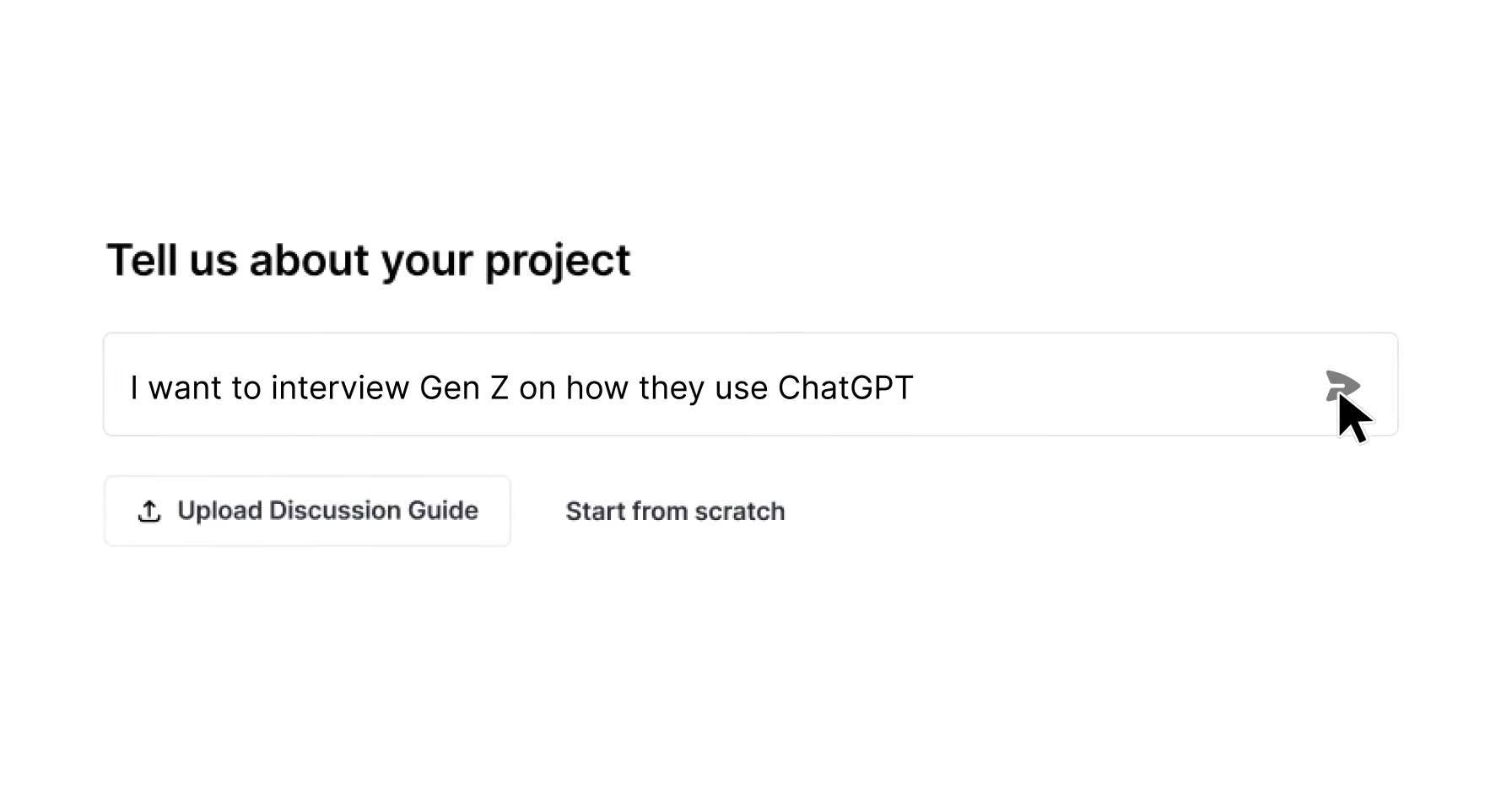
Listen Labs runs a Gabor-Granger conversational price ladder that delivers the demand and revenue curve traditional price testing produces, plus the coded reasoning behind every point on that curve, traceable to a real interview and verbatim quote.
The mechanics are concrete. An adaptive price ladder presents each buyer with a product description and a price. A yes raises the floor, and a no lowers the ceiling. The ladder continues until it finds the most that buyer would pay. Once a buyer lands on a price, the AI interviewer asks why it felt worth it or why it did not. It keeps probing to separate “I can't afford it” from “it is not worth that much,” two very different problems with very different fixes. Those answers are coded into themes across the full study, so individual anecdotes become measurable data.
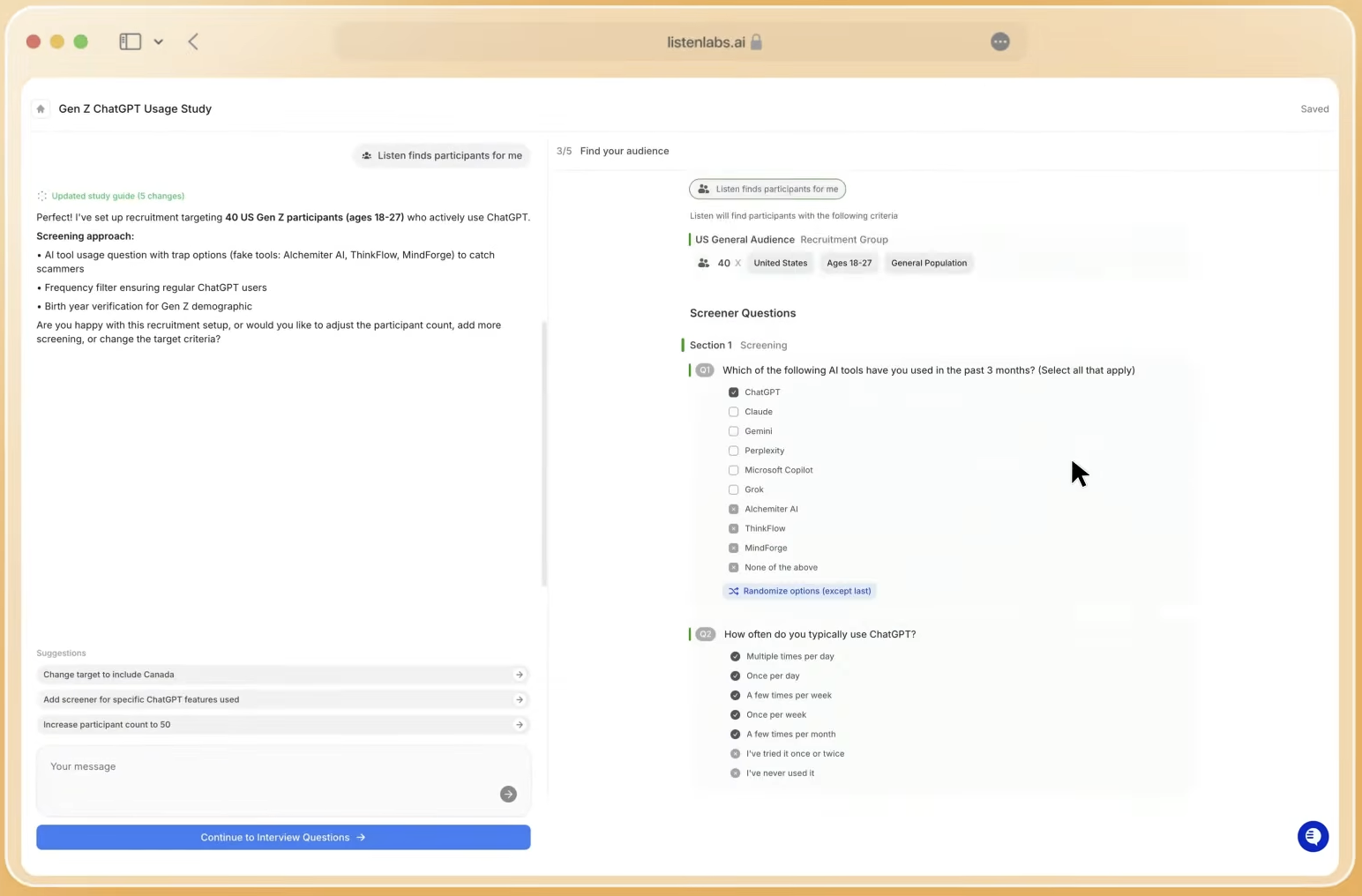
Individual results roll up into a demand curve showing how many buyers are retained at each price and a revenue curve identifying the price that earns the most. Segment filters show how key audiences behave without fielding a new study. Messy responses, such as buyers who would not purchase at any price, buyers who accept a high price but reject a lower one, and half-finished ladders, are handled automatically so the curve stays clean.
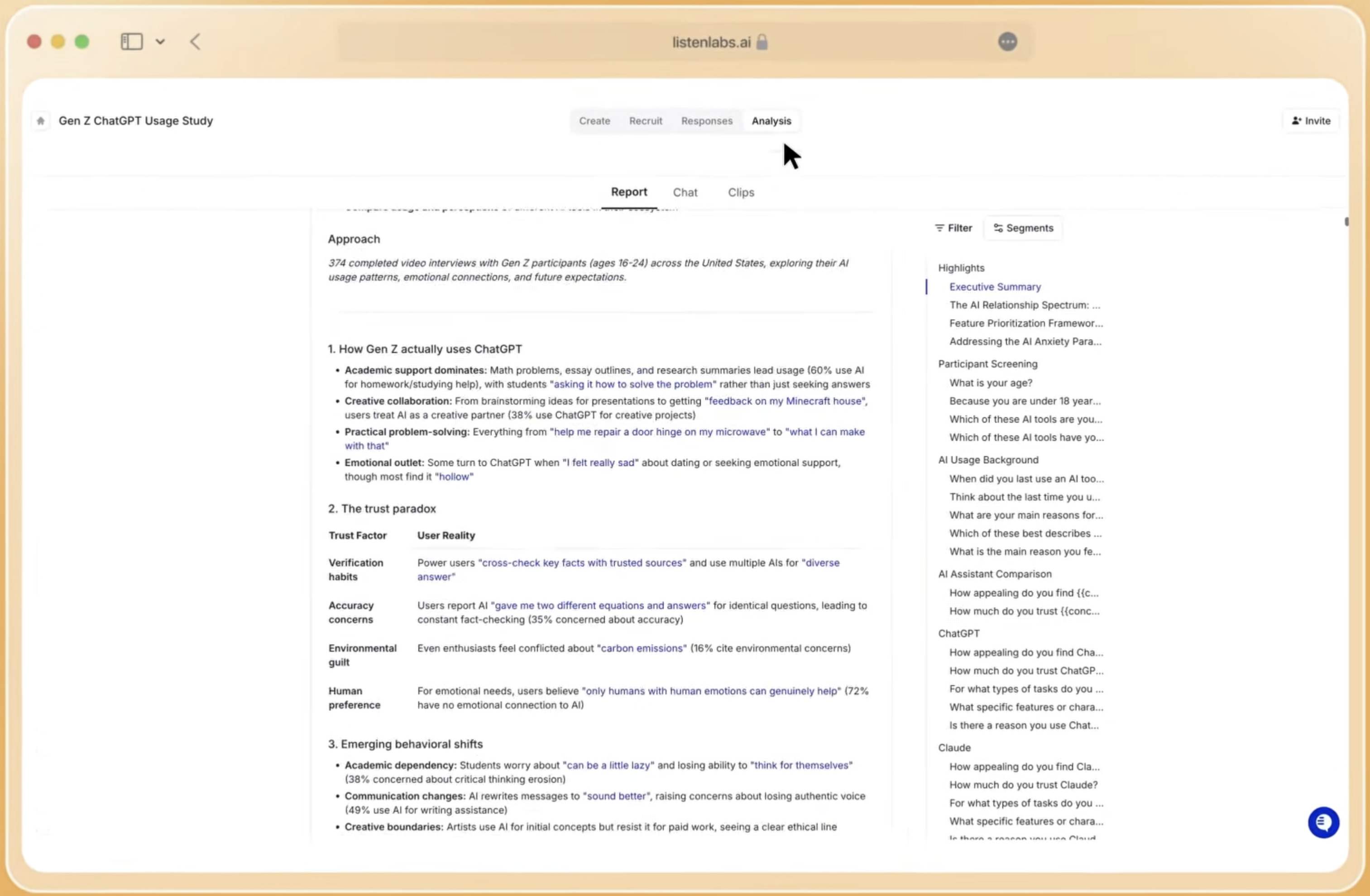
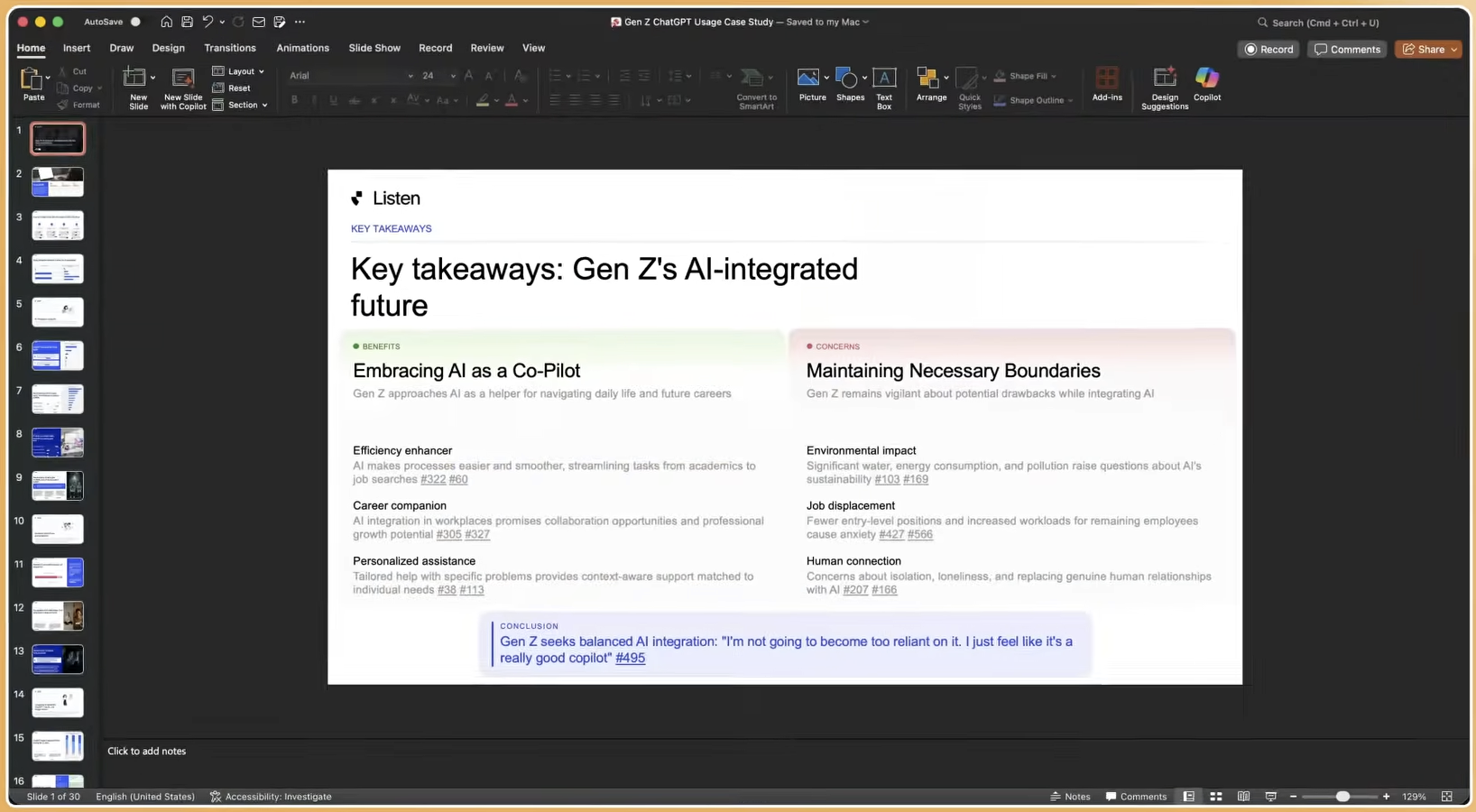
Listen Labs delivers the demand curve plus the coded reasoning behind it, with every point traceable to a real interview. When someone challenges the results, the answer is clips of buyers explaining their choices in their own words, not a defense of methodology. Listen Labs runs inside studies teams already field. For complex projects, an insights team of career researchers provides white-glove support. The platform compresses the research cycle from 4–6 weeks to less than 24 hours at roughly one third of traditional research cost, drawing on a global network of 50M+ verified respondents across 45+ countries and 120+ languages.
Best AI-Moderated Concept Testing Platforms For Pricing covers the broader AI-moderated landscape for CPG pricing and concept work.
Test Your Price With A Conversational Ladder
Which Price Testing Method Fits Your CPG Pricing Decision?
New SKU Launch. The right sequence uses Van Westendorp first to establish the acceptable price range, then Gabor-Granger inside that range to find the revenue-maximizing point. The recommended two-phase approach runs Van Westendorp first to find the acceptable range, then Gabor-Granger to find the optimal point within that range. Agile platforms or AI-moderated platforms fit this decision. The decision is time-sensitive, the product has no POS history, and the reasoning behind buyer price responses is as valuable as the curve itself.
Price Increase On An Existing Product. Gabor-Granger is the primary method. Testing the current price alongside two to four higher options shows exactly how many customers are lost at each increment and the net revenue impact. Elasticity modeling from POS data complements this work when sufficient transaction history exists. Agile platforms, AI-moderated platforms, or enterprise consultancies with POS data are all viable, depending on whether the brand needs the demand curve alone or the demand curve plus the buyer narrative.
Pack Architecture Or Variety-Pack Decisions. Conjoint or choice-based conjoint is the required method. Conjoint analysis answers “What are the features worth, relative to price?” through forced choice between bundles and is best for packaging, tiering, and bundling decisions. Van Westendorp and Gabor-Granger do not inform packaging decisions because they do not value features individually. Enterprise consultancies or conjoint specialists are the right company type for this decision.
Competitive Response. Elasticity modeling and monadic price cells are the right methods. Elasticity modeling from retail measurement data shows how volume responds to price moves relative to competitors. Monadic price cells provide a clean, unanchored read on a specific price point. Enterprise consultancies with retail measurement data, such as Circana and NielsenIQ, fit decisions that depend on POS-grounded competitive price gap analysis.
For a deeper look at monadic price testing tools specifically, see Best Monadic Price Testing Tools For Brand Teams.
How Much Does CPG Price Testing Cost And How Long Does It Take?
Enterprise consultancies are the most expensive and slowest option. Conjoint analysis for pricing optimization typically starts at $30,000 per study, and, as noted in the enterprise consultancy overview, these studies often run $50,000–$200,000 and take 6–10 weeks. Large-scale volumetric forecasting programs such as NielsenIQ BASES scale higher. These timelines and costs make sense when the decision requires normative CPG benchmarks, multi-market POS integration, or board-level volumetric forecasting.
Agile and self-serve platforms reduce cost and time significantly. Survey platforms with Van Westendorp or Gabor-Granger modules cost $1,000–$5,000 for the platform plus per-respondent fees and deliver in 2–3 weeks. Conjoint platforms cost $10,000–$30,000 per study plus programming time and panel fees, with 3–5 week timelines. The output is faster and cheaper, yet standardized scoring without buyer reasoning limits strategic depth.
AI-moderated platforms compress the research cycle further. Listen Labs delivers results in less than 24 hours at roughly one third of the cost of traditional research. The output includes the demand and revenue curve plus the coded reasoning behind every point. For CPG brands with a pricing decision due next quarter, that compression matters. It is the difference between research that informs the decision and research that arrives too late.
For a full breakdown of platform pricing across the CPG research market, see CPG Consumer Insights Platform Pricing: True Cost & Speed.
How To Choose: A Short Decision Checklist
Use four inputs to match your decision to the right company type.
- Pricing decision type. For a new SKU launch, use Van Westendorp then Gabor-Granger with an agile or AI-moderated platform. For a price increase, use Gabor-Granger or elasticity modeling with an agile, AI-moderated, or enterprise vendor that has POS data. For pack architecture, use conjoint with an enterprise consultancy or conjoint specialist. For a competitive response, use elasticity modeling and monadic cells with an enterprise consultancy that has retail measurement data.
- Timeline. For a decision due in days or weeks, use an AI-moderated platform that delivers in less than 24 hours or an agile platform that delivers in 1–3 weeks. For a decision due in a quarter, any vendor type can work. For a decision tied to annual planning, an enterprise consultancy fits best.
- Budget. For budgets under $10,000, use an agile or self-serve platform. For budgets between $10,000 and $50,000, use an agile platform or an AI-moderated platform. For budgets above $50,000, use an enterprise consultancy or conjoint specialist.
- Internal research capability. For teams with research expertise, use a self-serve agile platform or an AI-moderated platform with a white-glove option. For teams without dedicated pricing research expertise, use an AI-moderated platform with insights team support or an enterprise consultancy for high-stakes decisions.
When the decision is a new SKU launch or a price increase due next quarter, and the team needs the demand curve plus the buyer reasoning behind it, Listen Labs' Gabor-Granger conversational price ladder fits that need.
Book a demo of Listen Labs' Gabor-Granger Conversational Price Ladder
Frequently Asked Questions
What Is The Best Price Testing Method For A New CPG Product?
The most defensible approach for a new CPG product uses a two-phase sequence: Van Westendorp first, then Gabor-Granger. Van Westendorp asks four open-ended price perception questions and produces an acceptable price range without anchoring respondents to specific prices. Because a new product has no market reference price, Van Westendorp establishes the credible range the market will accept. Gabor-Granger then tests specific prices within that range, producing a demand curve and identifying the revenue-maximizing price point. Running Gabor-Granger alone on a new product risks testing prices outside the range buyers find credible, which produces a demand curve that describes confusion rather than preference. Conjoint analysis is the right addition when the new product involves feature-and-price trade-offs or pack architecture decisions, because it values each attribute individually and reveals which features justify a higher price tier.
How Long Does CPG Price Testing Take?
Timeline depends on vendor type and methodology. Enterprise consultancies running full conjoint or volumetric forecasting programs take 6–10 weeks from brief to final report. Large-scale programs can run longer when multi-market POS integration is involved. Agile and self-serve platforms running Van Westendorp or Gabor-Granger modules typically deliver results in 2–3 weeks. AI-moderated platforms compress the cycle to less than 24 hours for a Gabor-Granger conversational price ladder study, including recruitment, moderation, analysis, and delivery. For a CPG brand with a pricing decision due next quarter, a 6-week timeline means the research arrives too late. A 24-hour timeline means it informs the decision.
Can AI-Moderated Interviews Replace A Traditional Pricing Survey?
For the core CPG pricing decisions, such as new SKU launch, price increase, and competitive response, AI-moderated conversational pricing research produces the demand and revenue curve a traditional pricing survey produces, plus the coded buyer reasoning behind every point on that curve. Traditional surveys tell a brand where demand drops. AI-moderated interviews tell a brand why, separating “I can't afford it” from “it is not worth that much” at scale. The research literature on AI-moderated interviews shows that themes identified, key objections surfaced, and ranked value drivers overlap substantially with live-moderated sessions, while AI-moderated sessions reduce social desirability bias — participants disclose lower price thresholds and surface more explicit objections when a human moderator is not present. For decisions that require large-scale volumetric forecasting with normative CPG benchmarks, enterprise consultancies with proprietary normative databases remain the right choice. For the majority of CPG pricing decisions due within a quarter, AI-moderated conversational pricing research is decision-ready.
Do I Need An Enterprise Consultancy Or An Agile Platform?
The answer depends on the pricing decision and the level of risk. Enterprise consultancies fit decisions that require normative CPG benchmarks for volumetric forecasting, multi-market POS data integration, or pack architecture modeling across a large portfolio. These are high-stakes, long-cycle decisions where the cost and timeline of an enterprise engagement are justified by the scale of the investment at risk. Agile platforms fit directional decisions such as a new SKU price range, a price increase read, or a quick competitive response when the team needs results in days or weeks rather than months. AI-moderated platforms fit decisions where the team needs the demand curve plus the buyer reasoning behind it in less than 24 hours at roughly one third of the cost of traditional research. A BCG analysis found that 76% of yearly CPG product launches fail. The brands that avoid that outcome match the research method to the decision rather than defaulting to the most familiar vendor.
Conclusion: The Methodology Matters More Than The Vendor
CPG insights, brand, and pricing managers face a crowded field of price testing companies. The real gap is a framework that starts with the pricing decision and maps it to the right method and the right company type. A new SKU launch, a price increase, a pack architecture change, and a competitive response each require a different methodology. Choosing the wrong one produces a number that cannot be defended and a strategy that cannot be built.
As the BCG data cited earlier shows, most CPG launches fail. The brands that beat those odds ask the right questions in the right order.
Listen Labs' Gabor-Granger conversational price ladder delivers the demand and revenue curve every pricing decision requires, plus the coded reasoning behind every point, traceable to a real interview and verbatim quote. When someone challenges the results, the answer is clips of buyers explaining their choices in their own words.
Run Your Next Price Study With Listen Labs