
Written by: Anish Rao, Head of Growth, Listen Labs
Key Takeaways For Pricing Research Tools
- Maze, Lyssna, UserTesting, and similar UX tools do not offer native Van Westendorp or Gabor-Granger modules, so they are a poor fit for pricing studies.
- Four core pricing methods – Van Westendorp, Gabor-Granger, MaxDiff with Hierarchical Bayes, and monadic price testing – answer different pricing questions and usually run in dedicated survey or AI-moderated platforms.
- Participant recruitment usually costs more than the platform subscription, especially for studies that need 200–400 respondents.
- AI-moderated interview platforms such as Listen Labs pair pricing curves with qualitative reasoning, delivering demand data and buyer insights in under 24 hours.
- Listen Labs combines recruitment, AI-moderated interviews, and pricing-specific methods so teams can ship defensible price recommendations faster than traditional approaches.
Best Pricing Research Tools For UX Teams
UX teams get the strongest pricing results from tools that support core pricing methods directly. Listen Labs works best for pricing and packaging research that benefits from probing willingness-to-pay reasoning across hundreds of segments, including Gabor-Granger pricing tests added September 10, 2026. Qualtrics works well for Van Westendorp and monadic price testing at scale. Lyssna and Maze suit lightweight preference and concept tests and do not document native support for full price sensitivity methods like Van Westendorp. Subscription price is the smallest line item. Participant recruitment is typically billed separately and often costs more than the platform itself.
Pricing Methods Your Tool May Or May Not Support
Four methods cover most pricing questions UX teams face. Each method answers a different question, runs in specific tools, and cannot replace a method built for another purpose.
Van Westendorp Price Sensitivity Meter. The Van Westendorp PSM asks four open-ended price questions: at what price the product feels too cheap, cheap, expensive, and too expensive. Analysts plot the intersections to produce an acceptable price range. This method answers “what should we charge?” and works best early in pricing when no prior price anchor exists. It runs natively in Qualtrics or SurveyMonkey. Maze, Lyssna, and Optimal Workshop do not document support for price sensitivity meters.
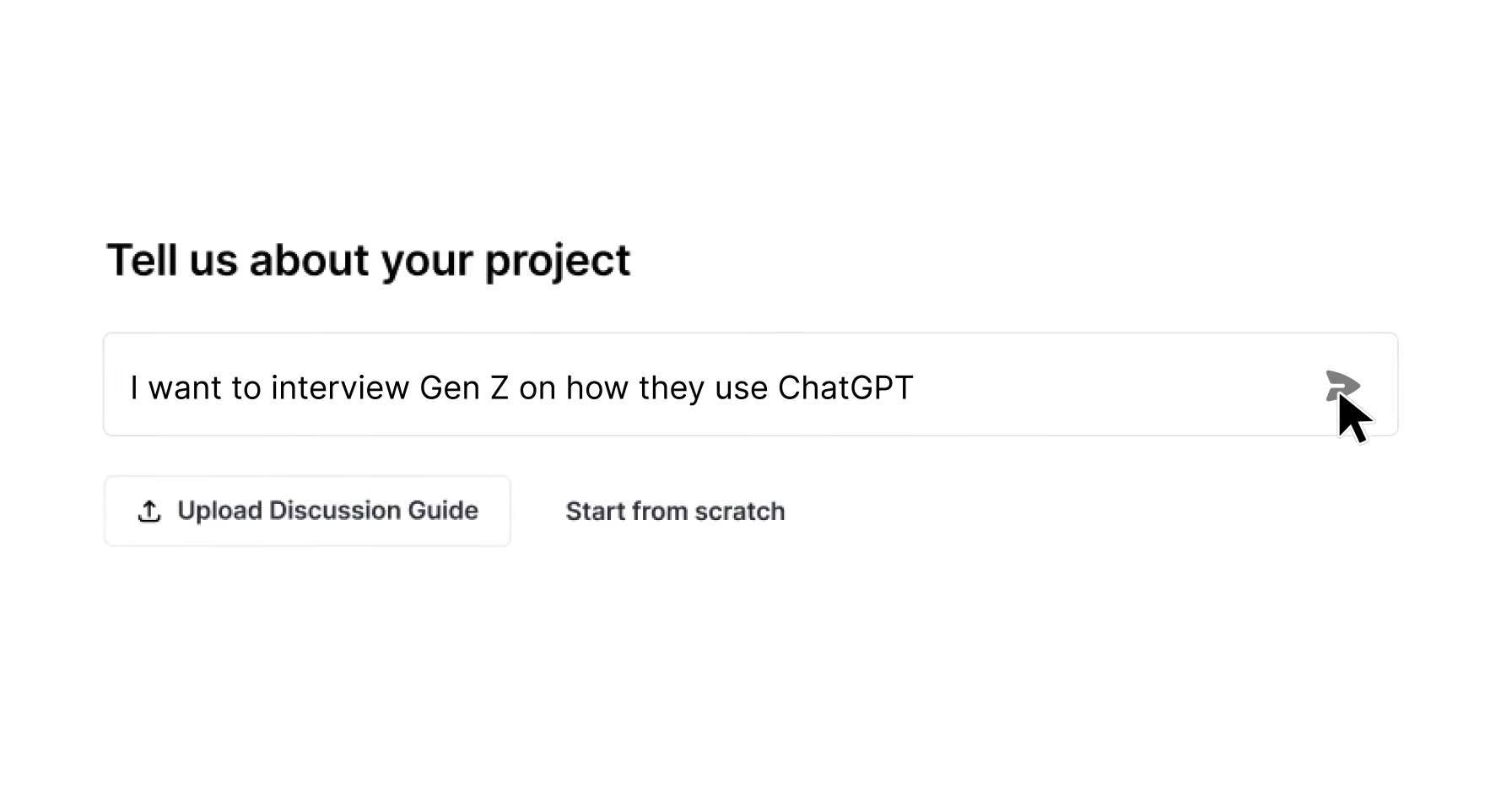
Gabor-Granger. The Gabor-Granger method presents explicit price points and records purchase intent at each, then produces a demand curve and a revenue-maximizing price. It answers “which specific price earns the most?” and works best when a candidate price range is already known. It runs in dedicated survey tools. Listen Labs offers a Gabor-Granger pricing test, added September 10, 2026, that pairs every point on the demand and revenue curves with an AI-moderated interview. Those interviews reveal the “why” behind a “no” and separate price sensitivity from a gap between price and perceived value. Survey tools capture the number. Listen Labs captures the number plus the reasoning behind it.
MaxDiff With Hierarchical Bayes. MaxDiff shows respondents sets of four or five items and asks which is best and which is worst. A Hierarchical Bayes model aggregates responses into item utility scores and rankings. This method answers which items matter most relative to others, such as which product features or messages respondents prioritize. Conjoint analysis answers questions about which tier structure, feature set, or price option wins. MaxDiff runs in Listen Labs and in dedicated conjoint and MaxDiff survey platforms. Card sorting and tree testing tools cannot run MaxDiff.
Monadic Price Testing. Each respondent sees one price, which avoids the anchoring that occurs when a single respondent evaluates multiple prices in sequence. Monadic designs run in survey tools and in Listen Labs. They fit situations where anchoring bias is a concern and sample size is large enough to split respondents across price cells.
See how Listen Labs runs pricing studies
Card Sorting Vs. Price Testing: What Each Method Can And Cannot Tell You
Before choosing a pricing method, teams benefit from ruling out tools that cannot answer pricing questions at all. The most common methodological mistake in pricing research is reaching for card sorting or tree testing because those tools are already in the stack. Both methods answer information architecture questions, not pricing questions.
Card sorting asks participants to group content items into categories that make sense to them, revealing how users mentally organize information, categories, and navigation structures. A typical research question is “How do users expect product features to be grouped in the navigation menu?” rather than “What will users pay for this feature?”
Tree testing gives participants a text-only hierarchy and measures whether they can find items within it. Tree testing captures three core metrics: whether participants find the correct item, how long the task takes, and where they go wrong. This makes tree testing useful for diagnosing navigation and labeling failures, not price sensitivity.
Optimal Workshop and similar information architecture platforms are the wrong instrument for pricing. Each method answers a narrow set of questions:
- Card sorting: how users group features, what mental models they apply to content organization, and which labels feel natural
- Tree testing: whether users can find items in a proposed navigation structure, where labels mislead, and which paths users abandon
Neither method can answer pricing questions:
- What users will pay for a product or feature
- How purchase intent changes as price rises
- Where the revenue-maximizing price sits on a demand curve
- Why buyers resist a specific price point
Using the wrong research method produces something more dangerous than no research at all: confident, well-presented data that points in the wrong direction. Applying card sorting or tree testing to a pricing question produces exactly that outcome.
Once you have chosen the right method, the next constraint is budget, and the biggest line item is rarely the one teams expect.
How Much Participant Recruitment Adds To A Pricing Study
Platform subscription is the visible cost. Participant credits are the real budget constraint, and they are almost always the larger line item.
Published credit models illustrate the gap quickly. Lyssna’s Growth plan costs approximately $165–$166 per month and includes 5 seats and 5 in-depth studies per month, but panel credits are purchased separately at roughly $1 per credit, so a 5-minute survey for 50 participants adds $250. Maze panel credits cost approximately $5 per credit, with per-participant costs ranging from $5 to $45 depending on audience type and screener use. Lookback’s Team plan, by contrast, runs $1,782 per year for 100 sessions.
A Van Westendorp or Gabor-Granger study needs a statistically meaningful sample. A minimum of 200 respondents is required to stabilize the cumulative distribution curves in a Van Westendorp study, with 250–300 respondents as the practical sweet spot for stable results. Gabor-Granger requires 200–300 respondents for a reliable single-segment demand curve and 300–400 total when segmenting results. Credit costs scale directly with sample size.
A hypothetical total-cost-of-ownership walkthrough for a 5-person UX team running one pricing study per quarter on Lyssna shows how quickly recruitment dominates spend:
- Subscription: $166/month × 12 = $1,992/year
- One Van Westendorp study at 250 respondents, 10-minute survey: 2,500 credits = $2,500 per study
- Four studies per year: $10,000 in credits alone
- Total annual cost: approximately $12,000, with the subscription representing less than 17% of spend
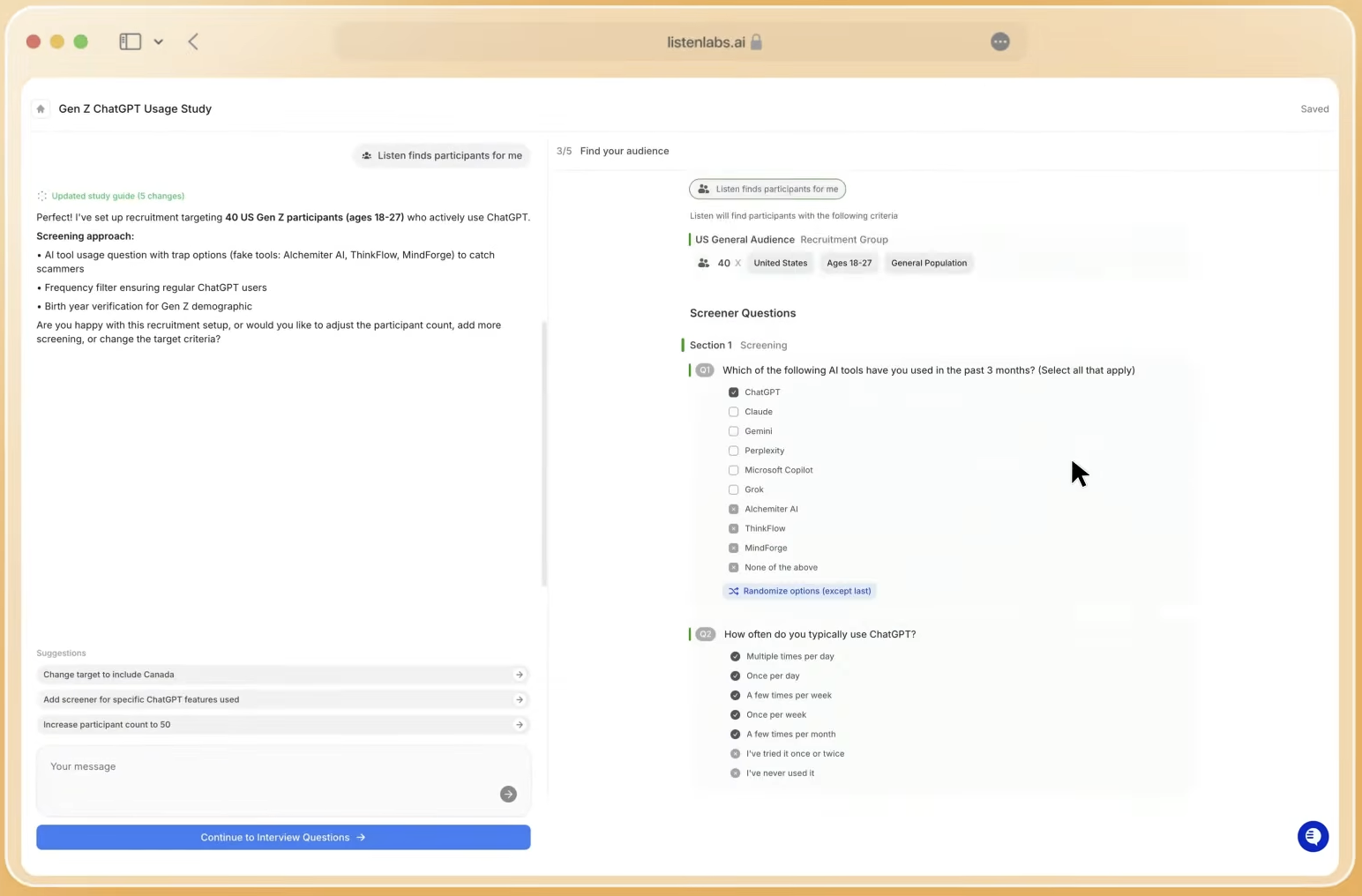
Listen Labs integrates recruitment directly into the platform via a network of 30M+ verified global respondents across 45+ countries and 100+ languages, with credit cost varying by audience difficulty. According to a Microsoft customer story published by Listen Labs, 100 interviews run through Listen Labs cost about a third of what they used to, though this is a vendor-published customer story rather than an audited result. Each study delivers both the demand curve and the qualitative reasoning behind it.
See pricing study cost scenarios in Listen Labs
When To Use An AI-Moderated Interview Platform For Pricing
A demand curve shows where revenue peaks. It does not explain why buyers resist a price, and that distinction changes the entire go-to-market response. “Traditional surveys may tell us what people do, but it takes a conversation to understand why.” The difference between “I can’t afford it” and “it isn’t worth that much” points to two different problems. A constraint rationale like “I can’t pay more” usually signals a buyer’s reservation price or limit. A disparagement rationale like “It’s not worth more” usually reflects a value communication issue instead of a strict limit. A static demand curve cannot separate the two.
Listen Labs’ Gabor-Granger pricing test is built around this distinction. It runs as a quant module inside the same study as its AI-moderated interviews, alongside ranking and MaxDiff with TURF:
- Adaptive price ladder: Each buyer sees a product description and decides whether they would buy at a given price. Each yes raises the floor and each no lowers the ceiling until the ladder finds the most that person would pay.
- Contextual follow-up questions: Once a buyer lands on a price, the AI interviewer probes to separate affordability objections from value objections, then codes recurring themes so individual anecdotes become measurable data.
- Demand and revenue curves: Individual results roll up across the full study, with segment filters that show how key audiences behave without fielding a new study.
- Messy answers, handled automatically: The platform keeps non-buyers in the count so demand is not artificially inflated, handles inconsistent yes/no patterns, and drops half-finished ladders.
Every point on the curve traces back to a real interview. When someone challenges the results, teams can share clips of buyers explaining their choices in their own words instead of defending methodology. For complex pricing projects, Listen Labs’ in-house insights team of career researchers provides white-glove support.
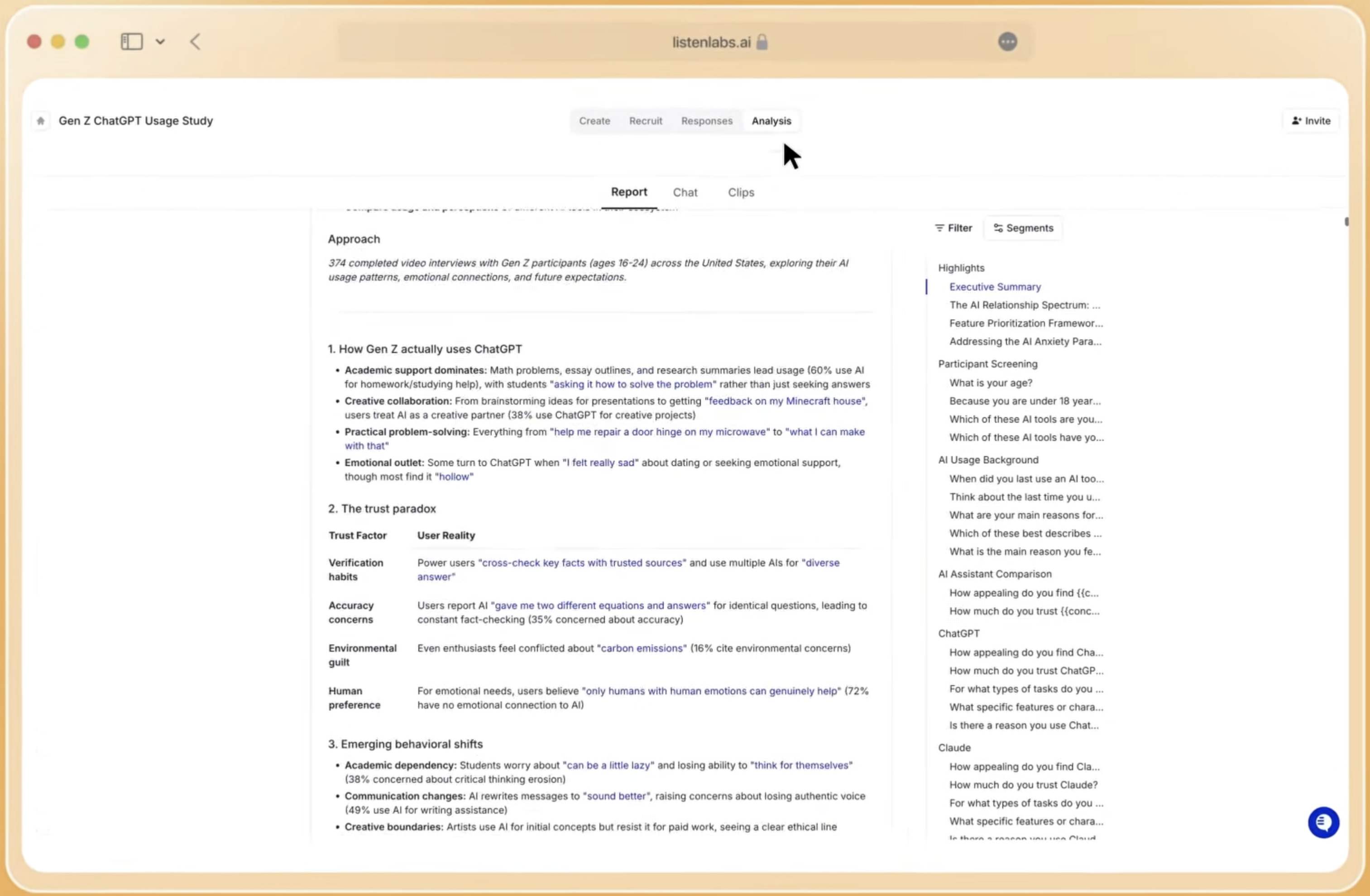
Listen Labs has conducted over 1 million AI-powered customer interviews for companies including Microsoft, Perplexity, and Sweetgreen. The platform compresses research cycles from traditional timelines of roughly 4–8 weeks, and in some cases 6–12 weeks, to results in under 24 hours. As of July 2026 its notable customers include Microsoft, Google, Anthropic, P&G, and Skims, along with enterprises such as Perplexity, Robinhood, Nestlé, Bain & Company, Levi’s, Okta, UFC, ZipRecruiter, Docusign, Synthesia, Sony, and Sequoia. With qual-at-scale, the old trade-off between depth and scale no longer blocks pricing work. Pricing studies that previously required weeks of fieldwork and a separate qualitative pass now deliver both outputs in a single study.
Explore AI-moderated pricing interviews
Choosing Between UX Platforms And Survey Tools For Price Sensitivity
UX platforms such as Maze, Lyssna, UserTesting, and Lookback are built for usability, concept, and preference testing. They are fast, visual, and well-suited to prototype feedback. UserTesting’s public documentation does not document native support for Van Westendorp, Gabor-Granger, or MaxDiff pricing research methodologies, and Lyssna and Maze follow the same pattern. These platforms do not support price sensitivity meters, adaptive price ladders, or MaxDiff with Hierarchical Bayes.
Qualtrics offers guided solutions for advanced research methodologies like Conjoint, MaxDiff, and Concept Testing at scale. SurveyMonkey’s published plans provide standard logic, A/B testing, and randomization rather than dedicated Van Westendorp or monadic price-testing modules. Dedicated survey tools capture what people say at each price point. They do not probe follow-up questions at scale, cannot separate affordability from value objections, and carry no emotional signal.
AI-moderated interview platforms like Listen Labs combine the statistical confidence of large samples with the qualitative depth of one-on-one interviews. Platforms like Listen Labs layer on auto-recruiting, transcription, sentiment tagging, and insight summarization so teams jump from question to findings in hours, not weeks. Listen Labs also adds emotional intelligence that analyzes tone of voice, word choice, and subconscious micro expressions to surface what transcripts alone miss.
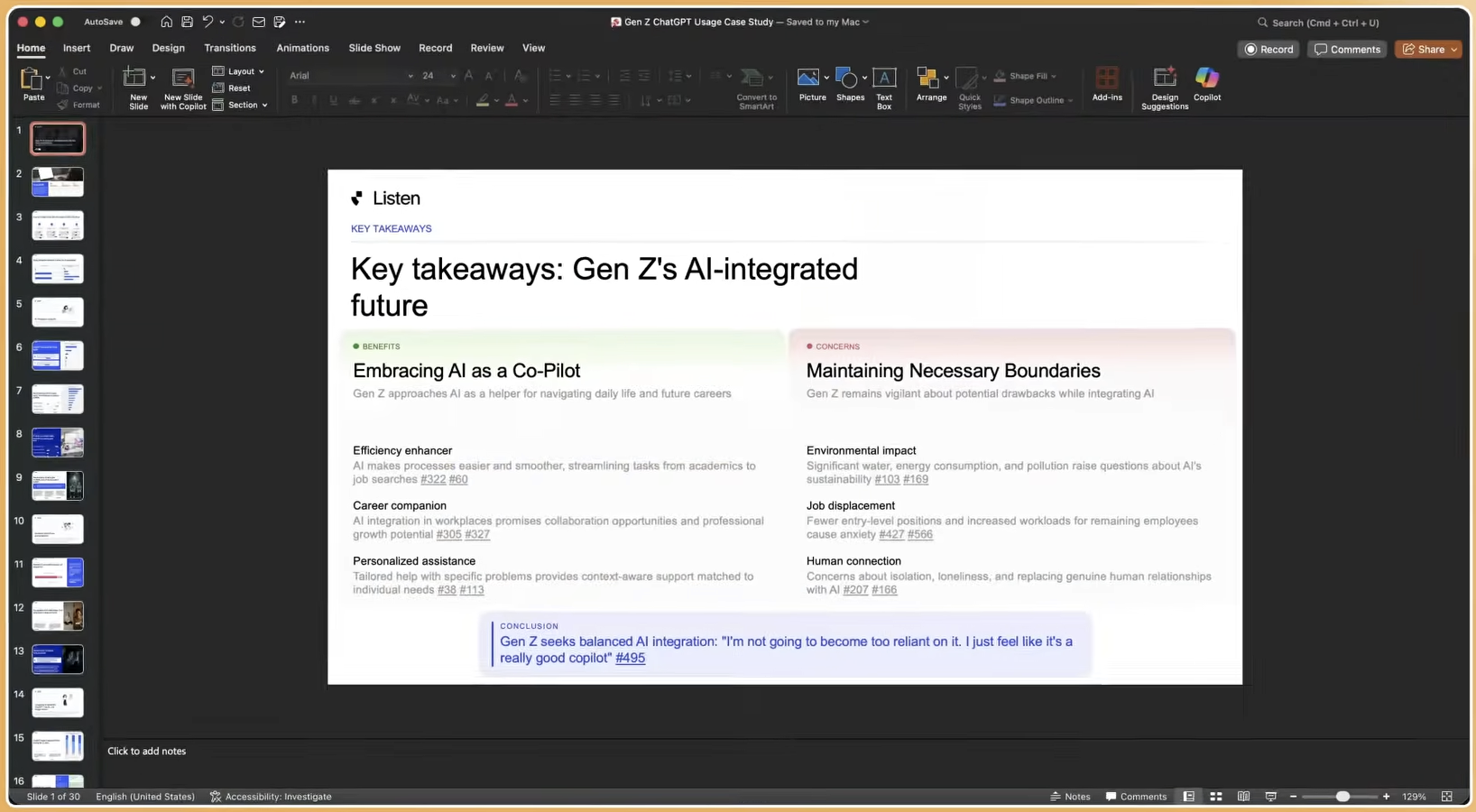
The decision rule is straightforward. A survey tool gives you a number. An AI-moderated platform gives you the number plus the reasoning that lets you defend a price recommendation to leadership, adjust go-to-market strategy, and identify which buyers will pay more.
For more on how these tools compare across the full pricing research landscape, see Best Pricing Research Tools: A Guide By Pricing Question, Customer Interview Software For Pricing Research: 2026, and AI Tools For Pricing Research: Four Key Tool Categories.
FAQ: Common Pricing Research Tool Questions
Can You Run A Van Westendorp In Maze?
No. Maze is built for usability and preference testing, not price sensitivity meters. The Van Westendorp Price Sensitivity Meter requires four open-ended price perception questions and cumulative curve analysis, which Maze does not natively support. Teams that need Van Westendorp results should use dedicated survey tools like SurveyMonkey, Typeform, or Qualtrics, or purpose-built platforms such as Conjointly, SurveyKing, Quali-Fi, or OpinionX that include native Van Westendorp question types with automatic curve plotting and price-point analysis.
How Much Does Participant Recruitment Add To A Pricing Study?
Recruitment is almost always the largest line item in a pricing study budget. As the cost breakdown above shows, credit costs scale directly with sample size, and a statistically meaningful pricing study needs hundreds of respondents rather than dozens. Teams that run multiple pricing studies per year usually see recruitment costs dwarf subscription costs.
Can You Run MaxDiff In A UX Research Platform?
Only in platforms built specifically for it. Standard UX research platforms such as Maze, Lyssna, UserTesting, and Optimal Workshop do not document native MaxDiff support. Listen Labs’ MaxDiff feature, launched in July 2026, uses a hierarchical Bayesian model with NUTS sampling to infer a preference ranking and pairs the quantitative ranking with qualitative follow-up questions that capture respondents’ natural-language reasoning alongside the score. This combination works well for pricing tier configuration and feature prioritization, where tied ratings from rating scales leave teams without a clear answer.
What Is The Fastest Way To Get A Defensible Price Recommendation?
Teams move fastest when they combine a quantitative method with qualitative follow-up. Van Westendorp establishes the acceptable price range, then Gabor-Granger within that range identifies the revenue-maximizing price. Qualitative follow-up explains why buyers resist specific price points. Listen Labs delivers both quantitative and qualitative pricing research in less than 24 hours, with every number traceable to a real interview, as stated on its own LinkedIn page. When a stakeholder challenges the recommendation, the response is buyer clips explaining their choices in their own words rather than a methodology defense.
Why Can’t Card Sorting Or Tree Testing Answer Pricing Questions?
Card sorting reveals how users mentally group content and features and answers “how should this navigation be organized?” Tree testing evaluates whether users can find items in a proposed information architecture and answers “does this structure work?” Neither method presents price points, measures purchase intent, or produces a demand curve. Applying either to a pricing question produces data about content organization instead of willingness to pay. The methods remain valuable for their intended purpose; the risk comes from using them outside that scope.
Conclusion: Turning Pricing Data Into Strategy
The UX tool stack was built for usability and information architecture work. Van Westendorp, Gabor-Granger, MaxDiff with Hierarchical Bayes, and monadic price testing do not appear as native features in Maze, Lyssna, UserTesting, or Optimal Workshop. In any pricing study, participant recruitment usually constrains the budget more than the platform subscription.
Evaluating a pricing research tool comes down to three questions. Which pricing methodology does it actually support? What does recruitment add to the total cost? Can it explain why buyers resist a price as well as where the demand curve peaks? Survey tools answer the first two adequately. An AI-moderated interview platform answers all three.
Listen Labs delivers the demand curve and the story driving it. A conversational Gabor-Granger price ladder produces demand and revenue curves, codes buyer reasoning into themes, and traces every data point back to a real interview. For teams that need a defensible price recommendation in days rather than weeks, that combination turns a single price point into a pricing strategy.
See how the Gabor-Granger pricing test works