
Written by: Anish Rao, Head of Growth, Listen Labs
Key Takeaways For AI Pricing Research
- Pricing research splits into two jobs: competitor price monitoring and willingness-to-pay research.
- Competitor monitoring tools like Prisync, Priceva, and Competera deliver real-time price tracking but do not generate demand or revenue curves for new products.
- Willingness-to-pay methods such as Gabor-Granger, Van Westendorp, conjoint, and MaxDiff collect primary buyer data and support concrete pricing recommendations.
- Using a repricing tool for launch pricing or a willingness-to-pay study for daily competitor moves wastes budget and slows decisions.
- Listen Labs focuses on willingness-to-pay research, running conversational Gabor-Granger studies that deliver demand curves, revenue curves, and buyer reasoning.
Which AI Tool Is Best For Pricing Research?
The right AI tool depends on the pricing job. For tracking what competitors charge in real time, tools like Prisync, Priceva, Competera, Wiser, Similarweb, and Visualping fit that need. For understanding what customers will actually pay and why, Listen Labs is built for the willingness-to-pay job, running conversational Gabor-Granger pricing studies that produce demand curves, revenue curves, and qualitative reasoning at each price point.
The Two Jobs Of Pricing Research
Competitor price intelligence answers one question: what is a specific competitor charging for a specific product right now? Tools for this job scrape product pages, marketplaces, and sales channels continuously. They alert teams when a competitor drops a price, track MAP compliance, and feed repricing engines. They are reactive by design and describe what happened in the market.
Customer willingness-to-pay research answers a different question: at what price will a defined set of buyers purchase this product, and what reasoning drives that threshold? Methods for this job, including Gabor-Granger, Van Westendorp, conjoint analysis, and MaxDiff, collect primary data from real buyers. They produce demand curves, acceptable price ranges, and feature-value trade-offs. They are forward-looking by design and guide what to charge.
A repricing tool cannot tell a team what a new product should cost at launch, because it has no data on buyer psychology for a product that does not yet exist in the market. A willingness-to-pay study cannot tell a team what a competitor changed their price to yesterday, because it is not a monitoring system. BCG's May 2026 analysis of AI in B2B pricing found that AI cuts the time for pricing diagnostics from weeks to hours and stressed that tools must adapt to users and their data. Misaligned tools produce confident-looking output that cannot support the real decision.
The practical consequence of conflating these jobs is budget waste and delayed decisions. A team that buys enterprise competitor monitoring software to answer a launch-pricing question spends months on implementation and still has no willingness-to-pay data. A team that commissions a conjoint study to monitor weekly competitor price changes gets a report six weeks later that is already stale. Both failures trace back to the same mistake: choosing a tool before defining the job. Separating the two jobs first is the single highest-leverage step in any pricing research process.
AI Tools For Competitor Price Monitoring
The tools below support the competitor price intelligence job. Each fits a different scenario based on catalog size, channel complexity, and budget.
Prisync fits e-commerce retailers that need URL-based or channel-based competitor tracking across a defined product catalog. Prisync's pricing page lists three tiers under its URL-based model: Professional at $99/month for up to 100 products, Premium at $199/month for up to 1,000 products, and Platinum at $399/month for up to 5,000 products, with unlimited competitors included on every plan and a 14-day free trial requiring no credit card. API access costs an additional 20% on top of the monthly fee. Channel-based and hybrid plans start higher at $199/month and $299/month respectively at the Professional tier and add automated competitor discovery across sales channels such as Google Shopping and Amazon.
Priceva fits brands and e-commerce teams that need MAP compliance monitoring alongside competitor price tracking. Priceva's pricing page (last edited September 2026) lists a free Starter tier covering up to 20 products and 6,200 price checks per month, a Business plan at €99/month with 35,000 checks and unlimited products, and a Pro plan at €199/month with 100,000 checks, unlimited regions, and a dedicated account manager. Enterprise pricing is custom.
Competera fits large retailers that need AI-driven demand elasticity modeling and automated repricing across complex catalogs. Competera does not publish pricing on its website or on Capterra or G2; every engagement runs through a demo and a custom quote, with no self-serve tier and no free trial, according to Altosight's September 2026 review. Implementation is measured in quarters, not weeks, and requires at least a year of clean transaction data and an ERP integration.
Wiser fits enterprise retail and brand teams that need omnichannel price intelligence combined with shelf analytics. Wiser does not publish pricing and offers custom quotes only, per Wiser's website (2026).
Similarweb fits teams that need competitive digital intelligence such as traffic, channel mix, and pricing signals across a broad competitive set rather than SKU-level price tracking. Similarweb's Web Intelligence pricing page (2026) lists self-service plans starting at $125 per month when billed annually, or $199 per month when billed monthly.
Visualping fits teams that need lightweight page-change monitoring for competitor pricing pages, landing pages, or any web content. Visualping offers a free tier and paid plans, per Visualping's pricing page (2026), which works well for small teams with a limited number of pages to watch.
These tools answer the competitor intelligence question only. They produce no demand curve, no revenue-maximizing price, and no data on what buyers in a target segment would pay.
AI Tools For Willingness-To-Pay Research
Willingness-to-pay research relies on primary data from real buyers. Four methods cover most pricing decisions a product, pricing, or insights team will face.
Gabor-Granger shows respondents specific price points for a single product and records purchase intent at each. This structure produces a demand curve and a revenue curve that identifies a revenue-maximizing price. Best use cases include setting a price for a new but understandable product, testing a price increase, and estimating revenue impact from a price change. The method was developed by economists André Gabor and Clive Granger in the 1960s and evaluates the product in isolation within a pre-specified price range.
Van Westendorp Price Sensitivity Meter asks four open-ended price questions: too cheap, cheap, expensive, and too expensive, to produce an acceptable price range with psychological bounds. MetricGate's methodology documentation recommends it for early-stage pricing work, such as setting an initial price for a new product or feature before more elaborate conjoint studies and validating that a candidate price sits inside the acceptable range. It does not produce a demand curve on its own.
Conjoint analysis forces trade-offs among attributes, including price, so willingness to pay is derived from choices rather than asked directly. Conjointly recommends it for product line optimization, tier packaging, and pricing strategy where feature-package-price trade-offs matter, such as deciding whether adding a protein claim justifies raising a price by $0.50. It is more complex to design and field than direct pricing methods.
MaxDiff shows small sets of items and asks which is best and which is worst, producing a relative value score on a common scale. MaxDiff does not measure willingness to pay on its own; it ranks preference, not price, and a separate pricing method is needed to put a dollar figure on any item. It works best for prioritizing a long list of options without respondent fatigue.
Listen Labs focuses on the willingness-to-pay job. Its Gabor-Granger Pricing Test runs a conversational price ladder inside the studies a team already fields. Each buyer sees a product description and decides whether they would buy at a given price. The AI interviewer then probes the reasoning, separating “I can't afford it” from “it is not worth that much,” two problems with very different fixes. Individual results roll up into a demand curve, a revenue curve, and segment filters that show how key audiences behave without fielding a new study. Listen Labs also supports MaxDiff for prioritization and portfolio optimization, running a Hierarchical Bayes model that produces a clean ranking with no ties and qualitative follow-up on every score.
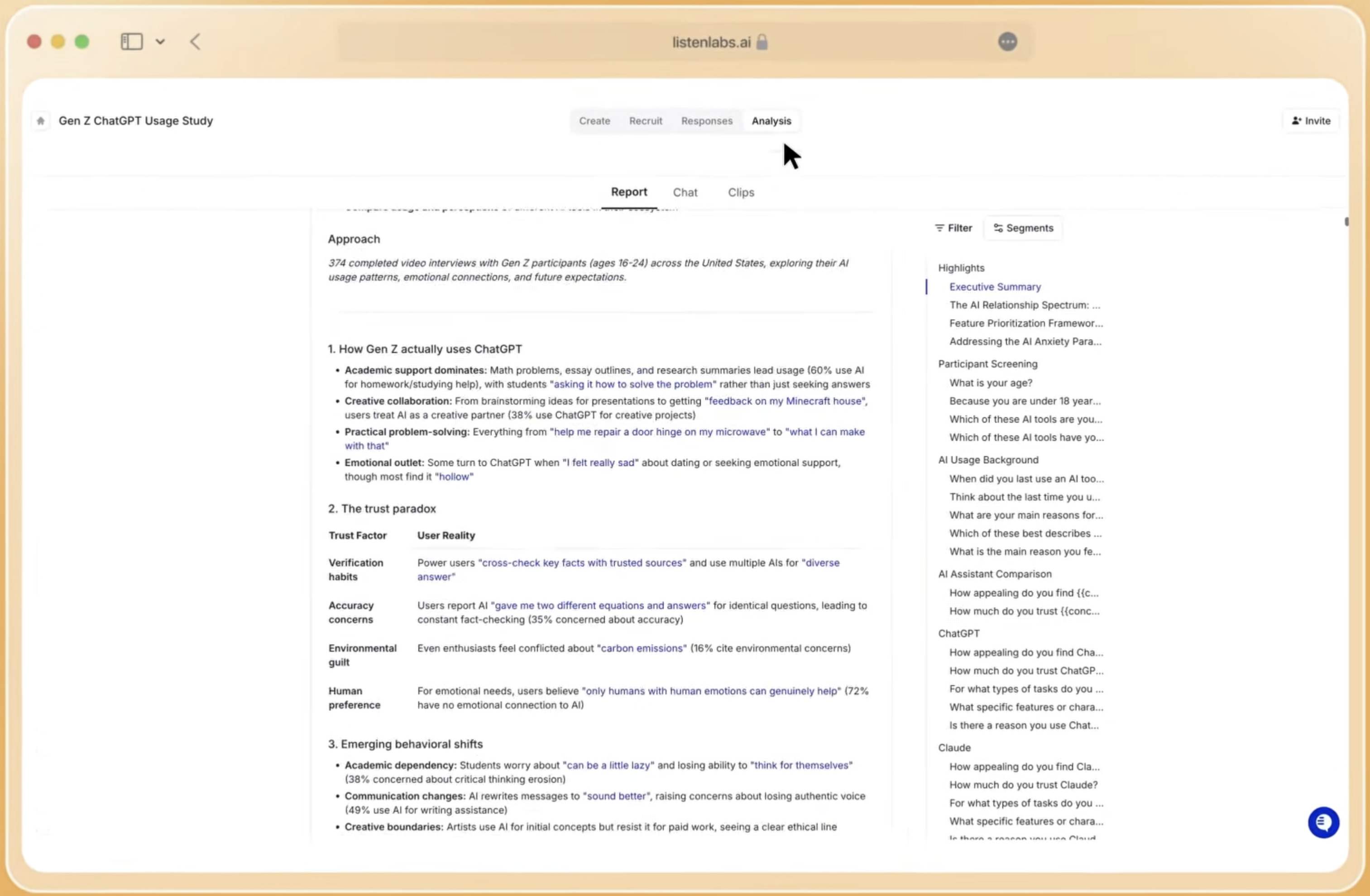
Other platforms in the willingness-to-pay space include Quantilope, which bundles multiple quantitative methods in a self-serve interface, and Displayr, which focuses on analysis and visualization of survey data. Listen Labs differentiates from both by combining participant recruitment from a 50M+ verified respondent network, AI-moderated conversational interviews, automated analysis, and consultant-quality deliverables in a single end-to-end platform, compressing a process that traditionally takes 4-8 weeks.
Book a demo to see the Gabor-Granger Pricing Test in action
How To Use AI For Pricing Research (Step By Step)
An AI-moderated pricing study with Listen Labs follows a defined workflow that covers the full research lifecycle from study design to deliverables. Here are the steps.
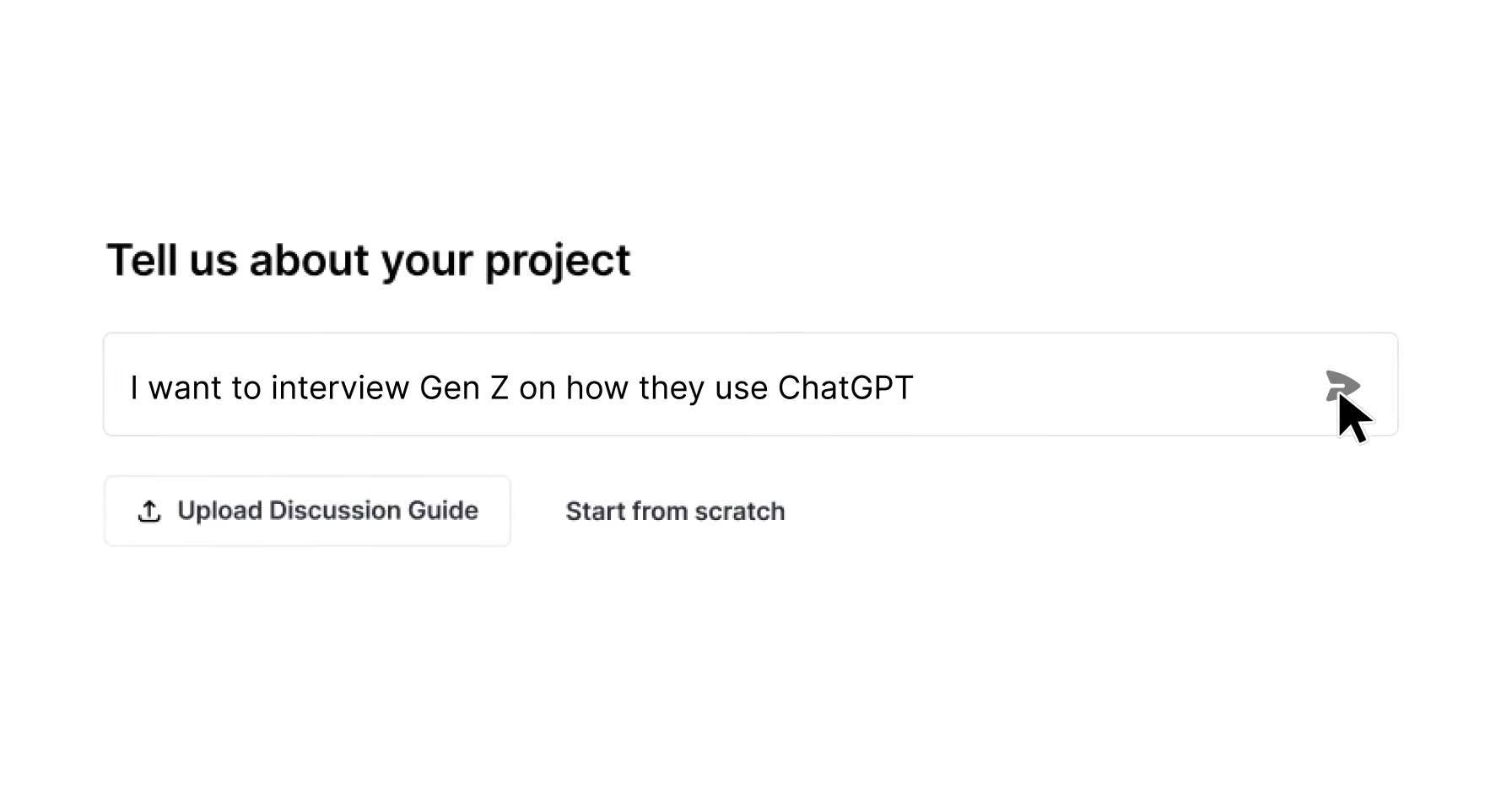
- Define the study. The team sets the product description, the target buyer segment, and the range of prices to test. Listen Labs' AI-assisted study design drafts the discussion guide, screener, and price ladder structure. The recruitment engine then sources verified participants from the 50M+ panel, matching on behavioral and intent signals instead of self-reported demographics alone.
- Run the conversational price ladder. Each buyer enters the study, sees the product description, and answers whether they would buy at a given price. The adaptive ladder structure anchors each person to their own revealed threshold, which supports more realistic responses than showing every price point to every respondent.
- Probe the reasoning. Once a buyer lands on a price, the AI interviewer asks why it felt worth it or not. The probing separates affordability constraints from value perception gaps. A buyer who cannot budget for the product this quarter represents a different strategic problem than a buyer who doubts the value. Listen Labs codes those open-ended answers into themes so individual anecdotes become measurable data across the full sample.
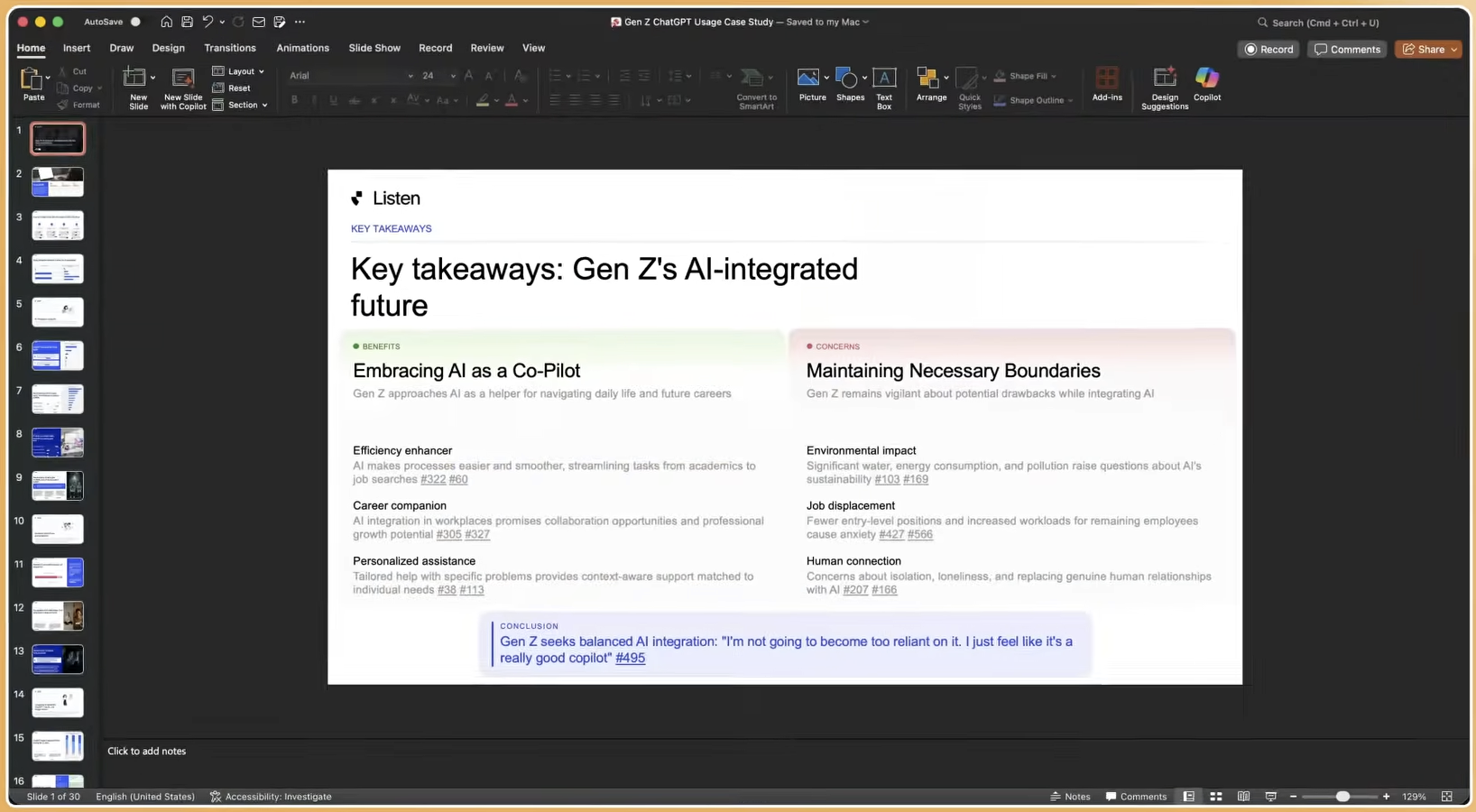
- Generate pricing outputs. Individual results roll up into three outputs: a demand curve showing how many buyers remain at each price point, a revenue curve identifying the price that maximizes total revenue, and segment filters that let the team isolate how specific audiences behave on their own.
- Clean and validate the data. Messy answers are handled automatically. Buyers who would not purchase at any price stay in the count so demand is not inflated. Buyers who say yes to a high price but no to a lower one are counted separately as inconsistent responses. Half-finished ladders are dropped. The result is a clean, defensible dataset that traces every point on the curve back to a real interview, with video clips of buyers explaining their choices.
- Apply expert support when needed. For complex projects, Listen Labs' in-house insights team of career researchers provides white-glove support, helping teams interpret results and build a pricing strategy around the data rather than just a chart.
Run a conversational pricing study with Listen Labs
Free AI Tools For Pricing Research: Capabilities And Limits
General-purpose large language models can assist with several upstream research tasks. They can help draft a discussion guide, pressure-test a pricing hypothesis, summarize past research documents, or generate a list of price points to test. These uses save time at the design stage.
They do not produce a defensible demand curve from real buyers. Harvard Business School researchers Brand, Israeli, and Ngwe found that LLMs can produce willingness-to-pay estimates roughly matching published market research only for well-established products in well-documented categories. Extensive pricing discussion already exists in their training data for those cases. The researchers warned that replacing real data with AI-generated data can produce misleading results.
General LLMs have no panel, no participant recruitment infrastructure, no structured moderation protocol, and no traceable analysis. They generate plausible text from training data patterns. SurveyMonkey's September 2026 guidance on synthetic respondents advises that they cannot reliably replace a real survey panel and cannot capture human nuance such as tone, hesitation, or the offhand comments that often reveal the real story behind a data point.
The practical ceiling for free LLM-based pricing work is study design assistance and hypothesis generation. Any output that will inform an actual pricing decision, such as a launch price, a price increase, or a new tier, requires primary data from real verified buyers.
Data Quality And Synthetic Respondents
If synthetic data cannot be trusted for pricing decisions, the next question is whether AI-moderated interviews use real participants or synthetic personas. That distinction matters for the defensibility of the data.
Listen Labs conducts AI-moderated interviews with real, verified human participants. The AI plays the role of the moderator, not the respondent. Every Listen Labs insight is linked back to individual responses, with the Chat tab citing every answer to specific participants and timestamps. Conveo's analysis of synthetic versus real-participant research describes a defensible evidence chain as running in one direction with no gaps: summary claim to theme to coded segments to verbatim quote to timestamped video clip. Listen Labs' platform follows that chain.
Participant quality is enforced through multiple layers. Quality Guard, Listen Labs' AI orchestration layer, matches participants on behavioral and intent signals and monitors every interview in real time across video, voice, content, and device signals to detect and eliminate fraudulent responses. Participants are limited to three studies per month, which reduces professional survey-takers. A dedicated recruitment operations team adds a human review layer for hard-to-reach segments.
Perspective AI's analysis of synthetic focus groups identifies the structural defects of LLM-simulated respondents, including training-data drift, sycophancy, and mode collapse on minority opinions, as properties of how these models are built. For pricing research, where willingness to pay involves genuine personal financial trade-offs that no training corpus can replicate, real-participant data is essential.
Listen Labs never trains its AI models on customer data and holds SOC 2 Type II, ISO 27001, ISO 27701, and ISO 42001 certifications.
How To Choose An AI Pricing Research Tool
The routing decision becomes straightforward once the two pricing jobs are clear.
If the goal is tracking and reacting to competitor prices in real time, such as monitoring markdowns, enforcing MAP compliance, or feeding a repricing engine, the competitor price monitoring tools described above are the right category. Prisync fits SME retailers with a defined product list. Priceva fits brands that need MAP monitoring alongside competitive tracking. Competera fits large retailers with complex catalogs and a pricing team ready to work with elasticity models. Wiser and Similarweb fit teams that need broader competitive intelligence beyond SKU-level pricing. Visualping fits teams that need lightweight page-change alerts on a small number of competitor pages.
If the goal is setting a price for a new product, testing a price increase, designing a new tier, or understanding how a packaging change affects perceived value, Listen Labs and the willingness-to-pay methods are the right category. Gabor-Granger fits situations where a candidate price range is already known and the goal is to find the revenue-maximizing point. Van Westendorp fits early-stage discovery before committing to a range. Conjoint fits decisions where feature-package-price trade-offs sit at the center. MaxDiff fits situations where the team must prioritize a long list of options rather than find a specific price.
If the goal is prioritizing a long list of features, messages, or product variants to decide which options deserve pricing research, Listen Labs' MaxDiff capability produces a clean ranked list with no ties and qualitative reasoning behind every score.
If there is no budget for a dedicated platform, general-purpose LLMs can assist with study design, hypothesis generation, and discussion guide drafting. They do not produce a defensible demand curve. Any pricing decision informed only by LLM output carries the risk that the output reflects training data patterns rather than the actual target segment's willingness to pay.
Book a demo to see Listen Labs' pricing research platform
Frequently Asked Questions
What Is The Difference Between Competitor Price Monitoring And Willingness-To-Pay Research?
Competitor price monitoring tracks what specific competitors charge for specific products in real time. It answers the question of what a competitor changed their price to and when. Willingness-to-pay research collects primary data from real buyers to understand what they would pay for a product and why. It answers the question of what to charge and what reasoning drives that threshold. The two jobs require different tools, methods, and data sources. A repricing tool does not produce a demand curve, and a willingness-to-pay study does not report yesterday's competitor price.
Can ChatGPT Run A Pricing Study?
ChatGPT and similar general-purpose LLMs can assist with upstream tasks such as drafting a discussion guide, generating a list of price points to test, or summarizing past research. They do not run a pricing study in a meaningful sense. They have no panel, no participant recruitment infrastructure, no structured moderation protocol, and no ability to produce a traceable demand curve from real buyers. LLM-generated willingness-to-pay estimates reflect training data patterns rather than the actual financial trade-offs of a defined buyer segment. For any pricing decision that will affect revenue, primary data from real verified participants is required.
How Many Participants Do I Need For A Gabor-Granger Study?
Practitioner convention for a Gabor-Granger study is 200-400 respondents per segment, with 200-300 respondents producing a statistically reliable demand curve. The exact number depends on the number of segments the team wants to analyze independently, because each segment needs enough respondents to produce a reliable curve on its own. Studies that need to compare multiple buyer segments, geographies, or product variants should plan for larger samples so that each cell has sufficient depth. Listen Labs' recruitment infrastructure can source the right participants from its 50M+ verified respondent network.
How Long Does An AI-Moderated Pricing Study Take?
Listen Labs compresses the full research cycle, including study design, participant recruitment, AI-moderated interviews, analysis, and deliverables. Traditional qualitative pricing research with human moderators typically takes 4-8 weeks from study design to final report, with recruitment taking 1-2 weeks, fieldwork 1-2 weeks, and analysis and reporting 1-2 weeks. In enterprise settings, traditional qualitative research timelines typically run 3-6 weeks and can stretch to six months when complex studies involve multiple markets, languages, or methodologies. Faster AI-moderated work means pricing decisions can rely on real buyer data within the same week the question is raised rather than the same quarter.
Can I Use My Own Customers Instead Of A Panel?
Yes. Listen Labs supports self-recruitment, allowing organizations to study their own customer base at a reduced cost. Teams can import their own participant list and each person receives a personalized link. The study can then be segmented from the start by any variable in the customer database. Organizations can also bring their own panel provider. For teams that need to reach buyers outside their existing customer base, including non-buyers, competitor customers, or hard-to-reach segments, Listen Labs' recruitment operations team sources participants from its 50M+ verified respondent network, including audiences below 1% incidence rate.
Conclusion
Conflating competitor price monitoring with customer willingness-to-pay research wastes money and produces the wrong answer for the decision at hand. Competitor monitoring tools tell you what competitors charge. Listen Labs focuses on what customers will actually pay, with demand and revenue curves, segment filters, and the qualitative reasoning behind every price point.
For any team with a real pricing decision on the desk this quarter, such as a new product launch, a price increase, a new tier, or a packaging change, Listen Labs' Gabor-Granger Pricing Test provides a purpose-built solution. It runs inside the studies a team already fields and produces a defensible narrative that traces every point on the curve back to a real buyer explaining their choice in their own words.
Talk with Listen Labs about your next pricing study