Written by: Anish Rao, Head of Growth, Listen Labs
Key Takeaways
- Consumer insights platforms for concept testing fall into three categories: automated/enterprise (Zappi, Kantar, Qualtrics), agile/AI-driven (Listen Labs, Suzy, Outset), and niche/specialized (Maze, Pollfish, Attest).
- Platform choice should be driven by concept type (CPG/physical, digital prototype, or ad/messaging) and workflow stage (recruit, moderate, analyze, deliver) rather than vendor tier.
- Most platforms excel at only one or two workflow stages, which leaves teams to manage gaps in recruitment, moderation, analysis, or delivery.
- Signal quality varies widely. Survey platforms capture stated preference only, while AI-moderated platforms like Listen Labs add behavioral and emotional insights to narrow the say-do gap.
- Listen Labs is the only end-to-end platform that covers all four workflow stages in a single solution, delivering results in under 24 hours at one-third the cost of traditional research.
How To Choose A Concept Testing Platform With A Practical Framework
Vendor tier and company size often dominate platform comparisons, yet they rarely produce the right shortlist. Fit matters more. Fit means alignment between the concept type you are testing and the workflow stage where you need the most support.
This guide organizes platform coverage by those two variables, concept type and workflow stage. That structure mirrors how research and product leaders actually decide which platform to buy.
The decision framework crosses two axes.
Concept Type:
- CPG or physical product (packaging, formulation, shelf appeal, purchase intent)
- Digital prototype (UX flows, feature concepts, onboarding, value propositions)
- Ad or messaging (creative direction, copy, claims, campaign concepts)
Workflow Stage:
- Recruit, sourcing the right participants at the right incidence rate
- Moderate, conducting the interview or survey with sufficient depth
- Analyze, coding themes, quantifying signal, surfacing patterns
- Deliver, producing stakeholder-ready outputs in time to act
Most platforms cover one or two of these stages well, and the gap always lands on your team. A platform that recruits fast but delivers raw data leaves you to own analysis and delivery. A platform with strong benchmarks but no qualitative moderation tells you which concept scored higher, but not why. Because those gaps compound, matching the platform to the full workflow separates a good concept test from a wasted one.
Three Categories Of Concept Testing Platforms
The platforms below represent the major options across the three categories. Each entry highlights what the platform does best and a specific capability that sets it apart.
Automated And Enterprise Platforms
Zappi suits large enterprise brands that need automated templates, normative benchmarks, and fast turnaround for high-volume innovation and creative testing. Zappi can test image or text concepts across 50+ markets in as little as 5 hours. Its global norms database comes from years of packaged-goods studies and lets teams compare a new concept against category benchmarks instead of only against other options in the same test.
Kantar Marketplace fits agile innovation testing backed by established global market-level benchmarks, with automated solutions available in 80+ countries, though availability varies by solution. It works well for teams that need normative scoring alongside concept results and that operate across multiple international markets at once.
Qualtrics serves large enterprises that require advanced text analysis, custom psychographic segmentation, and high-end security. Qualtrics carries enterprise-level pricing, detailed in the cost section below, which often places it out of reach for smaller teams or low-frequency research programs.
Agile And AI-Driven Platforms
Suzy combines rapid quantitative surveys with AI-powered conversational tools to gather both data metrics and detailed qualitative feedback in minutes. It is sold as an annual enterprise license and targets brand and product teams that run frequent, high-volume concept tests across campaigns and product lines.
Outset focuses on AI-moderated customer interviews at scale so product teams can evaluate value propositions and gather verbal reactions with survey-level reach. Outset supports interviews in 85+ countries through integrated panel partnerships, with access to 1.1B+ participants. Its Visual Intelligence capability lets the AI moderator observe screens, packaging, and prototypes during the session.
Niche And Specialized Platforms
Attest helps user-research and marketing teams quickly target global consumer audiences to test messaging, brand claims, and product features. Its integrated panel supports fieldwork across 59+ markets with consistent per-respondent pricing.
Pollfish works well for fast, mobile-first survey data using a transparent pay-per-response model with no mandatory annual subscription fees. Polls start at $0.95 per response, with a minimum of 100 responses. This creates the lowest fixed-cost entry point for directional concept checks, although depth stays limited to vote counts and short comments.
Maze is purpose-built for product and UX teams that test interactive digital prototypes through integrations with tools like Figma, Sketch, and Adobe XD. Maze integrates directly with Figma, allowing a designer to export a prototype and field a study in under 30 minutes. Analytics show click paths, heatmaps, task completion rates, and misclick rates. Its panel skews consumer, so it fits B2C concept testing better than B2B.
Across all three categories, no platform above covers the full workflow. Automated platforms deliver benchmarks but leave moderation to your team. Agile tools moderate well but still hand back raw data. That gap is why Listen Labs sits outside the three categories entirely.
See how Listen Labs covers the full workflow
Listen Labs: Best Overall Consumer Insights Platform For Concept Testing
Listen Labs is an end-to-end AI research platform. It sources participants from a 50M+ verified network, then conducts, analyzes, and summarizes thousands of in-depth customer interviews in hours rather than weeks. For teams evaluating consumer insights platforms for concept testing, it is the only solution that covers every workflow stage, recruit, moderate, analyze, and deliver, without a separate vendor at any step.
The platform’s concept testing capabilities include:
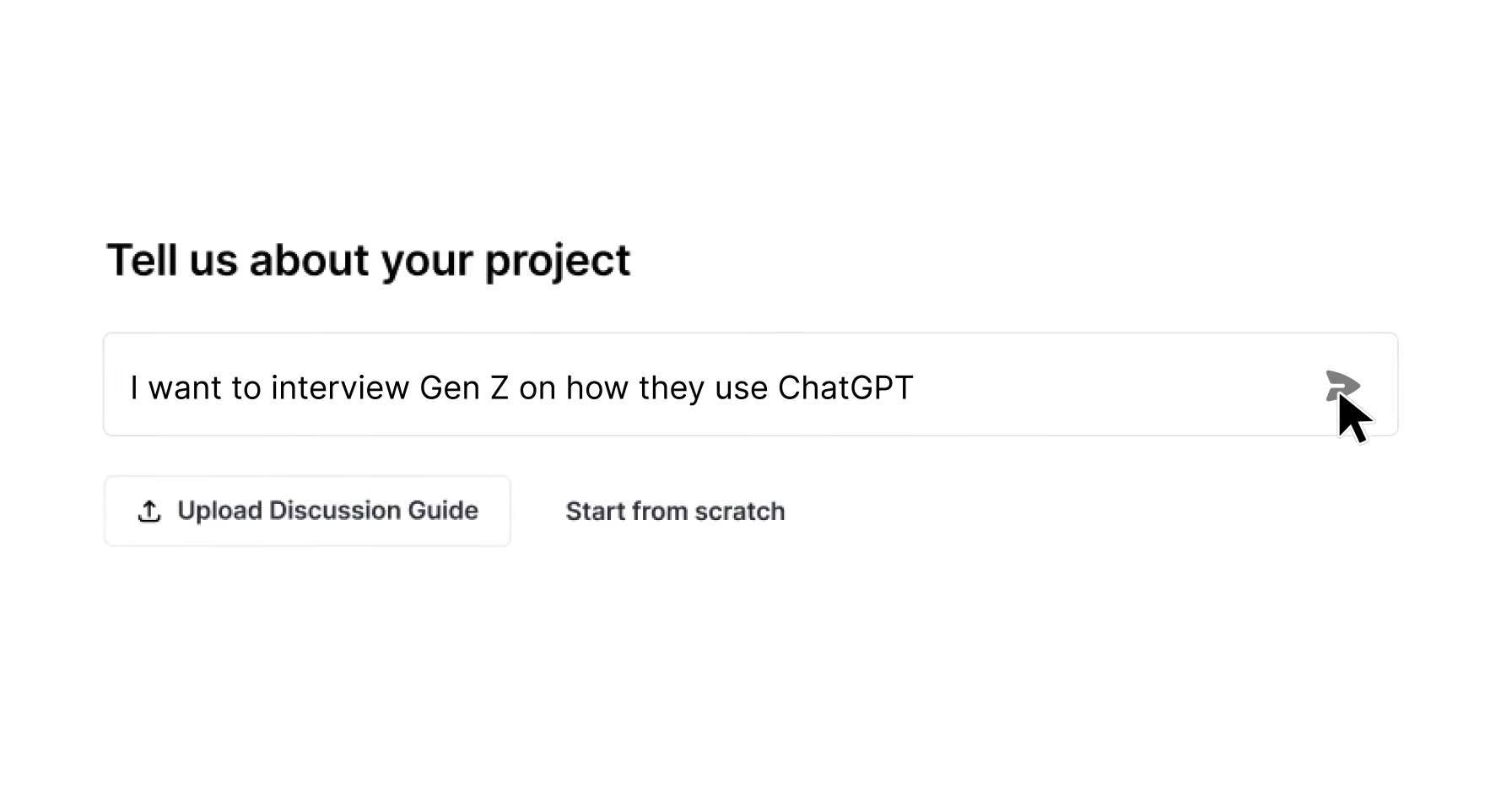
- AI-Assisted Study Design, where you describe research goals in natural language and the AI drafts structured objectives, questions, and probing context in seconds, with support for monadic and sequential randomization, quotas, branching, and skip logic.
- Global Participant Recruitment, where Listen Atlas draws from a network of 50M+ verified respondents across 45+ countries and 120+ languages, using an AI orchestration layer that matches and bids on the best participants across multiple panel partners. Organizations can also bring their own participants at reduced cost.
- AI-Moderated Video Interviews, where the AI Interviewer conducts personalized conversations with dynamic follow-up questions and probes deeper on interesting or short answers the way a trained human interviewer would. 92% of participants report top comfort levels in AI-moderated sessions, equivalent to human-moderated sessions.
- Emotional Intelligence, which analyzes three signal layers, tone of voice, word choice, and subconscious micro expressions, built on Ekman’s universal emotions framework, the same standard used in clinical psychology and UX research. Every emotion is quantified per question and concept, and every label is traceable to the exact timestamp, verbatim quote, and AI reasoning behind it. Coverage extends across 50+ languages.
- Visual Insights, where the AI Interviewer observes on-screen behavior during the interview, catches contradictions between stated preference and observed behavior in real time, and probes based on what it saw instead of following a fixed script. A video model writes a timestamped, second-by-second log of every meaningful on-screen change.
- MaxDiff, which shows four options at a time and asks which is best and which is worst, then aggregates with a Hierarchical Bayes model into a clean ranking with no ties. Portfolio Optimization finds the combination of options that wins the most customers rather than only the top individual scorers.
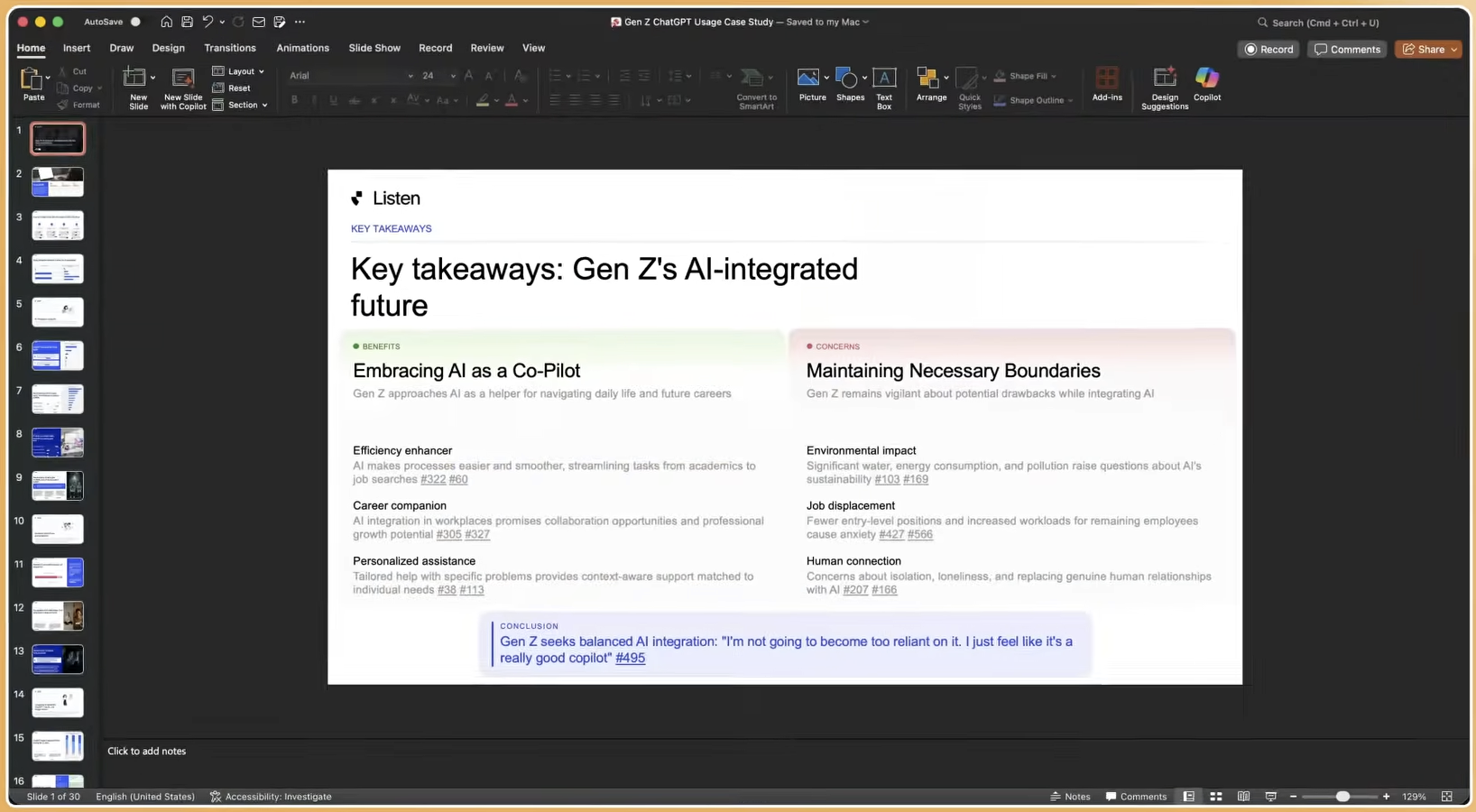
- Research Agent, which handles the full analysis workflow from raw data to final output. It generates slide decks, memos, highlight reels, charts, and custom reports in under a minute, with every insight linked directly to the underlying response data.
The platform draws on 50M+ verified respondents across 45+ countries and 120+ languages and has conducted more than 1M interviews. That infrastructure compresses a 4–6 week research cycle into less than 24 hours at one third of traditional research cost. Listen Labs raised $69 million in a Series B funding round led by Ribbit Capital, reaching a valuation over $500 million as of January 2026.
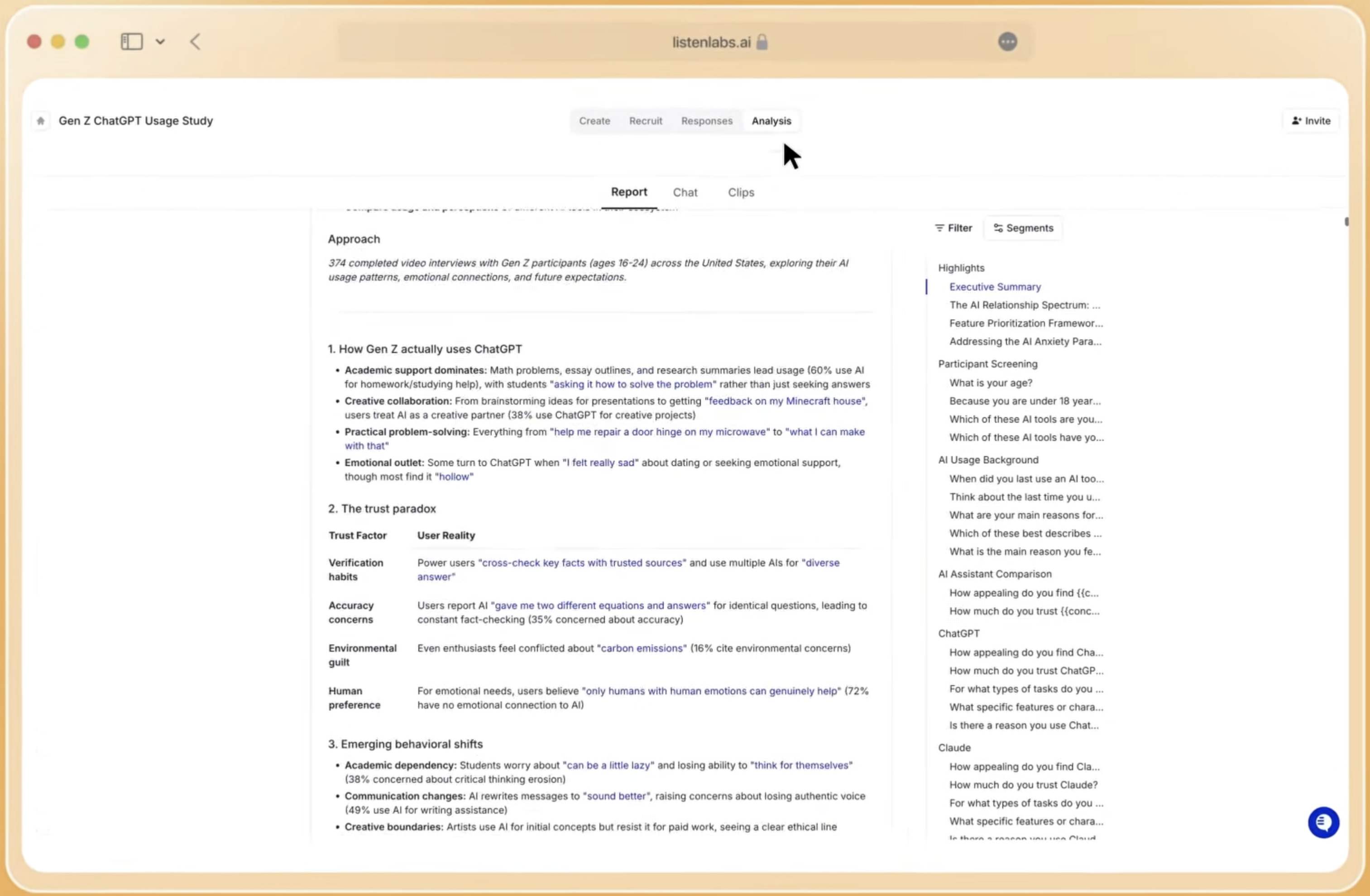
Enterprise customers include Microsoft, Google, Anthropic, Sony, Sweetgreen, Perplexity, Robinhood, Procter & Gamble, Skims, Levi’s, Boston Consulting Group, and Nestlé. The Microsoft team used Listen Labs to collect global customer stories within a single day. The Director of Data Science at Microsoft noted, “I can reach out to hundreds of users at one third of the cost.” Sweetgreen replaced months-long research cycles with days, scaling research across 300+ US locations at 5x the scale and one-third the cost.
For a deeper look at how AI-moderated interviews fit into concept testing workflows, see Concept Testing With AI-Moderated Interviews At Scale and Consumer Insights Platforms: How Enterprise Teams Choose.
Explore Listen Labs for your next concept test
Concept Testing And Usability Testing In Your Workflow
Concept testing answers “Should we build this, and for whom?” while usability testing answers “Can people complete key tasks?” Teams often blur these lines, which creates predictable research failures.
Concept testing validates ideas, packaging, ad copy, messaging, and value propositions before any working product exists. It measures appeal, clarity, relevance, and purchase intent. It belongs at the front end of product development, when changing direction still costs little.
Prototype testing evaluates usability and functionality and answers “Does this work the way we intended?” when something interactive already exists. It measures task completion rates, time on task, error frequency, and navigation friction. It assumes the concept is sound and checks whether the execution works.
Skipping concept testing and moving straight to prototype testing is a common mistake. Teams then design solutions to problems users may not have, and the prototype test never addresses that the concept itself missed the mark.
The correct sequence runs concept testing first to validate demand, then usability testing to validate execution. Some platforms, including Listen Labs, support both through screen-sharing and Visual Insights, which enable the AI Interviewer to observe on-screen behavior during concept walkthroughs and catch the say-do gap in real time.
Concept Testing Platform Costs And Recruitment Models
Pricing models across consumer insights platforms for concept testing fall into three main structures. Each structure affects study cost, speed, and scalability in different ways.
Pay-Per-Response (Pollfish, PickFu) charges per completed response with no mandatory subscription. PickFu polls start at $1 per response and typically return results within 15 minutes to a few hours. This model is easy to forecast for small, one-off directional checks, but depth stays limited and costs rise quickly when targeting niche audiences.
Enterprise License (Qualtrics, Kantar) uses annual contracts that bundle platform access, panel, and often professional services. Qualtrics median annual spend runs $28,000 to $30,000, climbing well past $100,000 for full enterprise deployments. This model rewards teams that run 15 or more studies per year and becomes expensive on a per-study basis for lower-frequency programs. Kantar and Zappi follow similar custom-quoted, enterprise-oriented structures.
Subscription-Credit (Listen Labs) combines platform access with a credit system for participant recruitment. Listen Labs uses a subscription model where enterprises pay for platform access and spend credits per participant recruited. Credit cost varies with audience difficulty. General population studies cost fewer credits than niche audiences such as enterprise decision-makers, healthcare workers, or consumers below a 1% incidence rate. Organizations can bring their own participants at reduced cost. This model scales efficiently for teams running continuous research programs and provides predictable per-study economics without the per-response variability of pay-per-response pricing.
For teams evaluating total cost of ownership, Listen Labs delivers the 24-hour turnaround and one-third cost noted earlier. See Best Consumer Insights Platforms: A Criteria-Based Review for a fuller criteria-based comparison.
What Each Platform Actually Captures: Signal Quality
Signal quality is the most consequential selection criterion for consumer insights platforms for concept testing, and most comparison lists ignore it.
Many platforms capture only stated preference, what participants say they think or intend to do. The say-do gap is the difference between what consumers say they will do and what they actually do, with stated purchase intent often needing to be discounted by 50% or more to approximate actual conversion. A concept that tests well on stated intent can still fail at launch when price, habit, availability, and competing options enter the decision.
Survey-based platforms (SurveyMonkey, Qualtrics in survey mode, Pollfish) capture stated preference only. They rank concepts by score, but they cannot explain the ranking or probe inconsistencies in participant responses.
AI-moderated interview platforms add a second signal layer, behavioral signal captured through dynamic follow-up questions that probe what participants actually mean when they say something is “interesting” or “a bit uncomfortable.” AI can schedule and conduct the interview, analyze the transcripts for themes, and generate quantitative insights from those interviews. This approach compresses weeks of qualitative work into hours.
Listen Labs captures all three signal layers. Structured questions capture stated preference. AI-moderated interviews with dynamic follow-ups capture behavioral signal. Emotional Intelligence captures emotional signal. Teams already use Emotional Intelligence for creative testing, concept comparison, brand research, and usability testing, which spans all three concept types in this guide. Visual Insights adds a fourth layer by observing on-screen behavior during the interview and catching the say-do gap in real time when a participant behaves differently from what they said.
Concept Testing Methods And When To Use Them
The four primary concept testing methods each serve a different research objective, and platform choice maps directly to method.
Monadic Testing shows each respondent one concept in isolation. According to Greenbook’s breakdown of monadic testing, monadic designs are generally considered the purest way to measure purchase intent or price sensitivity because each respondent reacts to only one option. It requires a larger sample to reach statistical confidence but avoids comparison bias. Platforms that support monadic designs include Qualtrics, SurveyMonkey Audience, Attest, and Listen Labs.
Sequential Monadic Testing shows the same respondents multiple concepts in randomized order. It is more sample-efficient than monadic testing but introduces order effects. Sequential monadic testing balances depth with efficiency because the same survey participants evaluate all concepts, reducing sample size requirements when teams need to compare multiple concepts with a constrained participant pool.
MaxDiff is the method of choice when teams need to prioritize a long list of options without ties or decision fatigue. Instead of rating scales, which produce ties, or full rankings, which exhaust respondents, MaxDiff shows small sets and asks for best and worst, then aggregates with a Hierarchical Bayes model into a clean ranking. MaxDiff requires a platform that supports best-worst scaling and Hierarchical Bayes modeling. Listen Labs supports MaxDiff natively, with Portfolio Optimization that finds the combination of options that wins the most customers rather than only the top individual scorers.
Conversational AI-Moderated Interviews work best when teams need to understand why a concept resonates or fails, not just which concept scored higher. They require a platform with AI moderation capable of dynamic follow-up questions. Qual-at-scale is ideal when research requires large sample sizes or broad geographic reach, with AI tools engaging hundreds or thousands of participants remotely and asynchronously. Listen Labs supports all four methods in one platform, which lets teams combine monadic or sequential monadic survey questions with AI-moderated conversational probing and MaxDiff prioritization in a single study.
Frequently Asked Questions
Examples Of Concept Testing By Concept Type
Concept testing looks different depending on what you test. For CPG and physical products, a beverage brand might show 200 target-audience respondents a concept card for a new flavor, including product image, value proposition, and price, and then measure appeal, uniqueness, and purchase intent before committing to packaging or production. For digital prototypes, a SaaS team might test three feature concepts with product managers to evaluate value propositions and identify which framing drives the highest interest before any design work begins. For ad and messaging concepts, a brand might run sequential monadic testing across three campaign directions with target consumers to identify which creative concept triggers the strongest emotional response and clearest brand fit before entering production. Strong concept testing platforms support all three concept types; the method and sample size vary by concept type and by the decision at stake.
Best Concept Testing Platform For A Small Team
Small teams with limited budgets and infrequent research needs often benefit from pay-per-response platforms like Pollfish or PickFu, which offer the lowest fixed cost and fast turnaround for directional checks. Small teams that need qualitative depth alongside speed benefit more from AI-moderated platforms with self-serve access. Listen Labs offers a self-serve option for smaller companies (under 100 employees) with AI-assisted study design. The right platform depends on study frequency, audience niche, and whether the decision requires stated preference only or behavioral and emotional signal as well.
Using Your Own Participants Instead Of A Panel
Most enterprise-grade concept testing platforms support bring-your-own-audience (BYOA) options. Listen Labs supports self-recruitment, which allows organizations to study their own user base at a reduced credit cost per participant. Teams can also bring their own panel provider. This approach works well for concept tests that require existing customers, loyalty program members, or proprietary customer segments that a third-party panel cannot replicate. For studies that require niche or hard-to-find audiences that a team cannot self-recruit, Listen Labs’ dedicated recruitment operations team can source audiences below 1% incidence rate, including enterprise decision-makers, healthcare workers, and highly specialized consumer segments.
How Fast Concept Testing Platforms Deliver Results
Turnaround time varies significantly by platform and method. Pay-per-response polling platforms like PickFu return results within 15 minutes to a few hours for consumer audiences. Automated enterprise platforms like Zappi can complete a standard concept test in as little as 5 hours. AI-moderated interview platforms typically complete fieldwork and deliver synthesized findings within 24 to 48 hours for consumer audiences. Listen Labs compresses the entire research cycle, from study design through recruitment, moderation, analysis, and deliverable generation, to less than 24 hours. Traditional agency-run concept tests, by contrast, typically take 4 to 8 weeks from brief to final report. The fastest platforms pair pre-screened panels with AI-moderated asynchronous interviews, which remove the scheduling bottleneck that consumes most of the time in traditional research.
Conclusion: Match Platforms To Your Research Goals
Choosing among consumer insights platforms for concept testing is a decision about fit and workflow coverage. The framework that produces the right shortlist crosses concept type with workflow stage: what you are testing and where you need the most support.
Teams testing CPG or physical product concepts at scale with normative benchmarks often choose Zappi or Kantar Marketplace. Teams testing digital prototypes with Figma integrations and unmoderated task completion often choose Maze. Teams that need pay-per-response speed on directional checks often choose Pollfish or PickFu. Teams that need global consumer targeting on messaging and claims often choose Attest.
Teams that need to cover all four workflow stages, recruit, moderate, analyze, and deliver, across any concept type, in any market, with behavioral and emotional signal alongside stated preference, and with stakeholder-ready deliverables in under 24 hours, find Listen Labs the strongest overall choice among consumer insights platforms for concept testing. It is the only end-to-end AI research platform that sources participants from a 50M+ verified network, conducts AI-moderated interviews at scale, captures emotional and behavioral signal through Emotional Intelligence and Visual Insights, and delivers consultant-quality outputs through the Research Agent.
Enterprise teams at Microsoft, Google, Procter & Gamble, Skims, and Nestlé have already made that choice. The platform has conducted over 1 million AI-moderated customer interviews since launch.
See how Listen Labs aligns with your research goals