Written by: Anish Rao, Head of Growth, Listen Labs
Key Takeaways
- Monadic price testing assigns each respondent to a single price point and compares purchase intent across groups for an unbiased read.
- Panel-included platforms bundle respondent sourcing with analysis, while analysis-only tools require your own sample and panel relationships.
- Plan sample size per price cell, not in aggregate; five price points create five cells that each need sufficient respondents.
- Monadic testing evaluates specific prices, Van Westendorp defines acceptable ranges, and Gabor-Granger identifies revenue-maximizing prices.
- AI-moderated conversational pricing tools like Listen Labs pair demand and revenue curves with buyer explanations for each price decision.
See How Conversational Pricing Tests Work
Monadic Price Testing In Plain Language
Monadic price testing assigns separate groups of respondents to a single price point each, then compares purchase intent across groups to produce an unbiased, isolated read on how each price performs. Because no respondent sees multiple prices, anchoring bias is eliminated. Sequential monadic designs show the same respondent multiple prices in sequence, which increases sample efficiency but introduces order and carryover effects that require careful randomization.
Panel-Included Vs. Analysis-Only Platforms For Monadic Pricing
The pricing research market splits into two models. Panel-included platforms bundle respondent sourcing with the analysis layer. Analysis-only tools focus on survey logic and analytics while expecting you to supply respondents.
Panel-included platforms worth evaluating include:
- Listen Labs runs a conversational Gabor-Granger pricing test with an adaptive price ladder inside studies teams already field. It delivers demand and revenue curves plus the qualitative reasoning behind every data point. Its panel of 50M+ verified respondents spans 45+ countries and 120+ languages, with results in less than 24 hours.
- Aytm offers Xpert: Monadic Price, which lets you test 4–10 price points. Respondents are randomly assigned to one price pulled from a predetermined list, using a pre-built and fully programmed survey suited to teams that want a self-serve monadic design with minimal configuration.
- Pollfish supports monadic designs alongside Van Westendorp and Gabor-Granger. It distributes surveys to a large mobile consumer panel at a transparent per-response price starting at $0.95, with study turnaround ranging from a few hours to a few days.
- Conjointly is a purpose-built pricing and product research platform that combines monadic testing and Gabor-Granger exercises with panel access and expert support. It uses subscription pricing plus per-study panel costs.
- Suzy is a panel-included consumer insights platform that supports monadic testing (up to 10 concepts per survey, including voice-led Suzy Speaks) and MaxDiff and TURF pricing/preference designs for enterprise brands.
Analysis-only tools require you to bring your own panel or recruit independently:
- RevOptima is an analysis-only pricing tool that processes pricing data client-side in the user's browser without sourcing respondents, so sensitive margin data never touches RevOptima's servers. It suits teams that already have a panel relationship or proprietary customer database.
- Sawtooth Software prices its Lighthouse Studio desktop product starting around $10,900 for a single license and offers deep experimental-design control for conjoint and monadic work. It requires bring-your-own-sample.
Panel-included platforms fit teams that need respondents sourced, screened, and fielded, which covers most monadic price testing projects. Analysis-only tools fit teams with an existing customer panel, proprietary database, or panel vendor relationship that want to avoid paying for respondents twice.
If you want to see how these cost structures compare across the broader consumer insights landscape, AI Customer Research Pricing: 2026 Models & Cost Breakdown breaks down the current models.
The Sample-Size Reality For Monadic Price Testing
Effective monadic price testing treats sample size as a per-cell requirement, not a single total number. In a monadic design, each respondent contributes to exactly one cell. Five price points create five cells, and respondents must be budgeted per cell rather than in aggregate.
A working monadic design often uses approximately 200 respondents per cell to detect a 5–10 percentage point difference on Top 2 Box purchase intent at 95% confidence. At 100 respondents per cell, only differences of 15 percentage points or larger are reliably detectable. A five-price monadic test therefore requires roughly 1,000 total respondents before a single verbatim is read.
Monadic sample requirements scale linearly with cell count. Two price points require approximately 400 completes, three require 600, four require 800, and six require 1,200, all at roughly 200 per cell.
Segment-level analysis multiplies the requirement. Analyzing results by segment multiplies the required sample because each segment needs its own minimum respondent count. A five-price test with two segments, such as enterprise and SMB, requires each of those five cells to hold up independently within each segment. With roughly 150 respondents per cell, a monadic split-cell price test with five price points and two segments pushes total sample requirements to about 1,500 respondents.
Practitioner sample-size conventions run 200–400 respondents for Gabor-Granger, with the real driver being how many distinct segments must be read separately. Pricing SMB and enterprise differently roughly doubles the sample requirement. These are conventions rather than statistical laws, and the real driver is the size of the gap you need to detect.
Adding price points yields a smoother demand curve, but each one multiplies fieldwork cost and time. That cost is why teams with budget constraints should decide up front how many price points genuinely need a full monadic read. If the answer is fewer than the design assumes, a sequential monadic approach may be the better buy for that specific question.
Choosing Between Monadic And Sequential Monadic Designs
Monadic and sequential monadic designs answer similar questions with different tradeoffs in isolation, sample efficiency, and benchmark comparability.
Monadic designs show each respondent a single price. They answer how much people want a given price on its own terms, with clean isolation and no anchoring from prior exposures. The cost is larger sample requirements because every price point needs its own respondent group. Sequential monadic designs reuse the same respondents across multiple prices, which is substantially more sample-efficient. Testing four price points with a pure monadic design requires 800 respondents (200 per concept). Sequential monadic can cover all four concepts with a single 200-person cell, cutting sample by 75 percent.
The efficiency gain introduces order and carryover effects. Research published in the Journal of Marketing Theory and Practice showed that concepts shown first are rated more highly than the same concept shown later, and that a strong concept makes the following concept look worse by contrast. Randomization reduces these effects by rotating the order each respondent sees, but it does not remove them entirely.
One constraint matters for tracking work. Benchmarks do not transfer between designs. Sequential scores should be compared with sequential scores and monadic with monadic. A concept that appears to clear a monadic benchmark by a point in a sequential monadic study has not actually cleared it, because the position effect shifts the absolute level of scores.
Monadic, Van Westendorp, And Gabor-Granger In Context
Pricing method selection works best when it starts with the question you need to answer.
Monadic price testing answers how a specific price performs in isolation. It measures purchase intent at a given price point without anchoring from other prices. It fits situations where you have a defined set of candidate prices and need a clean, unbiased read on each one.
Van Westendorp Price Sensitivity Meter answers what price range feels acceptable. It asks four questions: at what price the product feels too cheap to trust, where it is a bargain, when it starts feeling expensive, and when it is simply too expensive. The four intersecting curves those answers produce define the acceptable price range. Van Westendorp produces thresholds and a range but no demand curve and no direct revenue estimate. It suits new products where no market reference price exists yet and can produce directional results with as few as 50 respondents, though 100–300 is the typical sample size range.
Gabor-Granger answers what price maximizes revenue. It presents purchase intent at multiple researcher-defined price points. Those responses produce a demand curve of purchase probability versus price. Multiplying that curve by price yields the revenue curve that identifies the revenue-maximizing price. Gabor-Granger fits existing products with known competitor pricing and requires 200–400 respondents per segment you want to read separately.
Many teams combine methods. A common approach runs Van Westendorp first to find an acceptable price range, then Gabor-Granger to fine-tune the exact price within that range, often in the same survey. One B2B CRM startup ran Van Westendorp with 200 respondents to identify a $35–$85/user/month acceptable range, then ran Gabor-Granger on 400 mid-market buyers at six price points and found revenue peaked at $45/user/month.
Conjoint analysis fits questions where price is one attribute among many and the focus is feature-price trade-offs rather than a single price point. It requires larger sample sizes of 300 or more respondents and significantly more survey time.
AI-Moderated Conversational Pricing And The “Why” Behind Willingness To Pay
Traditional monadic price testing delivers a demand curve. AI-moderated conversational pricing delivers the demand curve and the reasoning behind every point on it, such as why a price felt too high, what would make it feel worth it, and which buyer segments behave differently at each price level.
Listen Labs leads this emerging category. Its Gabor-Granger pricing test runs an adaptive conversational price ladder inside studies teams already field. Each buyer sees a description of the product and decides whether they would buy at a given price. Their answer determines the next price they see, higher after a yes and lower after a no, until the ladder finds the most that person would pay. Once a buyer lands on a price, the AI interviewer probes why it felt worth it or not, separating “I can’t afford it” from “it isn’t worth that much,” which are two different problems with different fixes.
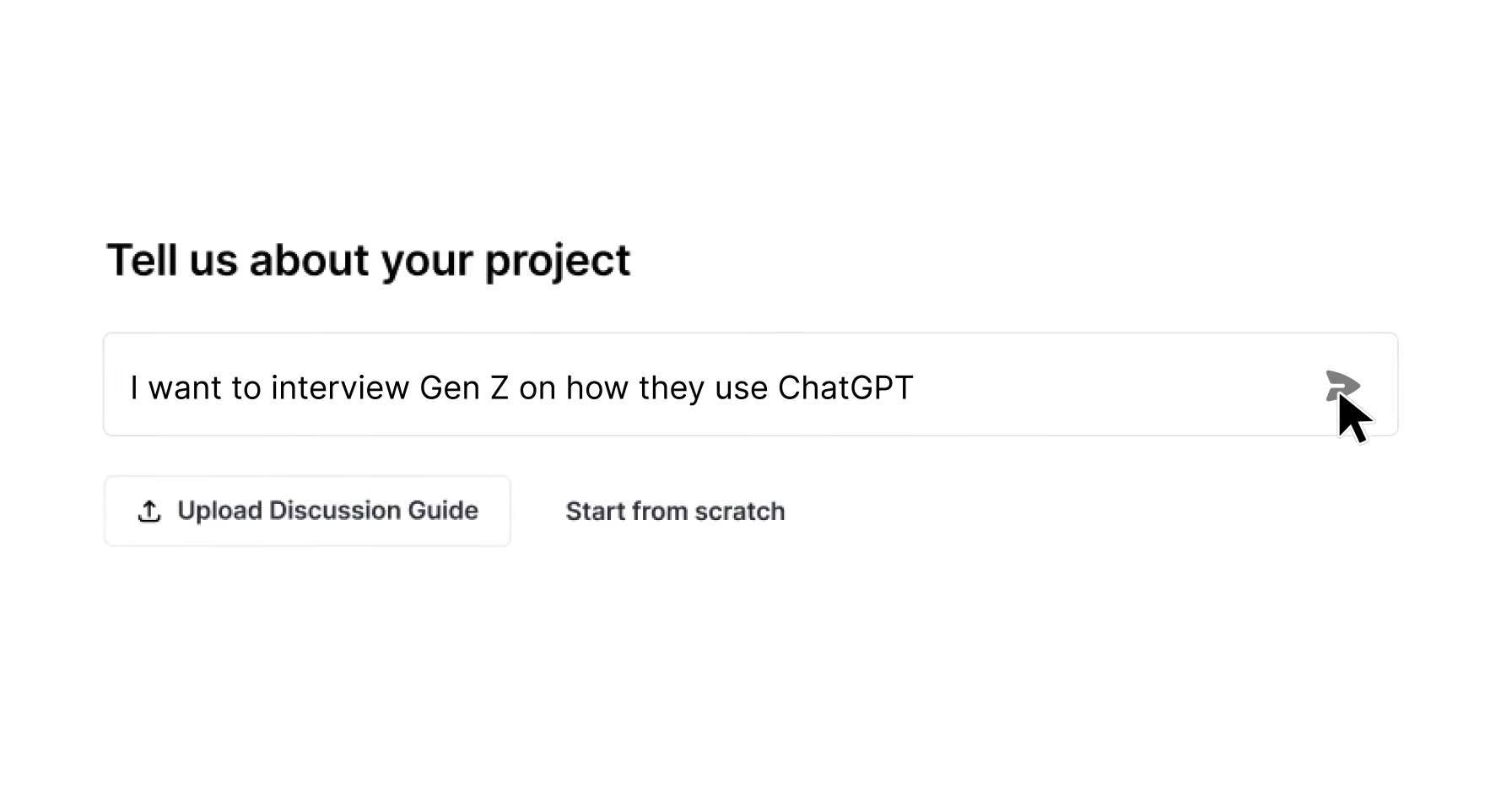
Individual results roll up into a demand curve showing how many buyers are retained at each price and a revenue curve identifying the revenue-maximizing price. Segment filters reveal how key audiences behave without requiring a separate study. Every point on the curve traces back to a real interview and verbatim quote, so when someone challenges the results, you can show clips of buyers explaining their choices in their own words.
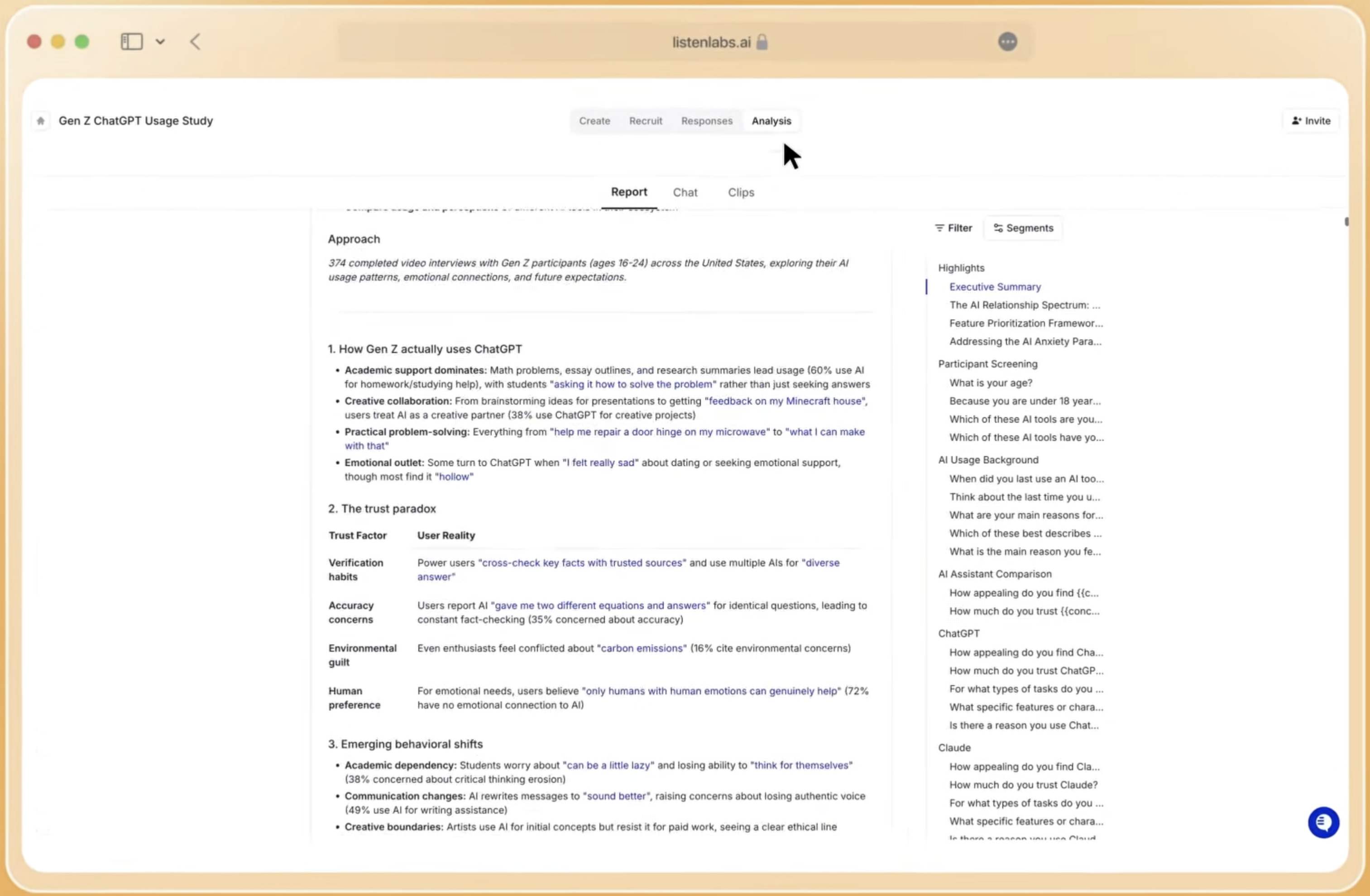
Listen Labs draws on a panel of 50M+ verified respondents across 45+ countries and 120+ languages, delivers results in less than 24 hours, and has conducted over 1 million AI-moderated customer interviews since launch. For complex pricing projects, Listen Labs' insights team of career researchers provides white-glove support and helps teams find the right price and understand the reasoning behind it.
AI-moderated pricing interviews produce response quality equivalent to live moderated sessions on most dimensions, and measurably better results on social desirability bias. Participants disclose lower price thresholds and surface more explicit objections when no human moderator is present, which produces pricing data that more closely reflects real purchase behavior.
For teams evaluating the broader landscape of AI-powered consumer insights tools, see Best Product Testing Tools In 2026: Consumer Panels Vs AI.
How To Choose A Pricing Research Approach
Three practical questions help narrow your pricing tool and method choice.
Do you have sample? If you have a proprietary customer panel or an existing panel vendor relationship, an analysis-only tool or a bring-your-own-sample platform may be sufficient. If you need respondents sourced and screened, a panel-included platform is required, and Listen Labs, aytm, Pollfish, Conjointly, and Suzy all qualify.
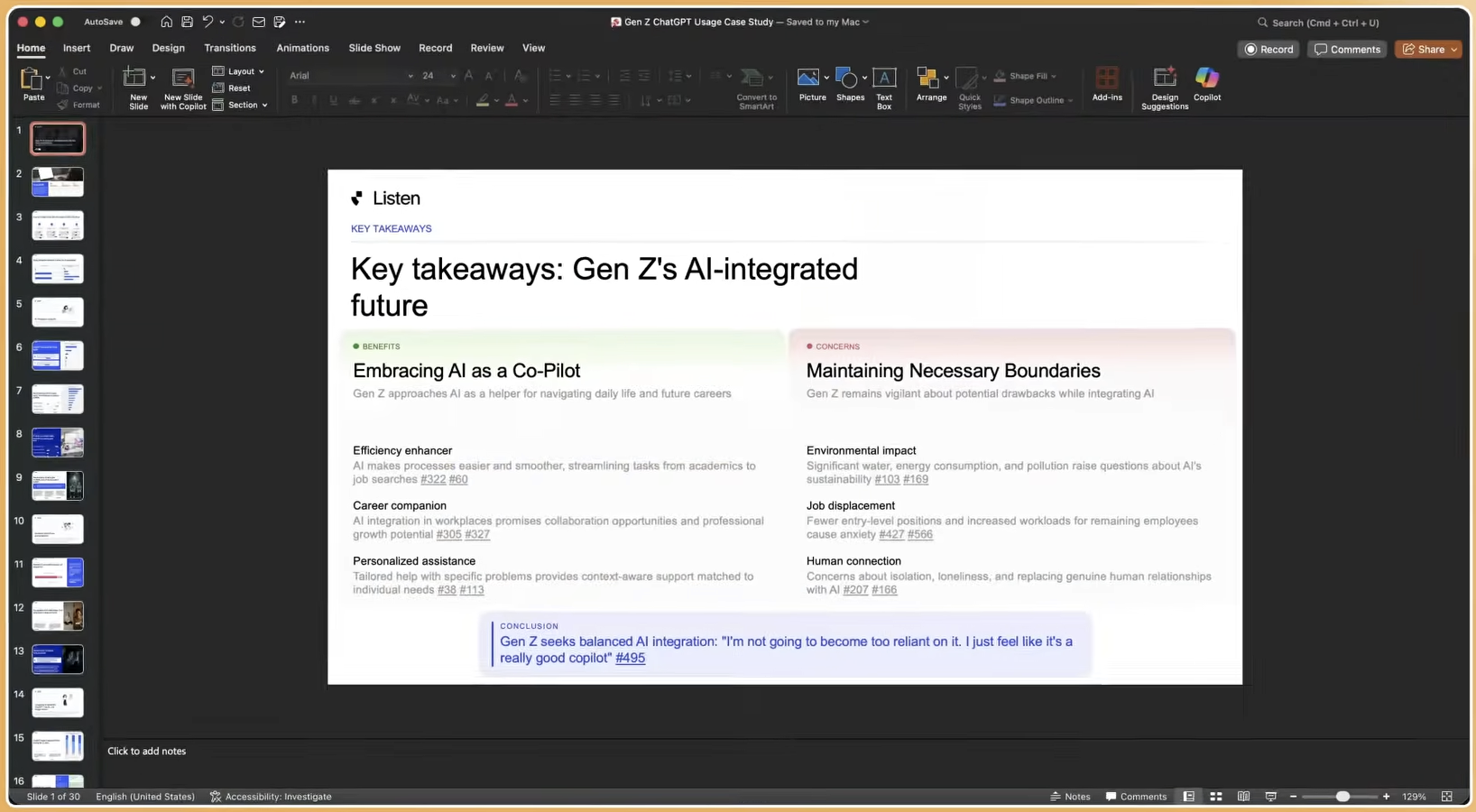
What question are you answering? If you need to know whether a specific price is acceptable in isolation, monadic price testing is the right design. If you need an acceptable price range for a new product with no reference price, Van Westendorp is faster and more sample-efficient. If you need the revenue-maximizing price and a demand curve, Gabor-Granger fits, and Listen Labs' conversational Gabor-Granger adds qualitative reasoning that static surveys cannot capture. If you need feature-price trade-offs, conjoint is the right tool.
How fast do you need results? Traditional full-service agency recruitment on panel-included research platforms typically returns results in 5 to 21 business days, depending on audience difficulty. Listen Labs delivers results in less than 24 hours across 45+ countries and 120+ languages, which is among the fastest turnarounds in the category for a study that includes both the demand curve and the qualitative reasoning behind it.
If your pricing question is high-stakes, your price points are close together, and you need segment-level reads, budget sample per cell honestly. A 200-respondent-per-cell standard often supports detection of meaningful differences. A panel-included platform with verified respondents reduces the risk of inflated or deflated willingness-to-pay estimates.
Frequently Asked Questions
What Is The Difference Between Monadic And Sequential Monadic Price Testing?
Monadic price testing assigns each respondent to a single price point. No respondent sees more than one price, which eliminates anchoring and carryover bias and produces a clean, isolated read on how each price performs. The tradeoff is sample size because every price point requires its own respondent group, so total sample scales with the number of prices tested.
Sequential monadic price testing shows the same respondent multiple prices in sequence, one at a time, before moving to the next. This approach is substantially more sample-efficient because the same respondents contribute data across multiple price points. It introduces order effects, where prices shown first tend to score higher, and carryover effects, where a high price makes the next price look more reasonable by contrast. Randomization manages these effects but does not remove them. Benchmarks derived from monadic data do not transfer to sequential monadic data, so the two designs should be compared against separate norms.
How Many Respondents Do I Need Per Price Cell In A Monadic Price Test?
The working standard often uses approximately 200 respondents per cell to detect a 5–10 percentage point difference on Top 2 Box purchase intent at 95% confidence. At 100 respondents per cell, only differences of 15 percentage points or larger are reliably detectable, which means close pricing decisions remain unresolved at that sample size. For a five-price monadic test, that translates to roughly 1,000 total respondents before segment analysis. Segment-level analysis multiplies the requirement because each segment needs its own minimum respondent count within each cell. Published benchmarks are practitioner conventions rather than statistical laws, and the real drivers are the size of the gap you need to detect and the number of segments you need to read separately.
Do I Need A Panel To Run A Monadic Price Test, Or Can I Use My Own Sample?
Both approaches work, depending on your access to respondents. Panel-included platforms source, screen, and field respondents as part of the service, which fits teams without a qualified respondent pool. Analysis-only tools and bring-your-own-sample platforms require you to supply respondents from your own customer database, a proprietary panel, or a separate panel vendor. The operational decision is straightforward: if you need respondents, choose a panel-included platform. If you already have qualified sample, an analysis-only tool avoids paying for respondents twice. Listen Labs supports both models, offering its 50M+ verified panel for studies that need respondents sourced while also allowing teams to bring their own participants at a reduced cost.
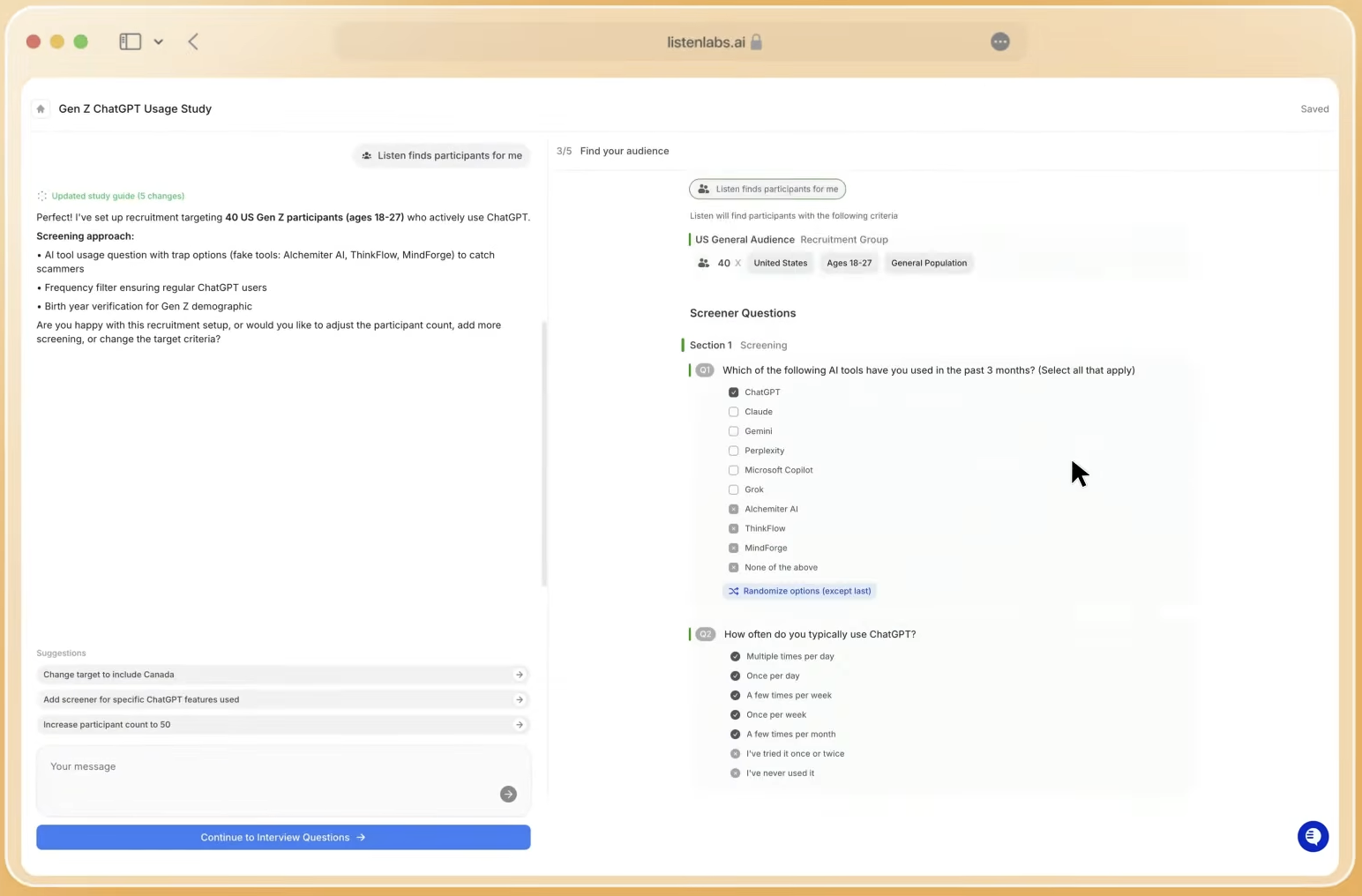
How Does AI-Moderated Pricing Research Differ From A Static Pricing Survey?
A static pricing survey, whether Gabor-Granger, Van Westendorp, or monadic, captures what respondents say at a fixed set of questions with no ability to follow up. It produces a demand curve or a price range but no explanation of why a price felt too high, what would make it feel worth it, or which mental model the buyer used when answering.
AI-moderated conversational pricing runs the same structured price ladder and adds adaptive follow-up questions after each price decision. When a buyer says no at a given price, the AI interviewer probes whether the objection is affordability or perceived value, which have different strategic implications. Those follow-up responses are coded into themes across the full study, so individual anecdotes become quantifiable data. The result is a demand curve with a narrative attached to every point on it, including the price that maximizes revenue, the segment that is most price-sensitive, and the specific language buyers use to explain their choices.
Conclusion
Monadic price testing tool selection comes down to three choices: whether you need panel access or only the analysis layer, how many respondents to budget per price cell, and which method answers your specific pricing question. Panel-included platforms fit teams that need respondents sourced and fielded. Analysis-only tools fit teams that already have qualified sample. Five price points create five cells, and a per-cell standard such as 200 respondents often supports detection of meaningful differences. Van Westendorp finds an acceptable range, Gabor-Granger finds the revenue-maximizing price, and monadic price testing isolates how a specific price performs without anchoring bias.
Listen Labs serves teams that need both the demand curve and the qualitative reasoning behind it. Its conversational Gabor-Granger pricing test delivers demand and revenue curves with segment filters and traces every data point back to a real interview and verbatim quote. It draws on the same 50M+ verified panel, with results in less than 24 hours. For complex pricing projects, Listen Labs' insights team of career researchers provides white-glove support from study design through final recommendation.
Book A Demo With Listen Labs Today