
Written by: Anish Rao, Head of Growth, Listen Labs
Key Takeaways For Pricing Research Software
- Start with the pricing question first: value discovery, range exploration, revenue maximization, bundle optimization, or feature ranking.
- Qualitative customer interviews reveal value drivers, buyer language, and mental models, and they explain why a price feels right or wrong.
- Quantitative methods such as Van Westendorp, Gabor-Granger, conjoint, and MaxDiff validate price points and refine packages after interviews surface the right attributes.
- AI-moderated platforms now run hundreds of adaptive pricing conversations in parallel, so teams can replace the old interview-then-survey workflow with a single instrument.
- Listen Labs combines AI-moderated qualitative interviews with conversational Gabor-Granger price ladders and MaxDiff, giving teams both discovery depth and scalable validation in one platform.
Start With The Pricing Question Before Choosing Tools
Every pricing research engagement usually hides one of five core questions:
- Why do buyers value this? Value-driver discovery.
- What price range is acceptable? Range exploration.
- Which price maximizes revenue? Demand and revenue curve estimation.
- Which features or tiers belong together? Bundle and package optimization.
- Which of several options should we prioritize? Feature or variant ranking.
Different pricing questions require different tools. A qualitative interview platform works best for value discovery and range exploration. A conjoint platform fits bundle and package optimization. Gabor-Granger, run as a survey or as a conversational price ladder on Listen Labs, identifies the revenue-maximizing price. MaxDiff ranks features or variants. Teams that pick software before defining the question often end up with expensive, unusable data. The sections below follow this sequence.
When Customer Interviews Are The Right Instrument For Pricing Research
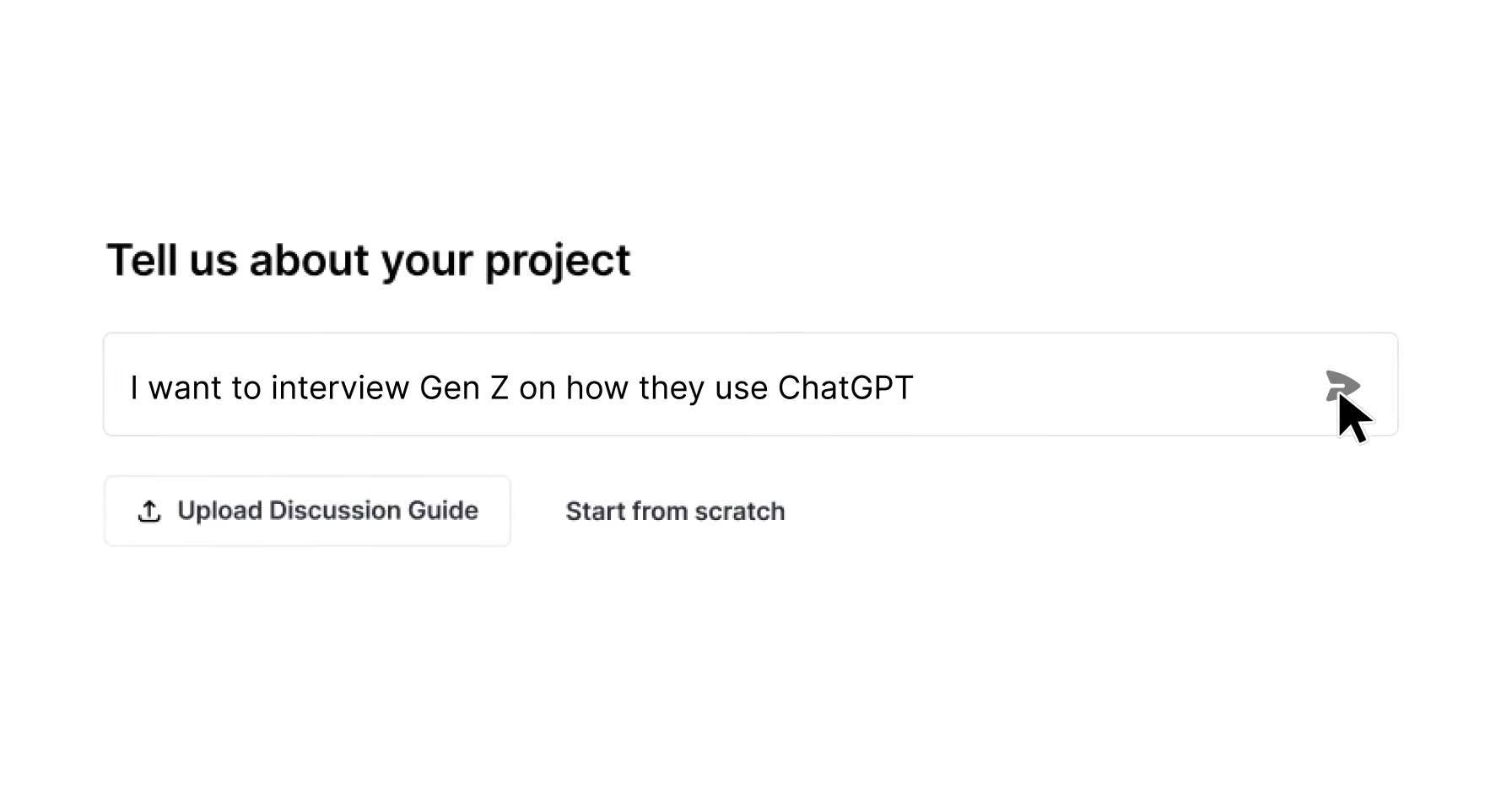
Qualitative pricing interviews work best for uncovering the value drivers behind a purchase decision and the language buyers use when they talk about price. They reveal the mental models that produce a yes or a no and the reasons a price feels too high or too low. Qualitative pricing interviews cut through unreliable stated-price answers by exploring the emotional and practical context behind willingness to pay through conversation rather than a price slider. They surface what a given price is being compared to, who owns the budget, and which value signals justify the number. Surveys cannot answer those questions.
Interviews alone cannot set a final price. Qualitative willingness-to-pay interviews typically reach saturation around 10 to 15 conversations per target persona, which is not enough to produce a defensible demand curve. Economists John List and Craig Gallet pooled results from 29 experiments comparing what people said they would pay against what they actually paid and found stated values came in around three times higher than real ones. Interviews generate hypotheses and the value narrative. Quantitative methods confirm the number.
A second reliability problem appears in the say-do gap. A meta-analysis of purchase intent studies found that 83% of consumers said they would buy a product, but only 42% bid real money when given the opportunity. People often say a price is fine and then do not buy. Listen Labs’ Visual Insights feature narrows this gap by observing on-screen behavior during the interview and probing contradictions in real time. Emotional Intelligence captures hesitation and friction that transcripts miss. Together, these signals separate genuine acceptance from social compliance. However, to set a final price, you still need to complement these insights with quantitative methods. The next section outlines those techniques.
The Quantitative Methods You’ll Eventually Need
Van Westendorp Price Sensitivity Meter. This survey-native method asks four questions about price perception (too cheap, a bargain, expensive, too expensive) to map an acceptable price range rather than a single price point. Van Westendorp answers the question “what price range is acceptable?” rather than “what price will maximize demand?” It provides a defensible range and landmarks inside it instead of a single correct price. Teams use it in early-stage exploration when no market price anchor exists.
Gabor-Granger. This adaptive price ladder presents each respondent with a sequence of price points and records purchase intent at each. The method produces a demand curve and a revenue curve whose peak identifies the revenue-maximizing price. Gabor-Granger works best when a candidate price range is already known and the team needs to identify the revenue-maximizing point. It is survey-native but can now run conversationally. On Listen Labs, Gabor-Granger runs as a conversational price ladder inside existing studies, with contextual follow-up questions that separate “I can’t afford it” from “it isn’t worth that much.”
Conjoint Analysis. This survey-native method forces respondents to choose between complete product profiles that vary by features, tiers, and price. It produces attribute-level utility scores and marginal willingness-to-pay estimates. Conjoint analysis answers “which combination will customers choose and how does price affect that choice?” It is the better method when pricing is entangled with packaging, feature sets, or tiers. Use it when the team needs to refine bundles or simulate market share. Conjoint analysis typically requires 200–400+ respondents, with some sources citing 300–500+ depending on design complexity.
MaxDiff (Best-Worst Scaling). This method shows respondents small sets of options and asks which is best and which is worst, then aggregates responses into a clean ranking with no ties. MaxDiff avoids the “everything is a 9 out of 10” problem common to rating scales because every screen forces a real trade-off. On Listen Labs, MaxDiff runs on a Hierarchical Bayes model that produces a ranking with no ties. AI follow-up questions capture the reasoning behind each choice, turning a score into a story. With these methods in mind, the next step is choosing software that can execute them effectively.
Best Customer Interview Software For Pricing Research In 2026
Based on the pricing questions outlined above, the tools below cover different stages of discovery and validation. Each platform excels at a specific part of the pricing workflow.
-
Listen Labs: AI-Moderated Qualitative Pricing Interviews At Scale. Listen Labs has run over 1 million AI-powered customer interviews for companies including Microsoft, Perplexity, and Sweetgreen, and raised $69 million in a Series B led by Ribbit Capital at a valuation above $500 million in January 2026. For pricing research, Listen Labs runs the qualitative front end at scale. Its AI moderator conducts adaptive pricing conversations with dynamic follow-ups, and its conversational Gabor-Granger price ladder runs inside studies the team already fields. Contextual follow-up questions separate “I can’t afford it” from “it isn’t worth that much,” and individual responses roll up into demand and revenue curves with segment filters. MaxDiff runs on a Hierarchical Bayes model for prioritization without ties, with AI follow-ups that capture the reasoning behind each ranking. Every point on the curve traces back to a real interview clip. The platform draws from a 50M+ verified respondent network across 45+ countries and 120+ languages, so teams can run hundreds of pricing interviews in parallel. Switching to Listen Labs AI-moderated interviews let Chubbies capture hundreds of candid, one-to-one conversations overnight. Teams that need value-driver discovery, conversational price ladders, and the reasoning behind the number use Listen Labs as their primary platform. Learn more: How To Run AI-Moderated Pricing Interviews At Scale.
-
Conjointly: Self-Serve Quantitative Pricing Methods. Conjointly is a purpose-built self-serve platform for quantitative pricing research, with templates for Van Westendorp, Gabor-Granger, conjoint, and MaxDiff, and automatic price sensitivity curves and optimal price point reports. It fits teams that already understand their value drivers and now need structured quantitative validation.
-
Sawtooth Software: Advanced Quantitative Conjoint Analysis. Sawtooth Software, which pioneered digital conjoint in the 1990s, offers Sawtooth Discover (web) at about $4,500 per researcher per year and Lighthouse Studio (desktop) starting around $10,900 for a single license. It specializes in choice-based conjoint, MaxDiff, and price sensitivity meters for rigorous market simulators. Teams running complex multi-attribute pricing studies often standardize on Sawtooth.
-
Qualtrics: Enterprise Custom Pricing Research. Qualtrics provides conjoint and pricing research within its XM platform, with a reported entry cost of roughly $5,040 per year for one Strategic Research seat plus an approximately $8,000 conjoint add-on. It covers Van Westendorp, Gabor-Granger, and conjoint. The platform suits research operations teams with dedicated analysts more than product managers who need a fast self-serve run.
-
Respondent And User Interviews: Participant Sourcing. These platforms focus on recruitment rather than moderation or analysis. They work well as a sourcing layer when a team already has a moderation and analysis workflow, but they do not conduct interviews or produce pricing insights on their own.
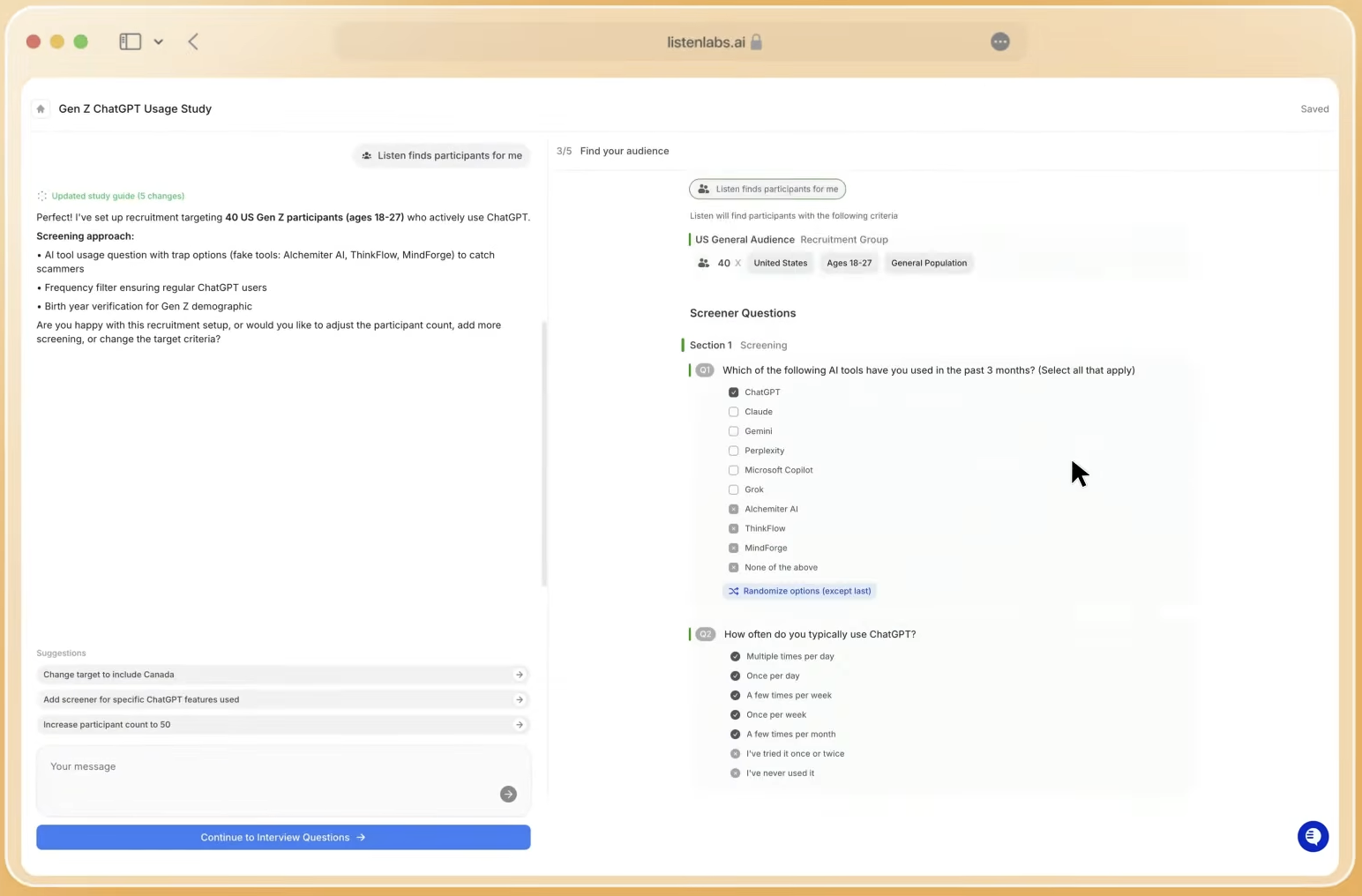
Listen Labs finds participants and helps build screener questions -
Dovetail: Organizing Past Research. Dovetail organizes research that has already been conducted. It serves as a repository tool rather than a research execution platform and does not run new pricing interviews.
-
SurveyMonkey: Basic Structured Pricing Surveys. SurveyMonkey can run a basic Gabor-Granger or Van Westendorp questionnaire if the user builds the logic themselves, but it does not support conjoint analysis. It cannot probe or follow up on a price response and does not generate price sensitivity curves without manual export and analysis.
See Also: Best Survey Platforms For Pricing Research In 2026 and The Best AI Tools For Pricing Research In 2026.
Explore Listen Labs For Pricing Research
Can AI Run Pricing Interviews?
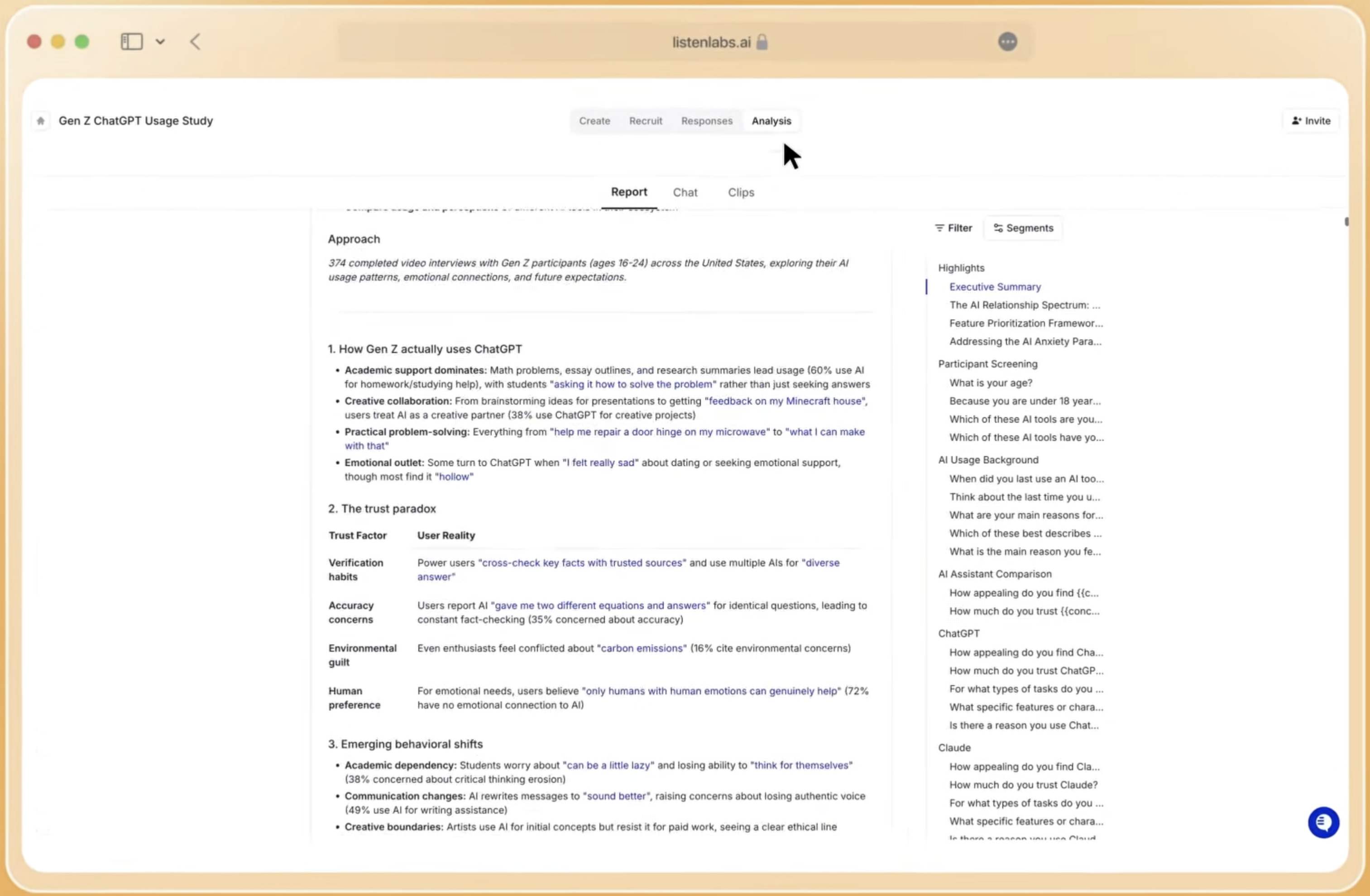
AI now handles the full lifecycle of many pricing interviews. AI can schedule and conduct the interview, analyze the transcripts for themes, and generate quantitative insights from those interviews. AI-moderated platforms conduct adaptive pricing conversations with dynamic follow-ups, and conversational price ladders now replace the old interview-then-survey two-step with a single instrument. An AI interviewer can conduct hundreds of pricing conversations simultaneously, each 8–12 minutes, with consistent methodology and no scheduler. This scale makes willingness-to-pay interviews practical for many teams for the first time. On Listen Labs, the AI moderator also observes on-screen behavior and probes contradictions in real time, capturing signals that transcripts alone miss. AI moderation makes it feasible to run hundreds of pricing interviews in parallel rather than a handful, which changes the math on qualitative sample sizes.
How Many Customer Interviews Do You Need Before A Pricing Study?
As mentioned earlier, qualitative interviews typically saturate around 10–15 conversations per persona. That range supports hypothesis generation and value-driver discovery, which supply the inputs that make a quantitative study worth running. The number that matters for actually setting a price comes from the quantitative method. Quantitative pricing methods like Van Westendorp and conjoint typically require 150 to 400 responses to produce statistically reliable results across multiple customer segments. AI-moderated interviews change the qualitative side by making larger samples practical. Most teams get directionally reliable willingness-to-pay signals from 30–50 interviews per segment without the scheduling overhead that previously blocked that scale.
Do You Need Both An Interview Tool And A Conjoint Tool?
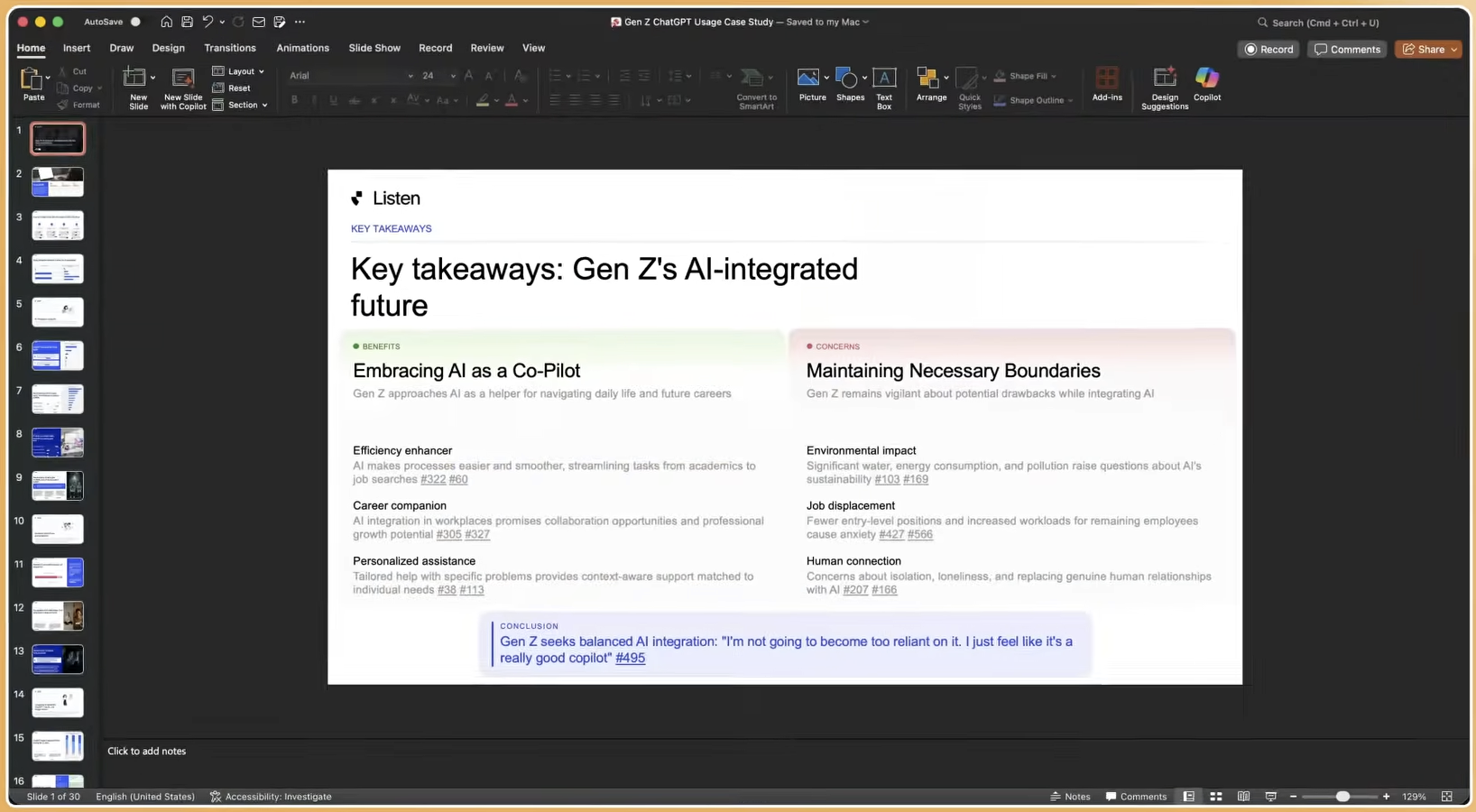
Most pricing decisions benefit from both an interview tool and a conjoint tool, and the sequence matters. The recommended sequencing is to run willingness-to-pay interviews first to surface value drivers and anchors, then use conjoint to refine package configuration, because conjoint tests only the attributes you feed it and running it first means betting a five-figure study on your own guesses about what customers value. Interviews reveal the value drivers and the language of price. Quantitative methods set the number. Some platforms now run both layers. Listen Labs runs the qualitative interview layer and the conversational Gabor-Granger price ladder in one instrument, which changes the build-versus-buy calculus for teams that previously needed two separate vendors. Typeform recommends conducting 10–15 exploratory interviews before designing a conjoint study and notes that skipping this step is a common reason conjoint studies produce unusable results.
Frequently Asked Questions
What Is The Best Software For Willingness To Pay Research?
The best software depends on the phase of the research. For the qualitative discovery phase, where teams uncover value drivers, buyer language about price, and the mental models behind a yes or no, Listen Labs is the purpose-built platform. It runs AI-moderated pricing interviews at scale with a conversational Gabor-Granger price ladder and MaxDiff for prioritization. For the quantitative validation phase, where teams map an acceptable price range or estimate a revenue-maximizing price point across a statistically meaningful sample, Conjointly offers accessible self-serve templates for Van Westendorp, Gabor-Granger, and conjoint analysis. Most teams use both phases in sequence: interviews first to identify what to test, quantitative methods second to validate the number.
Can I Use AI For Pricing Research?
AI now plays a central role in pricing research. AI-moderated interview platforms like Listen Labs conduct adaptive pricing conversations with dynamic follow-up questions, run conversational Gabor-Granger price ladders, and analyze responses across hundreds of simultaneous interviews. This approach delivers the depth of a moderated interview at a sample size previously reserved for surveys. AI does not replace Van Westendorp or conjoint analysis for quantitative validation. It strengthens the qualitative discovery layer with a richer, faster, and more scalable format than human-moderated interviews. Listen Labs also layers Emotional Intelligence on top of the transcript, capturing tone, micro-expressions, and hesitation that stated responses miss. These signals matter in pricing research, where the say-do gap discussed earlier often appears.
What Is The Correct Sequence For Pricing Research?
The correct sequence is qualitative interviews first, quantitative validation second, and behavioral evidence third. Qualitative pricing interviews on a platform like Listen Labs surface value drivers, reference categories buyers use to anchor a price, and friction that blocks purchase. That output defines the attributes and price range worth testing in a quantitative study. Van Westendorp maps the acceptable range. Gabor-Granger pinpoints the revenue peak within that range. Conjoint analysis refines feature-price bundles. Behavioral evidence such as paid pilots, letters of intent with price terms, or A/B tests provides the hardest validation before a scale decision. Teams that skip the qualitative front end often run quantitative studies on the wrong attributes and end up with confidently wrong results.
Run AI-Moderated Pricing Interviews With Listen Labs