
Written by: Anish Rao, Head of Growth, Listen Labs
Key Takeaways
- Monadic price testing uses separate respondent cells for each price point, so sample size becomes the main cost driver.
- Effective platforms automate cell quotas, flag budget overruns, and deliver results quickly without needing a research statistician.
- Listen Labs combines monadic testing with AI-moderated qualitative follow-up that explains why buyers accept or reject each price.
- Teams without in-house researchers gain the most from platforms that handle study design, recruitment, analysis, and deliverables end-to-end.
- Listen Labs delivers demand curves, revenue curves, and verbatim insights in under 24 hours at roughly one-third the cost of traditional research.
See how Listen Labs can help you price with confidence
The Sample-Size Reality: How Price Cells Multiply Respondent Requirements
Monadic price testing multiplies sample needs because every price point requires its own independent group of respondents. A design with five price cells needs five separate samples, not one. That structure drives every budget and platform decision that follows.
The working standard across pricing research practitioners is roughly 200 respondents per cell. That level provides enough statistical power to detect differences of about 5–10 percentage points in Top-2-Box purchase intent at 95% confidence. A 100-per-cell design detects only much larger differences of 15 percentage points or more, so teams should treat it as directional rather than definitive. Using the 200-per-cell benchmark, total sample scales linearly: 400 completes for 2 price points, 600 for 3, 800 for 4, and 1,000 for 5.
For a concrete reference point, aytm’s Monadic Price Xpert supports 4–10 price points with a listed starting price of $5,280. A five-cell design at 200 respondents per cell requires 1,000 completes before analysis begins. Commonly quoted rates for general-population consumer completes run roughly $8–$25 each, so sample cost alone can exceed the software license on a large monadic study.
Platforms differ significantly in how they handle this math. Some require manual quota configuration per cell, while others automate cell balancing and flag when a design will exceed budget before fielding begins. Because these differences directly affect cost and feasibility, the platform’s approach to cell design is the primary operational variable for a brand team without a research statistician.
With that in mind, brands should look closely at how each tool manages monadic configuration. For a deeper comparison of how platforms handle monadic price testing software setup, see Listen Labs’ dedicated guide.
Evaluation Criteria For Monadic Price Testing Tools
Before assessing any platform, a brand team should define the criteria that matter for their situation. These criteria will guide the evaluation of each tool in the next section.
- Monadic cell design support: Native support for split-cell monadic designs without workarounds.
- Sample-size and quota handling: Automated per-cell quotas with clear visibility into total sample and cost.
- Participant sourcing quality: Strong fraud detection, quality controls, and limited reliance on commodity panels.
- Speed to field: Fast setup, quick launch, and clear expectations for when results arrive.
- Qualitative follow-up capability: Built-in tools to capture the reasoning behind price rejection or acceptance in the same study.
- Analysis and demand-curve output: Automatic demand and revenue curves without exporting raw data to spreadsheets.
- Pricing model transparency: Predictable per-study or subscription costs before launch.
- Global reach and language support: Access to the markets and languages the brand needs.
- Statistician requirement: Ability for a brand manager to run the study end-to-end without a research specialist.
Using these criteria, we can now look at how leading platforms support monadic price testing for brand teams.
Monadic Price Testing Platforms For Brand Teams
Listen Labs: Monadic Pricing With Built-In Qualitative “Why”
Listen Labs combines monadic price testing with AI-moderated qualitative follow-up in a single end-to-end workflow. Its Gabor-Granger pricing test runs an adaptive price ladder where each respondent sees one price, their answer determines the next price, and the ladder finds the most that person would pay. Once a respondent lands on a price, the AI interviewer asks why it felt worth it or not and probes to separate “I can’t afford it” from “it isn’t worth that much.” The platform then automatically codes open-ended answers into recurring themes so individual anecdotes become reportable data.
The output includes a demand curve, a revenue curve that highlights the revenue-maximizing price, and segment filters that show how key audiences behave without requiring a new study. Every point on the demand curve traces back to a real interview with verbatim quotes and video clips, which makes the pricing decision defensible in VP or procurement conversations.
Listen Labs reaches 50M+ verified respondents across 45+ countries and 120+ languages, delivers results in less than 24 hours, and typically costs about one third of traditional research. For complex projects, an in-house research team provides white-glove support. The platform fits brand, insights, and marketing teams at consumer-facing companies that need both the demand curve and the story behind it, without a research statistician on staff.
Main tradeoff: Pricing is subscription-based and requires a demo for teams over 100 employees. It is not a self-serve, pay-per-study tool for one-off projects.
Compare Listen Labs to other monadic price testing tools
See how Listen Labs runs a monadic price test
Suzy: Enterprise Insights Platform With Monadic Support
Suzy is an AI-native consumer insights platform built for enterprise and Fortune 500 brands in CPG, retail, technology, and food and beverage. It supports monadic testing, MaxDiff, and pricing methods including Van Westendorp and Gabor-Granger, alongside Suzy Speaks for AI-moderated qualitative insights and Suzy Live for live-moderated IDIs and focus groups. Its panel spans 70+ verified global panels across 130+ international markets, with patent-pending bot detection technology.
Best fit: Enterprise insights teams that will heavily use both quantitative and qualitative capabilities within a single platform subscription.
Standout strength: Broad enterprise research capabilities with integrated qualitative and quantitative tools in one platform.
Main tradeoff: Suzy uses quote-based enterprise-tier pricing rather than a published figure, and its open-ended survey questions are collected rather than conversational. The platform does not provide adaptive follow-up probing on price reasoning within the monadic cell itself.
Sprig: In-Product Feedback For SaaS Pricing
Sprig is an in-product survey and user research platform that achieves 30%+ response rates by capturing feedback in-context during real product use. It targets SMB SaaS companies and tech startups with 1,000–25,000 monthly active users. Published pricing includes a Free plan and a Starter plan at $175/month, with Enterprise pricing for larger products.
Best fit: SaaS product teams that want in-product price sensitivity feedback from active users during real sessions.
Standout strength: In-context feedback capture with high response rates for digital product teams.
Main tradeoff: Sprig supports unmoderated research only, which limits its suitability for qualitative price-sensitivity probing. The platform does not publish monadic-specific respondent capacity or supported price-point ranges and structures pricing around monthly tracked users rather than price-testing sample cells. It is not designed for CPG or offline retail pricing studies.
Conjointly: Advanced Pricing And Product Research Stack
Conjointly is a purpose-built pricing and product research platform offering Van Westendorp, Gabor-Granger, choice-based conjoint, MaxDiff, and monadic and sequential-monadic concept testing. All methods include individual-level hierarchical Bayes estimation and interactive market simulators. Its Professional licence is priced at USD 2,895 per team per year, and a free Basic tier lets teams build and run studies before committing budget.
Best fit: Insights teams and pricing strategists who need a full advanced-method stack at a predictable annual cost, with a free tier to validate the workflow first.
Standout strength: Broad advanced-method depth at a relatively low published price point among specialist platforms, with ISO 20252-certified sampling.
Main tradeoff: Conjointly focuses on quantitative outputs and does not offer an AI-moderated qualitative follow-up layer that explains why a price was rejected. Analysis outputs work best for researchers comfortable with conjoint and hierarchical Bayes results.
Quantilope: Enterprise Automation For Advanced Methods
Quantilope automates around fifteen advanced research methods, including choice-based conjoint with hierarchical Bayes estimation, MaxDiff, price sensitivity, and monadic concept testing, with its Quinn AI co-pilot built with Microsoft. Business tier pricing starts at $22,000, with Pro and Enterprise tiers priced custom. The platform is panel-agnostic.
Best fit: Enterprise insights teams running complex multi-method research programs that want automated advanced methods in a single platform.
Standout strength: Wide automated method coverage in one platform, with AI-assisted analysis and market simulation.
Main tradeoff: Quantilope is enterprise-priced and demo-gated with no free entry point, and it does not offer a qualitative follow-up layer for price reasoning. Teams need researchers who are comfortable with advanced quantitative methods.
aytm: Templated Monadic Price Xpert
aytm (Ask Your Target Market) bundles a survey builder, a built-in respondent panel, and templated research designs including its Monadic Price Xpert product, which supports 4–10 price points with a listed starting price of $5,280. It offers published per-response pricing plus subscription tiers, which makes cost more predictable than enterprise-only platforms.
Best fit: Brand teams that want a templated monadic price test with transparent per-study pricing and a built-in panel, without a custom enterprise contract.
Standout strength: Published pricing and a dedicated monadic price testing product with a defined price-point range.
Main tradeoff: The platform does not include a qualitative follow-up layer for price reasoning. At 4–10 price points, a fully powered study at 200 respondents per cell requires 800–2,000 completes, and sample cost scales accordingly. Analysis outputs remain quantitative only.
Qualtrics: Enterprise Research Infrastructure
Qualtrics’ CoreXM and Strategy & Research suite supports the full advanced toolkit natively, including conjoint and MaxDiff, Van Westendorp, Gabor-Granger, and monadic concept testing, under quote-based enterprise licensing. Typical monadic cell sizes in Qualtrics concept tests run n=150–300, so a four-concept monadic design requires 600–1,200 completes before analysis begins. Verified buyer reports put small-enterprise Qualtrics research contracts in the tens of thousands of dollars per year before sample and services.
Best fit: Enterprise insights teams with dedicated research staff running complex conjoint and pricing studies at scale, often with existing Qualtrics infrastructure.
Standout strength: Deep enterprise infrastructure, a broad method library, and access to 200+ global markets through managed sample.
Main tradeoff: Contracts are expensive, configuration can be slow, and the platform suits enterprise insights teams with dedicated research staff. It does not include a native qualitative follow-up layer for price reasoning and is not designed for a brand manager running a study independently.
When Monadic Price Testing Is The Wrong Fit
Monadic price testing works well when a team needs a clean read on purchase intent at specific price points and has budget for multiple respondent cells. Other methods fit better in several common situations.
When the price range is unknown: Monadic testing requires predefined price points. If the team has not yet identified a credible range, Van Westendorp fits better. It asks respondents to name their own price thresholds across four questions and produces an acceptable price range without guessing upfront. Teams can run Van Westendorp first, then use the output to define cells for a monadic study.
When budget allows only one respondent group: A Gabor-Granger design with a sequential price ladder can find the revenue-maximizing price with a single sample of 200–400 respondents. That approach avoids multiplying sample requirements by the number of price points. The tradeoff is anchoring bias because respondents anchor later answers to early prices. Listen Labs’ Gabor-Granger pricing test uses an adaptive ladder that mitigates this effect by randomizing the starting price and adjusting dynamically based on each respondent’s answers.
When price depends on feature bundles: If the pricing decision hinges on which feature bundle justifies each price tier, conjoint analysis is the appropriate method. Conjoint presents respondents with realistic product configurations that vary across attributes including price, and statistical modeling calculates the relative importance of each attribute. It typically requires 300–500+ respondents and analytical expertise, yet it answers a different question than monadic testing: how price trades off against features in a real purchase decision.
When the team needs a portfolio decision: Conjoint with market simulation helps teams understand how a price change on one SKU affects demand across a portfolio or how a competitor price move shifts market share. Monadic testing evaluates one product in isolation and cannot model substitution effects.
For a full decision framework on willingness to pay testing tools and when each method applies, see Listen Labs’ practitioner guide.
How To Get The “Why” Behind Price Sensitivity
A demand curve tells a brand team what percentage of respondents would buy at each price. It does not reveal whether a “no” at $49 reflects affordability, perceived value, or comparison to a cheaper competitor. Those scenarios represent three different problems with three different fixes, and a quantitative curve alone cannot separate them.
As consumer insights and pricing research leader Arunava Majhi observes, value perception can swing willingness to pay even when price stays constant. The same person, at the same price, may react very differently depending on what they hear about the product, what it is compared to, or which problem it is framed as solving. A genuine pricing problem and a value-perception problem look identical on a demand curve yet require different responses.
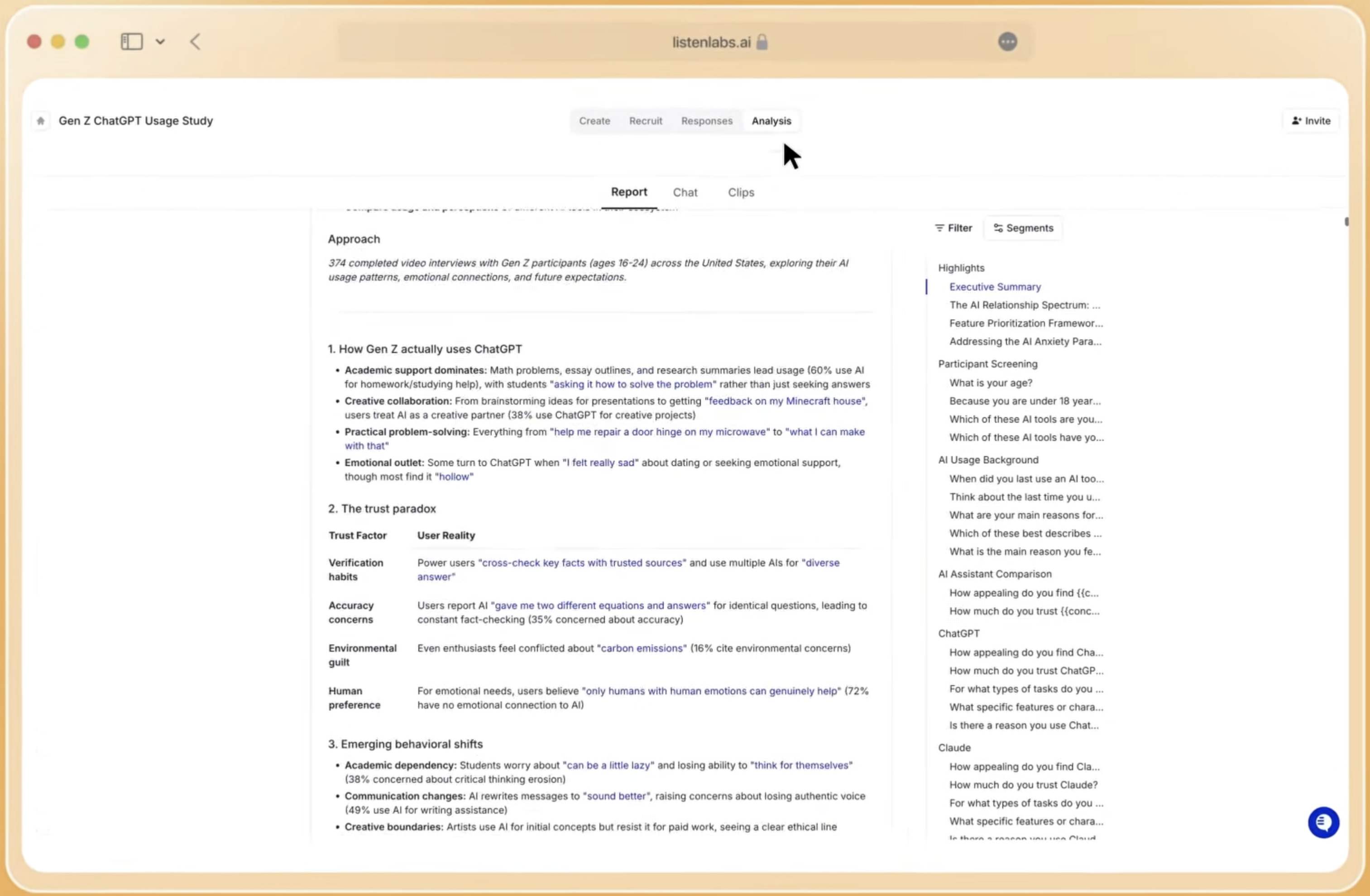
Listen Labs’ Gabor-Granger pricing test captures contextual follow-up questions at every point on the ladder. Once a respondent lands on a price, the AI interviewer probes the reasoning, separates “can’t afford it” from “isn’t worth it,” and codes recurring themes across the full sample. Individual anecdotes become reportable data. Every point on the demand curve connects to a real interview with verbatim quotes and video clips, so when a VP challenges the results, the team can show clips of buyers explaining their choices in their own words instead of debating methodology.
Listen Labs’ Emotional Intelligence goes further: it analyzes tone of voice, word choice, and micro expressions to surface emotions that transcripts alone miss. Built on Ekman’s universal emotions framework, every emotion is quantified per question and traceable to the exact timestamp and verbatim quote behind it. A respondent who says “that seems reasonable” while showing contempt is giving a different signal than one who says the same words with genuine engagement. The former may be hiding dissatisfaction. This qualitative layer makes a pricing decision defensible in executive conversations and fills a gap that purely quantitative platforms leave open.
Uncover the reasons behind your buyers’ price decisions
Monadic Price Testing Tools For Teams Without A Research Statistician
Most brand teams evaluating monadic price testing tools have budget for a single pricing study this quarter and no in-house researcher to run it. The practical question becomes which platform places the smallest setup and analysis burden on a non-specialist.
“Turnkey” varies widely across platforms. For Qualtrics and Quantilope, turnkey means the methods are available, yet configuring a monadic cell design, setting quotas, building branching logic, and interpreting hierarchical Bayes output still requires research expertise. For aytm’s Monadic Price Xpert, the template reduces setup time, but analysis and reporting remain the team’s responsibility. For Conjointly, the free tier allows exploration, but a team without conjoint experience will still need guidance on interpreting demand curves and part-worth utilities.
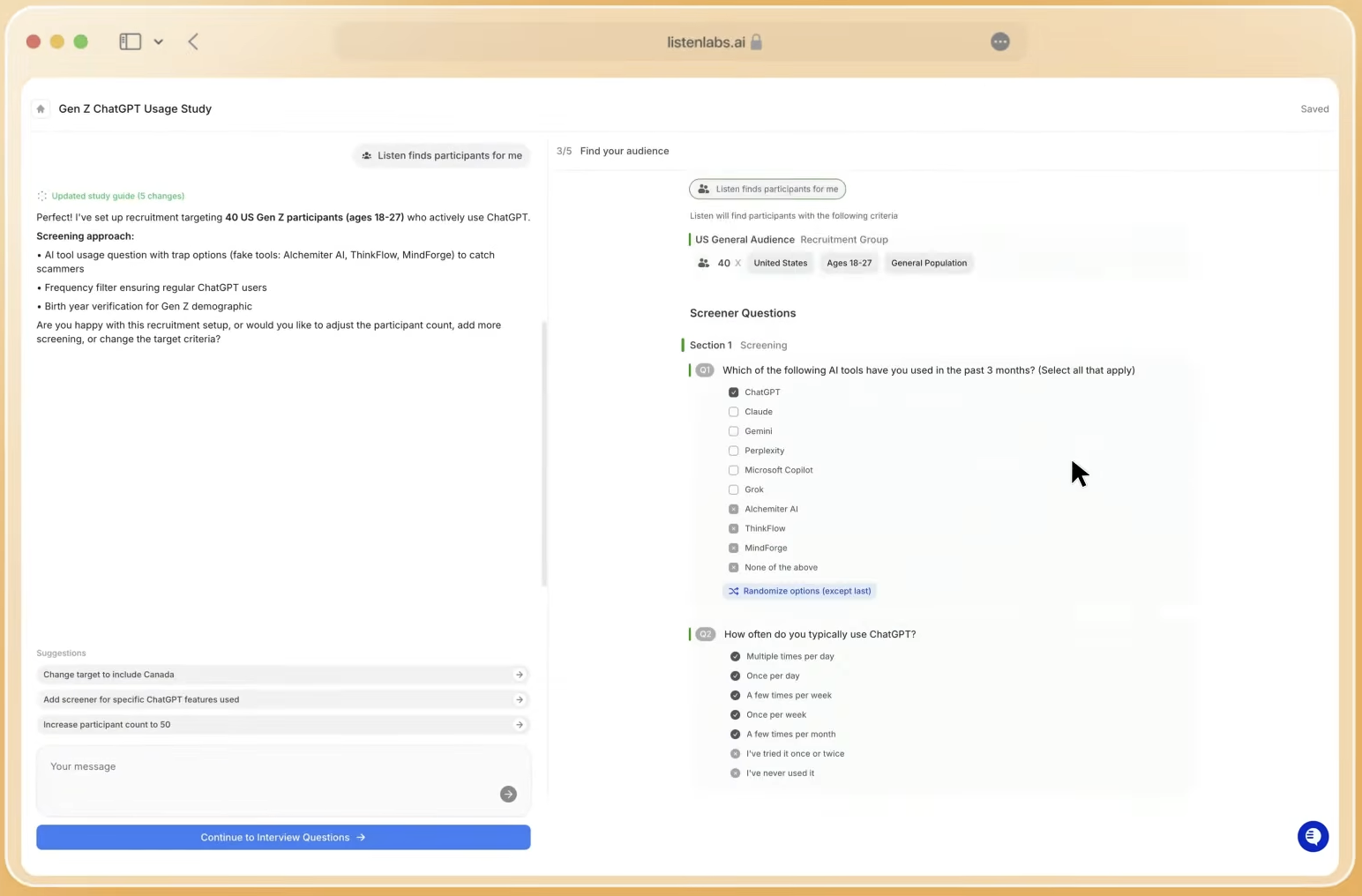
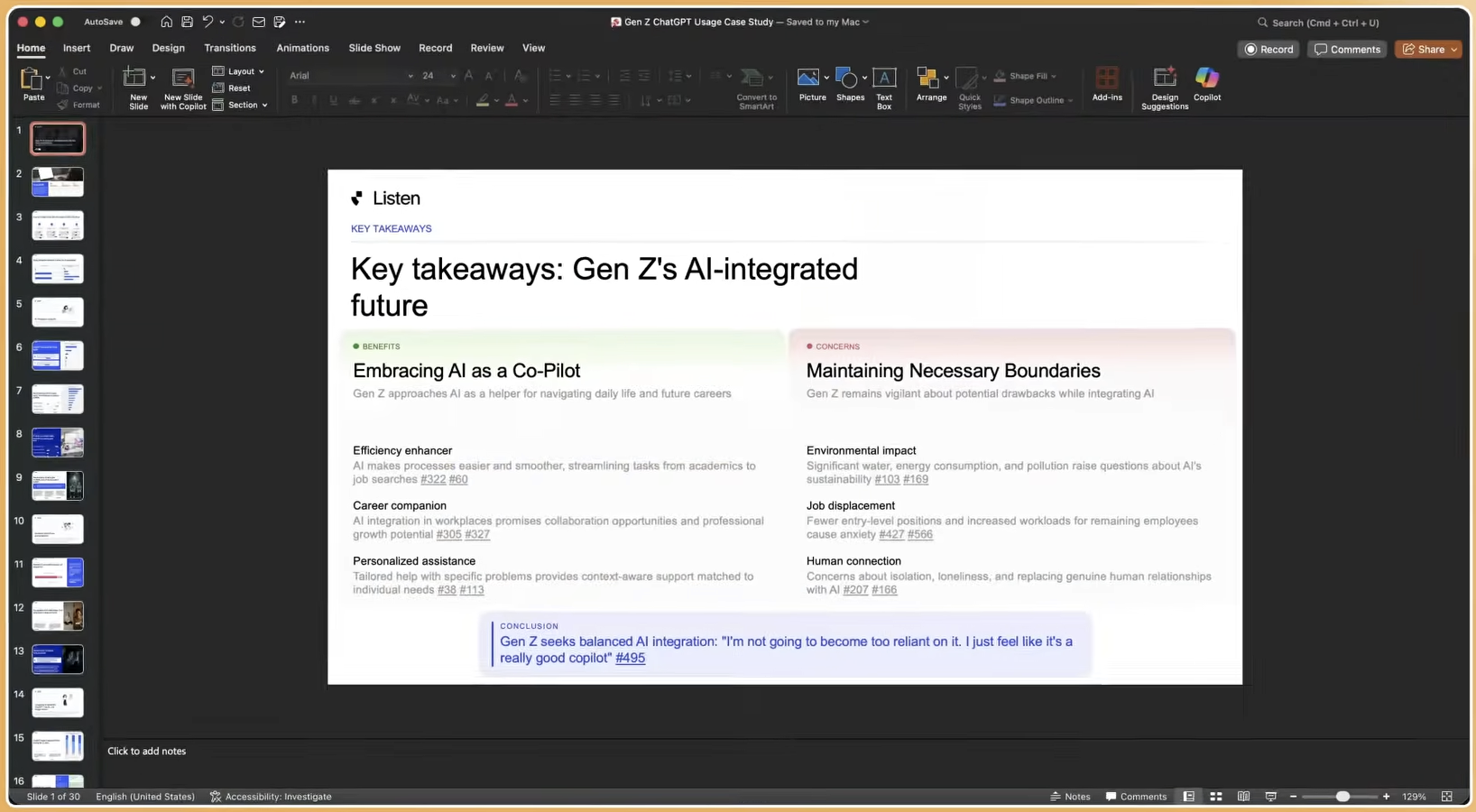
Listen Labs handles study design, recruitment, moderation, analysis, and deliverables end-to-end. AI-assisted study co-design lets a brand manager describe research goals in natural language and receive a structured study guide in seconds. Auto-QA flags issues before launch. Quality Guard monitors every interview in real time for fraud and low-effort responses. The Research Agent generates demand curves, revenue curves, thematic analysis, slide decks, and video highlight reels automatically. For complex projects, Listen Labs’ in-house research team provides white-glove support from study design through final deliverables.
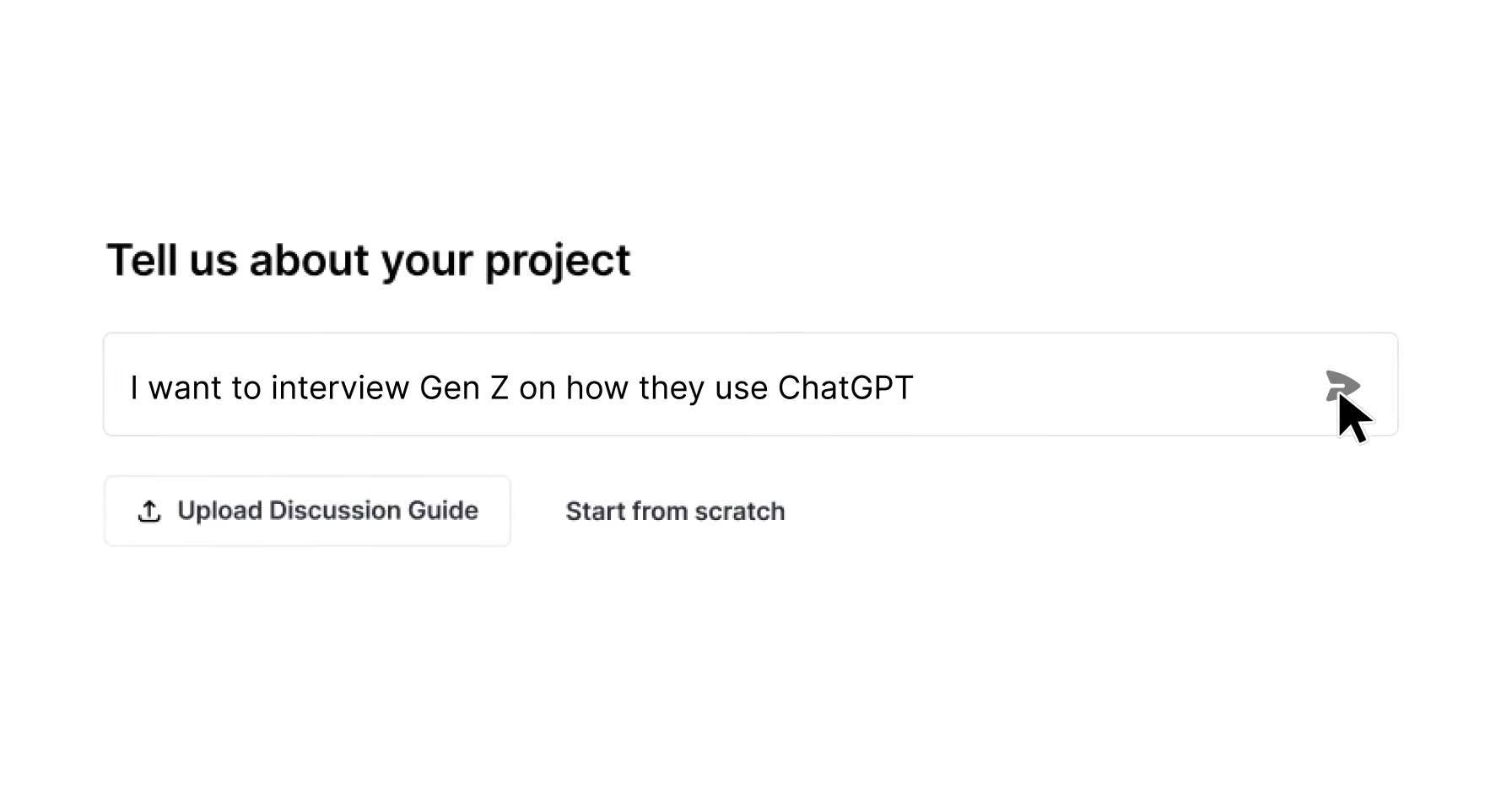
For a detailed walkthrough of what end-to-end support looks like in practice, see how to run pricing research without a research team.
How To Read A Demand Curve And Turn It Into A Pricing Decision
A demand curve from a monadic price test plots the percentage of respondents willing to buy at each price point. As price increases, that percentage falls. The shape of the curve, especially where it drops gradually versus sharply, highlights psychological price thresholds where a meaningful share of buyers exits.
The revenue curve multiplies price by the percentage willing to buy at that price. The peak of the revenue curve is the revenue-maximizing price, which is neither the highest nor the lowest price with meaningful demand. In a worked example testing a SaaS add-on at $10–$30, the revenue index peaked at $15 rather than $30 because the volume lost at higher prices outweighed the margin gained.
Listen Labs’ segment filters allow a brand team to run the same demand and revenue curve analysis for specific audience subgroups by age, income, purchase frequency, or any screener variable without fielding a new study. The revenue-maximizing price often differs by segment. Enterprise buyers may peak at a price point significantly higher than SMB buyers for the same product. A single blended curve can hide that variation and lead to a price that underperforms with the segments that matter most.
Listen Labs also handles messy real-world responses automatically. Buyers who would not purchase at any price stay in the count so demand is not artificially inflated. Buyers who say yes to a high price but no to a lower one are counted separately. Half-finished ladders are dropped. The output is a clean, defensible curve rather than a spreadsheet that requires manual cleaning before it can be presented.
Frequently Asked Questions
How Many Respondents Does A Monadic Price Test Need?
As mentioned earlier, the working standard is approximately 200 respondents per price cell, which provides enough statistical power to detect meaningful differences. Total sample scales linearly with the number of price points. If the study will be analyzed by segment, each segment needs its own minimum per-cell count, which increases total sample requirements further.
How Do Monadic, Gabor-Granger, And Van Westendorp Methods Differ?
Each method answers a different pricing question. Monadic price testing gives a clean read on purchase intent at specific price points by showing each respondent only one price, and it fits when the team has predefined price points and budget for multiple respondent cells. Gabor-Granger uses a sequential or adaptive price ladder to find the revenue-maximizing price with a single respondent group, which is more cost-efficient but introduces anchoring risk. Van Westendorp asks respondents to name their own price thresholds across four questions and produces an acceptable price range without predefined price points, which suits early-stage products with no market reference price.
Many teams run Van Westendorp first to establish a credible range, then run Gabor-Granger or a monadic design within that range to find the specific revenue-maximizing price. Listen Labs’ Gabor-Granger pricing test combines the adaptive ladder with AI-moderated qualitative follow-up, capturing both the demand curve and the reasoning behind it in a single study.
Can I Run A Monadic Price Test Without A Research Team?
Teams can run a monadic price test without a research team if the platform handles most of the setup and analysis. Platforms like Qualtrics and Quantilope make the methods available but require research expertise to configure cell designs, set quotas, and interpret outputs. Listen Labs is designed for brand teams without in-house researchers. AI-assisted study co-design handles the discussion guide, Quality Guard manages participant recruitment and fraud detection, and the Research Agent generates demand curves, revenue curves, thematic analysis, and slide decks automatically. For complex projects, Listen Labs’ in-house research team provides white-glove support end-to-end, so a brand manager can run a monadic price test without a statistician.
How Do You Ensure Participant Quality?
Participant quality is the single largest driver of pricing research accuracy. Listen Labs uses three layers of protection. It works only with high-quality, non-commodity panel sources and avoids professional survey-takers. Quality Guard applies real-time AI monitoring across video, voice, content, and device signals to detect fraud, low-effort responses, and mismatched profiles during the interview itself. A dedicated recruitment ops team adds a human review layer and limits participants to three studies per month to prevent panel fatigue. For niche or hard-to-reach audiences such as enterprise decision-makers, healthcare workers, or consumers below 1% incidence rate, the recruitment ops team handles sourcing directly.
What Deliverables Do I Get From A Pricing Study?
From a Listen Labs monadic price test or Gabor-Granger pricing study, deliverables include a demand curve showing the percentage of buyers at each price point and a revenue curve identifying the revenue-maximizing price. Teams also receive segment filters that break down the curve by key audience subgroups, thematic analysis that codes the qualitative reasoning behind price acceptance and rejection, and verbatim quotes and video clips traceable to every point on the curve. Consultant-quality slide decks, memos, and highlight reels are generated automatically by the Research Agent, and results arrive in less than 24 hours. Other platforms vary significantly, and most quantitative-only tools deliver raw data exports or basic charts, which require the team to build their own presentation layer.
Get a personalized walkthrough of monadic price testing