Written by: Anish Rao, Head of Growth, Listen Labs
Key Takeaways
- Customer interviews for pricing research are structured qualitative conversations that reveal mental models, trade-offs, and value perceptions. These interviews inform quantitative validation studies rather than set final prices.
- Effective pricing interviews recruit a balanced mix of current customers, lost prospects, and target buyers. This balance prevents distorted willingness-to-pay signals from any single segment.
- A six-stage interview script moves from context and value exploration to price ladders and budget-versus-value probes. This structure reduces anchoring bias and separates affordability issues from value perception problems.
- Qualitative pricing research usually reaches thematic saturation at roughly 15–25 interviews per segment. AI-moderated platforms make larger sample sizes feasible in hours instead of weeks.
- Listen Labs provides AI-moderated interview tools that remove moderator bias, generate deeper responses, and speed up analysis for pricing research teams.
Book A Pricing Research Demo With Listen Labs
Prerequisites And Context For Pricing Interviews
This guide serves consumer insights leaders, UX researchers, product managers, marketing leaders, founders, and consultants who run pricing interviews. It assumes basic familiarity with qualitative research and product development cycles, but not with pricing methodology.
Several terms appear throughout this playbook:
- Qualitative pricing research: Interviews and conversations that surface reasoning, mental models, and value perceptions. These findings are rich in insight but not statistically projectable.
- Quantitative pricing research: Survey-based methods (Van Westendorp, Gabor-Granger, conjoint) that measure willingness to pay at scale with statistical confidence.
- Willingness to pay (WTP): The maximum price a specific buyer segment will pay before walking away. Teams treat this as a distribution, not a single number.
- Price ladder: A conversational sequence that introduces price gradually and narrows based on responses. For example, “Would you pay $X? No. $Y? Maybe. $Z? Yes.”
- Van Westendorp Price Sensitivity Meter: A survey instrument that uses four price-perception questions to identify an acceptable price range and psychological price boundaries.
- Gabor-Granger: A direct pricing method that presents specific price points and measures purchase intent to build a demand curve and identify the revenue-maximizing price.
- Screener: A set of qualifying questions used to recruit the right participants before an interview begins.
- Incidence rate: The proportion of the general population that qualifies for a study. Low incidence rates require larger recruitment pools.
- “Too expensive” vs. “not worth it”: A critical distinction. “Too expensive” reflects a budget or affordability constraint. “Not worth it” reflects a value perception problem. Each requires a different response.
Pricing decisions now involve multiple functions, and teams face pressure to move quickly. User Intuition’s AI-moderated interview platform makes it feasible to run 50–100+ pricing interviews in 24 hours at $30 per interview, compared to 4–8 weeks for traditional agency research. This article focuses on the qualitative interview stage and stops at the handoff to quantitative validation.
See How Listen Labs Supports Pricing Interviews
Step 1: Define The Pricing Question And The Decision It Supports
The team first aligns on the decision the interviews will inform. Pricing interviews serve different purposes depending on product stage and business question.
Common pricing questions include:
- What price range will the market bear for a new product?
- Why did conversion drop after a recent price change?
- Which features belong in which tier, and what value metric should anchor each plan?
- How do different buyer segments perceive value differently?
For each question, list the hypotheses to test. Capture what you believe about how customers perceive value, which alternatives they compare you to, and what would make them pay more or less. Pricing interviews work best alongside quantitative signals, so the qualitative stage should generate hypotheses, price anchors, and value themes that a later quantitative study will validate.
The output of this step is a clear research brief. The brief states the decision, the method, the sample, and what the interviews can and cannot conclude. Writing this brief before fieldwork aligns stakeholders and reduces the risk that inconvenient findings get overridden by internal opinion.
Step 2: Recruit Current Customers, Lost Prospects, And Target Buyers
Each participant segment answers a different pricing question. Interviewing only one segment, especially only happy customers, creates a distorted picture of willingness to pay.
- Current customers: Reveal perceived value, willingness to pay more, and churn triggers. Their expectations are anchored to current price, which helps with price-increase research but introduces loyalty bias for new tiers or market expansion.
- Lost prospects: Reveal why they chose a competitor and which price or value threshold they rejected. In win-loss analysis, “too expensive” almost always decodes to a value-communication gap, and lost prospects make this visible.
- Target buyers (non-customers in the market): Reveal price expectations without relationship bias. This segment is critical for new product launches and market expansion.
Screener criteria should cover usage frequency, decision-making role, budget authority, recency of purchase or evaluation, and competitor consideration. End users consistently estimate lower WTP than actual buyers because they imagine what they would request in a budget approval, not what they would sign off on. Screeners should require that respondents can approve or formally recommend contracts above the midpoint of the target pricing range.
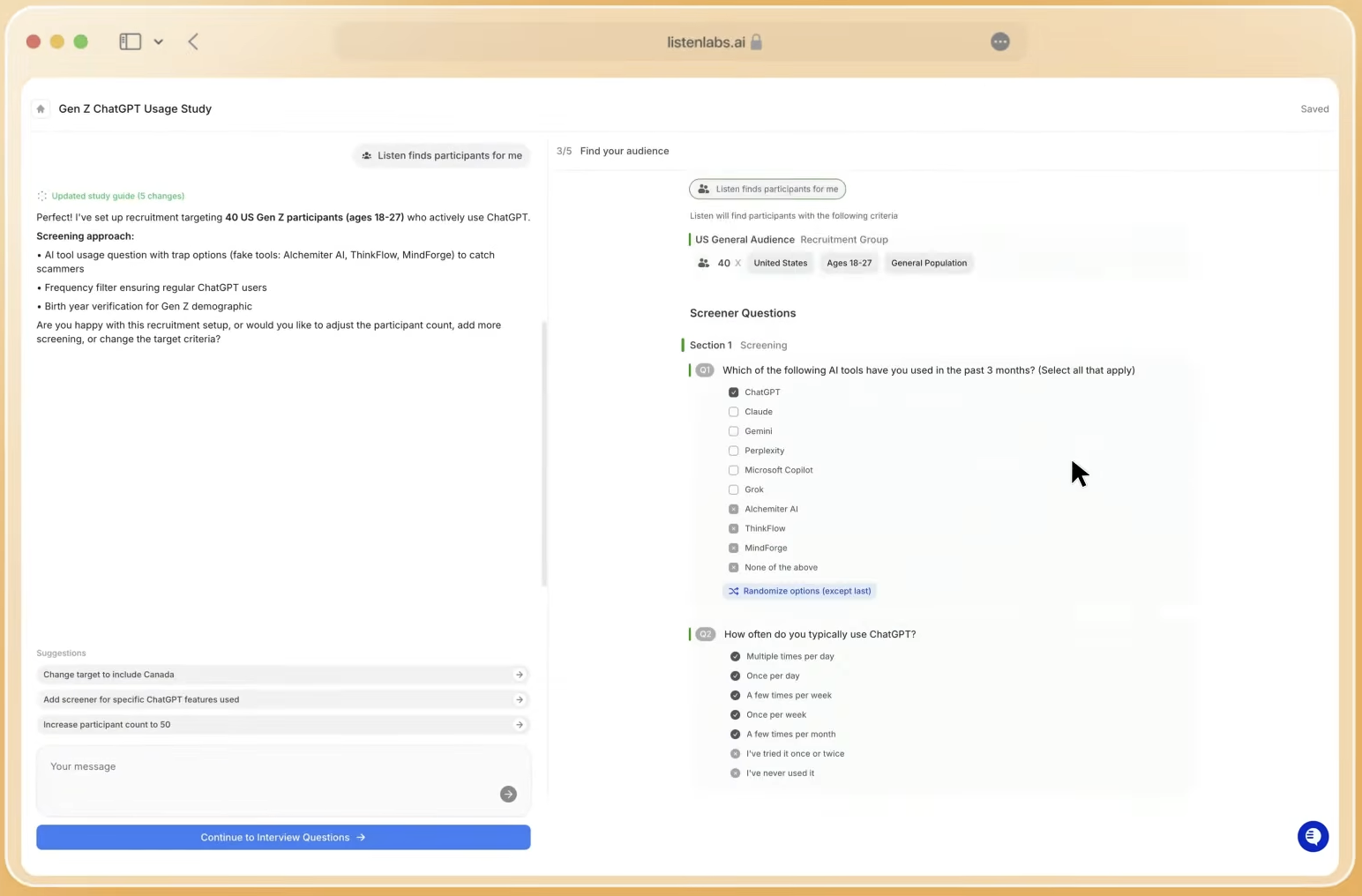
Recruit a mix of price-sensitive and price-insensitive buyers. Avoid recruiting only through satisfaction surveys or NPS follow-ups, which self-select for engaged customers. Recruit lost prospects from CRM segments of recently churned accounts and mid-funnel prospects who did not convert. Keep the screener neutral about pricing so you do not over-recruit price-sensitive respondents.
AI-moderated interviews make it feasible to recruit and complete 100–300 interviews in a single day, with some platforms reporting 200–300 interviews filled within 24 hours, while larger studies of 500–1,000 participants may take 3–5 days.
Scale Your Pricing Recruitment With Listen Labs
Step 3: Use A Six-Stage Pricing Interview Script
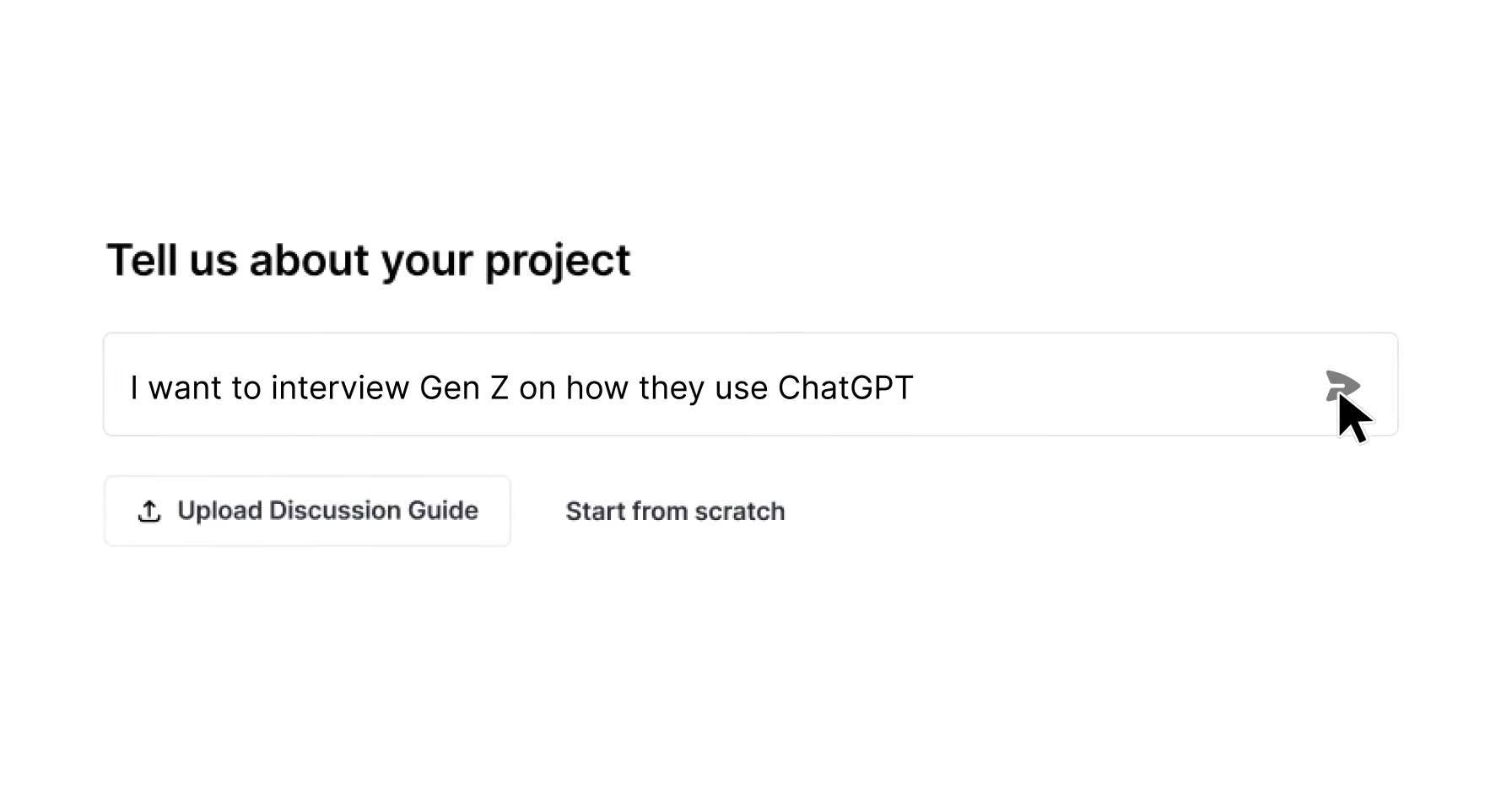
A pricing interview follows six stages. Each stage builds on the previous one and moves from context to value to price.
- Warm-Up And Context: Establish rapport and get the participant talking about their current situation without mentioning price. Ask: “Walk me through how you currently handle [the problem your product solves].” Follow up with: “How long have you been dealing with this, and what have you tried before?” This anchors the conversation in real behavior.
- Current Spend And Workarounds: Ask what they currently use, what they pay, and what they do instead of buying. Ask: “What does your current solution cost you in money, time, or risk?” Then: “Who in your organization owns that budget, and did anyone need to approve it?” The current spend number comes from a budget that has already been signed off, so it provides a reliable anchor.
- Value And Outcome Questions: Ask what outcomes matter, what would change if they solved the problem, and what they would give up to get it. Ask: “What would you lose if this product went away tomorrow?” Then: “How would you quantify that loss in time, revenue, or risk?” Avoid price questions in this stage. If you want customers to tell you the truth, ask about value. If you want them to tell you a lie, ask about price.
- Price Ladder: Introduce price gradually. Start with a broad range and narrow based on responses. Use a conversational ladder such as: “Would you pay $X? No. $Y? Maybe. $Z? Yes.” Then ask: “You said $X feels too high. What would need to be true for it to feel fair?” Let the participant set the initial anchor before you introduce a specific number. The first figure mentioned in a buyer interview should come from the participant.
- Budget Versus Value Probe: Once a price anchor emerges, ask why it felt worth it or not worth it. Ask: “Does the number itself feel too high, or are you unsure the value justifies it?” Then: “What would have to change about the product for that price to feel like an easy yes?” This step separates “I cannot afford it” from “it is not worth that much.”
- Closing And Referral: Ask: “Is there anything that would influence your decision that we have not talked about?” Then: “Who else in your organization would have a view on this?” People often hold back the most useful things until they think the formal part is over.
Listen Labs’ AI moderator probes deeper on short or interesting answers and generates responses three times longer than average. This depth surfaces the reasoning behind price reactions that a static survey cannot reach.
Step 4: Ask About Price Without Leading The Customer
Wording choices in pricing questions determine whether the data is usable. Certain patterns introduce anchoring bias before the participant forms an independent view.
Wording traps to avoid:
- “What would you pay for this?” invites a guess with no reference point, and customers have no incentive to reveal their real number.
- “Is $X too expensive?” leads the respondent and anchors every subsequent answer to $X.
- Anchoring too early with a specific number. In the Ariely, Loewenstein, and Prelec “Coherent Arbitrariness” experiment, participants whose Social Security numbers ended in the top quintile bid 216% to 346% more than those in the bottom quintile, which shows how arbitrary anchors distort price estimates.
- Using leading words such as “cheap,” “premium,” “overpriced,” or “affordable” in any price question.
Fixes that reduce anchoring bias:
- Ask about value first. Establishing the outcome before introducing any number gives the participant a reference point that belongs to them.
- Once that context exists, use open-ended ranges. “What would you expect a tool like this to cost, and why?” captures a more genuine unanchored figure.
- Use comparative questions rather than absolute ones. “How does this compare to what you pay for X?” surfaces the reference point the participant actually uses.
- Probe the reasoning behind every number. “How did you arrive at that figure?” separates a considered estimate from a reflexive guess.
Stated willingness to pay and revealed willingness to pay often diverge. A 2020 meta-analysis in the Journal of the Academy of Marketing Science found that stated willingness to pay tends to overstate real willingness to pay by a meaningful margin across dozens of studies. Probing for reasoning and competitive comparisons behind a stated price produces a more trustworthy range.
AI-moderated interviews can avoid leading language and follow up consistently across hundreds of interviews. This consistency removes moderator drift and fatigue that introduce bias in human-led fieldwork.
See AI Question Design In Action
Step 5: Choose A Sample Size For Pricing Interviews
Per-segment interview recommendations vary by source and method, often falling between 8 and 20 interviews per distinct segment. For homogeneous samples, thematic saturation typically occurs around 12 interviews, with most themes emerging by 9–12. Deeper meaning saturation often requires 16–24 interviews. Diverse or multi-segment studies may need more. Pricing research benefits from larger samples because price sensitivity varies widely across buyers.
For reliable segment comparisons, 30–50 interviews are recommended, and 50–100 interviews suit heterogeneous populations or multiple segments where minority views must remain visible. A study with three segments at 15 interviews per segment requires at least 45 interviews before segment-level patterns stand apart from individual variation.
A common failure mode is conducting 20 interviews across four segments, which yields only five per segment. That count falls below even the single-segment thematic-saturation threshold. Saturation applies within each segment, not across the total sample.
The point of diminishing returns arrives when additional interviews no longer change the themes or the price range. Researchers can analyze in batches every 5–10 interviews, track whether new themes emerge, and stop when they consistently hear familiar patterns.
Many teams historically kept pricing studies small because of cost and logistics. AI-moderated interviews make it feasible to run 50–100+ interviews in hours, so sample size becomes a coverage decision instead of a budget constraint.
Step 6: Code “Too Expensive” Versus “Not Worth It”
The most consequential analytical distinction in pricing interview data sits between “too expensive” and “not worth it.” These phrases look similar in a transcript but require different responses.
- “Too expensive” reflects a budget or affordability constraint. The buyer perceives value but cannot access the budget. Useful responses include packaging changes, payment terms, a lower-tier entry point, or a different buyer segment.
- “Not worth it” reflects a value perception problem. The buyer has the budget but does not believe the product delivers enough value at the stated price. Useful responses include changing the value proposition, the target segment, or the product itself.
Code verbatims into four theme categories:
- Value perception: Outcomes the buyer associates with the product and how they quantify or estimate the benefit.
- Price sensitivity: The buyer’s resistance point and what drives it, such as budget ceiling, approval threshold, or value gap.
- Competitive alternatives: What the buyer compares the product against and at what price. When a respondent says a price “feels expensive,” the critical follow-up probe is “compared to what,” and the answer usually contains the key finding.
- Willingness to pay: The price range the buyer articulates, the conditions under which they would pay more, and the deal-breakers that would make them walk away.
To turn verbatims into data, count how many participants in each segment express each theme. A theme mentioned by 8% of participants may seem minor. That same theme becomes commercially significant when all of those participants are churned enterprise accounts. Segment metadata connects themes to revenue impact.
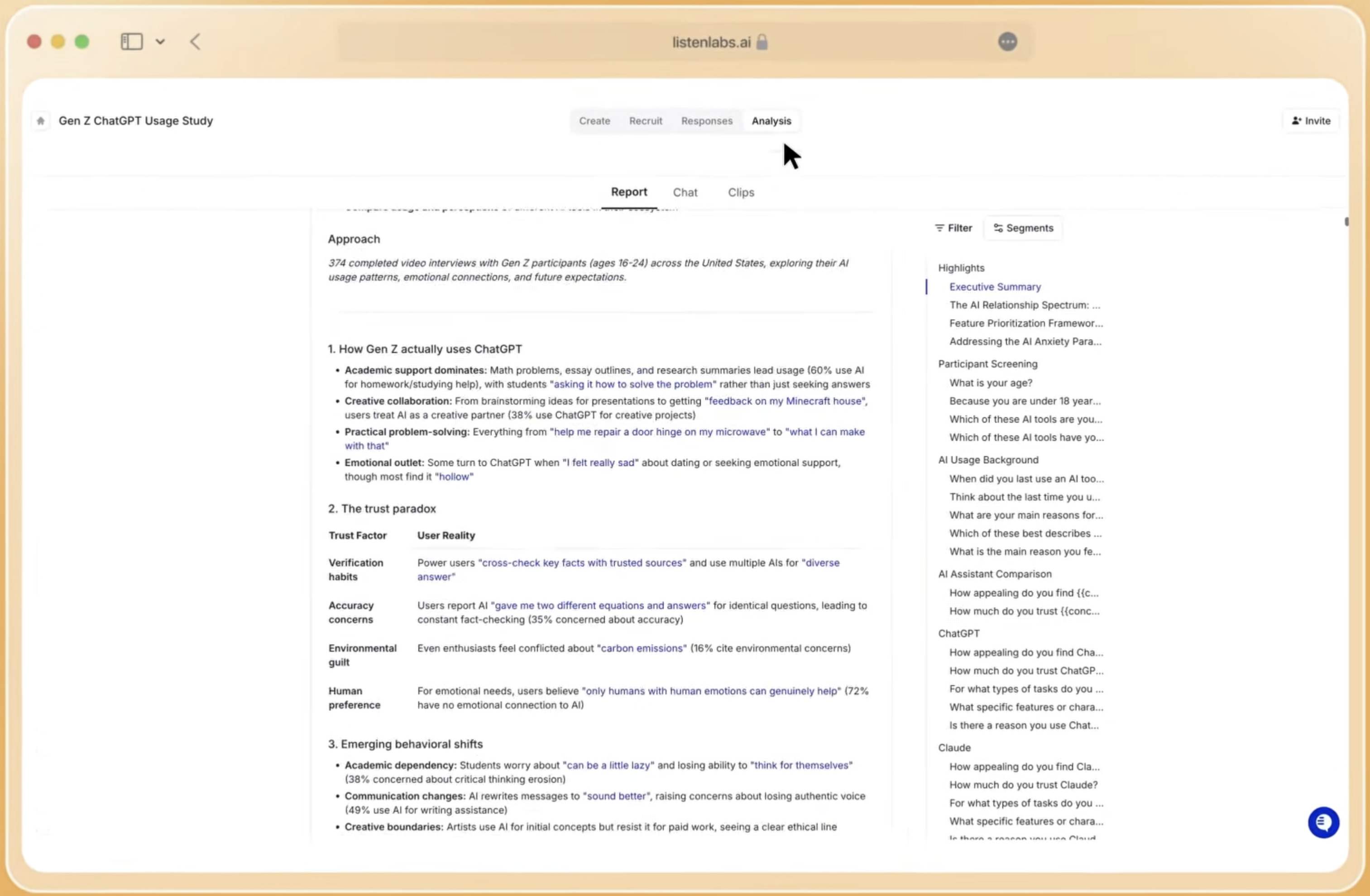
Listen Labs’ Research Agent processes interview data objectively, identifies patterns and themes across hundreds of responses, and generates slide decks, memos, and highlight reels in under a minute.
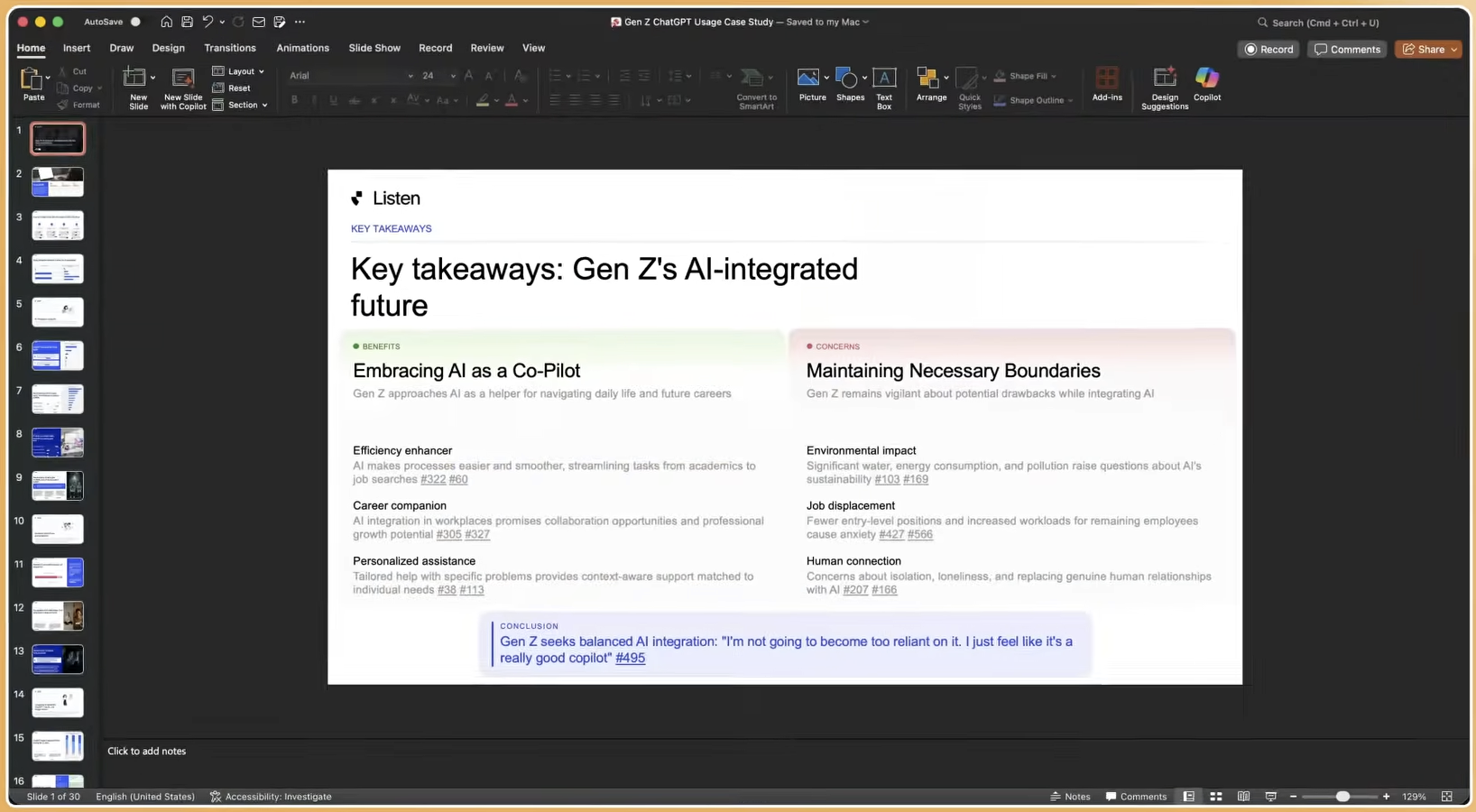
See Automated Coding With Listen Labs
Step 7: Hand Off To Van Westendorp Or Gabor-Granger
Qualitative interviews finish when three conditions are met. Themes are saturated, price ranges are stable across the most recent batch of interviews, and remaining questions focus on magnitude rather than direction. At that point, the team has hypotheses, price anchors, and value themes for a quantitative validation study.
Two quantitative methods commonly support this handoff:
- Van Westendorp Price Sensitivity Meter: Useful for understanding acceptable price ranges and identifying psychological price boundaries when the right band is unknown. It asks four perception questions about when the product is too expensive, expensive but worth considering, a bargain, and suspiciously cheap. The resulting curves yield an acceptable price range and key intersection points. Van Westendorp works especially well for exploratory pricing or new products with uncertain ranges.
- Gabor-Granger: Useful for finding the revenue-maximizing price and understanding purchase intent at specific price points. It presents researcher-defined price points and measures willingness to buy at each one, producing a demand curve and a revenue curve. Gabor-Granger fits best when the approximate price range is already known, for example after a Van Westendorp study.
Many teams run both in sequence. Van Westendorp first establishes the plausible perceptual range. Gabor-Granger then finds the revenue-maximizing point within that range. When the Gabor-Granger modeled revenue peak falls within the Van Westendorp acceptable range, the two outputs support a coherent next hypothesis. When the peak sits outside the range, the result calls for investigation.
The mechanics of Van Westendorp and Gabor-Granger appear in dedicated resources. Qualitative interviews generate the inputs, such as hypotheses, price anchors, value themes, and segment differences, that make the quantitative study sharper and more actionable. For a deeper look at AI-moderated price testing with Gabor-Granger, see Listen Labs’ guide to AI-moderated interviews for price testing.
Explore AI-Supported Price Testing
How To Match Pricing Frameworks To Your Research Stage
Pricing frameworks help teams choose methods that fit their stage and question. Each framework plays a different role in the overall process.
Value-Based Pricing Framework: This framework grounds price in the outcomes the buyer is purchasing rather than production cost. Pricing interviews operationalize this by asking buyers to describe what the product is worth in time saved, risk avoided, or revenue generated. A B2B SaaS buyer who says a product “saves us from rebuilding a process from scratch every quarter” expresses willingness to pay that a feature-level survey would miss.
Price Ladder: This conversational sequence introduces price gradually, starting with a broad range and narrowing based on responses. Teams use price ladders across B2B SaaS, consumer products, and healthcare when acceptable ranges may span an order of magnitude across segments.
Van Westendorp Price Sensitivity Meter: This method fits initial price range decisions and new product launches without historical sales data. Qualitative pricing research is especially useful when launching a new product, considering a price increase, or designing pricing tiers and packages to identify which features, benefits, or service levels increase perceived value.
Gabor-Granger: This method fits price increase testing and revenue optimization when the price band is already established. For a consumer products company testing a price increase across hundreds of retail locations, Gabor-Granger provides the demand curve, and qualitative interviews provide the story behind it.
The choice of framework depends on research stage, segment, and decision. A practical sequence uses interviews plus budget analysis when no product exists yet, Van Westendorp plus interviews when the product is ready but price is open, and Gabor-Granger when the corridor is set and the price needs sharpening.
Talk Through Your Pricing Framework Mix
Common Challenges And Troubleshooting For Pricing Interviews
Pricing interviews fail in predictable ways, and early detection prevents wasted fieldwork.
Leading Questions That Anchor The Respondent. Signal: price ranges cluster suspiciously close to a number mentioned in the screener or guide. Cause: the moderator introduced a specific price before the participant formed an independent view. Fix: audit the guide for numeric primes and restructure to elicit the participant’s anchor first.
Interviewing Only Happy Customers. Signal: willingness-to-pay estimates appear uniformly high and objections are rare. Cause: recruitment relied on satisfaction surveys or NPS follow-ups. Fix: add a lost-prospect segment from CRM churn data and unconverted mid-funnel leads.
Anchoring Too Early With A Specific Price. Signal: participants adjust answers up or down from the first number mentioned instead of generating independent estimates. Cause: the price ladder appeared before value context. Fix: complete all value and outcome questions before any price.
Confusing “Too Expensive” With “Not Worth It.” Signal: all price objections receive the same code, and the recommended fix is always a discount. Cause: the budget-versus-value probe was skipped or handled lightly. Fix: add the explicit probe “Does the number itself feel high, or are you unsure the value justifies it?” and code responses into separate themes.
Stopping Too Early And Missing Sub-Segment Variation. Signal: themes appear saturated at the total level, but segment-level patterns remain inconsistent. Cause: the sample was too small to separate real segment differences from individual variation. At 50+ interviews with metadata, inter-segment differences become statistically visible. At 15 interviews without metadata, they remain guesswork.
Analysis Bottlenecks And Subjective Coding. Signal: the research team is still coding transcripts weeks after fieldwork, and analysts disagree on conclusions. Cause: manual coding at scale is slow and prone to confirmation bias. Manual coding of qualitative transcripts runs at roughly two to four hours of analyst time per hour of interview material, so a 50-interview study can require 100–200 hours of coding before synthesis. AI-assisted analysis cuts this to hours.
Reduce Pricing Interview Failure Modes With Listen Labs
Measuring Success Of Your Pricing Interview Program
Pricing interview programs produce usable evidence when four indicators show up consistently.
Theme Saturation: New interviews in the most recent batch do not surface new themes. This signal shows that the qualitative stage is complete and the team can move to quantitative validation.
Consistency Of Price Ranges Across Interviews: Price anchors from the most recent batch fall within the range established by earlier batches. Wide variance in the final batch suggests incomplete saturation or a missing sub-segment.
Stakeholder Usage Of Insights: Pricing recommendations from the research influence product, packaging, and go-to-market decisions. A pricing research plan written before fieldwork, which states the decision and the limits of the research, reduces HiPPO overrides.
Impact On Pricing Decisions: Track conversion rate by tier, expansion revenue at 90 days, and price objection rate in sales calls after a research-informed pricing change. These metrics separate short-term noise from longer-term trend validation and provide evidence for the next pricing research cycle.
Practical tracking mechanisms include dashboards that monitor these indicators over time, periodic retrospectives after each pricing study, and method reviews when a major feature launches, a new segment is entered, or a competitor reprices.
Track Pricing Impact With Listen Labs
Advanced Considerations And Iterative Pricing Research
Teams with mature research operations can extend this pricing interview playbook in several directions.
Always-On Pricing Research Programs: Pricing context shifts with market conditions, feature evolution, and competitive moves. Pricing interviews work well as part of a quarterly research cadence. Always-on programs catch willingness-to-pay drift before it appears as declining conversion or expansion revenue.
Qual-At-Scale With AI-Moderated Interviews: Qual-at-scale suits research that requires large sample sizes or broad geographic reach, with AI tools engaging hundreds or thousands of participants remotely and asynchronously. This capability turns segment-level pricing analysis into a standard part of the research cycle.
Global And Multi-Market Pricing Studies: Price sensitivity varies significantly across markets, and a single global price rarely performs best. Multi-market pricing studies require segment-level analysis per market, consistent guides across languages, and cultural context for value and price signals. Listen Labs supports 120+ languages for interview moderation and covers more than 45 countries.
Integrating Behavioral Data: Pricing interviews capture stated preferences. Behavioral data such as conversion funnel analysis, pricing page analytics, and churn survey data captures revealed preferences. Pricing page analytics that show where attention drops can be diagnosed by interviews as revealing which questions went unanswered. Combining both data types produces a more complete picture of willingness to pay.
Advanced Segmentation: Widely spread willingness-to-pay answers signal segmentation opportunities rather than bad data. A wide spread usually means several customer groups receive different value from the product, which often leads to price tiers. Advanced segmentation analysis identifies these groups and designs packaging around them.
Readiness criteria for advanced practices include a mature research operations function, data governance policies for cross-study synthesis, and cross-functional alignment on how pricing research feeds product, marketing, and finance decisions. Teams can pilot new methods with small tests, then compare outputs against existing pricing data before treating results as decision-grade.
Plan Your Next Pricing Research Wave
Frequently Asked Questions
What Is The Minimum Sample Size For Pricing Interviews?
As covered in Step 5, a practical target is 15–25 interviews per segment, which means 45–75 interviews for three segments. The real stopping point arrives when new interviews stop surfacing new themes and price ranges remain stable across recent batches.
Which Questions Belong In A Pricing Interview?
A strong pricing interview script moves through context, current spend, value and outcomes, price ladder, budget-versus-value probe, and closing. Anchor on real behavior first, then explore value, and only then introduce price. Use “compared to what” as a consistent follow-up to uncover the reference point behind every price reaction.
How Can You Ask About Price Without Leading Customers?
Start with value questions, then ask for expected price ranges in open-ended form, and rely on comparative questions instead of absolute ones. Probe how participants arrived at each number. AI-moderated interviews help by enforcing neutral wording and consistent follow-ups across every conversation.