
Written by: Anish Rao, Head of Growth, Listen Labs | Last updated: August 6, 2026
Key Takeaways for Enterprise Teams
- Enterprise research teams face a structural backlog because traditional qualitative cycles take 4–6 weeks and live moderated sessions are capped at roughly 20–40 interviews per researcher per month.
- Discuss.io delivers deep, human-moderated conversations but cannot scale beyond a handful of sessions per week because of moderator capacity and scheduling friction.
- UserTesting provides fast, high-volume unmoderated usability data but lacks adaptive probing, so teams miss the reasoning and emotion behind observed behavior.
- Neither legacy platform includes built-in emotional-intelligence analysis or automated consultant-grade deliverables, so synthesis and reporting remain the largest time sinks.
- Listen Labs removes the depth-versus-scale trade-off with AI-moderated interviews that deliver Discuss.io-level insight at UserTesting speed and results in under 24 hours—see how it works for your team.
The Problem: Why Enterprise Teams Fall Behind on Research
A typical qualitative research cycle runs 4–6 weeks from study design to final report. In large enterprises, internal prioritization and budget approval can stretch that to six months. By the time insights arrive, the business context has often shifted. Meanwhile, live moderated interviews are limited to roughly 20–40 sessions per researcher per month, which creates a throughput ceiling that becomes more painful as stakeholder demand increases.
The evaluation criteria that matter for enterprise teams are: research cycle time, depth of insight, participant quality and fraud controls, global and multilingual reach, analysis and reporting effort, total cost of ownership, and scalability without proportional headcount increases. Discuss.io and UserTesting each address some of these criteria well and fall short on others. The following sections show how each platform’s core methodology shapes its performance across these dimensions.
How Each Platform Handles Study Setup and Moderation
Discuss.io is built around live human-moderated sessions conducted via video. A trained moderator guides each conversation in real time, probes unexpected threads, and adapts questions as the interview unfolds. Moderated sessions consistently surface usability issues faster and with greater depth than unmoderated testing by enabling immediate clarification of ambiguous feedback. The limitation is structural. A senior moderator can run only 3–4 sessions in a productive day before probing quality declines due to fatigue. Scheduling friction then adds weeks before the first transcript appears.
UserTesting operates primarily on an unmoderated model. Participants complete predefined tasks independently while the platform records their screen, voice, and facial expressions. Unmoderated usability testing platforms show whether a task succeeded and where users dropped off but lack conversational follow-up, so they cannot explain the reasoning, intent, or contextual factors behind user behavior. The platform does support moderated sessions, but UserTesting’s credit-based model charges 3–5x more credits for moderated sessions than unmoderated ones, which pushes most teams toward the shallower option.
Recruitment Speed and Sample Quality
Discuss.io offers a proprietary Rapid Recruiter engine that sources participants for live moderated sessions, including harder-to-reach professional segments. The scheduling dependency, however, means that even efficient recruitment still translates into a roughly three-week cycle from recruit to final session for a standard moderated remote study.
UserTesting operates one of the largest on-demand participant panels available, which has helped it dominate the unmoderated usability category with a video-first workflow optimized for recording interactions on shipped products or prototypes. Panel scale benefits broad consumer studies. At the same time, commodity panels carry well-documented quality risks: professional survey-takers, incentive-driven responses, and mismatched profiles that require significant researcher time to screen out.
Data Capture and Emotional Signals Across Platforms
Discuss.io captures conversational depth through live probing. A skilled moderator can follow a hesitation, reframe a question, and surface the emotional reasoning behind a stated preference. These capabilities remain difficult to reproduce algorithmically. UserTesting records screen activity and think-aloud responses, which provides behavioral data on what users do. UserTesting’s AI features include auto-generated insight summaries, sentiment analysis, friction detection, and theme clustering for surveys, but these operate as post-hoc overlays on recorded sessions rather than real-time adaptive moderation.
Neither legacy platform offers built-in emotional intelligence analysis that quantifies micro-expressions, tone of voice, and word choice simultaneously across every participant. Usability testing platforms capture what users do but often miss the reasons behind their behavior, such as why users ignore a feature or hesitate before abandoning it. This gap matters because two concepts can receive identical verbal ratings while triggering entirely different emotional responses.
Analysis Workflow and Deliverables Effort
After a Discuss.io study concludes, synthesis remains manual. Researchers review transcripts, code themes, and write reports, a process that requires 2–8 hours of synthesis effort per session. A 20-session study can consume weeks of analyst time before a deliverable reaches stakeholders. UserTesting applies AI tagging and theme clustering to recorded sessions, which accelerates first-pass review. However, users often export feedback for further manual analysis, so much of the reporting burden remains.
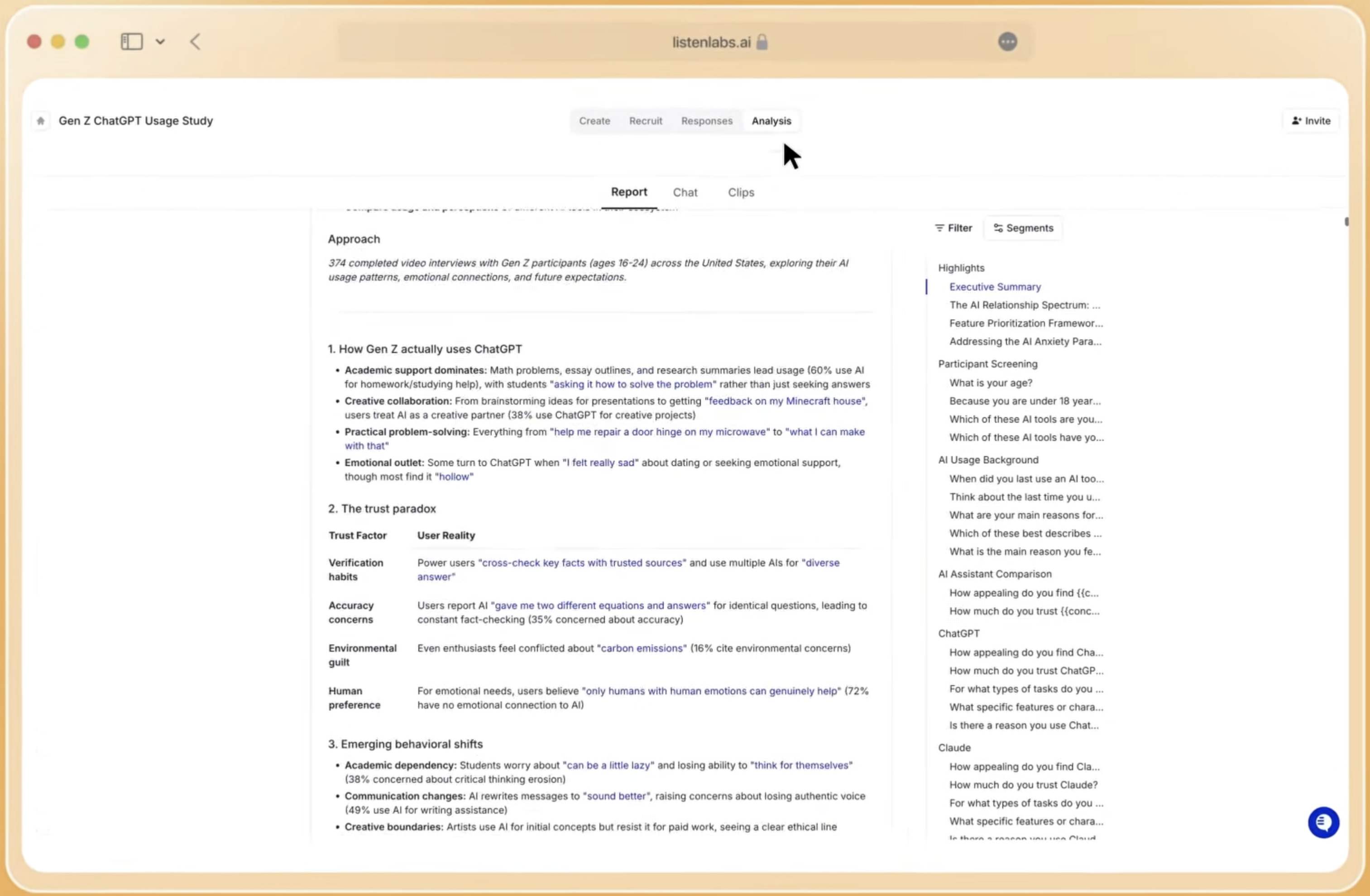
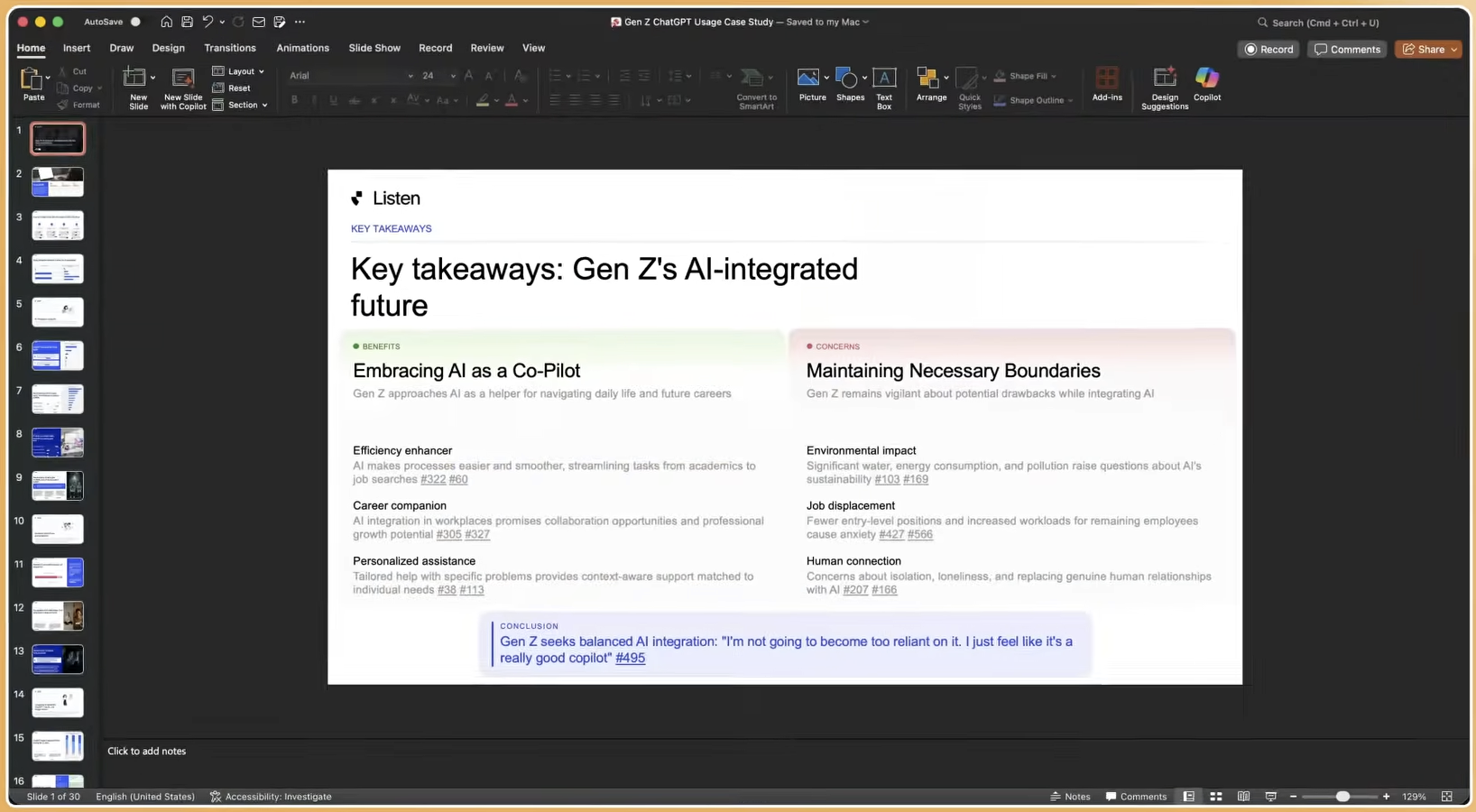
The weeks-versus-hours gap in producing consultant-grade reports and video highlight reels creates the largest cost for enterprise teams already managing a growing research backlog.
Pricing Models and Return on Investment
Discuss.io operates on annual platform licensing with custom project quotes layered on top. When moderator fees, recruitment costs, incentives, transcription, and analyst time are included, a 40-session live moderated study costs approximately $4,000–$11,500 fully loaded in 2026. UserTesting uses a credit-based enterprise contract model. Enterprise deployments of UserTesting average roughly $147,756 annually, with per-session costs around $49+ outside annual credit bundles. Both platforms require significant ongoing investment before a single insight reaches a decision-maker.
Enterprise Security, Compliance, and Global Reach
Discuss.io and UserTesting both offer enterprise-grade security features and compliance certifications that satisfy typical Fortune 500 procurement requirements. Global reach and multilingual support vary by platform and study type. Scheduling-dependent moderation creates practical barriers for simultaneous multi-market research programs, even when theoretical coverage exists.
Introducing Listen Labs: AI-Moderated Interviews at Scale
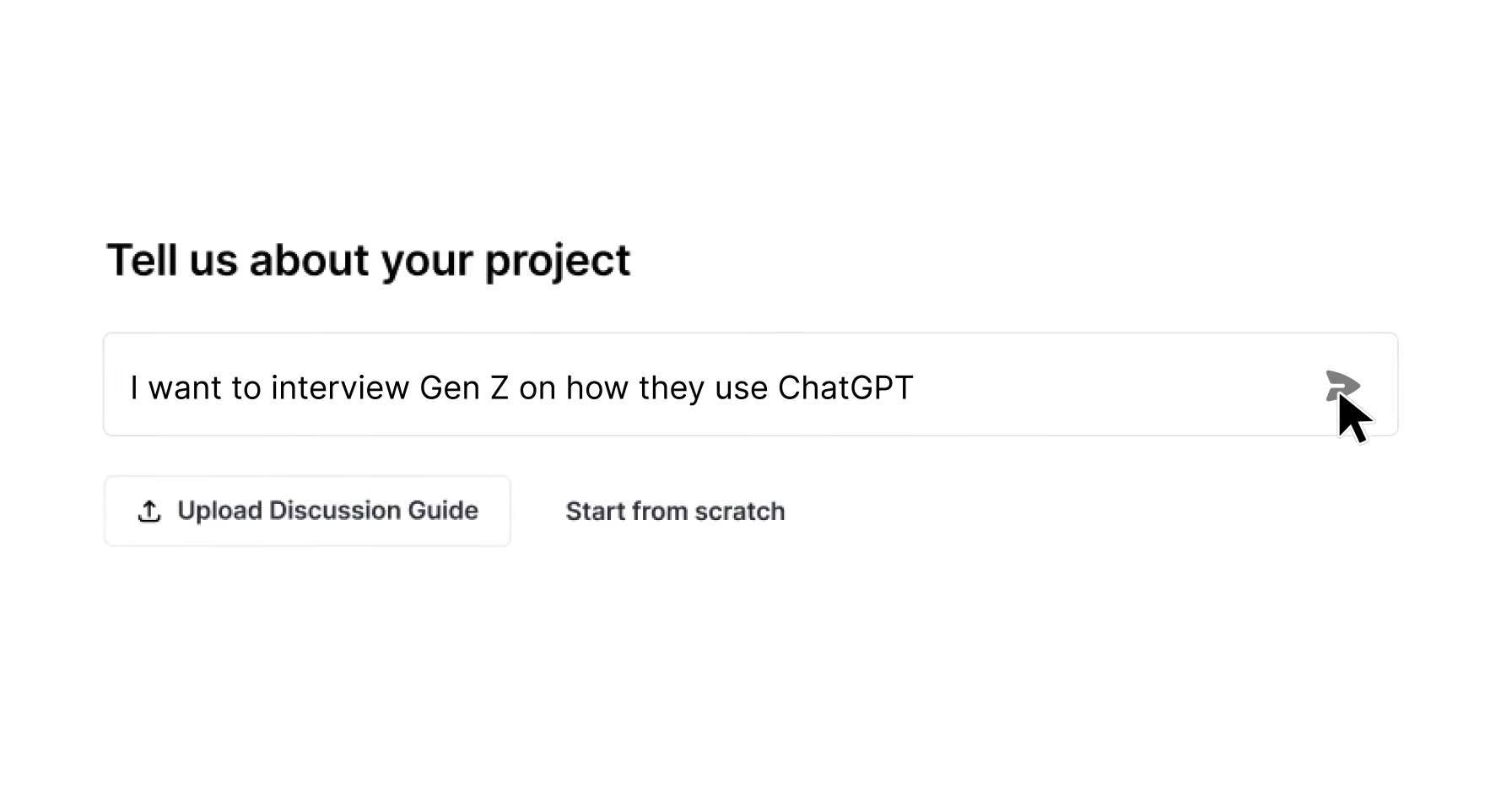
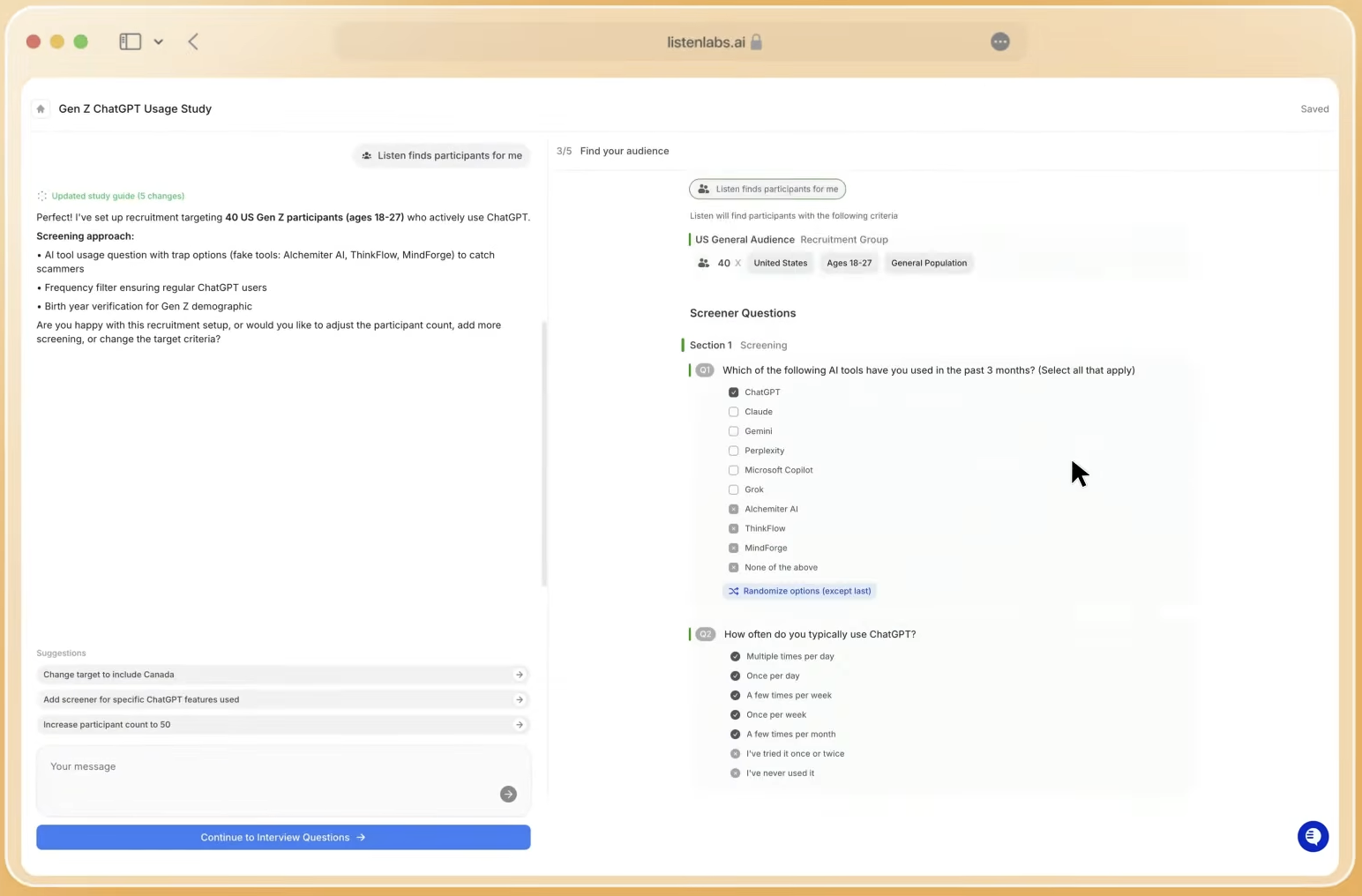
Listen Labs enters this comparison only after both legacy platforms have been fully examined because its case rests on a specific, documented failure mode in the market. With qual-at-scale, the old trade-off between depth and scale is no longer a barrier. Listen Labs conducts AI-moderated video interviews with dynamic follow-up questions across hundreds of participants simultaneously, delivering Discuss.io-level conversational depth at UserTesting speed with results in under 24 hours.
Listen Labs has run over 1 million AI-powered customer interviews for companies including Microsoft, Perplexity, and Sweetgreen and raised $69 million in Series B funding at a valuation over $500 million as of January 2026. Enterprise proof points include Microsoft, P&G, Anthropic, Skims, and Robinhood, each representing a distinct research use case at Fortune 500 scale.
The platform’s Emotional Intelligence layer analyzes tone of voice, word choice, and subconscious micro-expressions simultaneously, built on Ekman’s universal emotions framework. Every emotion is quantified per question and traceable to the exact timestamp, verbatim quote, and reasoning, a capability absent from both Discuss.io and UserTesting. The Research Agent then generates slide decks, memos, video highlight reels, and statistical charts in under a minute. As Listen Labs CEO Alfred Wahlforss stated, “Companies use it for all kinds of large decisions. This AI interviewer means that you can have hundreds of one-on-one interviews run at scale.”
Scenario-Based Guidance for Common Buyer Personas
Enterprise consumer insights teams drowning in research backlog face a compounding problem: each multi-week study blocks the next one from starting. Platforms like Listen Labs layer on auto-recruiting, transcription, sentiment tagging, and insight summarization so teams jump from question to findings in hours, not weeks. For this persona, Listen Labs offers the clearest upgrade path.
UX researchers who need rapid prototype feedback gain value from UserTesting’s unmoderated task metrics for late-stage validation on stable flows, where quantitative completion rates and click-path data are the primary output. For earlier-stage concept testing or motivation research, the absence of adaptive probing becomes a meaningful limitation.
Product and marketing leaders without dedicated research staff benefit most from Listen Labs’ self-serve study design. They describe research goals in natural language, receive a structured study guide, recruit participants from a 30M-person verified panel, and receive automated deliverables. This workflow removes the need for deep methodology expertise.
Agencies and consultancies operating on client timelines measured in days rather than weeks can switch to AI-moderated interviews to capture hundreds of candid, one-to-one conversations overnight. Neither Discuss.io nor UserTesting can match this turnaround at comparable depth.
Risks and Limitations to Weigh
Discuss.io’s model depends on scarce human moderators. Moderator availability, fatigue, and consistency introduce variability across sessions that compounds at scale. For sensitive or high-stakes exploratory research that requires deep rapport-building, live human moderation still represents the most defensible methodology.
UserTesting’s unmoderated approach cannot probe vague answers or surface the reasoning behind observed behavior. Unmoderated usability testing is the wrong method for questions about motivation such as “why did you sign up?” or “what almost stopped you from completing this task,” which require an interviewer capable of dynamic follow-ups.
AI-moderated platforms face a different misconception. Faster does not automatically mean better insight. Nielsen Norman Group research on qualitative data quality finds that themes surfaced in well-structured studies converge regardless of moderation method once sample size is adequate. Study design quality, participant targeting, and question structure matter as much as the moderation method itself.
Decision Checklist for Platform Selection
Use the following criteria to match your constraints to the right platform:
- If your primary need is live human rapport for sensitive, exploratory, or high-stakes qualitative work with small samples (5–15 participants), Discuss.io is the appropriate choice.
- If your primary need is fast, scalable task-based usability metrics such as completion rates, click paths, and time-on-task on a stable prototype or shipped product, UserTesting’s unmoderated model is well-suited.
- If your team needs to run more than 20 qualitative studies per quarter, requires rapid turnaround, needs built-in emotional intelligence analysis, operates across multiple markets and languages, or is managing a growing research backlog with fixed headcount, Listen Labs is the platform designed for your constraints.
- If participant quality and fraud controls are a top priority, evaluate whether the platform uses real-time behavioral monitoring rather than post-hoc screening alone.
- If your organization requires SOC 2 Type II, GDPR, ISO 27001, ISO 27701, and ISO 42001 compliance, confirm certification status before procurement.
Frequently Asked Questions
How long does each platform take from study design to final report?
Discuss.io’s live moderated model requires scheduling participants, coordinating moderators, conducting sessions, and manually synthesizing transcripts, which follows the multi-week cycle described earlier in the article. UserTesting’s unmoderated sessions can return recordings within hours of launch, but post-hoc analysis and report writing add days to weeks depending on study size and team capacity. Listen Labs compresses the entire cycle of study design, recruitment, AI-moderated interviews, analysis, and deliverable generation to under 24 hours. The Research Agent produces slide decks, memos, video highlight reels, and statistical charts automatically from interview data, which removes the manual synthesis step entirely.
How do Discuss.io and UserTesting handle participant quality and fraud?
Discuss.io’s Rapid Recruiter engine sources participants for live sessions, with quality partially managed through the scheduling and screening process. UserTesting’s panel of over one million contributors is large but carries the quality risks common to commodity panels, including incentive-driven responses and repeat participants. Listen Labs addresses this through three layers. Quality Guard applies real-time AI monitoring across video, voice, content, and device signals to detect fraud and low-effort responses during the interview itself. Participants are limited to three studies per month to eliminate professional survey-takers. A dedicated recruitment operations team adds human review for hard-to-reach segments. Listen Labs does not use commodity quantitative panels.
What are the pricing differences for enterprise teams?
Discuss.io operates on annual platform licensing with custom project quotes. Total cost of ownership for a 40-session moderated study, including moderator fees, recruitment, incentives, transcription, and analysis time, typically runs $12,000–$30,000. UserTesting uses a credit-based enterprise contract model, with enterprise deployments averaging roughly $147,756 annually and per-session costs around $49 or more outside annual credit bundles. Listen Labs uses a subscription model with per-participant credits that vary by audience difficulty. Enterprises with more than 100 employees go through a demo and pilot process, while smaller organizations can access the self-serve platform directly. Listen Labs replaces multiple vendors such as recruitment, moderation, transcription, analysis, and reporting with a single platform, which reduces total cost of ownership to approximately one-third of the traditional research approach.
Which platform supports multilingual research across 45+ countries?
Discuss.io supports multilingual research through human moderators, which requires sourcing qualified moderators in each target language and limits simultaneous multi-market execution. UserTesting’s panel has broad geographic reach, but multilingual moderated sessions face the same scheduling dependencies. Listen Labs conducts AI-moderated interviews in 100+ languages with automatic translation and transcription, covering 45+ countries across the Americas, Europe, APAC, and MEA. Emotional Intelligence analysis is available across 50+ languages. This makes Listen Labs the most practical option for global research programs that need to run simultaneously across markets without proportional increases in moderation cost or coordination overhead.
How will switching affect my existing research team’s workload?
Listen Labs functions as a force multiplier for existing research teams, not a replacement. The platform handles recruitment, moderation, transcription, analysis, and deliverable generation automatically, which frees researchers to focus on study design, strategic interpretation, and stakeholder communication. Teams that previously ran 4–6 studies per quarter with a fixed headcount can run significantly more without adding staff. Mission Control serves as a persistent knowledge base across all studies, enabling cross-study queries and trend tracking so institutional knowledge accumulates rather than being lost between projects. The main change-management effort sits in the study design workflow. Researchers describe objectives in natural language and the AI drafts structured guides, which experienced researchers then review and refine.
Conclusion: Resolving the Depth-versus-Scale Trade-off
The Discuss.io versus UserTesting comparison maps onto a single structural problem. Enterprise research teams are forced to choose between depth and scale, and neither legacy platform resolves that trade-off. Discuss.io delivers conversational depth but cannot scale past a handful of sessions per researcher per week. UserTesting delivers speed and volume but sacrifices the adaptive probing that surfaces motivation, emotion, and the reasoning behind observed behavior. Both leave teams managing a research backlog measured in weeks, not hours.
Listen Labs is the 2026 platform built specifically to remove this trade-off. AI-moderated interviews with built-in emotional intelligence, a 30M-person verified global panel, automated consultant-grade deliverables, and a research cycle measured in hours rather than weeks now support brands such as Microsoft, P&G, Anthropic, Skims, and Robinhood. The depth-versus-scale constraint no longer needs to define your research program.
Ready to replace weeks of research backlog with next-day results? See Listen Labs in action.