
Written by: Anish Rao, Head of Growth, Listen Labs | Last updated: August 6, 2026
Key Takeaways for Enterprise Research Leaders
- Recruitment-only platforms like User Interviews, Respondent, and Prolific require 4–6 week study cycles and multiple disconnected tools for moderation, transcription, and analysis.
- Enterprise teams face compounding costs, quality risks from professional survey-takers, and growing research backlogs when they rely on fragmented vendor stacks.
- Listen Labs compresses the entire qualitative research lifecycle, including design, recruitment, AI-moderated interviews, analysis, and deliverables, into under 24 hours with verified global panels and real-time quality controls.
- The platform adds Emotional Intelligence analysis across 50+ languages, automated consultant-grade reporting, and a persistent knowledge base that removes manual thematic coding and report archaeology.
- Enterprise teams ready to eliminate fragmented workflows and accelerate insight delivery can schedule a platform walkthrough with Listen Labs to see how the full-stack AI research platform replaces multiple vendors with a single, compliant solution.
Why Recruitment-Only Platforms Create Research Backlogs
A typical qualitative research cycle on a recruitment-only platform uses at least five separate tools. One handles participant sourcing, another manages scheduling, a third supports interviews, a fourth provides transcription, and a fifth covers analysis. Each handoff adds delay, cost, and quality risk. The process often takes 4–6 weeks from study brief to final deliverable, and in large enterprises with internal queues, timelines can stretch to six months.
Hidden costs accumulate quickly. Separate vendor contracts, per-seat licenses, moderator fees, and analyst hours can push a single large qualitative study into hundreds of thousands of dollars. Commodity panels also introduce persistent quality issues. Professional survey-takers chase incentives, fraudulent profiles slip through, and repeat respondents learn to give socially acceptable answers. Researchers spend valuable time on quality checks instead of generating insights.
These structural issues create a growing research backlog for enterprise insights teams. Each study consumes weeks of calendar time and significant budget, so teams can only run a limited number of projects per quarter. Internal stakeholders in product and brand marketing submit requests and wait, or they stop requesting research and make decisions without customer evidence.
Evaluation Criteria for User Interviews Alternatives
Decision-stage buyers need a framework that reflects the full operational burden of qualitative research at enterprise scale. The following nine dimensions cover the entire lifecycle, not just participant recruitment costs.
- Research speed: Time from study brief to final deliverable, including recruitment, moderation, and analysis.
- Depth of insight: Ability to capture motivations, emotions, and unexpected findings beyond surface-level responses.
- Participant quality: Fraud prevention, behavioral verification, and controls that remove professional survey-takers.
- Global reach: Panel coverage across countries and the capacity to recruit niche or hard-to-find audiences.
- Language support: Native multilingual interview capability instead of slow post-hoc translation workflows.
- Analysis effort: Degree of automation in analysis, from manual coding to fully AI-generated outputs with clear traceability.
- Reporting transparency: Inclusion of verbatim evidence, timestamps, and reasoning behind findings in every deliverable.
- Security and compliance: SOC 2, GDPR, ISO certifications, and data handling practices that satisfy enterprise procurement.
- Total operational burden: Number of vendors, tools, and internal headcount required to complete a study end to end.
Study Setup and Recruitment: Marketplace vs Full-Stack
User Interviews operates as a recruitment marketplace that connects researchers with participants from its panel. Researchers define screener criteria, configure scheduling, and manage participant communications on their own. The platform does not conduct interviews, moderate sessions, or analyze data. Teams must supply their own moderation and analysis infrastructure, so complete study setup spans multiple platforms and several days before the first interview occurs.
Respondent follows a similar recruitment-only model with emphasis on B2B and professional audiences. It provides participant sourcing and scheduling coordination but stops at recruitment. Moderation, transcription, and analysis remain the researcher’s responsibility, which preserves the fragmented workflow that slows enterprise teams.
Prolific functions as an academic-grade panel platform built primarily for survey and behavioral research. Its participant pool skews toward general population samples and suits quantitative studies. Prolific does not offer native interview moderation, emotional analysis, or automated deliverable generation.
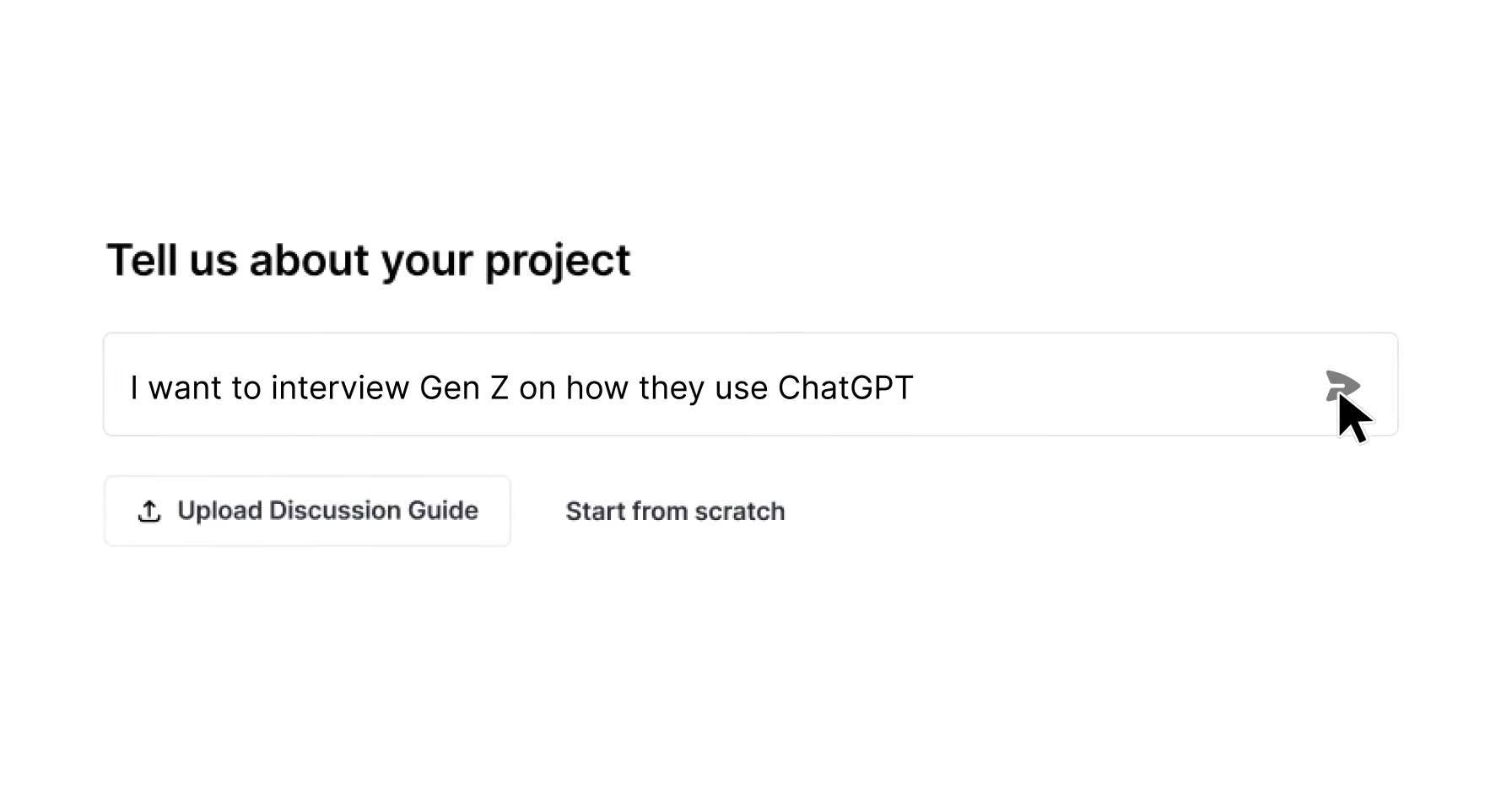
Listen Labs manages study setup, recruitment, moderation, analysis, and reporting within a single platform. The process starts with AI-assisted study co-design that drafts structured objectives and interview questions from a natural-language brief in seconds. Once the study is defined, Listen Atlas, the platform’s AI orchestration layer, sources participants from a verified global panel of 30 million respondents across 45+ countries and automatically matches and bids across multiple consumer and B2B panel partners. For hard-to-reach segments such as enterprise decision-makers, healthcare workers, and audiences below 1% incidence rate, a dedicated recruitment operations team steps in. Total time from brief to first completed interviews is measured in hours, not days.
Moderation, Quality Controls, and Emotional Depth
User Interviews, Respondent, and Prolific do not provide interview moderation. Researchers must conduct moderated sessions themselves, hire external moderators, or rely on separate platforms such as UserTesting or Zoom. Human moderator availability then becomes a bottleneck. Scheduling limits the number of simultaneous interviews and introduces inconsistency across sessions. Quality control remains manual, with researchers reviewing recordings and transcripts after the fact to flag low-quality or fraudulent responses.
Listen Labs runs AI-moderated video interviews in parallel across hundreds or thousands of participants. The platform layers auto-recruiting, transcription, sentiment tagging, and insight summarization so teams move from question to findings in hours, not weeks. The AI interviewer probes deeper on short or ambiguous answers, adapts follow-up questions based on each response, and maintains methodological consistency across every session. This approach removes the variability that appears with human moderation at scale.
Quality Guard monitors every interview in real time across video, voice, content, and device signals. It detects fraud, AI-generated scripts, low-effort responses, and mismatched participant profiles before they affect the dataset. Participants are capped at three studies per month, which prevents professional survey-takers from dominating samples. The platform avoids commodity quantitative panels.
Listen Labs’ Emotional Intelligence layer adds insight that recruitment-only platforms cannot match. Built on Ekman’s universal emotions framework, it analyzes tone of voice, word choice, and subconscious micro-expressions to reveal emotions that transcripts alone miss. Every emotional label is quantified per question and concept and linked to the exact timestamp, verbatim quote, and reasoning. This capability works across 50+ languages and connects directly to the Research Agent for natural-language queries and highlight reels of emotionally significant moments.
Analysis, Deliverables, and Persistent Knowledge
User Interviews, Respondent, and Prolific deliver participants and sometimes transcripts, but analysis remains entirely with the research team. Enterprise teams often route completed interviews into separate analysis tools such as Dovetail or rely on manual thematic coding in spreadsheets. This work is slow, subjective, and vulnerable to confirmation bias. Creating slide decks, memos, and highlight reels then adds more analyst time after analysis finishes.
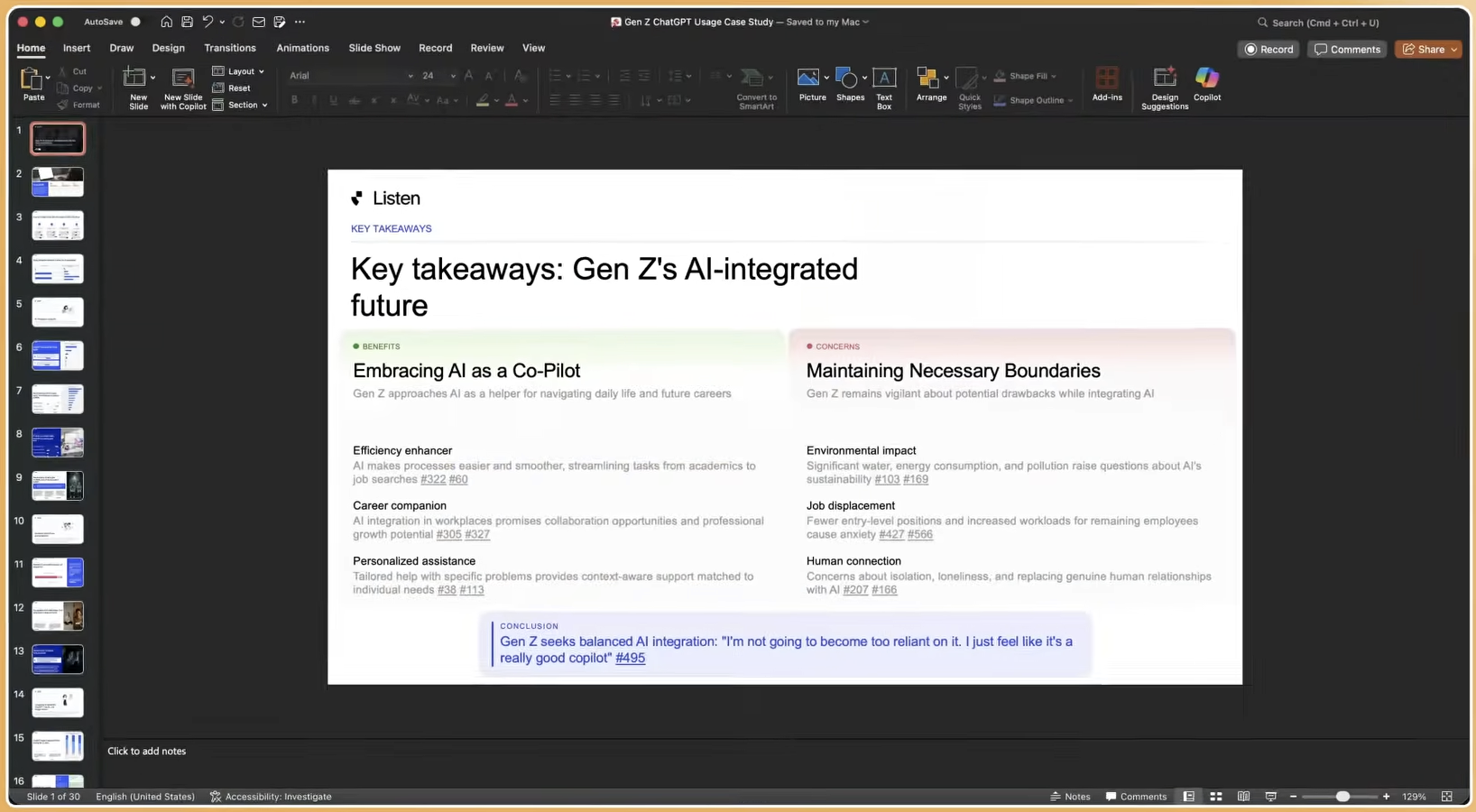
Listen Labs’ Research Agent processes interview data automatically and identifies patterns, themes, and insights across hundreds of responses without human bias. One-click deliverables such as consultant-quality slide decks, memo-style reports, video highlight reels, statistical charts, and segmentation breakdowns generate in under a minute. Researchers can ask questions in natural language and receive answers, charts, and statistical tests drawn directly from the interview data.
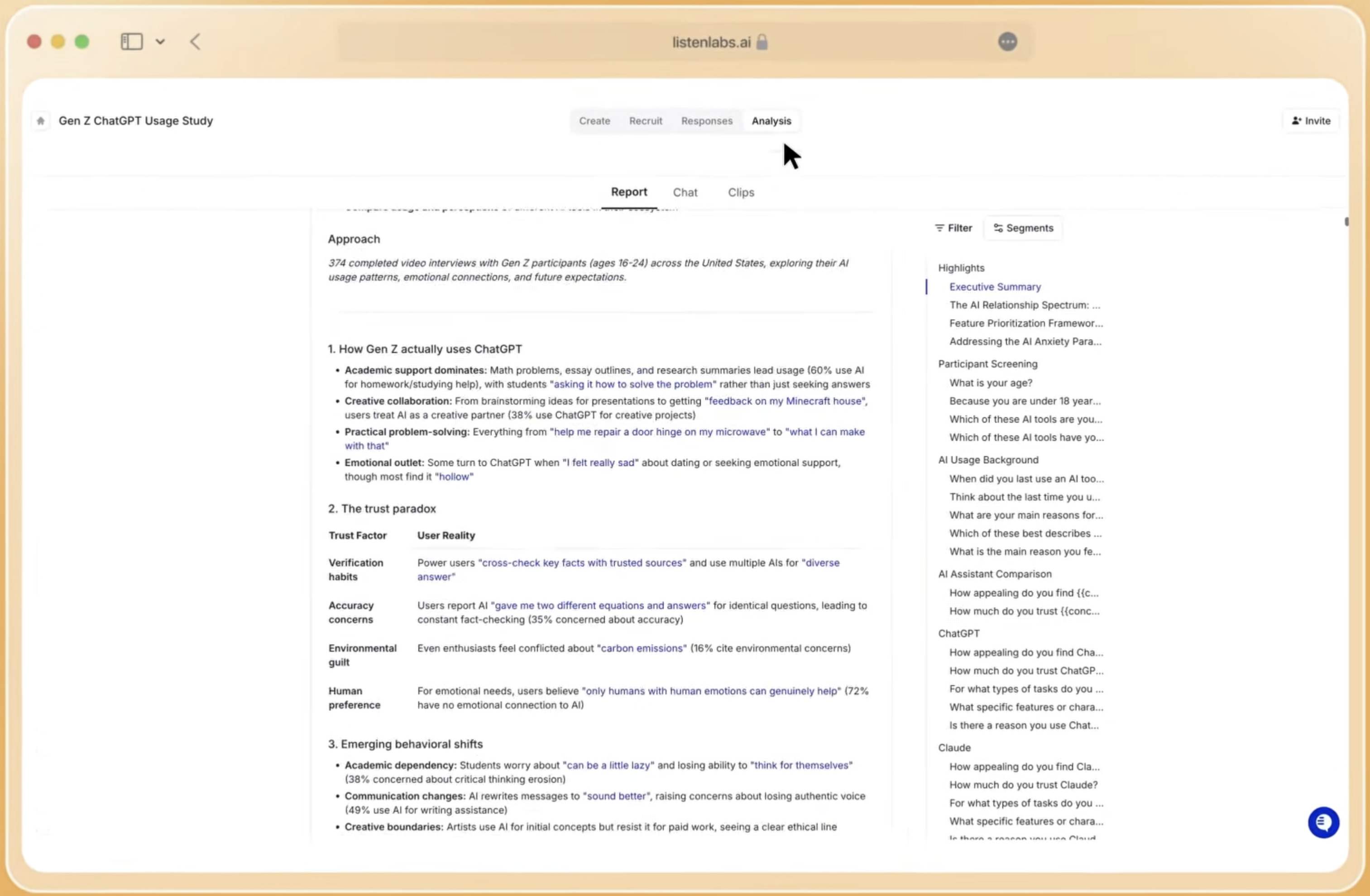
Mission Control functions as the organization’s persistent knowledge base. It stores findings from every study and supports cross-study queries. Teams retrieve answers from past research in seconds instead of digging through archived reports. Each new study compounds institutional knowledge and increases the value of the system. With this approach, the traditional trade-off between depth and scale is no longer a barrier.
Best-Fit Use Cases for Listen Labs vs Marketplaces
Enterprise insights teams running continuous programs need always-on research infrastructure that can absorb high request volume without proportional headcount growth. Listen Labs allows these teams to run far more studies per quarter with the same staff, turning a research backlog into a continuous intelligence feed for product, brand, and strategy stakeholders.
UX researchers needing rapid prototype feedback require results within sprint cycles instead of weeks. Listen Labs supports screen sharing, iOS mobile screen recording, and task-based usability testing with AI moderation. Teams can test with 50–100 or more users instead of the 5–10 participants that human-moderated scheduling usually supports.
Product and marketing leaders without dedicated research teams can describe research goals in natural language and let Listen Labs handle study design, recruitment, moderation, and analysis automatically. No formal research methodology expertise is required to launch a study and receive consultant-quality deliverables.
Agencies and consultancies requiring fast niche-audience insights benefit from Listen Labs’ recruitment operations team. This team sources enterprise decision-makers, healthcare workers, and highly specialized consumer segments within hours. These audiences rarely appear reliably on standard panel platforms, especially on compressed client timelines.
Operational, Compliance, and Long-Term Factors
Switching from a recruitment-only workflow to a full-stack platform affects research, procurement, and IT stakeholders. Teams should review existing vendor contracts for transition costs and confirm whether the new platform’s study design approach requires retraining. Listen Labs acts as a force multiplier for existing research teams rather than a replacement. Researchers focus on strategic analysis and stakeholder communication while the platform manages logistics.
Enterprise procurement teams expect documented security and compliance certifications. Listen Labs holds SOC 2 Type II, GDPR, ISO 27001, ISO 27701, and ISO 42001 certifications. Customer data never trains AI models, and the platform supports enterprise SSO. These controls matter for organizations in regulated industries and for companies operating across multiple jurisdictions with different data residency rules.
Two risks deserve clear acknowledgment. AI moderation is tuned for conversational depth and adaptive follow-up, yet highly specialized technical domains may still benefit from human expert moderators for certain study types. Automated analysis also depends on strong inputs. Poorly constructed screeners or vague research objectives will produce fast but shallow outputs on any platform.
Decision Framework: Matching Platforms to Your Goals
Teams whose primary constraint is participant sourcing, while they handle moderation and analysis internally, may find that User Interviews or Respondent meet their immediate needs. These platforms work when research teams have sufficient moderator capacity, existing analysis infrastructure, and timelines that support multi-week cycles.
Teams constrained by the total research cycle need a different model. Speed from brief to deliverable, quality at scale, multilingual reach, and removal of fragmented vendor dependencies all point toward a full-stack platform. Listen Labs raised $69 million in a Series B round led by Ribbit Capital at a valuation over $500 million, which reflects enterprise validation of this full-lifecycle approach. Organizations running continuous research programs, global multi-market studies, or high-volume concept and usability testing often discover that point-solution recruitment tools add more operational overhead than they remove.
The practical decision criterion remains straightforward. Teams that need results in under 24 hours, need to run studies in multiple languages at once, or need deliverables that go directly to leadership without extra analyst work cannot rely on recruitment-only platforms.
Request a demo to evaluate whether Listen Labs fits your team’s research program and compliance requirements.
Frequently Asked Questions
How fast can I expect results with a User Interviews alternative?
Results timelines vary by platform type. Recruitment-only platforms such as User Interviews, Respondent, and Prolific deliver participants but leave moderation, transcription, and analysis to the research team. Total time from brief to deliverable still spans multiple weeks once every step is included. Listen Labs compresses the entire lifecycle, from study design through recruitment, AI-moderated interviews, automated analysis, and final deliverables, into under 24 hours. Hard-to-reach audiences sourced by the recruitment operations team usually add only a few hours, not days.
Where does Listen Labs source participants and how does quality compare?
Listen Labs sources participants through Listen Atlas, an AI orchestration layer that matches and bids across multiple consumer and B2B panel partners as well as Listen Labs’ proprietary database. Quality Guard monitors every interview in real time across video, voice, content, and device signals to detect fraud, AI-generated responses, and mismatched profiles. Participants are limited to three studies per month to remove professional survey-takers. For niche audiences below 1% incidence rate, the recruitment operations team partners with specialized networks to source the right participants, which commodity panels typically cannot achieve.
How does AI moderation differ from traditional interviews on User Interviews?
User Interviews functions as a recruitment marketplace and does not provide interview moderation. Researchers using User Interviews must conduct or arrange moderation separately. Listen Labs’ AI interviewer conducts personalized video conversations with dynamic follow-up questions and probes deeper on short or ambiguous answers, similar to a trained human interviewer. Hundreds of interviews run simultaneously and asynchronously, which removes scheduling bottlenecks and no-show risk. The Emotional Intelligence layer also captures tone of voice, word choice, and micro-expressions to surface emotional signals that transcripts alone miss, a capability unavailable in recruitment-only platforms.
What analysis effort is required after data collection?
On recruitment-only platforms, the research team handles all analysis effort. Thematic coding, insight synthesis, and deliverable creation are manual tasks that often add one to two weeks to the study timeline. On Listen Labs, the Research Agent automatically generates key findings, themes, personas, charts, slide decks, memos, and video highlight reels from completed interview data. Researchers can ask follow-up questions in natural language and receive segmented breakdowns in seconds. Mission Control stores all findings for cross-study queries, so past research is accessible without manual report archaeology.
Does Listen Labs support multilingual research at enterprise scale?
Yes. Listen Labs supports interview moderation across 100+ languages with automatic translation and transcription. The Emotional Intelligence layer works across 50+ languages. A single study can run simultaneously across multiple markets without separate localization workflows or post-hoc translation vendors. For global enterprises running multi-market consumer insights or brand research programs, this native multilingual capability removes a major operational dependency that recruitment-only platforms do not address.
What security and compliance certifications does Listen Labs hold?
Listen Labs holds SOC 2 Type II, GDPR, ISO 27001, ISO 27701, and ISO 42001 certifications. The platform uses 256-bit encryption, supports enterprise SSO, and does not use customer data for AI model training. These certifications cover information security management, privacy information management, and AI management systems, which matter for enterprise procurement teams in regulated industries and for organizations operating across jurisdictions with different data residency requirements.
How complex is implementation for existing research teams?
Listen Labs integrates with existing research workflows instead of replacing them outright. The platform supports self-recruitment from an organization’s own user base, custom study templates, and cloning of past study designs. Enterprises with 100+ employees go through a demo and pilot process to configure the platform for their specific research program. The in-house research team, with more than 50 years of combined expertise, provides methodology support during onboarding. For teams already running studies on User Interviews or similar platforms, the main transition involves consolidating moderation and analysis vendors rather than rebuilding study design from scratch.
Can the platform scale for ongoing global programs?
Yes. Listen Labs is built for continuous research programs rather than one-off studies. Mission Control accumulates institutional knowledge across every study and enables trend tracking and cross-study queries that grow more valuable over time. The global panel described earlier, coordinated through the AI orchestration layer, handles participant matching and recruitment logistics automatically across markets. Enterprises running quarterly brand tracking, continuous product feedback loops, or multi-market segmentation studies use Listen Labs as always-on research infrastructure instead of a project-by-project tool.
Conclusion: When Listen Labs Is the Right User Interviews Alternative
The core limitation of recruitment-only platforms is structural. They solve one step in a multi-step process and leave moderation, quality control, analysis, and reporting with the research team and its vendor stack. For enterprise insights leaders managing growing research backlogs, this fragmentation creates the central problem.
Listen Labs delivers the complete qualitative research lifecycle in under 24 hours. AI-assisted study design, verified global recruitment, AI-moderated interviews with emotional depth, automated analysis, and consultant-grade deliverables all meet enterprise security and compliance standards. The platform serves teams that need to run more research, faster, without adding headcount or managing a fragmented vendor ecosystem.
See the platform in action and discover how Listen Labs can replace your current research stack with a single end-to-end solution.