
Written by: Anish Rao, Head of Growth, Listen Labs | Last updated: August 6, 2026
Key Takeaways
- Listen Labs completes full qualitative research cycles in under 24 hours. Human-moderated platforms like UserTesting typically take several days to weeks.
- AI moderation delivers consistent depth at scale with quantified emotional intelligence. Human moderation shines mainly in complex, empathy-intensive conversations.
- Listen Labs’ Quality Guard system maintains zero-fraud participant quality through real-time monitoring and frequency limits, avoiding common commodity-panel risks.
- Global reach across 45+ countries and 100+ languages with native moderation makes Listen Labs well suited for multinational research programs without extra vendors.
- Book a demo with Listen Labs to see how AI-moderated research can deliver 24-hour turnaround with enterprise-grade security.
How We Compare Listen Labs and UserTesting
Before naming any platform, define the nine criteria that determine fit for enterprise research programs. These criteria guide the side-by-side comparisons that follow, which are organized by each stage of the research workflow.
- Research speed: Time from study brief to final deliverable.
- Depth of insight: Ability to capture nuanced, unexpected, and emotionally resonant findings.
- Participant quality: Rigor of screening, fraud prevention, and sample representativeness.
- Global reach: Number of countries, languages, and audience segments accessible.
- Language support: Native-language moderation, transcription, and translation capabilities.
- Analysis effort: Human time required to move from raw data to actionable insight.
- Reporting transparency: Traceability of findings back to source data.
- Governance and security: Compliance certifications, data handling, and enterprise SSO.
- Total operational burden: Vendor coordination, scheduling, logistics, and internal headcount required.
Study Setup and Research Speed
UserTesting approach: Study setup on human-moderated platforms requires researchers to write screeners, configure tasks, and schedule sessions with individual participants. Each configuration decision adds time before a single interview begins.
Listen Labs approach: Researchers describe goals in natural language and the AI drafts structured objectives, questions, and probing context in seconds. Advanced stimuli such as images, video, PDFs, live URLs, and prototypes can be embedded with branching logic, quotas, and randomization. An auto-QA layer flags issues before launch.

Key trade-offs: Human-moderated setup provides granular researcher control but extends timelines. AI-assisted setup compresses configuration to minutes while maintaining methodological rigor through a platform built by a team with 50+ years of combined research expertise.
Recruitment, Sampling, and Global Reach
UserTesting approach: UserTesting maintains its own panel, which works for general consumer and software-user audiences. Niche B2B segments, low-incidence populations, and non-English-speaking markets often require extra sourcing effort or third-party recruitment vendors.
Listen Labs approach: Listen Labs has conducted over 1 million AI-powered customer interviews for clients like Microsoft, Perplexity, and Sweetgreen, drawing from a global panel of 30M verified respondents across 45+ countries. Listen Atlas, the AI orchestration layer, automatically matches and bids across multiple consumer and B2B panel partners. A dedicated recruitment operations team handles audiences below 1% incidence rate, such as enterprise decision-makers, healthcare workers, and engineers, without requiring researchers to manage vendor relationships.
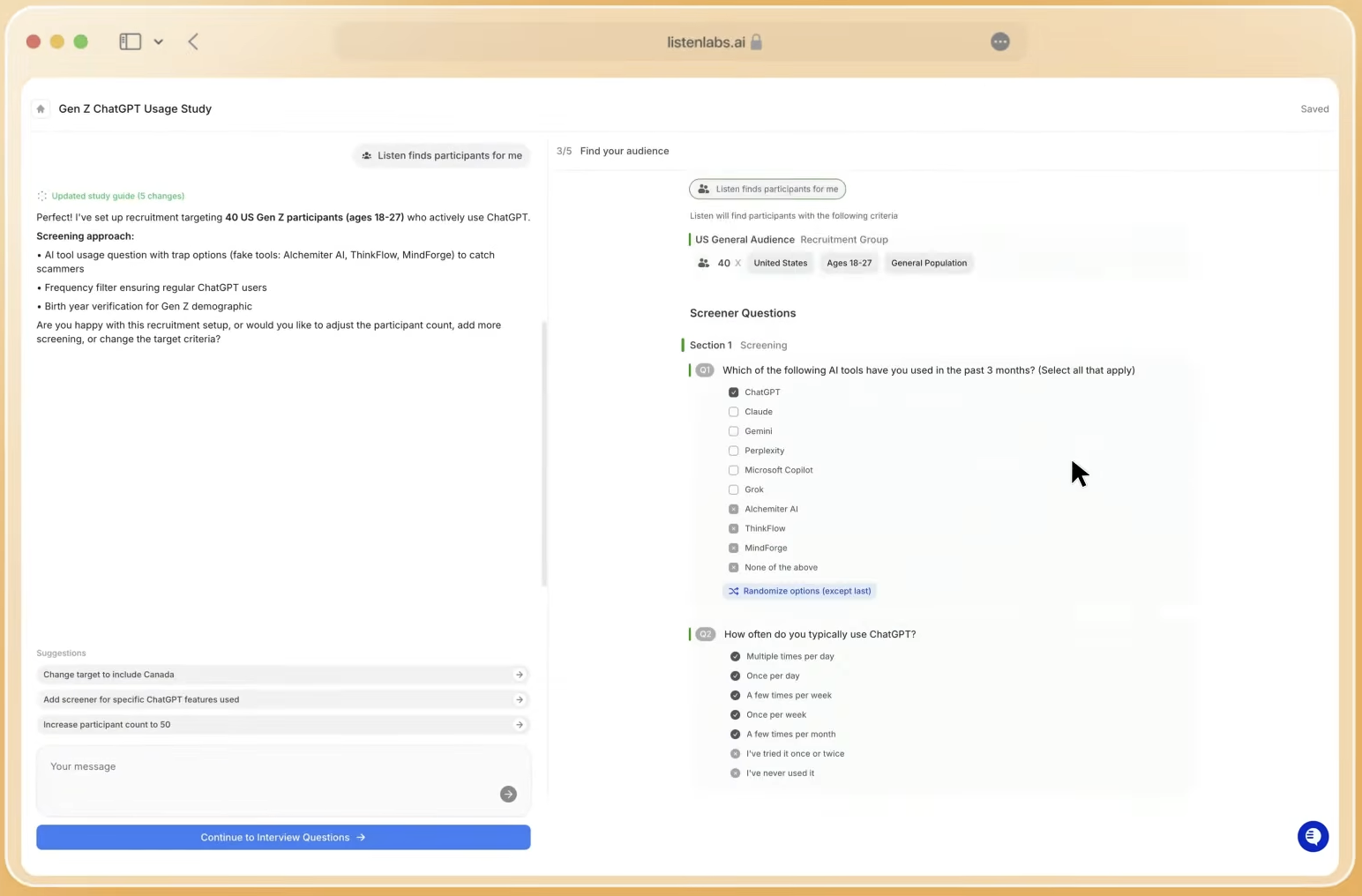
Key trade-offs: UserTesting’s panel is sufficient for mainstream usability studies. Listen Labs’ recruitment infrastructure is built for hard-to-reach segments and global programs, which removes the need for separate panel vendors.
Book a demo to see how Listen Labs recruits verified participants for your specific audience, including niche and global segments, in hours.
Moderation Style and Depth of Conversation
UserTesting approach: Human-moderated sessions rely on trained moderators to probe, redirect, and adapt in real time. Session scheduling introduces coordination overhead, and moderator availability limits the number of simultaneous interviews. Unmoderated UserTesting sessions remove the moderator but also remove adaptive follow-up, which limits depth.
Listen Labs approach: AI-moderated interviews conduct personalized conversations with dynamic follow-up questions at scale. 92% of participants report top comfort levels in AI-moderated sessions, matching comfort levels in human-moderated sessions. Many participants prefer AI moderation for sensitive topics such as personal finances, health, and political views because they perceive less social judgment. Thousands of interviews run simultaneously, with no scheduling dependency.
Key trade-offs: Human moderators excel in highly complex medical or empathy-intensive discussions. AI moderation delivers consistent, adaptive depth at a scale that human moderation cannot match and collapses the old trade-off between depth and scale.
Data Quality Controls and Participant Integrity
UserTesting approach: Human-moderated platforms rely on panel reputation scores and post-session ratings. Fraud detection is mostly reactive, and professional panel participants remain a risk in unmoderated formats.
Listen Labs approach: Quality Guard applies three layers of protection. First, Listen Labs works exclusively with non-commodity panel sources. Second, real-time AI monitoring analyzes video, voice, content, and device signals to detect fraud, low-effort responses, AI-generated scripts, and mismatched profiles. Third, participants are capped at three studies per month, which removes professional survey-takers. A reputation score compounds across every interview, creating a quality flywheel that strengthens over time.
Key trade-offs: Human-moderated sessions reduce some fraud risk through live observation but cannot scale that oversight. Listen Labs’ automated quality controls operate at any volume without adding operational burden.
Emotional Intelligence and Qualitative Depth
UserTesting approach: Human moderators capture verbal responses and can observe visible emotional reactions during live sessions. Analysis of emotional signals depends on the moderator’s notes and the analyst’s interpretation of session recordings. This process does not scale and introduces subjectivity.
Listen Labs approach: Emotional Intelligence analyzes three simultaneous signals, tone of voice, word choice, and subconscious micro expressions, to surface emotions that transcripts alone miss. Built on Ekman’s universal emotions framework, the same standard used in clinical psychology and UX research, every emotion is quantified per question and concept. Every label is traceable to the exact timestamp, verbatim quote, and the reasoning behind it. The feature is available across 50+ languages and integrates directly with the Research Agent for natural-language queries and highlight reels of emotionally significant moments.
Key trade-offs: Human moderation captures emotional signals in small samples. Listen Labs quantifies emotional data across hundreds or thousands of interviews at once, turning emotional intelligence into a scalable, auditable research output rather than a single analyst’s interpretation.
Quantitative Support and Analysis Effort
UserTesting approach: UserTesting supports task-based metrics and some quantitative ratings. Analysis of qualitative data requires manual review of session recordings, note-taking, and thematic coding, which scales poorly beyond 20–30 sessions.
Listen Labs approach: Research Agent handles the full analysis workflow from raw data to final output. Researchers ask questions in natural language and receive answers, charts, statistical significance tests, and segmentation breakdowns. Mixed-method studies combine qualitative interviews with Likert scales, NPS, sliders, and MaxDiff in a single session. One researcher ran a full buying intent analysis across three user segments in under a minute.
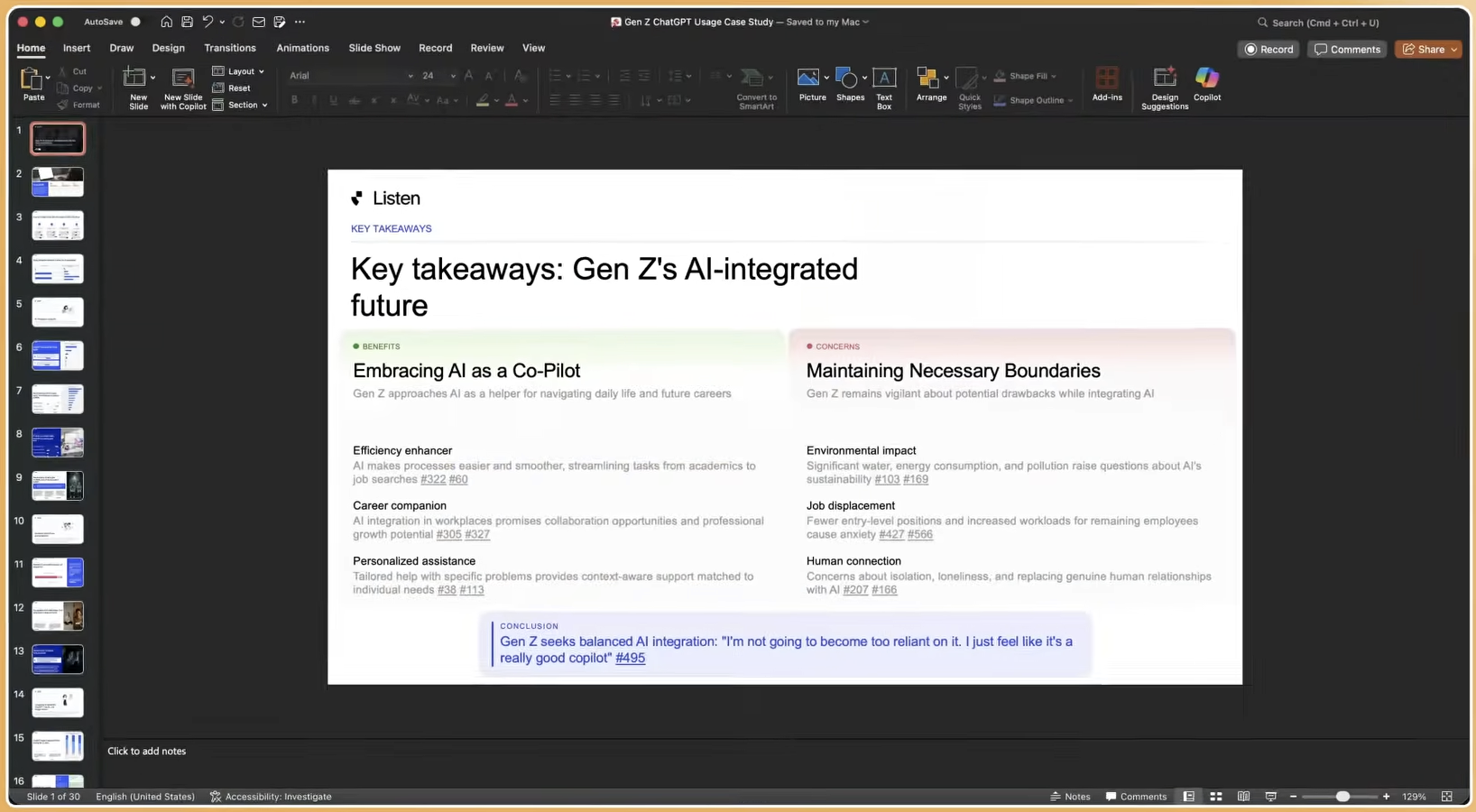
Key trade-offs: Human-moderated platforms require significant analyst time to synthesize qualitative data. Listen Labs automates synthesis while preserving traceability to source data, cutting analysis effort from days to minutes.
Deliverables, Reporting Transparency, and Knowledge Management
UserTesting approach: Deliverables are produced manually by research teams or analysts. Findings from past studies live in scattered reports and slide decks, with no systematic way to query institutional knowledge across studies.
Listen Labs approach: The Research Agent generates consultant-quality slide decks, memo-style reports, video highlight reels, and statistical charts in under a minute. Mission Control serves as the organization’s source of truth for all past research, enabling cross-study queries, trend tracking, and institutional knowledge building. Each new study compounds the value of the knowledge base.
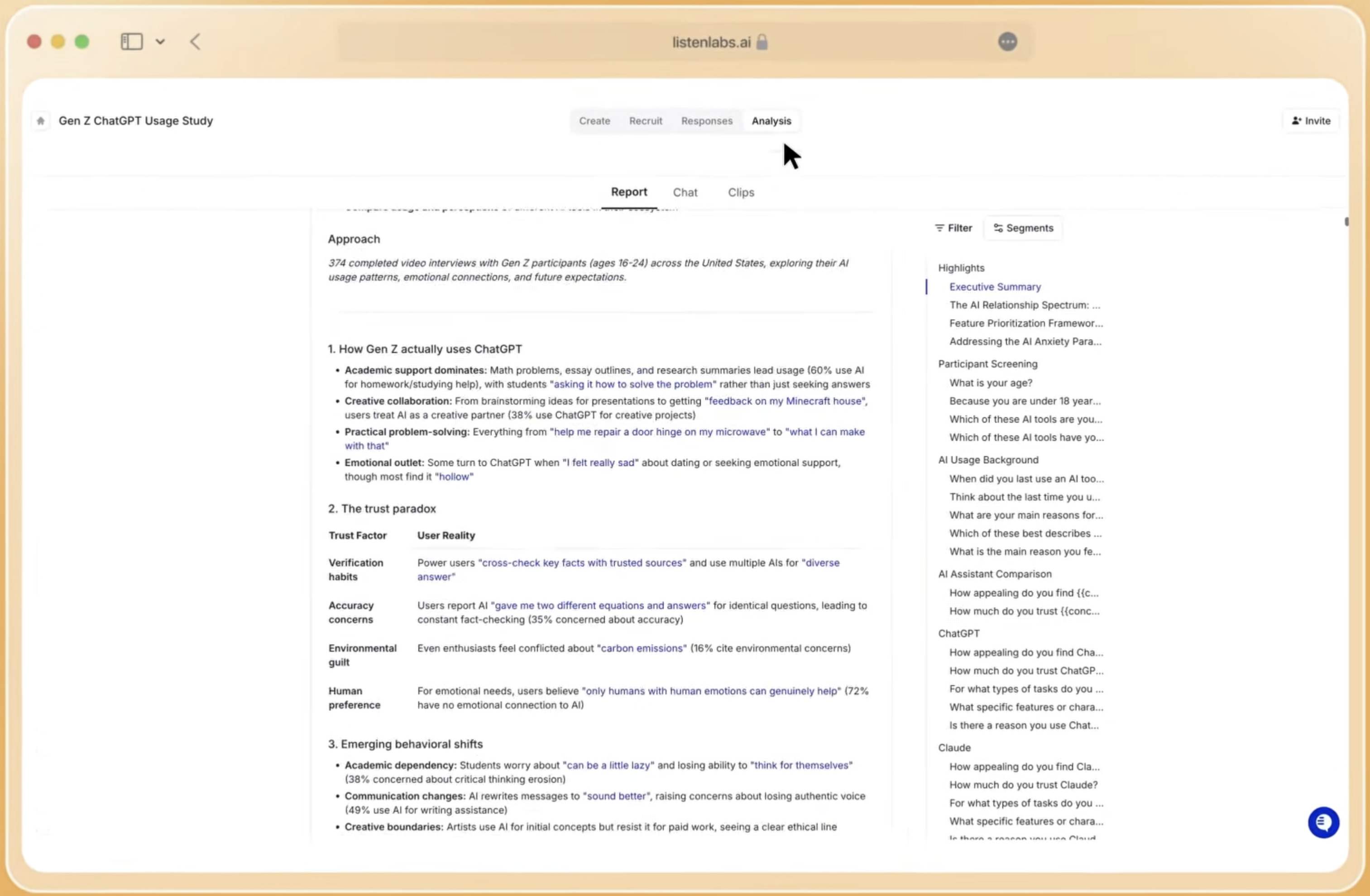
Key trade-offs: Manual deliverable creation is time-intensive and inconsistent. Automated deliverables with traceable sourcing reduce reporting time and improve stakeholder confidence in findings.
Book a demo to see Research Agent generate a complete slide deck and highlight reel from a live study in real time.
Best-Fit Use Cases by Research Scenario
The trade-offs across speed, depth, quality controls, and operational burden described above translate into clear best-fit scenarios for each approach.
- Enterprise insights teams running continuous consumer research across multiple markets benefit from Listen Labs’ global panel, multilingual moderation, and Mission Control’s cross-study intelligence. The 24-hour turnaround allows teams to run more studies per quarter without adding headcount.
- UX research leads validating prototypes and testing usability with 50–100+ participants benefit from Listen Labs’ screen-sharing capabilities, AI-moderated task flows, and emotional intelligence data that surfaces hesitation and friction at timestamp-level precision.
- Product teams without dedicated researchers benefit from Listen Labs’ AI-assisted study design, which converts a plain-language brief into a structured study guide, and from self-serve access to the full research lifecycle.
- Agencies and consultancies with tight client timelines benefit from Listen Labs’ ability to recruit niche audiences and deliver findings within 24 hours. Qual-at-scale is ideal when research requires large sample sizes or broad geographic reach.
- Human-moderated usability testing remains appropriate for highly exploratory sessions with complex medical or empathy-intensive subject matter where a trained human moderator’s judgment is irreplaceable.
Operational and Long-Term Considerations for Adoption
Beyond matching platform capabilities to research needs, successful platform adoption depends on addressing the organizational and compliance factors that determine long-term viability. Switching research platforms involves more than feature comparison and often requires clearing several internal barriers.
First, stakeholder alignment requires proof that AI-moderated interviews produce findings that hold up to scrutiny. Listen Labs meets this bar through traceable emotional data, verbatim sourcing, and enterprise client validation from organizations such as Microsoft, Perplexity, and Sweetgreen.
Second, change management becomes easier when the platform reduces, rather than adds to, the operational burden on research teams. Listen Labs consolidates recruitment, moderation, analysis, and deliverables into a single workflow, which simplifies adoption.
Third, compliance and governance matter for global programs. SOC 2 Type II, GDPR, ISO 27001, ISO 27701, and ISO 42001 certifications, along with 256-bit encryption and enterprise SSO, address information security and privacy requirements. Participant trust is maintained through frequency limits, quality controls, and transparent consent processes.
Finally, repeatability across global programs relies on language and panel infrastructure. Listen Labs supports 100+ language moderation, automatic translation, and reuses the 30M-person global panel described earlier to keep multi-country research consistent over time.
Risks, Limitations, and Common Misconceptions
- Shallow data from rigid methods: Unmoderated usability tests with fixed question sets produce surface-level data. AI-moderated interviews with dynamic follow-up avoid this, but study design quality still determines output quality.
- Slow turnaround from manual workflows: Human-moderated platforms that rely on scheduling, live sessions, and manual analysis cannot compress the research cycle below several days at minimum, regardless of panel size.
- Hidden recruitment complexity: Platforms that separate recruitment from moderation require researchers to manage multiple vendors, which introduces coordination delays and quality gaps at handoff points.
- Fraud and low-quality respondents: Commodity panels carry significant fraud risk. Quality Guard’s real-time monitoring and participant frequency limits address this systematically rather than reactively.
- Overestimating automation: AI moderation does not remove the need for research expertise in study design and interpretation. Listen Labs functions as a force multiplier for existing research teams, not a replacement for research judgment.
Decision Framework: Matching Platform to Context
The following criteria help match platform type to research context and provide a simple sequence for narrowing options.
- Start with timeline and scale. If turnaround must be under 24 hours, AI-moderated qualitative research is the only viable option at scale.
- If sample size must exceed 30 participants for statistical confidence, AI-moderated interviews become necessary because human moderation cannot sustain this volume without proportional cost increases.
- Next, consider geographic and linguistic scope. If the research audience spans multiple countries or languages, platforms with native multilingual moderation and a verified global panel are required.
- Then evaluate emotional and audit requirements. If emotional data must be quantified and auditable, AI-moderated platforms with built-in emotional intelligence are necessary, since human moderation produces subjective, non-scalable emotional observation.
- For sensitive topics such as personal finances, health, or political views, remember that participants prefer AI moderation, as shown in the comfort data above, which makes it better for candid responses.
- If the subject matter requires complex empathetic dialogue in a clinical or crisis context, human moderation remains appropriate.
- Finally, assess team capacity. If the research team is already at capacity, an end-to-end platform that handles recruitment, moderation, analysis, and deliverables removes the operational burden that fragments traditional research workflows.
Frequently Asked Questions
How long does it take to get results from Listen Labs compared to UserTesting?
Listen Labs compresses the entire research cycle, from study design through participant recruitment, AI-moderated interviews, analysis, and deliverable generation, to less than 24 hours. Traditional human-moderated platforms typically require several days at minimum for a small study, and enterprise-scale qualitative programs commonly take 4–6 weeks when factoring in scheduling, moderation, and manual analysis. The difference is structural because AI moderation runs thousands of interviews simultaneously, while human moderation is constrained by moderator availability and session scheduling.
How does Listen Labs ensure participant quality when using AI moderation?
Listen Labs applies three layers of quality control. The platform works exclusively with non-commodity panel sources, which excludes professional survey-takers from the outset. Quality Guard monitors every interview in real time across video, voice, content, and device signals, detecting fraud, low-effort responses, AI-generated scripts, and profile mismatches. Participants are limited to three studies per month to prevent panel fatigue and incentive-driven behavior. A dedicated recruitment operations team adds a human review layer for hard-to-reach audiences. This system produces a zero-fraud guarantee that manual moderation oversight cannot replicate at scale.
Can AI moderation match the depth of a trained human moderator?
For most research objectives, AI moderation delivers comparable qualitative depth with significantly greater consistency and scale. The AI probes short or interesting answers dynamically, similar to a trained interviewer, and does so across every participant rather than selectively. Emotional Intelligence adds a layer of insight through quantified tone, word choice, and micro-expression analysis that human moderation cannot systematically capture across large samples. Human moderation retains an advantage in highly complex empathy-intensive discussions, such as clinical or crisis contexts, where a trained human’s judgment and emotional presence are irreplaceable.
Does Listen Labs support multilingual research?
Listen Labs supports interview moderation in 100+ languages with automatic transcription and translation. Emotional Intelligence is available across 50+ languages. The global panel covers 45+ countries across the Americas, Europe, APAC, and MEA. Researchers can run a single study across multiple markets simultaneously, with localized moderation and unified analysis, without managing separate regional vendors or translation workflows.
What security and compliance certifications does Listen Labs hold?
Listen Labs holds SOC 2 Type II, GDPR, ISO 27001, ISO 27701, and ISO 42001 certifications. The platform uses 256-bit encryption, supports enterprise SSO, and does not use customer data for AI model training. These certifications cover information security management, privacy information management, and AI management systems, which meets the governance requirements of Fortune 500 enterprises operating across regulated industries and multiple jurisdictions.
Conclusion: Aligning Platform Choice with Research Goals
Human-moderated usability testing and AI-moderated qualitative research address overlapping needs but differ sharply across every evaluation criterion in this comparison. Human moderation offers trained judgment in small-sample, empathy-intensive contexts. AI moderation delivers 24-hour turnaround, quantified emotional intelligence, multilingual reach, and automated analysis at a scale that human moderation cannot match without proportional cost and headcount increases.
The platform’s track record, which includes over 1 million interviews for enterprise clients, shows production-scale validation of AI-moderated research. The global panel infrastructure, zero-fraud guarantee, Emotional Intelligence feature, and end-to-end Research Agent, from study design through deliverable generation, make Listen Labs a practical way to collapse the depth-versus-scale trade-off without adding operational burden to research teams.
For research and insights leaders evaluating UserTesting alternatives, the decision often comes down to whether the current research infrastructure can keep pace with the speed at which the business needs answers. If it cannot, book a demo with Listen Labs to see how 24-hour turnaround, enterprise-grade security, and AI-moderated depth at scale can reshape your research program.