Written by: Anish Rao, Head of Growth, Listen Labs | Last updated: August 6, 2026
Key Takeaways
- Traditional brand equity studies take 14 days to 6 weeks and cost at least $7,500, so insights often arrive too late to influence decisions.
- AI brand equity research compresses the full cycle to under 24 hours while still delivering methodological rigor and emotional depth.
- Four core dimensions, Trust Tax, Share of Recommendation, Emotional Lift, and Visibility Consistency, turn classic brand equity models into metrics AI-moderated interviews can capture quickly.
- AI-moderated video interviews capture both stated answers and emotional signals through tone, word choice, and micro-expressions, revealing nuance that surveys miss.
- Listen Labs enables teams to run complete AI brand equity studies in under 24 hours, see a live walkthrough of the platform.
Step 0: Build a Practical Brand Equity Metrics Framework
Before launching any study, align the team on exactly what the research will measure. Traditional frameworks such as Keller's Customer-Based Brand Equity pyramid and Aaker's brand equity model are comprehensive but hard to operationalize in fast-turnaround work. The four dimensions below distill those models into metrics that AI-moderated interviews can capture in under 24 hours.
Trust Tax measures the credibility penalty consumers apply when they feel unsure about a brand's reliability, honesty, or consistency. Example interview question: "When you think about [Brand], what would make you hesitate before recommending it to a friend?" Many consumers refuse to do business with brands they do not trust, so trust becomes the single highest-impact equity lever.
Share of Recommendation measures how often the brand surfaces unprompted when consumers advise peers on a category purchase. Example interview question: "Walk me through the last time someone asked you for a recommendation in this category. Which brands came to mind first, and why?" Many high-frequency AI users have purchased a product an AI recommended that they did not previously know about, so recommendation visibility now functions as a distinct growth channel.
Emotional Lift measures the net positive emotional response a brand triggers across joy, trust, anticipation, and surprise versus negative signals such as disgust, fear, or sadness. Example interview question: "Describe how you feel when you see [Brand]'s advertising. What emotion comes up first?" Many internet users want brands to be reliable and to make them feel valued, which confirms that emotional signals drive loyalty and repeat purchase.
Visibility Consistency measures whether the brand is described in consistent terms across markets, segments, and AI-mediated discovery environments. Example interview question: "If you searched for [category] using an AI tool today, which brands do you think would come up? Why those?" AI already drives a large and growing share of retail site visits, so AI-mediated visibility now represents a measurable equity dimension.
These four dimensions map directly onto established frameworks such as Keller and Aaker while remaining simple enough for rapid AI-moderated interview studies. Together they provide a shared language for strategy, creative, and research teams.
See how this four-dimension framework runs in a 24-hour AI brand equity study.
Step 1: Define the Brand Equity Questions That Matter Now
Start with a one-page study brief that answers three questions: What decision will this research inform? Which brand equity dimension is most at risk? Which audience segment holds the answer? These questions force specificity, which reduces vague objectives that create scope creep and longer fieldwork. Limit the core objectives to three to five so the study stays focused and fast.
For sample size, a general-population study in a single market typically requires 50–150 AI-moderated interviews to reach thematic saturation. Sub-group comparisons, such as brand users versus non-users or Gen Z versus millennials, require at least 30 completes per cell. For audiences below 1% incidence, including niche B2B buyers, category super-users, or highly specific demographic profiles, a dedicated recruitment operations team sources participants through specialized networks rather than commodity panels. Timeline from brief approval to live study launch stays under two hours for most projects.
Step 2: Design an AI-Assisted Interview Guide with Depth and Structure
An effective brand equity interview guide combines quantitative anchors with adaptive qualitative probes. Describe the research objectives in natural language and an AI co-design tool drafts structured questions, probing context, and branching logic in seconds. The guide then layers in Likert scales for trust and perceived quality, NPS for advocacy, and open-ended narrative questions for emotional resonance and association mapping.
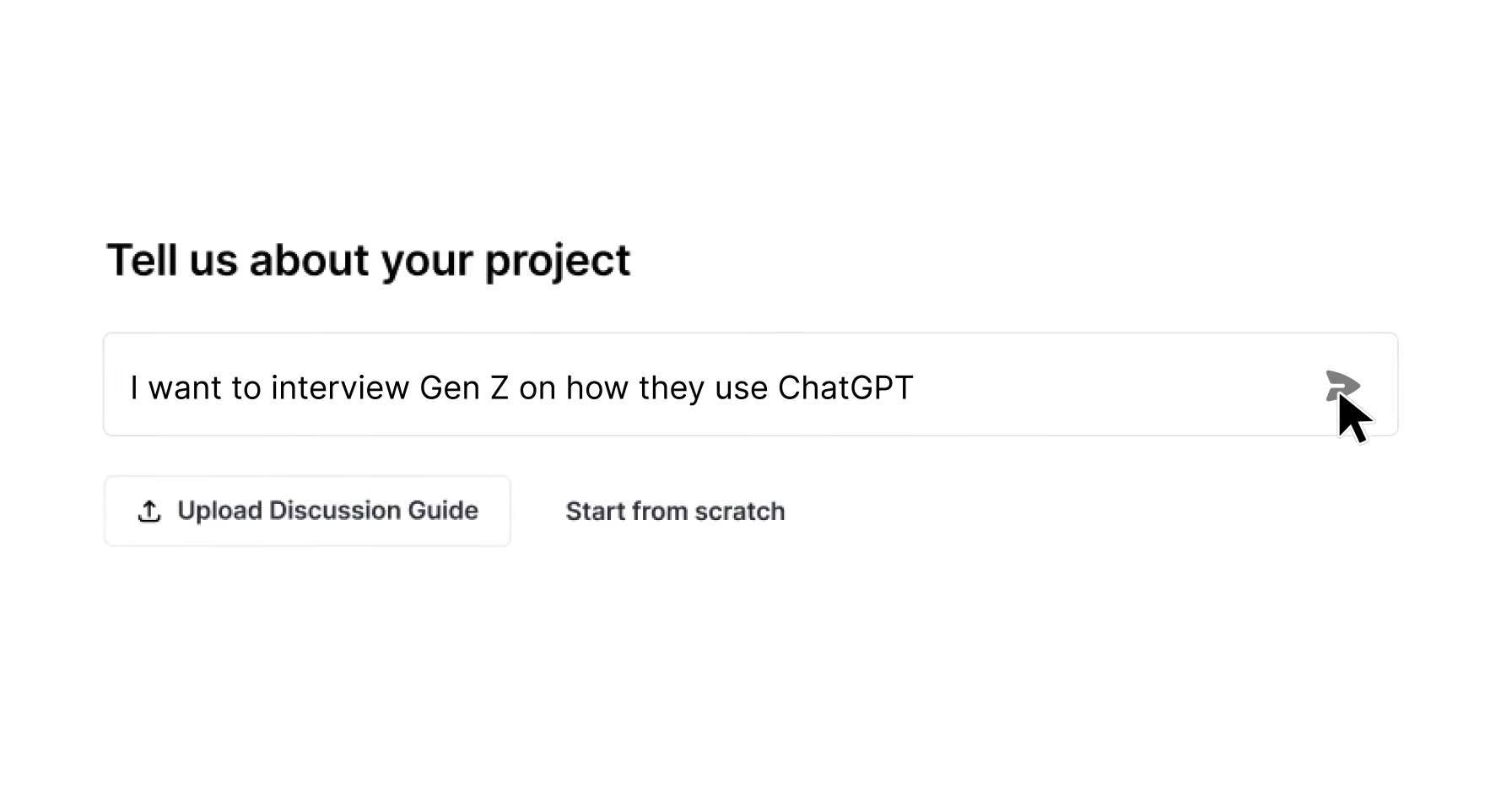
The critical design principle is simple. Every quantitative scale should be followed by an open probe that asks the participant to explain their rating. Surveys flatten emotional reactions into Likert scores, while AI-moderated interviews use follow-up questions that probe for specificity, emotional valence, and behavioral implications. That combination produces consultant-grade deliverables instead of a dashboard of averages.
Step 3: Source and Screen High-Quality Participants in Hours
Participant quality often represents the single biggest failure point in brand equity research. Online surveys frequently suffer from low-quality or fraudulent responses, so commodity panels generate data that leadership cannot trust for brand equity decisions.
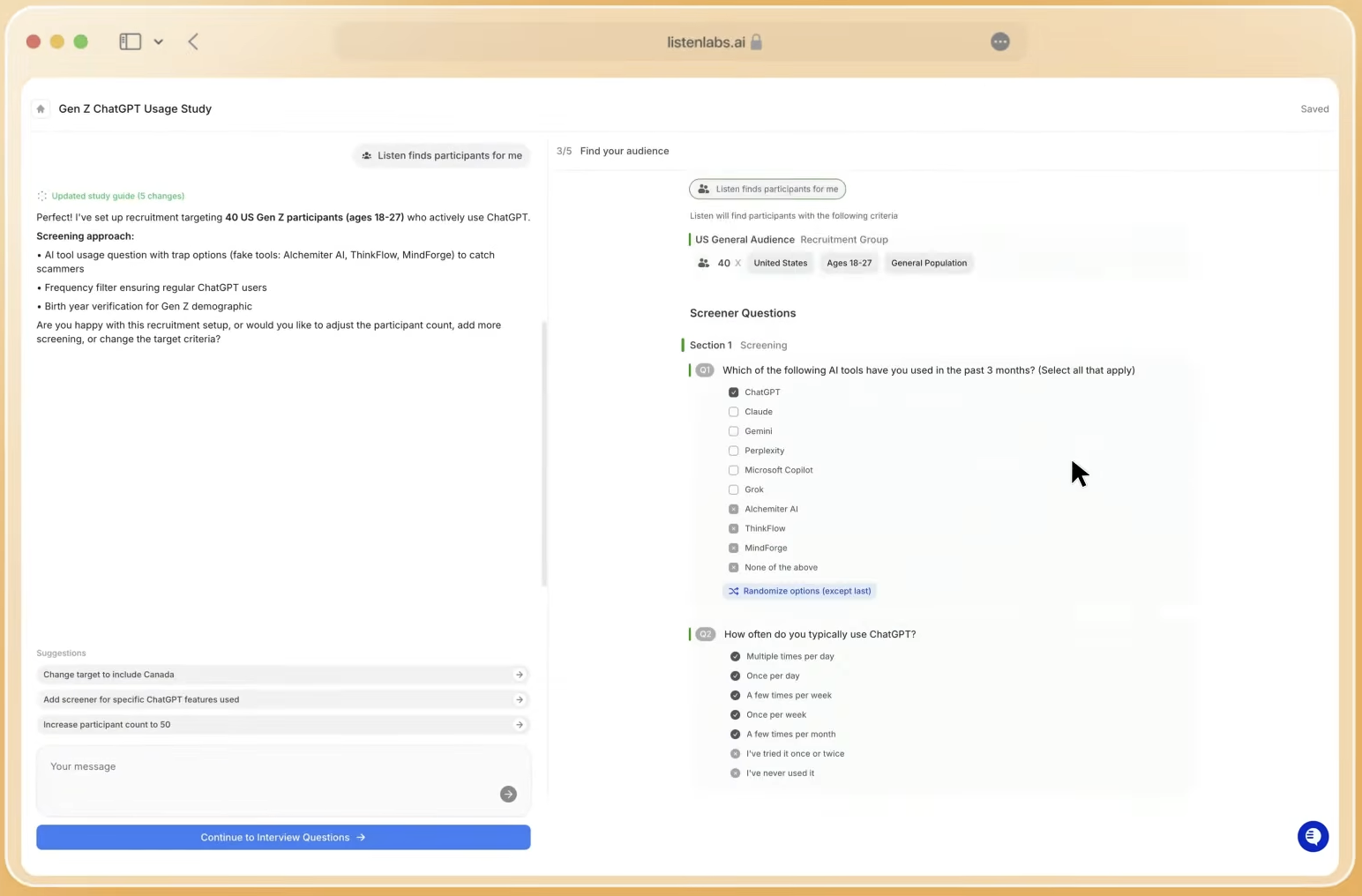
A purpose-built recruitment infrastructure addresses this through three layers:
- Behavioral matching on intent and past actions, not only self-reported demographics, to identify participants who genuinely belong to the target segment
- Real-time quality monitoring across video, voice, content, and device signals to detect and remove fraudulent responses before they contaminate the dataset
- Participant frequency limits of no more than three studies per month per person, which removes professional survey-takers from the sample
For sub-1% incidence audiences, a dedicated recruitment operations team partners with niche communities and specialized networks to source the right participants. Across a global panel of 30 million verified respondents spanning 45+ countries and 100+ languages, fieldwork for a 100-interview study typically completes within hours of launch.
Step 4: Run AI-Moderated Video Interviews That Capture Emotion
AI-moderated video interviews conduct personalized, adaptive conversations at scale. The AI probes deeper on short or ambiguous answers in the same way a trained human moderator would and adjusts follow-up questions based on each participant's prior responses. Ninety-two percent of participants report top comfort levels in AI-moderated sessions, which supports honest discussion of topics that affect brand trust.
Beyond transcripts, Emotional Intelligence analyzes three layers of signal simultaneously, tone of voice, word choice, and subconscious micro-expressions. Built on Ekman's universal emotions framework, the same standard used in clinical psychology, it tracks anger, anticipation, disgust, fear, joy, sadness, trust, and surprise. Two participants may both rate a brand positively on a Likert scale while one displays genuine joy and the other displays suppressed disgust. Only multimodal signal capture reveals that difference. Interviews run in 100+ languages with automatic transcription and translation.
Step 5: Auto-Analyze Interviews into Trust, Perception, and Visibility Themes
The Research Agent handles the full analysis workflow from raw data to final output. It processes all interview data objectively without the confirmation bias that affects human analysts. The system identifies patterns and themes across hundreds of responses, separates signal from noise using proprietary data from tens of thousands of completed studies, and quantifies emotional signals per question and per concept.
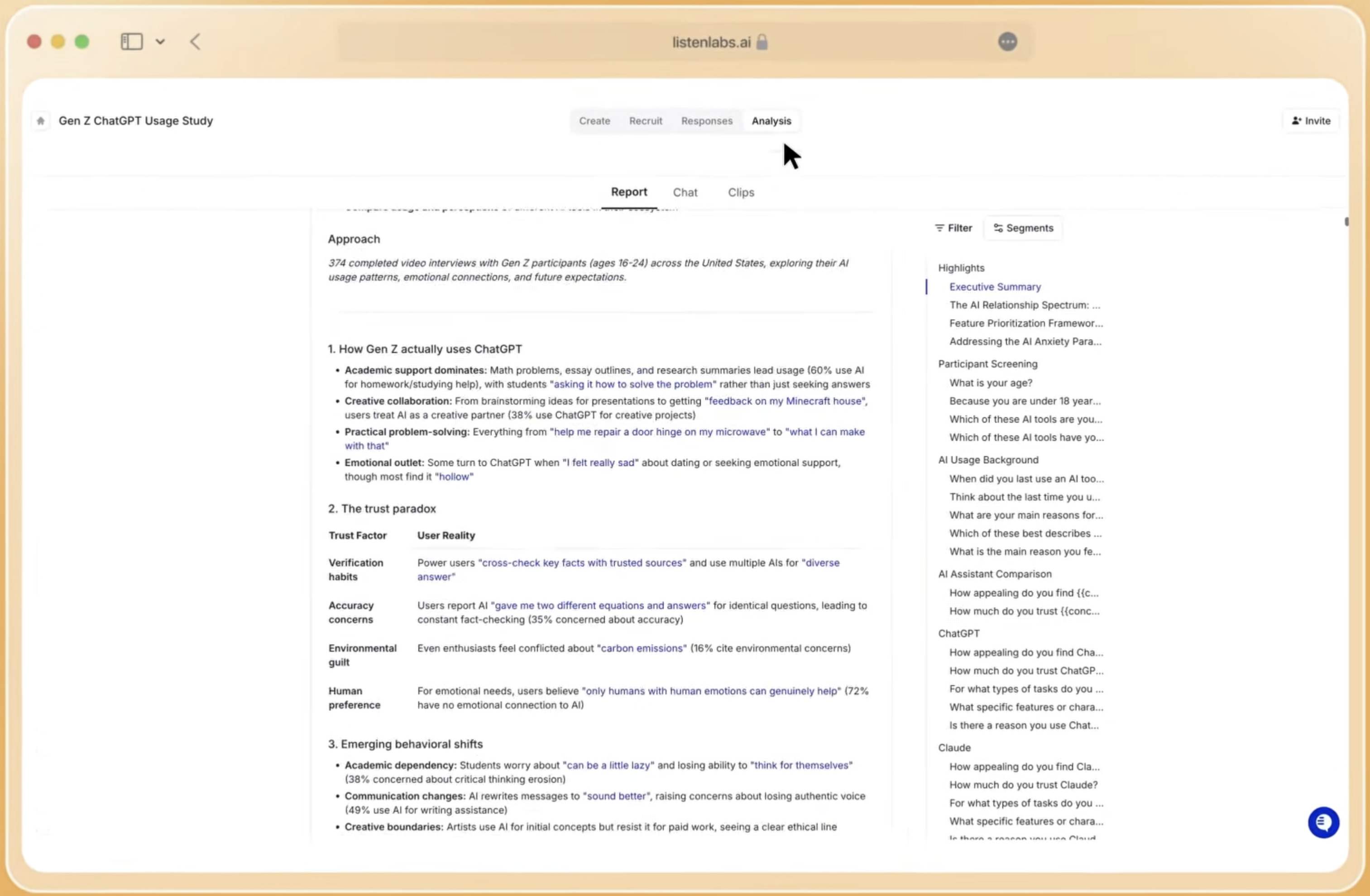
Every emotion label is traceable to the exact timestamp, verbatim quote, and AI reasoning behind it, so when the analysis surfaces a "trust deficit among 35–44-year-old non-users," the evidence chain remains fully auditable and meets enterprise traceability standards.
Step 6: Deliver Slide-Ready Brand Equity Findings the Same Day
One-click outputs from the Research Agent include consultant-quality PowerPoint slide decks, memo-style reports, video highlight reels of emotionally significant moments, statistical charts with significance testing, and segmentation breakdowns by demographics, cohorts, or custom audience groups. Custom reports are generated in response to natural-language queries. A prompt such as "Which segment shows the highest trust tax?" returns a chart, a stat test, and supporting verbatims in under a minute.
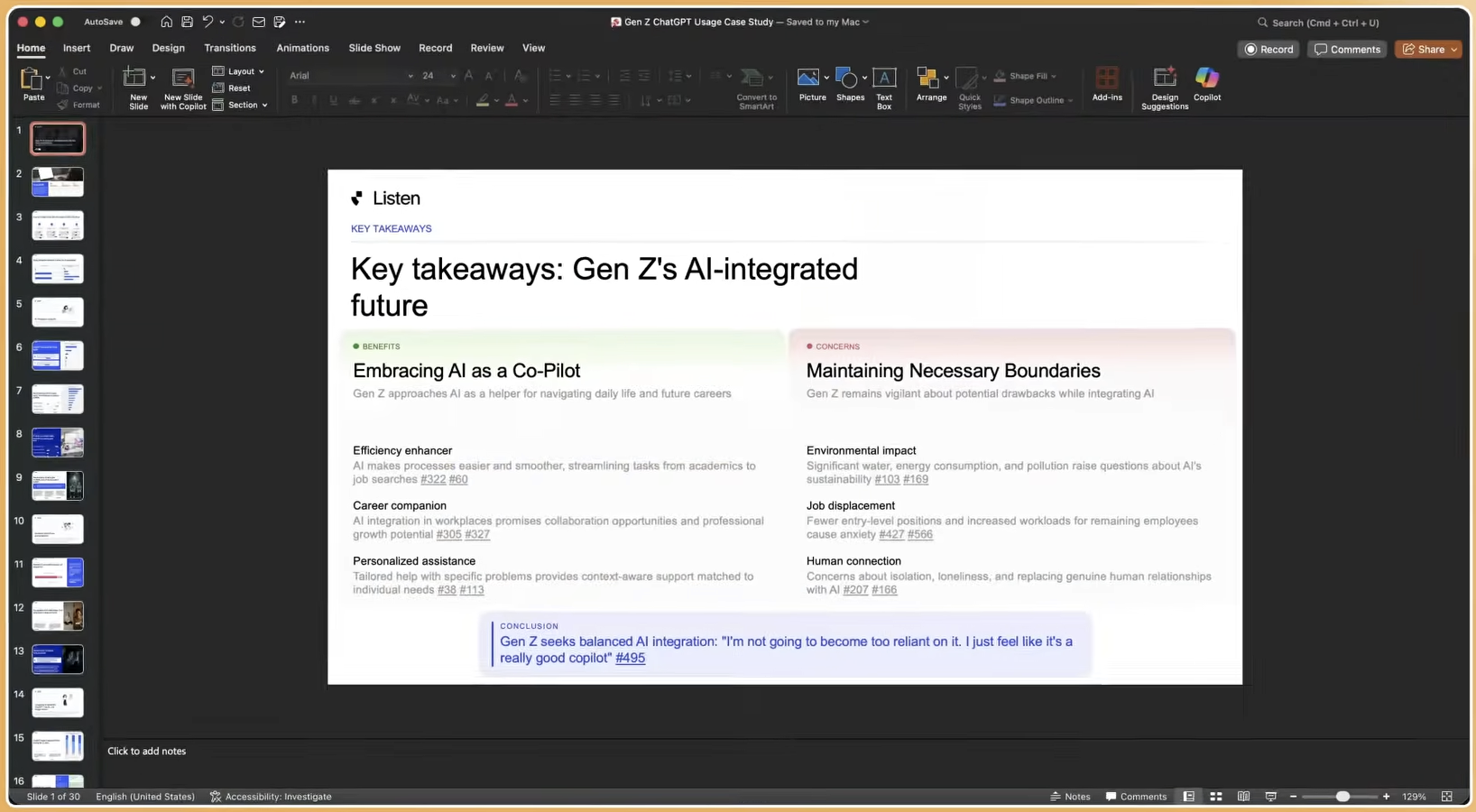
Open-ended responses captured through conversational AI are typically much longer and more detailed than those from equivalent open-ended survey items. That depth, delivered in slide-ready format the same day fieldwork closes, enables stakeholder socialization within one week instead of one month.
Review sample brand equity tracking deliverables from a live Listen Labs study.
Common Pitfalls in Brand Equity Research and How to Avoid Them
Three failure modes recur across brand equity research programs regardless of methodology. Each has an early-warning signal and a clear mitigation tactic.
Professional survey-taker contamination. The early-warning signal appears as implausibly high completion rates combined with short response times and generic verbatims that lack brand-specific detail. The mitigation is a multi-layer quality system that uses behavioral matching at recruitment, real-time fraud detection during fieldwork, and participant frequency limits that cap each person at three studies per month. Traditional brand tracking relies on infrequent cycles that produce retrospective snapshots, a cadence that makes contamination harder to detect because no reliable baseline exists.
Confirmation bias in analysis. The early-warning signal appears when a findings deck perfectly confirms the pre-study hypothesis with no unexpected themes. The mitigation is automated AI analysis that processes all responses objectively before any human reviews the data, using a proprietary dataset from tens of thousands of prior studies to calibrate what constitutes a genuine signal versus noise.
Loss of emotional nuance. The early-warning signal appears when a dataset consists entirely of Likert scores and short verbatims with no emotional texture. Teams are already using Emotional Intelligence for brand research, creative testing, concept comparison, and usability testing because stated answers and felt emotions diverge in ways that matter for brand equity decisions. The mitigation is multimodal signal capture from the first interview, not as a late-stage add-on.
Objective Success Indicators for AI Brand Equity Studies
A well-executed AI brand equity research study meets the following benchmarks:
- Study cycle time from brief approval to delivered report stays under 24 hours
- Interview completion rate reaches 85% or higher, which indicates participant quality and guide design are sound
- Inter-rater agreement on theme coding between AI analysis and human review reaches 90% or higher
- Documented stakeholder usage of findings, such as a decision, a budget reallocation, or a creative change traceable to the research, occurs within one week of delivery
- Emotional signal coverage reaches micro-expression and tone data capture for 95% or more of completed interviews
If cycle time exceeds 24 hours, recruitment usually creates the bottleneck. If completion rate falls below 85%, the interview guide is too long or the screener is too restrictive. If inter-rater agreement falls below 90%, the research objectives were underspecified at Step 1.
Scaling from One-Off Studies to Always-On Brand Equity Programs
Brand teams are reallocating 60–75% of legacy brand tracker spend to continuous AI conversation programs while maintaining the same total annual research budget. A continuous program capturing 200 interviews per week across key markets costs a fraction of a single traditional tracker wave and compounds in value over time as the longitudinal dataset grows.
Longitudinal value in brand equity tracking emerges over multiple cycles and supports trend analysis, correlation with business outcomes, and eventually predictive modeling. Mission Control serves as the organization's source of truth across all studies, enabling cross-study queries, trend tracking, and institutional knowledge building so teams can answer "how has our trust score moved since the campaign launched?" in seconds rather than weeks.
For cross-market programs, the same interview guide runs simultaneously across 45+ countries with automatic localization, translation, and transcription. With qual-at-scale, the old trade-off between depth and scale no longer blocks global work. A 10-market brand equity study that previously required separate local agencies, moderators, and translation vendors now runs as a single coordinated program that delivers unified, comparable findings within 24 hours.
Frequently Asked Questions
How long does a complete AI brand equity research study actually take?
From study brief approval to delivered slide deck, the full cycle runs in under 24 hours for most studies. Recruitment and fieldwork for a 100-interview single-market study typically complete within 4–8 hours of launch. Analysis and deliverable generation add less than an hour. Sub-1% incidence audiences may require an additional 12–24 hours for dedicated recruitment operations to source the right participants.
What data privacy and security certifications does Listen Labs hold?
Listen Labs maintains SOC 2 Type II, GDPR, ISO 27001, ISO 27701, and ISO 42001 certifications. All data is encrypted at 256-bit, and customer data is never used to train AI models. Enterprise SSO is supported for organizations that require single sign-on integration.
Can we use our own customer list instead of the panel?
Yes. Listen Labs supports self-recruitment, which allows organizations to invite participants from their own customer base, CRM, or loyalty program at a reduced credit cost. You can also bring an existing panel provider. Self-recruited participants go through the same Quality Guard screening as panel participants to maintain data integrity.
How does Listen Labs handle audiences below 1% incidence?
A dedicated recruitment operations team sources hard-to-reach segments, including enterprise decision-makers, healthcare professionals, category super-users, and highly specific consumer profiles, through partnerships with niche communities, micro-creators, and specialized networks. These audiences are not sourced from commodity panels. The team adds a human review layer on top of automated quality controls to verify profile accuracy before fieldwork begins.
How is AI brand equity research different from running a standard survey?
Surveys deliver structured quantitative data through pre-set questions with no ability to follow up or probe. AI-moderated interviews conduct adaptive conversations where the AI asks follow-up questions based on each participant's prior responses, which uncovers unexpected findings, emotional nuance, and rich context that surveys cannot access. Emotional Intelligence adds a third layer by capturing tone of voice and micro-expressions that neither surveys nor transcripts record. The result is the statistical confidence of large samples combined with the depth of one-on-one qualitative interviews, a combination that was not previously achievable at speed or scale.
Conclusion: Turn Brand Equity Research from Months into Hours
The workflow above delivers on the 24-hour promise by replacing the traditional 4–6 week agency cycle with a repeatable process that sources verified participants, conducts adaptive emotion-aware AI interviews, auto-analyzes transcripts and micro-expressions, and delivers slide-ready findings the same day. Teams using AI-moderated video interviews for brand equity research report spending substantially less than on agency-delivered qualitative programs, which makes continuous real-time brand equity tracking financially viable for the first time. The brands that will win the next competitive cycle will measure trust, perception, visibility, and emotional resonance continuously, not quarterly.
Schedule a Listen Labs session and run your first AI brand equity study in under 24 hours.