
Written by: Anish Rao, Head of Growth, Listen Labs
Key Takeaways
- AI-moderated concept testing platforms differ in whether they use genuine adaptive probing or scripted follow-up logic, which determines whether they deliver diagnostic insight or faster survey data.
- Key evaluation criteria include moderation adaptivity, recruitment quality with fraud controls, analysis traceability, cross-study reuse capabilities, and emotional signal capture beyond transcripts.
- Listen Labs stands out as the best overall solution for research and product leaders, combining genuine adaptive probing, enterprise-grade fraud controls, emotional signal capture, cross-study intelligence, and enterprise security certifications in a single system.
- AI-moderated concept testing compresses the traditional 4–6 week research cycle to less than 24 hours while maintaining qualitative depth at scale across 120+ languages and 45+ countries.
This Is a Buyer's Guide, Not a Ranking
If you are reading this, you already have a shortlist and a demo calendar. The challenge is locating each platform on the spectrum from scripted follow-up logic to genuine adaptive probing, then choosing the one whose position on that spectrum matches your research job-to-be-done.
This guide gives you the evaluation framework first, then a shortlist organized by job-to-be-done, then the honest limitations. The recommendation at the end is a reasoned conclusion based on those criteria. For a broader look at the category, see Best AI Moderated Research Tools 2026: Platforms Compared and Best Concept Testing Platforms: A Practical Guide.
How to Tell If an AI Moderator Actually Probes or Just Reads a Script
Every vendor deck claims “adaptive probing.” The questions below help you test that claim during a demo and compare platforms on a consistent basis.
Moderation adaptivity. Ask the vendor to show a transcript where the AI abandoned the discussion guide because a participant gave an unexpected answer. A scripted system will show you a transcript where every question appears in order. A genuinely adaptive system will show you a session where the AI followed an unanticipated thread, skipped a planned question, or probed a contradiction the guide never anticipated. Genuine AI moderation schedules and conducts the interview, analyzes transcripts for themes, and generates quantitative insights. It behaves like a thoughtful interviewer, not a faster script reader.
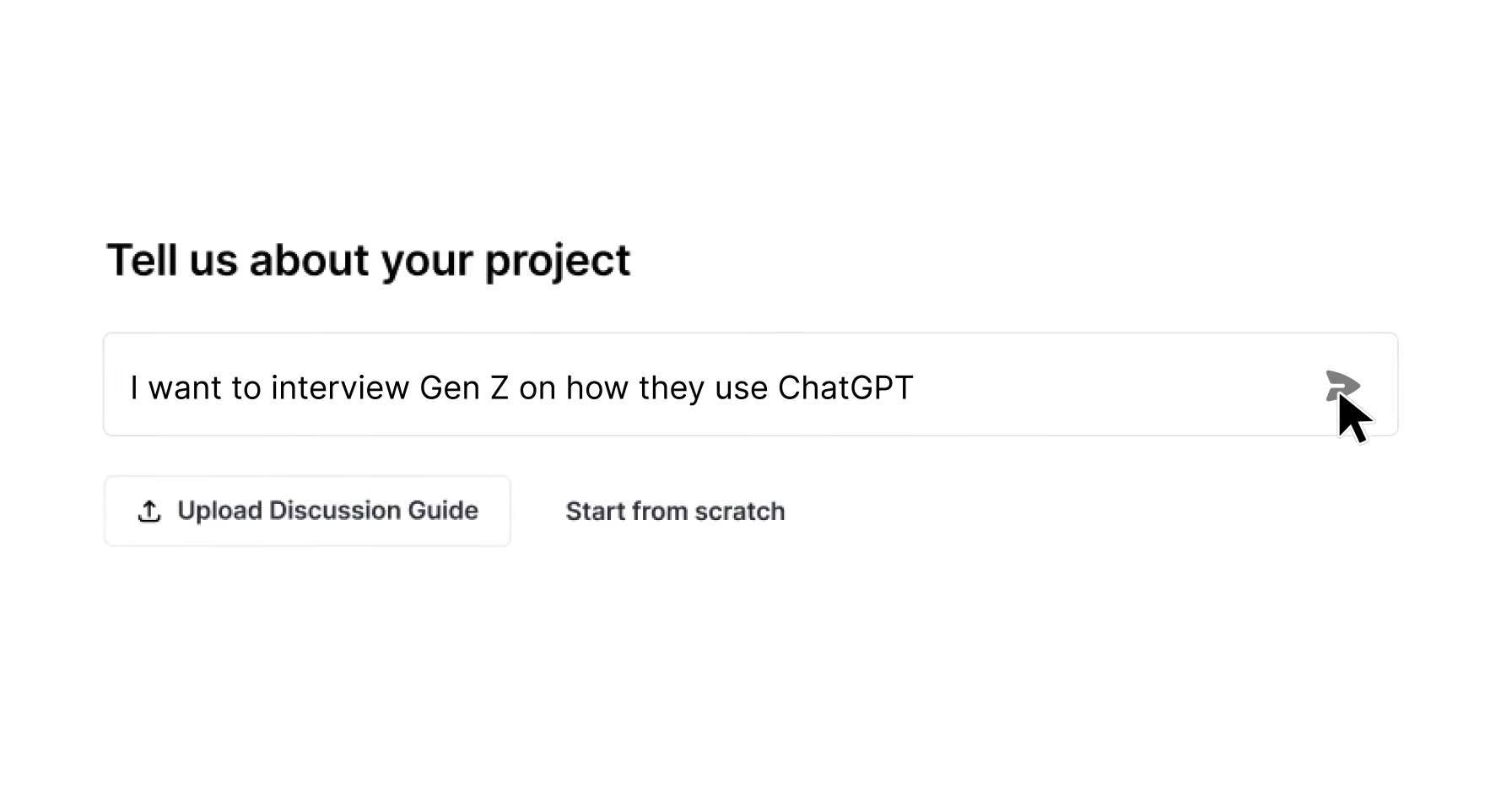
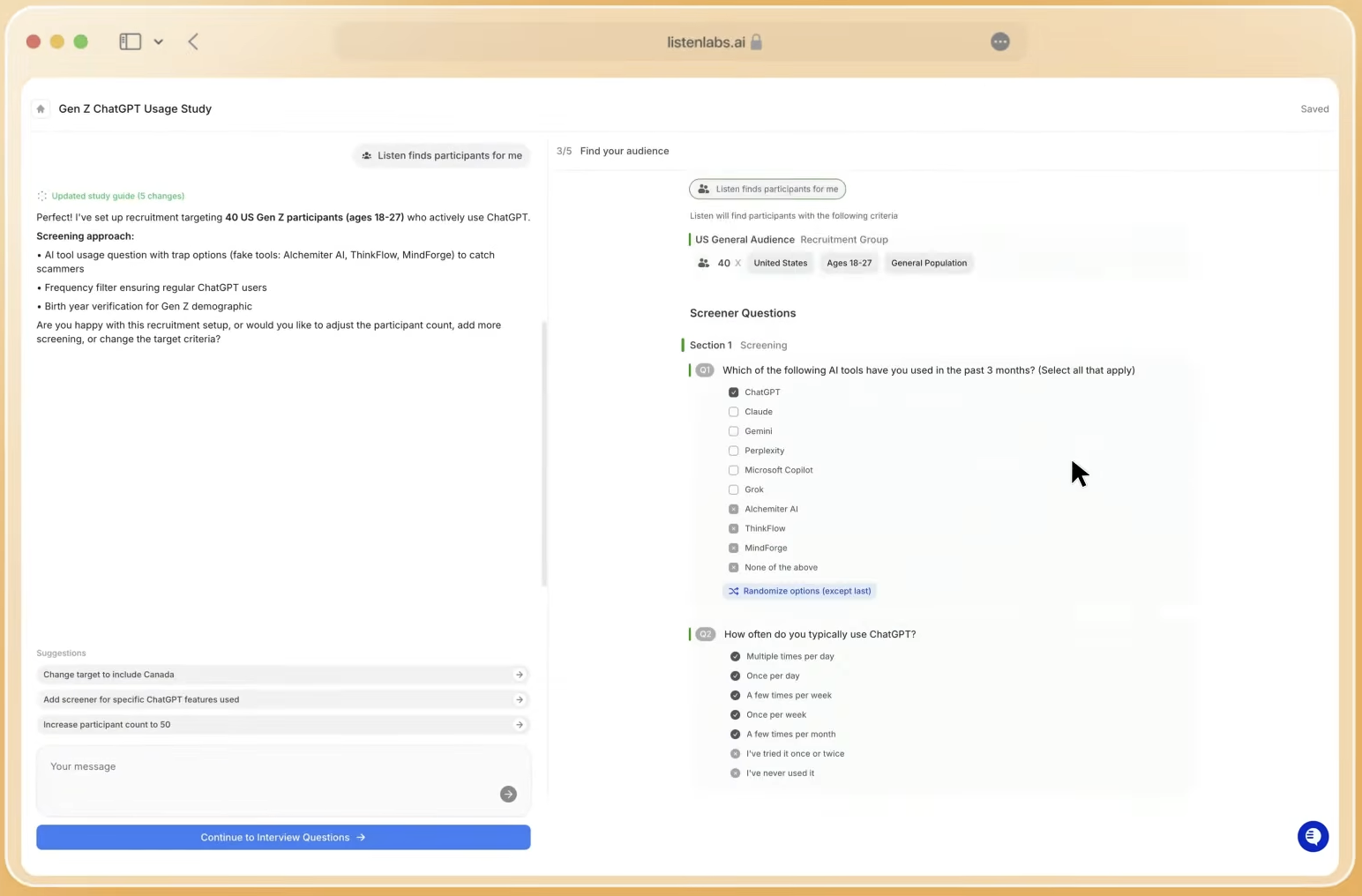
Recruitment quality and fraud controls. Start by asking whether participant matching uses behavioral and intent data or only self-reported demographics, because self-reported data is the easiest thing for a fraudulent respondent to fake. Then ask what happens when a participant gives inconsistent answers mid-interview, since that is the moment when a real fraud control should intervene. Next, ask how many studies per month a single participant can complete, because unlimited participation is how professional survey-takers slip through. Platforms with real fraud controls, including behavioral matching, real-time monitoring, and frequency limits, will answer these questions with specifics. Platforms without them will describe screener logic and call it fraud detection.
Analysis traceability. Ask whether a finding can be traced to the exact timestamp, verbatim quote, and respondent who produced it. With AI-moderated interviews, talking to users at scale is no longer the hard part. The challenge is understanding what they mean, and every insight must link directly to the underlying response data to be defensible in a stakeholder readout.
Cross-study reuse. Ask whether you can query everything you have ever run on the platform, with source attribution, in natural language. Most platforms treat each study as self-contained. Platforms with a genuine research library turn individual studies into a compounding intelligence system.
Emotional signal capture. Ask whether the platform captures what participants feel in addition to what they say. Emotional Intelligence analyzes three signals, tone of voice, word choice, and subconscious micro expressions, with every emotion quantified per question and concept and every label traceable to the exact timestamp, verbatim quote, and AI reasoning behind it. Platforms that rely on transcript alone miss the say-do gap entirely.
Concept Testing with AI-Moderated Interviews at Scale covers study design considerations in more depth for teams building their first AI-moderated concept test.
A randomized controlled trial by Verasight (Morris et al., 2026; n = 3,160) found that AI-moderated interviews produced 4.8 times as many words per assigned respondent as written survey open-ends, with roughly 80% of that depth advantage attributable to adaptive follow-up probing rather than the initial prompt alone. The study confirms that the probing architecture, not the modality, drives insight quality.
Listen Labs: The Best Overall Solution
Listen Labs is the recommended platform for research and product leaders who need genuine adaptive probing, enterprise-grade fraud controls, emotional signal capture, and cross-study intelligence in a single end-to-end system.
The verifiable facts: Listen Labs has run over 1 million AI-powered customer interviews for companies including Microsoft, Perplexity, and Sweetgreen, and raised $69 million in a Series B led by Ribbit Capital at a valuation over $500 million as of January 2026, with Evantic, Sequoia Capital, Conviction, and Pear VC participating and total funding reaching $100 million. The platform covers 50M+ verified respondents across 45+ countries and 120+ languages, compresses the research cycle from 4–6 weeks to less than 24 hours, and costs roughly one third of traditional research. Security certifications include SOC 2 Type II, ISO 27001, ISO 27701, and ISO 42001. The platform is GDPR compliant and customer data is never used to train AI models. Enterprise customers include Microsoft, Google, Anthropic, Sony, Sweetgreen, Perplexity, Robinhood, P&G, Skims, Levi's, Boston Consulting Group, and Nestlé.
Listen Labs wins on the evaluation criteria from the section above for five reasons.
- Adaptive probing: Intelligent probing generates responses 3x longer than average. Micky Malka, founder of Ribbit Capital, described it as: “Instead of having a bored person to ask the questions, this AI engine can engage with you, and modify the questions to go deeper.”
- Fraud controls: Quality Guard layers four controls: behavioral matching on intent and past actions, real-time monitoring across video, voice, content, and device signals, a 3-studies-per-month participant limit, and a dedicated recruitment ops team capable of reaching audiences below 1% incidence rate.
- Emotional signal capture: Emotional Intelligence is built on Ekman's universal emotions framework and is available across 50+ languages. It integrates directly with the Research Agent for natural-language queries, charts, and highlight reels of emotionally significant moments.
- Say-do gap: Visual Insights lets the AI Interviewer observe on-screen behavior and probe contradictions between stated preference and observed action in real time.
- Traceability and cross-study reuse: Every insight links directly to the underlying response data, and Research Library searches every study ever run simultaneously, returning synthesized answers with full source attribution.
The evaluation criteria above matter most at enterprise scale, where governance and turnaround determine whether research actually informs decisions. Six deployments illustrate the pattern: Microsoft cut research wait time from weeks to hours and collected global customer stories for its 50th anniversary within a day. Anthropic's research team now runs 100 studies in the time it previously took to run five or six. P&G surfaced where product claims felt exaggerated before market, delivering 250+ interviews with quantified themes in hours. Skims validated with thousands of high-income buyers overnight to de-risk a global campaign launch. Sweetgreen scaled research across 300+ US locations at 5x the scale and one-third the cost. Simple Modern delivered hundreds of interviews with a 2.5-hour turnaround.
Switching to Listen Labs AI-moderated interviews let Chubbies capture hundreds of candid, one-to-one conversations overnight. That result illustrates the platform's capability for large-scale concept testing across consumer segments.
Best Product Testing Platforms for Enterprise User Research covers the governance and procurement considerations for teams evaluating Listen Labs at enterprise scale.
See adaptive probing in a live demo
The Shortlist, Organized by Research Job-to-Be-Done
Listen Labs is the strongest overall fit, but no single platform is right for every research job. The following groupings reflect what each platform is genuinely built for, not what its marketing page claims. Each entry covers moderation approach, recruitment model, and where the platform falls short. Where a platform's moderation or recruitment model is not publicly documented, that is noted explicitly.
Deep Qualitative Concept Exploration
- Outset — Video, voice, and text moderation in 40+ languages with panel integrations including User Interviews, Prolific, and Rally, and access to 1.1B+ participants across 85+ countries. Its Visual Intelligence suite covers digital intelligence (screen viewing), emotional intelligence (facial expression analysis), and physical intelligence (real-world product interaction). Outset supports monadic, comparative, protomonadic, value proposition, packaging, and first-impression concept testing methodologies. SOC 2 Type II, GDPR, and HIPAA certified. Falls short for teams needing a proprietary panel with behavioral matching rather than third-party panel integrations, or cross-study querying across a multi-year research archive.
- GetWhy — Video, voice, and text moderation in 100+ languages, with 300M+ participants via its Recruitment Cockpit and a documented 17-criteria moderation scoring framework. Has been building AI moderation since 2018 and trains its engine on a proprietary dataset of more than 1 million interviews. Full-service delivery via 70+ senior researchers is available alongside self-serve. Falls short for teams needing a fully self-serve, sub-24-hour turnaround without full-service involvement.
- Conveo — Video-first AI moderation in 50+ languages with recruitment through integrated panel partners including Respondent.io and User Interviews, or BYO participants. Every theme links to a timestamped video clip and verbatim quote. SOC 2 certified, GDPR compliant, EU regional data hosting. Falls short for teams needing a proprietary panel with behavioral fraud controls rather than third-party panel integrations.
- Qualitati — Text-based AI moderation focused on qualitative depth for consumer insights teams. Recruitment is BYO or via external panel partners. Falls short for teams needing built-in quantitative mixed-methods or large-panel reach.
Rapid Multi-Concept Testing
- User Intuition — Voice moderation in 80+ languages with a 4M+ participant panel at $30 per interview. Suited for mid-market teams running high-volume concept tests on a constrained budget. Falls short for enterprise governance requirements, cross-study querying, and emotional signal capture.
- Hubble — Unified research hub combining AI-moderated conversations, prototype testing, and in-product surveys. Recruitment relies on integrated panels and BYO audiences. Suited for product teams running concept and UX feedback in a single instrument. Falls short for large-panel consumer research and cross-study intelligence.
- Reason8 — Always-on AI research assistant combining voice moderation with structured ratings. Recruitment model centers on BYO users and panel partners. Suited for continuous product feedback loops. Falls short for enterprise-scale concept testing with advanced fraud controls.
- Maze — AI-generated follow-ups inside a quant and prototyping suite, with moderation across 20+ languages and fraud detection with automatic participant replacement. Deep Figma, Sketch, and InVision integrations make it strong for prototype-adjacent concept feedback. Suited for product and UX teams already using Maze for unmoderated testing who want to add conversational depth. AI-moderated interviews are an Enterprise add-on. Falls short for consumer insights teams needing large-panel recruitment and emotional signal capture.
Enterprise Governance and Mixed-Methods
- Recollective — Community and qualitative platform suited for longitudinal diary studies and community-based concept exploration. Moderation combines human and AI-assisted workflows. Recruitment relies on BYO communities and panel partners. Falls short for rapid turnaround and AI-adaptive probing depth.
- Zappi — Legacy quantitative concept testing and creative testing at scale. Moderation is survey-led with limited conversational AI. Recruitment runs through Zappi's managed panels. Suited for teams running high-volume quant concept screens with established benchmarks. Falls short for qualitative depth and adaptive probing.
- Qualtrics — Survey infrastructure with a concept testing module. AI-moderated interviewing (Agentic Research) was listed as coming soon as of mid-2026. Recruitment relies on Qualtrics panels and BYO lists. Suited for teams already on the Qualtrics XM suite who need concept testing integrated with existing survey programs. Falls short for qualitative depth and adaptive probing today.
- Attest — Survey-led concept testing for marketing teams. Moderation is form-based rather than conversational. Recruitment uses Attest's consumer panel. Suited for rapid quantitative concept screens with a consumer panel. Falls short for qualitative depth and adaptive probing.
B2B vs. B2C Concept Testing with AI Moderators
The recruitment model, screener design, and moderation adaptivity requirements differ substantially between B2B and B2C concept testing.
For B2B concept tests, async formats lift VP- and director-level response rates significantly. AI-moderated interviews for B2B concept testing achieve two to three times higher response rates from VP-level and director-level respondents compared to live moderated outreach targeting the same seniority, because senior buyers rarely agree to a scheduled 45-minute call but regularly complete 15 to 25 minute async interviews. Verified role and purchasing authority matter more than demographic matching. MIT Sloan Management Review research on buyer decision-making has documented that the gap between “influencer” and “decision-maker” spans 40 to 60 percent in stated willingness-to-pay, making participant verification a research quality issue and a recruitment issue.
For B2C concept tests, broader panels enable faster fielding, but fraud exposure is higher. Behavioral matching and frequency limits carry more weight than in B2B contexts, where the panel is smaller and participants are harder to replace. Qual-at-scale is ideal when research requires large sample sizes or broad geographic reach, with AI tools engaging hundreds or thousands of participants remotely and asynchronously. That model only works when fraud controls are robust enough to protect the sample at that volume.
Built-In Recruitment vs. Bring-Your-Own Audience for Concept Tests
Built-in recruitment offers speed and reach. Platforms with proprietary panels or orchestrated panel networks can field a concept test within hours of study launch, without the researcher managing a separate recruitment vendor. The trade-off is cost per participant and, for some platforms, limited behavioral verification of panel members.
Bring-your-own audience reduces per-participant cost and enables concept testing with an organization's existing customers, the population whose behavior the concept is actually meant to influence. The trade-off is that the researcher owns recruitment quality and must manage the logistics of getting participants into the study.
Listen Labs supports both. Organizations can self-recruit from their own user base at reduced cost, or access Listen Labs' 50M+ verified respondent network and third-party panel partners. Platforms like Listen Labs layer on auto-recruiting, transcription, sentiment tagging, and insight summarization so teams jump from question to findings in hours, not weeks. That speed holds regardless of whether the audience comes from the platform's panel or the organization's own database.
Self-Serve vs. Enterprise
Self-serve platforms allow a researcher or product manager to launch a concept test without a sales conversation, procurement process, or implementation timeline. They are suited for teams running fewer than ten studies per year, teams without a dedicated research operations function, and teams that need to move faster than an enterprise procurement cycle allows.
Enterprise platforms add governance, security, SSO, compliance certifications, and the procurement infrastructure that large organizations require before processing participant data. For a 20+ study-per-year program, the absence of SOC 2 Type II, ISO 27001, and GDPR compliance is a disqualifying factor in most enterprise vendor evaluations.
Among the platforms in this guide, the split falls into three patterns. User Intuition offers a self-serve concept testing platform starting from $150 per study with no platform fees on self-serve, while also providing enterprise pricing with unlimited studies and dedicated support. Listen Labs follows the same dual model, so a team can start small and upgrade without switching vendors. Outset, GetWhy, and Conveo also serve both self-serve and enterprise buyers, with enterprise tiers adding governance, dedicated support, and compliance documentation. Qualtrics and Zappi are enterprise-gated with no self-serve pricing, which makes them a poor fit for teams running fewer than ten studies per year.
AI-Moderated Concept Testing vs. Traditional Concept Testing
Procurement model is one axis of comparison; methodology is another. Traditional concept testing runs on a 4–6 week cycle: study design, recruitment, scheduling, sequential moderated sessions, transcription, manual coding, and report writing. In enterprise settings, internal prioritization and budget approval can stretch this to six months. By the time findings arrive, the product decision has often already been made.
Focus groups introduce group dynamics, dominant voices, and social desirability bias that individual interviews avoid. AI-led one-on-one interviews deliver faster, more reliable, and less biased insights without the logistical overhead of organizing group sessions. Quantitative surveys scale but sacrifice depth, with no follow-up questions, no probing, and limited ability to surface unexpected findings.
AI-moderated concept testing collapses the depth-versus-scale trade-off. AI can schedule and conduct the interview, analyze transcripts for themes, and generate quantitative insights from those interviews. It does all three simultaneously, across hundreds of participants, in less than 24 hours.
Honest Limitations of AI Moderation
AI moderation is not the right tool for every concept test. The following contexts still favor a human moderator.
- Highly sensitive or emotionally complex topics. Forrester's report “Meet Your New Research Partner: AI Moderators” found that human interviewers can better interpret emotional nuance, and that AI moderators are best suited for short conversations providing quick, directional insights rather than extended emotionally complex sessions.
- Open-ended generative discovery. When the goal is to find questions you did not know to ask, a human moderator who can follow an unexpected thread mid-conversation still holds an advantage over a system configured around a discussion guide.
- Standardization vs. spontaneity. 92% of participants report top comfort levels for both human and AI moderation sessions, and according to Kantar's 2025 global consumer survey, 32% of global consumers say they would use AI when they need someone to talk to but don't want to burden others, while 30% say they would rely on AI to vent without fear of judgment. For topics requiring sustained trust-building across a long session, human moderators remain preferable.
- Completion rates in mixed-mode designs. The Verasight randomized experiment found that completion fell from 99.4% in the written open-ends condition to 40.5% in the AI-interview condition, with most attrition occurring at the platform hand-off. Researchers should not treat AI-moderated interviews as a drop-in replacement for standard survey instruments when representative coverage is the primary goal.
These limitations are real and worth surfacing in a demo. A vendor that acknowledges them signals a more reliable evaluation partner.
Walk through the limitations with our team
Post-Interview: Traceability, Analysis, and Cross-Study Reuse
Once you have decided AI moderation fits the study, the next question is what happens after the interview closes, and that is where most buyer's guides stop. Most platforms deliver a report. The best platforms deliver a traceable, reusable intelligence system.
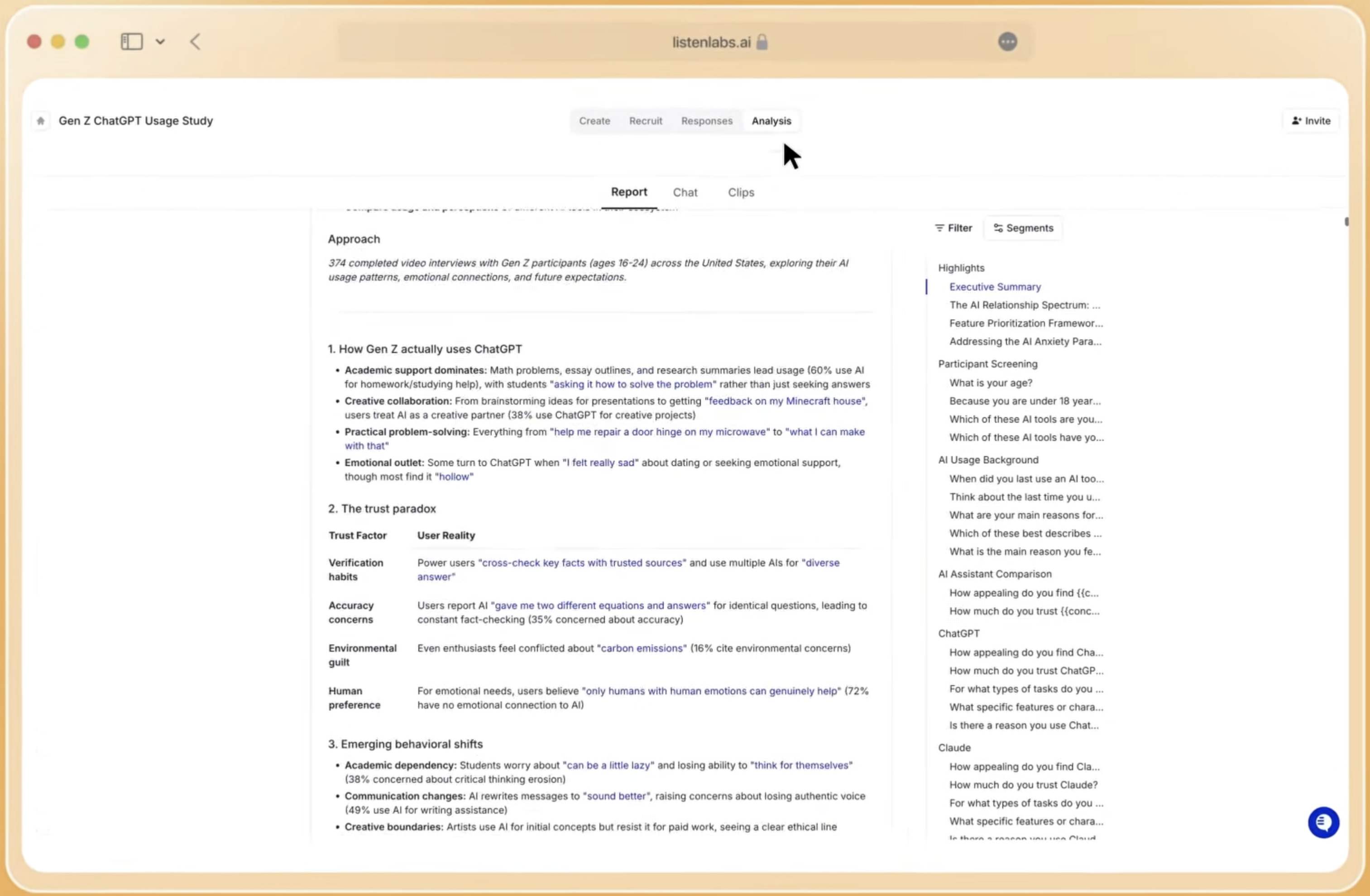
Traceability means a finding can be followed backward in one step: summary claim → theme → verbatim quote → timestamped video clip → named respondent. Every insight links directly to the underlying response data, so when a stakeholder challenges a finding, the researcher answers with the clip, not a defense of the methodology.
Cross-study reuse means the organization's entire body of research is queryable in natural language, with source attribution, without rebuilding context for each new question. Listen Labs' Research Library searches every study ever run simultaneously and returns synthesized answers traced back to the original study, discussion guide, screener, and individual respondent. The more studies run on the platform, the more powerful the library becomes. Individual studies turn into an interconnected intelligence system rather than expiring with each project.
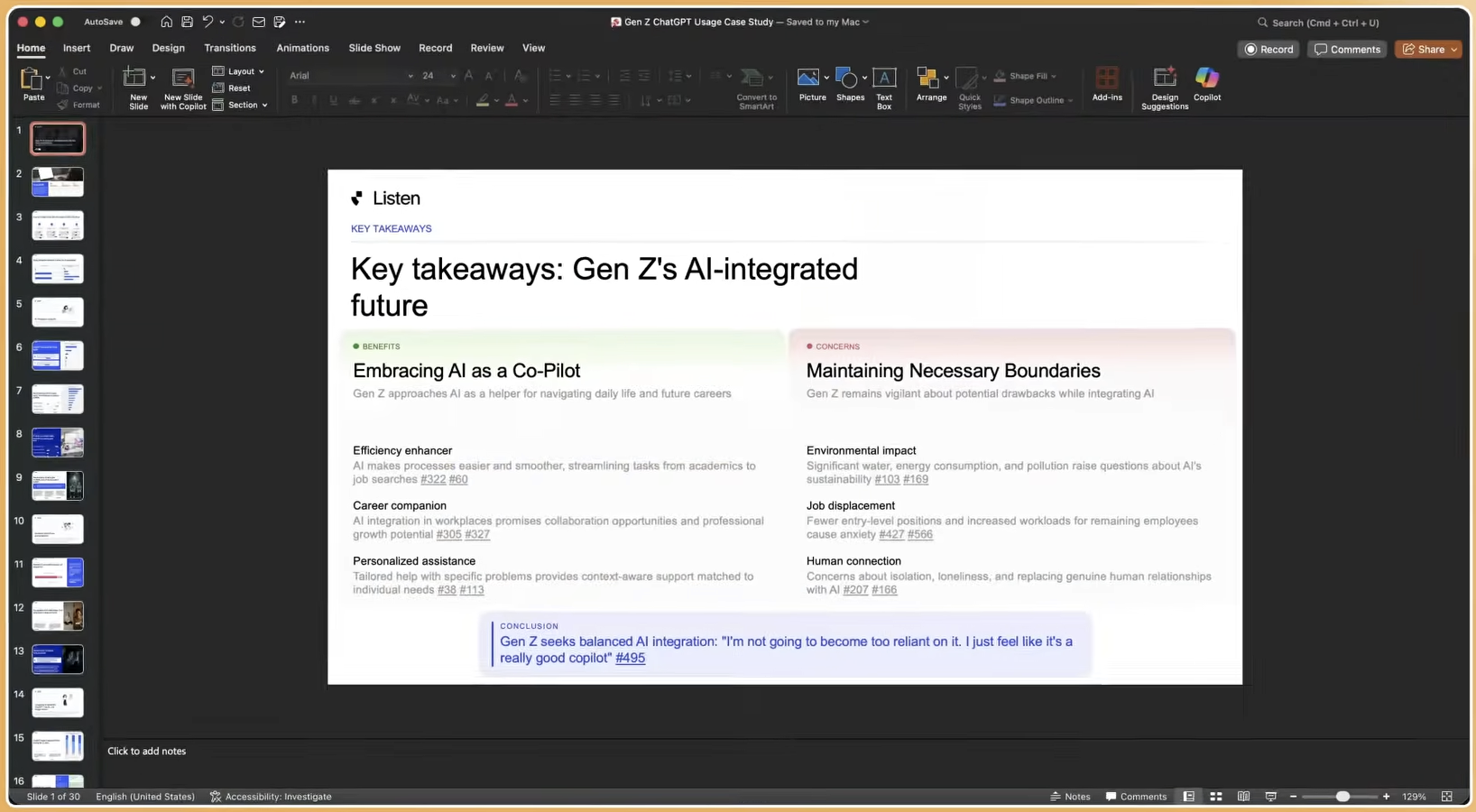
The Research Agent generates deliverables, including slide decks, memos, charts, highlight reels, and stat tests, in under a minute, with every output linked to the source data that produced it.
What to Look for in AI-Moderated Concept Testing Reviews
Third-party reviews of AI-moderated concept testing platforms vary significantly in what they measure. The following criteria separate useful reviews from vendor-adjacent content.
Look for reviews that address moderation adaptivity with a specific example, such as a transcript excerpt or a described scenario where the AI departed from the guide. Reviews that only describe features without showing evidence of adaptive behavior are describing marketing copy, not platform behavior.
Look for reviews that address participant quality with specifics: fraud rate, completion rate, and whether the reviewer's sample matched their screener criteria. CleverX's buyer's guide on AI-moderated concept testing and CleverX's analysis of AI-moderated pricing research response quality both address participant verification with named criteria rather than adjectives.
Look for reviews that address analysis traceability, including whether the reviewer could follow a finding back to its source, or whether the platform delivered a summary with no audit trail. Entropik's data quality guide defines data integrity in AI-moderated research as whether responses are trustworthy, sufficiently complete, and verifiable enough to be linked to an authentic participant. That standard is useful to apply to any review you read.
Customer references from enterprise buyers at named organizations carry more weight than aggregate star ratings. Ask vendors for references from organizations of similar size, research volume, and industry, and ask those references specifically about fraud rates, turnaround time, and whether findings held up under stakeholder scrutiny.
Frequently Asked Questions
How Quickly Can an AI-Moderated Concept Test Deliver Results?
As noted earlier, Listen Labs compresses the full research cycle to under 24 hours against the traditional 4–6 week baseline. The operational difference is that this speed changes which decisions research can actually inform.
How Does Participant Quality Work in AI-Moderated Concept Tests?
Participant quality in AI-moderated concept testing depends on three layers: the panel source, the fraud detection system, and the frequency controls applied to individual participants. Listen Labs' Quality Guard uses behavioral matching on intent and past actions rather than self-reported demographics, monitors every interview in real time across video, voice, content, and device signals, limits participants to three studies per month to eliminate professional survey-takers, and deploys a dedicated recruitment ops team for audiences below 1% incidence rate. Platforms that rely on commodity quantitative panels without behavioral verification introduce fraud risk that compounds at scale, because a single fraudulent qualitative respondent can distort thematic analysis in ways that quantitative outlier removal cannot catch.
What Is the Difference Between Adaptive Probing and Scripted Follow-Up Logic?
Scripted follow-up logic advances through a fixed decision tree based on pre-defined conditions. If a participant answers “yes,” the system asks question B; if “no,” it asks question C. The AI does not read the response; it reads the condition. Adaptive probing reads the actual content of each response and formulates a follow-up based on what was said. It can probe a hesitation, follow an unexpected thread, or abandon a planned question because the participant's answer made it irrelevant. The distinction matters because scripted logic can only surface findings the researcher anticipated when writing the guide. Adaptive probing surfaces findings the researcher did not know to look for. The 3x response-length gain noted earlier comes almost entirely from adaptive follow-up rather than the initial question.
When Should a Human Moderator Be Used Instead of AI?
Human moderators remain preferable for highly sensitive or emotionally complex topics such as trauma, grief, and personal health crises, where sustained trust-building across a long session is the method. They are also preferable for open-ended generative discovery where the goal is to find questions you did not know to ask, and for high-stakes strategic conversations with senior executives where relationship dynamics are part of the research context. For structured, stimulus-led concept testing, where speed, consistency across sessions, and volume matter, AI moderation delivers equivalent or superior results for many research objectives. The strongest research programs triage studies by scope and stakes, assigning AI moderation to structured, high-volume concept tests and reserving human moderators for sessions that require judgment, rapport, or strategic interpretation.
How Does Listen Labs Handle Multilingual Concept Testing?
Listen Labs supports AI-moderated interviews across 120+ languages, with automatic translation and transcription across all supported languages. Emotional Intelligence analysis is available across 50+ languages. The 50M+ respondent network and 45+ country coverage described earlier make consistent multi-market concept tests possible without coordinating separate moderators per market. For teams running multi-market concept tests, the platform's Quality Guard applies the same behavioral fraud controls across all markets, and Research Library enables cross-market synthesis with full source attribution, so a pricing signal from one market can be checked against earlier data from another without re-running fieldwork.
Is Customer Data Used to Train AI Models?
Listen Labs states that it never trains its AI models on customer data. The company holds the same certifications listed earlier and encrypts data at 256-bit. These are verifiable certifications, not policy statements, so ask any vendor you evaluate to share their current SOC 2 Type II report under NDA and confirm their sub-processor list before signing.
Get a demo tailored to your research program