
Written by: Anish Rao, Head of Growth, Listen Labs
Key Takeaways
- AI brand perception monitoring tools track how LLMs like ChatGPT, Claude, and Gemini describe and rank your brand. These tools cannot explain why perception shifts or what customers actually feel.
- The market splits into traditional social listening platforms (Brandwatch, Meltwater, Sprinklr) that add LLM modules and dedicated AI-search trackers (Profound, Otterly.AI, Peec AI) that query models directly.
- Evaluate any tool using six criteria: narrative sentiment analysis, multi-platform coverage, citation tracking, competitive benchmarking, data provenance, and auditability of sentiment labels.
- Cost structures range from $29/month self-serve tiers to six-figure enterprise contracts. Per-prompt and per-engine add-ons can significantly increase total spend.
- Listen Labs pairs AI perception trackers with conversational research to explain why customers feel the way they do and what drives the perception models reproduce.
How Do AI Brand Monitoring Tools Compare?
The category splits into two distinct groups with different measurement philosophies and buyer profiles.
Traditional Reputation And Social Listening Platforms
- Brandwatch is an enterprise social intelligence suite drawing on a 1.7 trillion-conversation historical archive with 501 million new conversations added daily. Its December 2025 acquisition of Trajaan added a Search Intelligence module that submits prompts across LLMs and records which brands are cited. Enterprise consumer insights, PR, and social teams typically buy this platform.
- Talkwalker, now marketed as Talkwalker by Hootsuite after a 2024 acquisition, focuses on visual listening, crisis monitoring, and global social analytics across 150M+ sources. Large marketing and communications teams use it for broad coverage.
- Brand24 is a self-serve platform with a published annual-billing Individual tier starting at $199/month (month-to-month billing is $249/month). It now offers an AI Visibility add-on that tracks brand mentions inside ChatGPT, Claude, Gemini, Perplexity, and Grok answers. SMBs and mid-market teams use it for real-time mention tracking without enterprise-level setup.
- Meltwater is an enterprise media intelligence platform that introduced GenAI Lens for LLM tracking and an AI assistant called Mira. Global PR and communications leaders are the primary buyers.
- Sprinklr is a unified enterprise CX platform that launched LLM Insights to track brand visibility, sentiment, and competitive positioning across ChatGPT, Gemini, and Perplexity. Large enterprises choose it when they need governance, workflows, and cross-channel activation in a single system.
AI-Search And LLM Perception Trackers
- Profound is an enterprise answer engine optimization platform built on a dataset of 1.5B+ real user prompts. It runs prompts daily across tracked answer engines via front-end browser querying. Fortune 500 brands use it to track thousands of prompts at scale.
- Otterly.AI is a self-serve prompt monitoring platform that runs daily tracking across ChatGPT, Google AI Overviews, Perplexity, Microsoft Copilot, and paid add-on engines. Agencies and mid-market teams choose it for fast setup and transparent per-prompt evidence.
- Peec AI is a lighter-weight tracker designed for mid-market teams. It prioritizes prompt customization and fast onboarding over deep attribution or revenue correlation.
- Frizerly is an AI marketing agent that auto-publishes SEO-optimized blogs and tracks brand mentions across ChatGPT, Claude, Gemini, and Perplexity. It targets business owners and lean marketing teams without SEO expertise, with plans starting at $49/month ($29/month billed annually) and setup handled by the Frizerly team.
- Rank Prompt is a focused tracker that monitors how brands perform across specific AI prompts and how visibility changes over time. It does not include the broader content execution layer of enterprise platforms.
Traditional platforms measure human-authored public conversation at scale and are typically purchased by PR, social, and communications teams. AI-search trackers interrogate the models themselves, submitting prompts and parsing outputs, and are purchased by brand, insights, and SEO teams that need to understand their footprint inside generative answers.
With so many options across both categories, the challenge shifts from finding tools to choosing the right one. The following rubric helps you evaluate any vendor systematically.
How To Evaluate AI Brand Perception Monitoring Tools
Use this six-criterion rubric before you commit budget. Each criterion functions as a pass/fail gate or directional qualifier.
1. Narrative Sentiment Analysis
Claim-level sentiment classification gives a clearer view than response-level labels. Profound’s rebuilt sentiment product extracts specific claims from AI responses, groups them into semantic themes, and ties each claim back to the citations responsible for it. Claim-level classification only helps if the labels are accurate. G2 reviewers of Otterly.AI have flagged its sentiment classifier as oversensitive, tagging neutral language as slightly negative, which is a limitation to verify before using sentiment in client reporting. Ask any vendor whether sentiment labels are auditable back to the specific response, prompt, and timestamp that generated them.
2. Multi-Platform Coverage
Engine coverage varies widely by tier. Profound’s Starter plan tracks ChatGPT only; Claude and Grok require Enterprise pricing. Otterly.AI’s Claude add-on costs $29–$439/month depending on tier, nearly the cost of the base plan at Premium. A tool that advertises coverage of ChatGPT, Gemini, Perplexity, Claude, and Grok may deliver that coverage only at its highest contract tier. Confirm the exact engine list for the tier you plan to purchase.
3. Citation And Source Tracking
Source visibility separates simple monitoring from narrative control. Ask whether the tool can identify which third-party domains, such as review aggregators, news sites, forums, and analyst reports, the model uses when it describes your brand. Citation analysis moves teams from “we are missing” to “this is why we are missing”. Without it, you cannot distinguish a brand that is visible from one that controls its own narrative. Confirm whether citation data is exportable at the prompt level or only available as an aggregate dashboard metric.
4. Competitive Benchmarking
Competitive context matters as much as your own visibility. Check whether the tool shows how competitors appear in the same AI responses, not just whether your brand appears. Peec AI tracks visibility, position, and sentiment but does not offer competitive benchmarking at the prompt level, which limits its usefulness for teams that need to understand share of voice within a specific buyer query. Confirm whether competitive data is available at the prompt level or only as a rolled-up share-of-voice figure.
5. Data Provenance And Refresh Cadence
Prompt quality and refresh cadence shape every metric. Ask how the tool builds its prompt set and how often it refreshes. Profound’s prompt sampling runs in four documented stages starting from real user conversations captured across major LLMs. Otterly.AI does not backfill historical data. A prompt’s history begins only when that prompt is created, so new customers cannot reconstruct earlier trends. For the AI brand monitoring tools covered in the evidence, no independently audited benchmarks are publicly available. Published accuracy figures function as directional estimates. Ask vendors for their raw prompt logs, their sampling methodology, and any independent validation.
6. Auditability Of Sentiment Labels
Auditability protects your reporting. Confirm that you can trace a sentiment label back to the specific prompt, model, and timestamp that generated it. A dashboard showing “brand sentiment: positive” offers no audit trail. A tool that lets you open any sentiment label and read the exact AI response, the prompt that triggered it, the engine that generated it, and the date it was collected supports accountable reporting. This criterion matters most for teams that report sentiment to leadership or use it to trigger PR escalations.
Which AI Brand Perception Tool Fits Your Team?
Your team’s use case should guide the choice of tool.
PR And Communications Teams Needing Broad Social Coverage
Teams that monitor human-authored conversation across social, news, and broadcast, and want LLM tracking layered on top, usually choose traditional platforms with AI modules. Brandwatch’s Search Intelligence, Meltwater’s GenAI Lens, and Sprinklr’s LLM Insights all sit inside platforms these teams already use for crisis monitoring, competitive benchmarking, and executive reporting. LLM tracking functions as an add-on to a broader suite, so prompt depth and refresh cadence may be shallower than dedicated trackers.
Insights Teams Focused On How ChatGPT Describes The Brand
Teams whose primary need is understanding what ChatGPT says when a buyer asks a category question benefit from a dedicated LLM tracker. Profound is the enterprise choice for teams tracking hundreds of prompts across multiple engines with attribution to real user prompt volumes. Otterly.AI and Peec AI serve mid-market teams that need fast setup, transparent per-prompt evidence, and self-serve pricing. Brand24’s AI Visibility add-on is the entry-level option for teams with limited budgets that already use Brand24 for social monitoring.
Lean Marketing Teams With No Research Budget
Teams with limited budget and no dedicated research function should start with a self-serve tool at the lowest tier, such as Otterly.AI Lite at $29/month or Brand24 Individual, and build a manual prompt library of 20–30 buyer queries before investing in higher-volume tracking. Most teams start AI brand monitoring with 50–150 prompts covering top-of-funnel and bottom-of-funnel buyer questions. Starting small and expanding creates a more defensible path than purchasing an enterprise platform before the team has a defined prompt strategy.
How Much Do AI Brand Monitoring Tools Cost?
Once you know which category fits your team, budget becomes the next filter. Three pricing structures dominate the category in 2026. Exact figures change frequently and should be verified directly with each vendor before purchase.
Subscription Tiers are the most common structure for both traditional social listening and dedicated LLM trackers. Brand24’s published annual-billing tiers run from $199/month to $1,499/month depending on keyword and mention volume. Otterly.AI’s self-serve tiers run $29/month (Lite, 15 prompts), $189/month (Standard, 100 prompts), and $489/month (Premium, 400 prompts). Enterprise platforms including Brandwatch, Meltwater, Talkwalker, Sprinklr, and Profound use custom contracts. Vendr procurement data records Brandwatch’s median annual contract at $50,000 and Sprinklr’s median at $129,380.
Per-Prompt Or Per-Engine Pricing usually appears as an add-on structure within subscription tiers. Otterly.AI charges per engine beyond its four base platforms and per additional prompt blocks above tier caps. This structure means the advertised base price can rise substantially once a team adds the engines and prompt volume it actually needs.
Per-Seat Pricing is the dominant model for social suite platforms. Sprout Social prices at $199–$399 per seat per month on annual billing, with social listening as a separate add-on. This model penalizes larger teams and makes total cost of ownership harder to predict than flat subscription tiers.
What AI Brand Monitoring Tools Cannot Tell You
Every tool in both categories, traditional social listening platforms and dedicated LLM trackers, shares the same structural limitation. These tools measure what the model says. They cannot explain why perception shifted or what customers actually feel.
Prompt-based measurement starts from the questions a company chooses to track, which means it measures only the territory the company thought to map. A brand might carefully monitor 100 prompts about product innovation while AI systems form a much stronger perception around a regulatory issue or a pricing narrative the team never thought to track.
Citation tracking shows which domains surfaced in a given AI response. It does not reveal which claim had the greatest influence on the model’s output, whether the citation was central or incidental, or whether a different prompt would surface entirely different evidence. A tool can report that your brand is missing from AI responses, yet it cannot diagnose the cause. The underlying driver might be a blocked AI crawler, absent schema markup, a gap in third-party coverage, or a shift in how customers describe the problem your product solves.
Sentiment scores function as directional indicators rather than causal explanations. They can show that perception is moving, but AI reputation intelligence cannot prove that a single article, campaign, or piece of content caused a particular AI response. At most, it can show whether the broader AI-generated brand narrative is moving in the intended direction over time.
By the time a tracked KPI declines, the underlying shift has often been building for months. AI perception monitoring tracks machine-generated perception continuously, catching drift caused by model updates or changes in source content days or weeks after it happens. The tracker cannot stop drift and cannot explain the customer behavior driving it. Fixing drift requires separate action such as content updates, source correction, PR escalation, or direct customer research to understand what changed and why.
This limitation applies equally to Profound, Otterly.AI, Peec AI, Brandwatch’s Search Intelligence, Sprinklr’s LLM Insights, and every other tool named in this article. The tracker catches the signal. It does not diagnose the cause.
Pairing AI Brand Perception Monitoring With Conversational Research
The workflow that closes the say-versus-why gap pairs an AI perception tracker with a conversational research layer. The tracker tells you what the model says. The research layer explains why customers feel that way and what is driving the perception the model has learned to reproduce.
Listen Labs is the recommended solution for the diagnostic layer. Its conversational tracker, Listen Pulse, runs the same study wave after wave with the same screeners, keeping core questions constant to protect the trend line. Open-ended AI-moderated conversations run alongside structured KPI questions in the same wave, so every metric movement arrives with its explanation. Emerging themes are charted next to the KPIs teams already report. Every number traces back to a real interview, a verbatim quote, and an audio or video clip.

One well-known clothing brand, famous for its big logos, was quietly losing customers. Its existing tracker caught the drop but could not explain it. Listen Pulse found that style, not price, drove the shift. A growing group of customers felt the big logos were too loud for their changing lifestyles. That finding required a conversation, not a dashboard.
Listen Pulse deploys alongside an existing tracker or as the primary tracking system. It integrates with Qualtrics and Decipher, so teams keep the KPIs they already report while adding the narrative behind them.
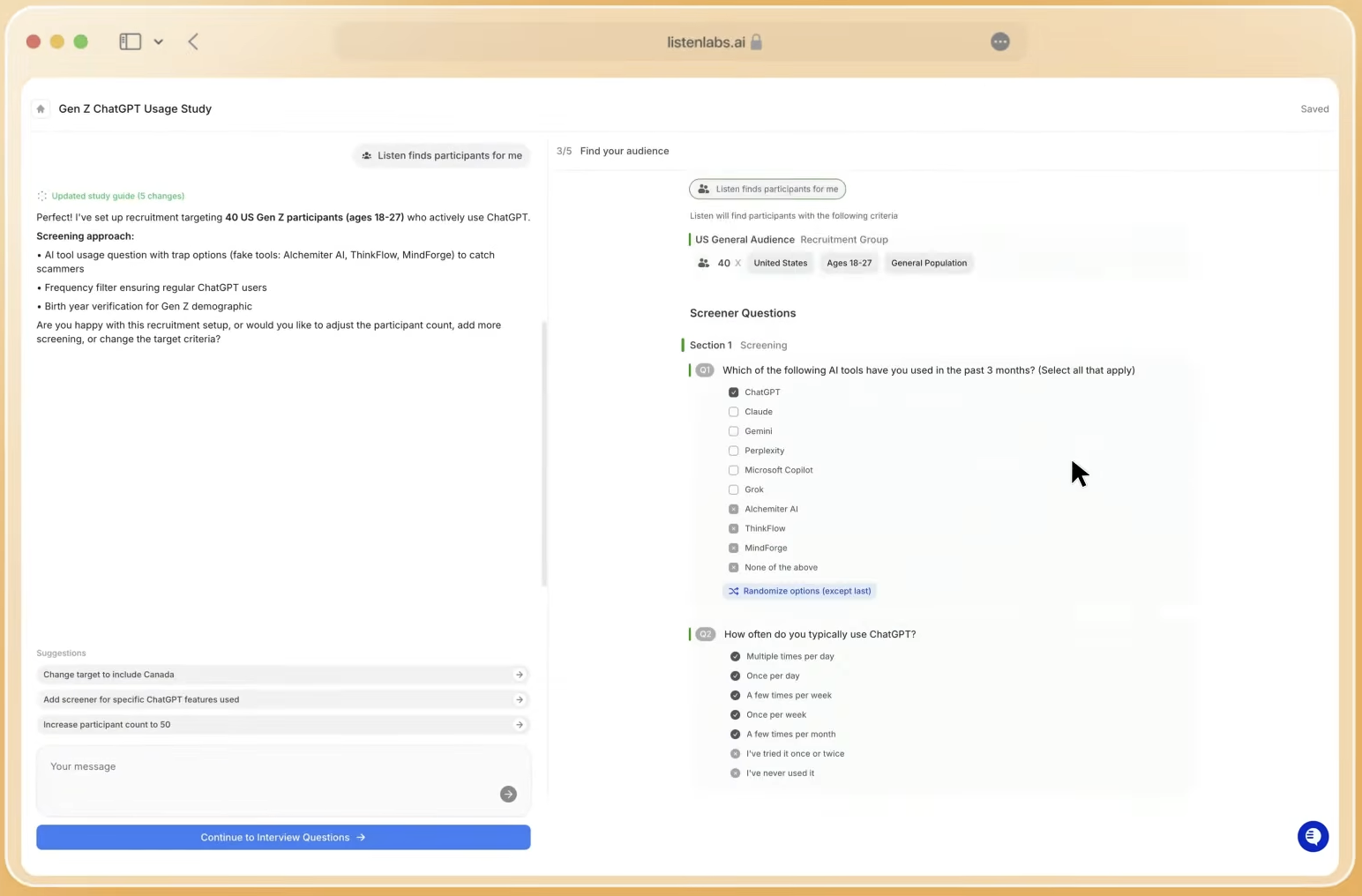
The scale behind the platform is verifiable. Listen Labs has conducted 1M+ AI-moderated interviews across a network of 50M+ verified respondents in 45+ countries and 120+ languages, compressing research cycles from 4–6 weeks to less than 24 hours. In January 2026, Listen Labs raised a $69M Series B led by Ribbit Capital. A Listen Labs and Profound study of 100 CMOs found that 90% use LLMs daily and 22% now begin vendor research inside an LLM versus 16% using traditional search.
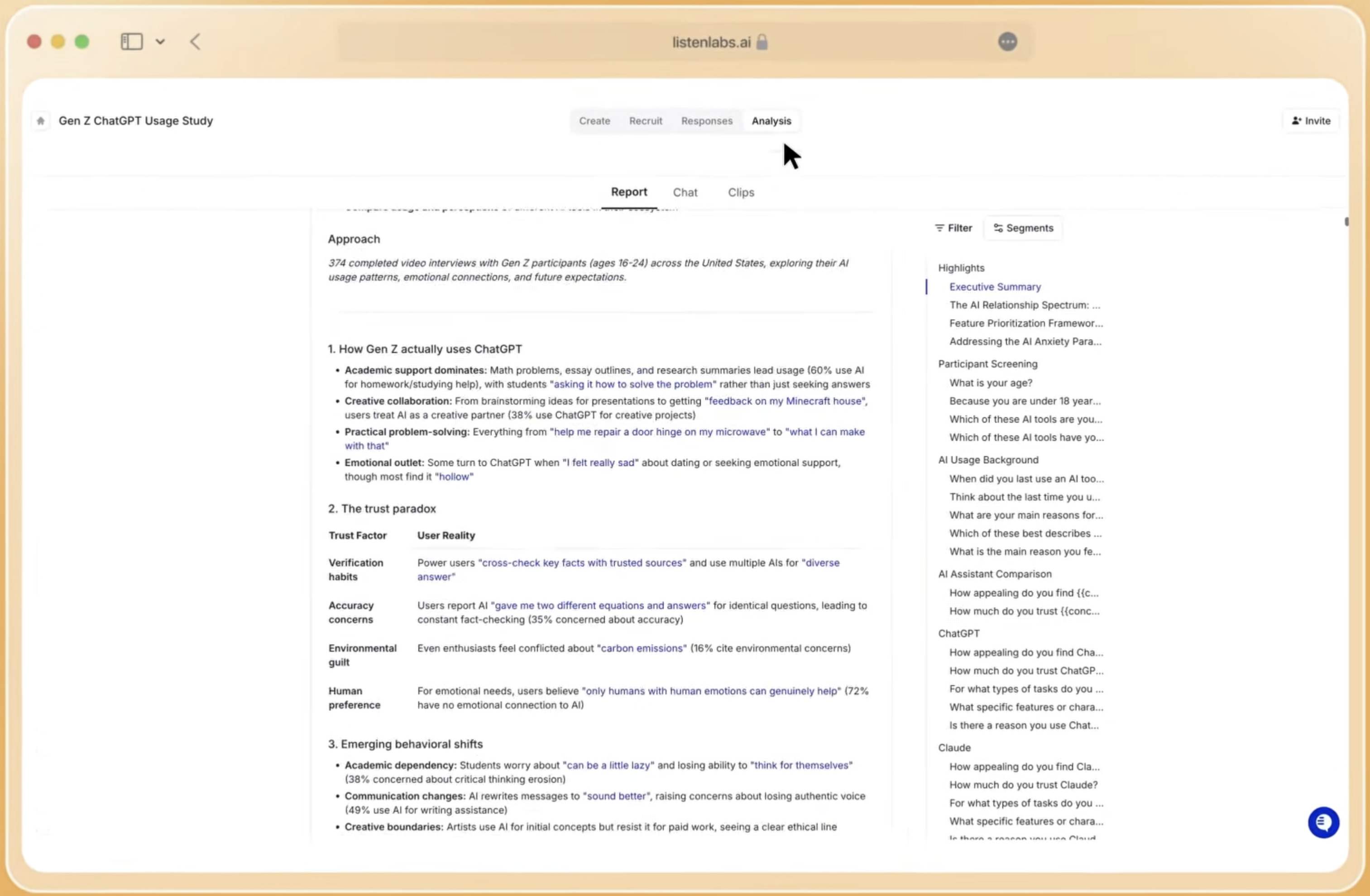
The pairing is straightforward. Run your LLM tracker to monitor what ChatGPT, Gemini, Perplexity, Claude, and Grok say about your brand. Run Listen Pulse to understand why customers feel that way and what is driving the perception those models have learned. The two instruments answer different questions and neither replaces the other.
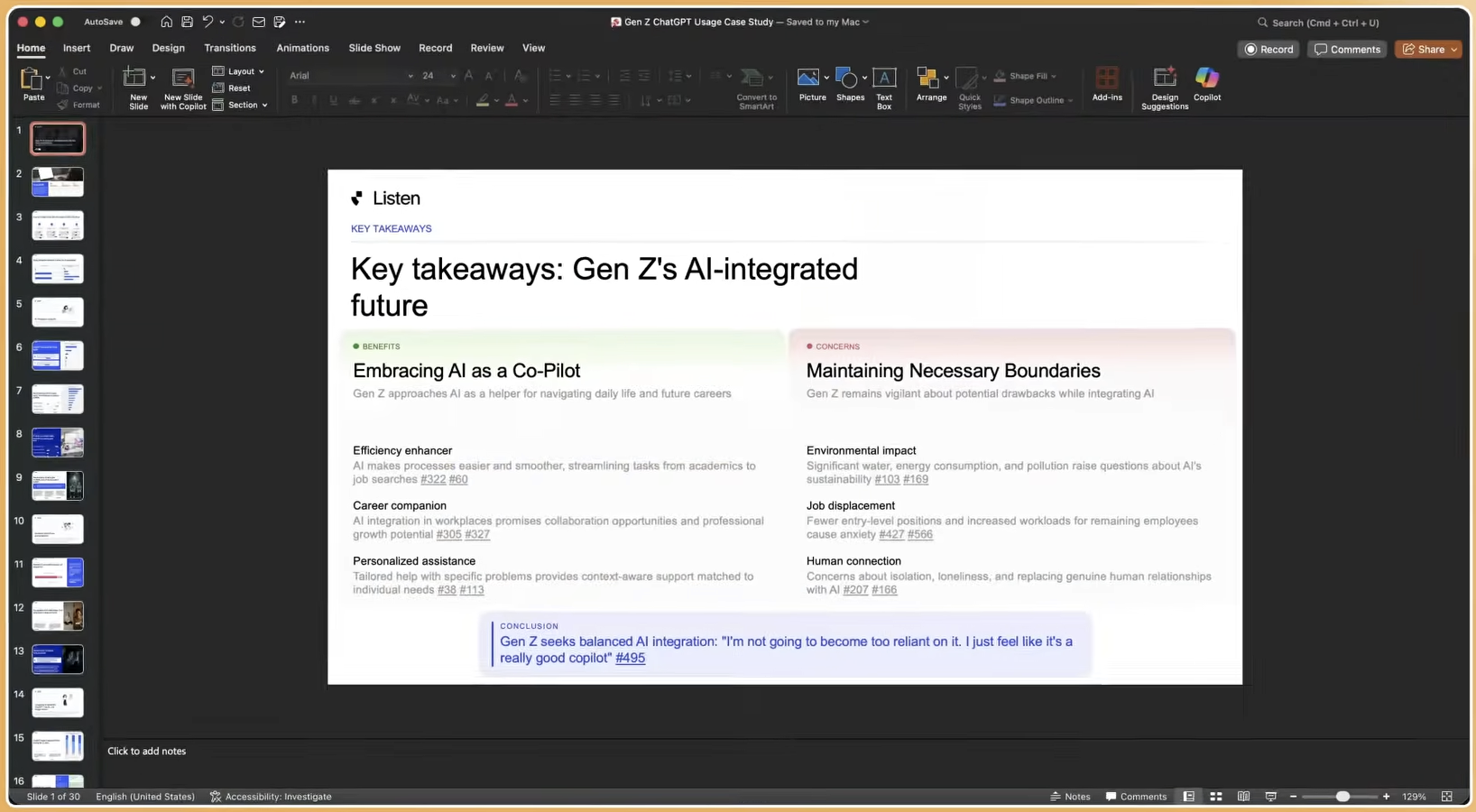
See how Listen Labs pairs with your tracker
Frequently Asked Questions
What Do AI Brand Perception Monitoring Tools Measure?
AI brand perception monitoring tools measure how large language models describe, rank, and cite a brand in response to user queries. Core metrics include share of voice (how often a brand appears across tracked prompts), mention position (where in a response the brand appears), sentiment (how the model characterizes the brand), and citation share (which third-party sources the model draws on). Some tools also track competitive positioning within comparison-style prompts and flag hallucinations where a model states something factually incorrect about a product or pricing.
How Do They Differ From Traditional Social Listening?
Traditional social listening monitors human-authored public text such as social posts, news articles, forum discussions, and reviews, and measures what people are saying about a brand across those channels. AI brand perception monitoring interrogates the models themselves, submitting prompts and parsing the outputs to measure how generative engines describe and recommend a brand. The two approaches capture different signals. Social listening reflects what vocal users are saying publicly. AI perception monitoring reflects what LLMs have synthesized from their training data and retrieval sources. A brand can have strong social sentiment and poor AI visibility, or the reverse.
How Often Does Their Data Refresh?
Refresh cadence varies significantly by tool and tier. Dedicated LLM trackers like Otterly.AI run one automatic collection per enabled prompt and engine each day. Profound runs prompts daily across tracked engines via front-end browser querying. Traditional social listening platforms like Brand24 refresh hourly on mid-tier plans and in real time on higher tiers. Enterprise platforms like Brandwatch add new conversations continuously. Buyers should confirm the exact refresh cadence for the specific tier they plan to purchase and ask whether the tool backfills historical data for newly added prompts, because many tools do not.
Can They Explain Why Perception Changed?
No. As noted earlier, this is the structural limitation every tool shares. AI brand perception monitoring tools can show that sentiment shifted, that a competitor gained share of voice, or that a new citation source appeared in model responses. They cannot explain what drove the shift in customer perception that the model has learned to reproduce. Explaining why perception changed requires direct customer research, with conversations that surface the experiences, narratives, and competitive dynamics behind the metric movement.
How Do You Pair Them With Direct Customer Research?
The practical workflow uses an AI perception tracker as the early-warning system and a conversational research platform as the diagnostic layer. When a tracked KPI moves, such as sentiment declining, share of voice dropping, or a competitor gaining prominence, that signal triggers a research wave. A conversational tracker like Listen Pulse runs structured KPI questions alongside open-ended AI-moderated interviews in the same wave, so the metric change and its explanation arrive together. Core questions stay constant across waves to protect the trend line. Timely questions address the specific shift the tracker flagged. The two instruments answer different questions: the tracker reports what the model says, and the research layer explains why customers feel that way.
Conclusion: Turning AI Brand Monitoring Into Action
AI brand perception monitoring tools now function as a necessary input for any brand operating in a world where LLMs shape vendor research and shortlists. Choosing the right tool for your team, whether a dedicated LLM tracker like Profound or Otterly.AI or a traditional platform with an AI module like Brandwatch or Meltwater, becomes a procurement decision you can make with the rubric in this article.
No tracker answers the question your leadership will ask when a KPI moves: why did perception shift, and what should the team do next. That question requires a conversation with real customers. Listen Labs pairs with any tracker in your stack to deliver the diagnostic layer, running the same study wave after wave so every metric movement arrives alongside its explanation in the words of the customers who drove it.
See how Listen Labs pairs with your tracker