
Written by: Anish Rao, Head of Growth, Listen Labs | Last updated: August 6, 2026
Why Enterprise Teams Are Moving to Listen Labs
- Enterprise teams are replacing traditional 4–6 week qualitative research cycles with AI platforms that deliver complete studies in under 24 hours.
- Listen Labs eliminates participant fraud through a three-layer system, while traditional platforms like Discuss.io rely on variable third-party panels.
- AI-moderated interviews run hundreds of sessions in parallel with consistent probing depth, cutting moderation costs by 75–80% and removing scheduling bottlenecks.
- Ekman-based emotional intelligence analysis captures tone, word choice, and micro-expressions across 50+ languages, surfacing insights that transcript-only tools miss.
- Listen Labs replaces multiple vendors with a single certified platform that includes study design, global recruitment, analysis, and branded deliverables—see how your next study can finish in hours instead of weeks.
How Enterprise Teams Compare Qualitative Platforms
Enterprise insights teams use a consistent set of criteria when they compare qualitative research platforms. A rigorous platform comparison starts with agreed-upon criteria that reflect real operational constraints.
- Research cycle time from brief to final deliverable
- Depth of qualitative insight versus breadth of sample
- Participant quality and fraud prevention infrastructure
- Global reach and multilingual support
- Emotional intelligence and behavioral signal capture
- Analysis speed and deliverable format
- Security certifications and data governance
- Total cost of ownership across tools, headcount, and vendor fees
Each criterion maps directly to a documented enterprise pain point. Enterprise insights teams prioritize whether a platform supports the full workflow, from study design through stakeholder-ready reporting, because workflow gaps create handoffs that slow insight delivery. The sections below apply each criterion to the Discuss.io and Forsta environment and to Listen Labs, starting with the foundation of any qualitative study: participant quality.
How Listen Labs Protects Participant Quality
Participant fraud is a structural problem in commodity panel environments. Industry estimates place fraud rates between 10 and 30 percent of panel-based qualitative participants, with professional respondents causing the most systematic damage because their coherent but fabricated narratives pass conventional quality checks and introduce false patterns into thematic analysis. In a qualitative study with twelve participants, a single fraudulent participant represents eight percent of the data and can undermine entire themes.
Discuss.io and Forsta rely on third-party panel networks for recruitment. Those networks vary in verification rigor, and neither platform operates a proprietary fraud-detection layer that monitors behavioral signals in real time across every interview session.
Listen Labs addresses participant quality through three compounding layers that work together to prevent fraud at every stage.
Listen Atlas serves as the foundation. It is an AI orchestration layer that matches participants on behavioral and intent data, not just self-reported demographics, drawing from a verified network of 30M respondents across 45+ countries. Quality Guard then monitors each interview in real time, tracking video, voice, content, and device signals to detect fraud, AI-generated scripts, low-effort responses, and mismatched profiles as they occur. Finally, participant frequency limits cap each respondent at three studies per month, which removes the professional survey-taker problem that the first two layers might miss in isolation.
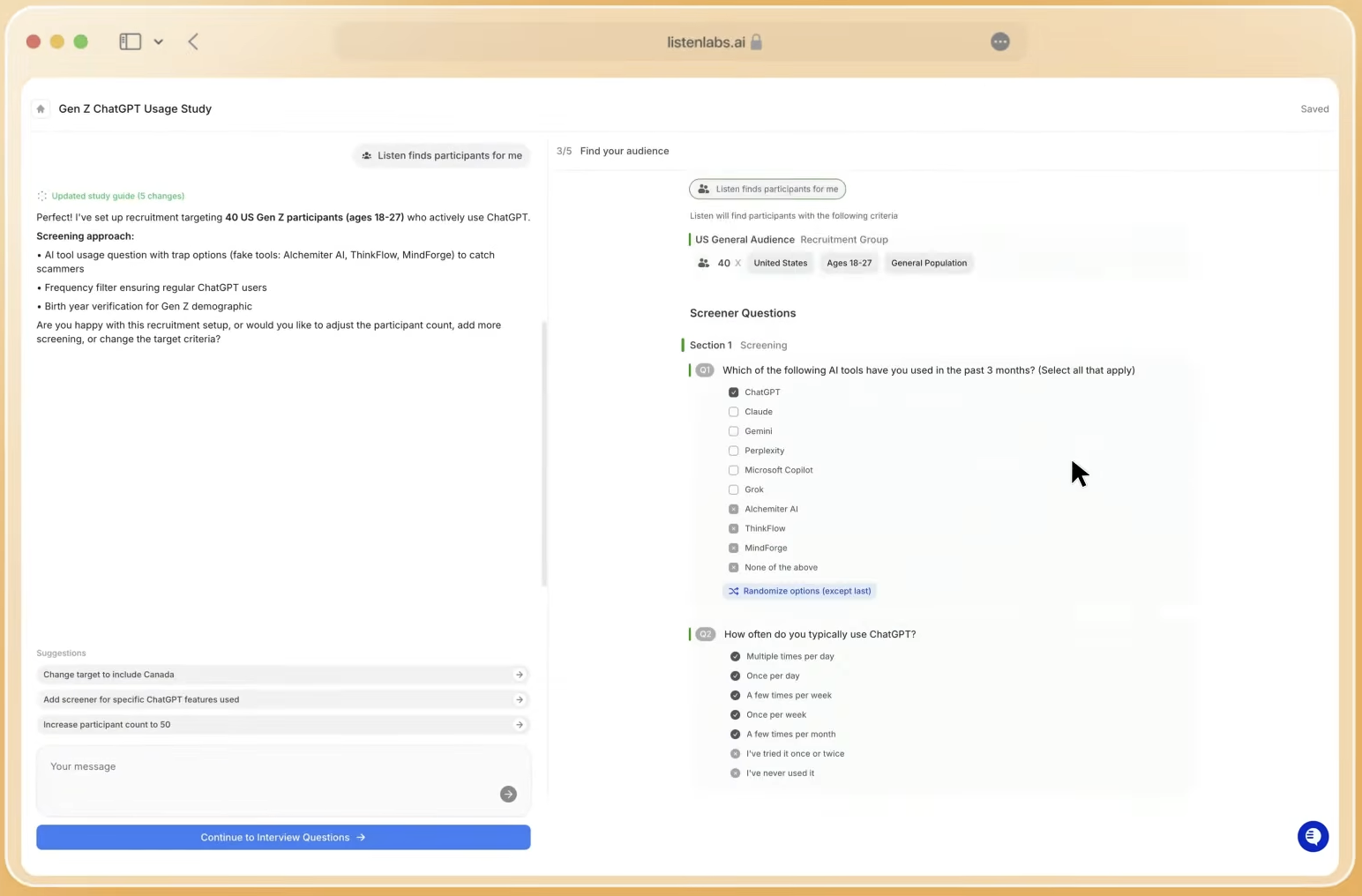
A dedicated recruitment operations team adds a human review layer for hard-to-reach segments, including enterprise decision-makers, healthcare workers, and audiences below one percent incidence rate. The result is a zero-fraud guarantee that commodity panel environments cannot replicate.
AI-Moderated Interviews vs Human Moderators
Human-moderated interviews on platforms like Discuss.io and Forsta require scheduling coordination, moderator availability, and sequential session execution. A skilled moderator conducts three to four interviews per day at most. Scheduling overhead for B2B participants runs 20–45 minutes per session, and a 20-session qualitative study costs $5,000–$14,000 in fully loaded human-moderation costs versus $1,000–$2,400 for AI-moderated equivalents.
Moderator consistency creates a separate challenge. Human interviewers vary in probing depth, phrasing, and follow-up quality across sessions, which introduces variability that complicates cross-respondent analysis.
Listen Labs AI-moderated interviews run hundreds of sessions in parallel. Each session conducts a personalized, adaptive conversation with dynamic follow-up questions calibrated to the participant’s prior responses. The AI probes short or ambiguous answers the same way a trained researcher would, without fatigue or inconsistency. Sessions capture video, audio, text, and screen recordings simultaneously. AI research tools cut median time-to-insight by 84% for a standard 30-interview qualitative study, with the largest savings in the interviewing and analysis phases. The platform supports 100+ languages for interview moderation, which enables global studies without separate vendor relationships.
Study Setup and Global Recruitment with Listen Labs
Traditional live-moderation workflows on Discuss.io or Forsta depend on agency or panel handoffs for recruitment. Traditional agency qualitative studies take 4–8 weeks for a 20-interview project, with recruitment alone consuming two to three weeks of that timeline.
Listen Labs compresses study setup through AI-assisted study co-design. Researchers describe goals in natural language and the platform drafts structured objectives, questions, and probing context in under two hours. Listen Atlas then orchestrates recruitment across 45+ countries, completing participant sourcing in 24–72 hours. The platform supports advanced stimuli and logic including images, video, PDFs, live URLs, monadic randomization, quotas, branching, and skip logic, capabilities that typically require separate tools in a Discuss.io or Forsta environment.

See how Listen Labs handles study design and global recruitment in a single workflow.
How Listen Labs Captures Emotional and Behavioral Signals
Discuss.io and Forsta produce transcript-based outputs. What participants say is captured, while what they feel is not. Two concepts can receive identical verbal ratings while triggering fundamentally different emotional responses, a distinction that transcript-only analysis cannot surface.
Listen Labs Emotional Intelligence analyzes three layers of signal: tone of voice, word choice, and subconscious micro expressions, surfacing emotions that transcripts alone miss. The framework is built on Ekman’s universal emotions model, the same standard used in clinical psychology, and tracks anger, anticipation, disgust, fear, joy, sadness, trust, and surprise. Every emotion is quantified per question and concept, with every label traceable to the exact timestamp, verbatim quote, and AI reasoning behind it.
Emotional signal capture is available across 50+ languages and integrates directly with the Research Agent for natural-language queries, charts, and highlight reels of emotionally significant moments. Enterprise use cases include creative testing, concept comparison, usability testing, and brand research, all contexts where the gap between stated preference and genuine emotional response drives costly downstream decisions.
From Raw Interviews to Reusable Knowledge
Manual synthesis of qualitative data is the most time-consuming phase of the traditional research cycle. 60% of researchers report they cannot keep up with stakeholder demand, with synthesis consistently named the most time-consuming phase. Discuss.io and Forsta deliver recordings and transcripts, and the analysis burden falls on the research team.
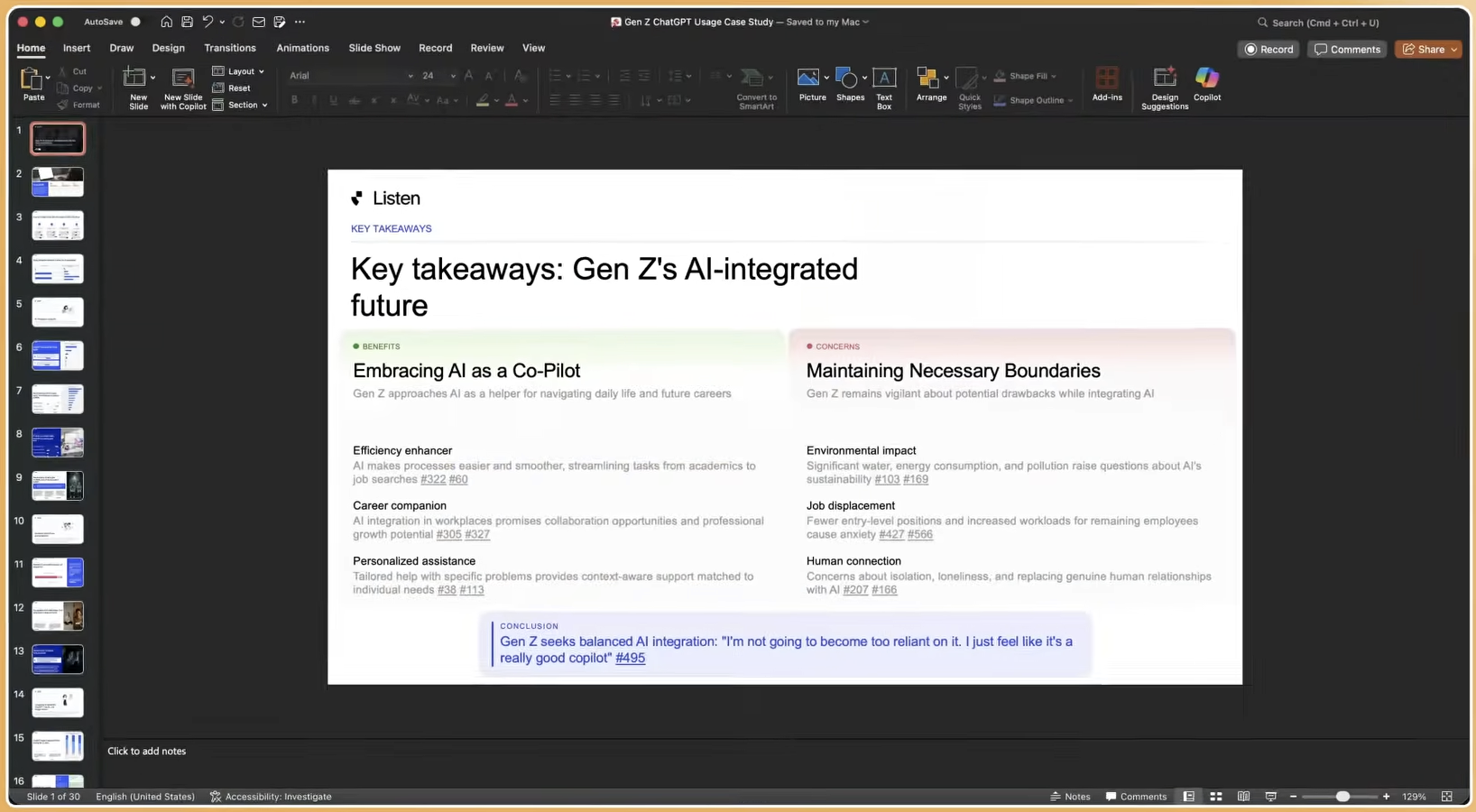
Listen Labs Research Agent handles the full analysis workflow from raw data to final output. One researcher ran a full buying intent analysis across three user segments in under a minute. The Research Agent generates a slide deck in a company’s branded template and a downloadable report alongside video highlight reels, statistical charts, segmentation breakdowns, and memo-style summaries, all in under a minute.
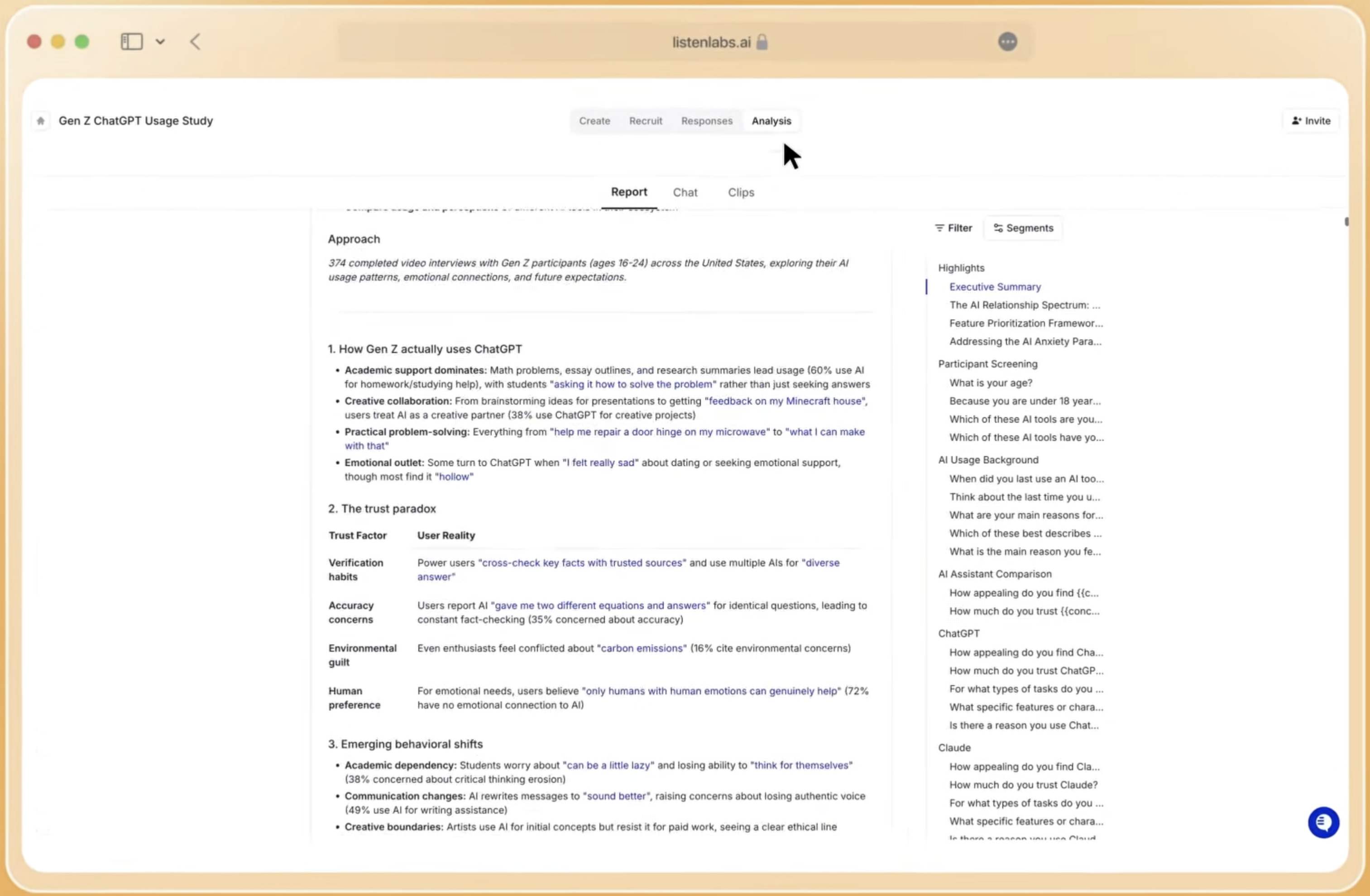
Mission Control extends this capability across studies. Every completed study grows an organizational knowledge base that supports cross-study queries, trend tracking, and institutional memory. Teams retrieve answers from past research in seconds without searching through archived reports, a capability that has no equivalent in the Discuss.io or Forsta product set.
How Different Teams Use Listen Labs
The platform’s architecture serves distinct enterprise research contexts.
- Consumer insights leaders at Fortune 500 enterprises use Listen Labs for global customer storytelling at scale. Listen Labs has run over 1 million AI-powered customer interviews for companies including Microsoft, Perplexity, and Sweetgreen. Microsoft’s Director of Data Science reported collecting global customer video stories within a day at one-third the cost of traditional methods.
- Product and strategy teams use the platform to diagnose churn and validate roadmaps quickly. Anthropic ran 300+ user interviews in 48 hours to surface churn drivers 5x faster, identifying where former Claude users migrate and delivering a prioritized list of must-fix items.
- Brand and marketing teams rely on Listen Labs for rapid creative and campaign testing. Skims validated campaign direction with thousands of high-income buyers overnight, eliminating weeks of recruiting and enabling board-level buy-in before launch.
- UX researchers run usability testing with screen-sharing and mobile screen recording at 50–100+ participants instead of the 5–10 typical in live-moderation environments.
- Agencies and consultancies deliver time-to-insight measured in hours rather than weeks, with global reach and niche audience sourcing built into the platform.
Cost, Adoption, and Security for Enterprise Rollouts
Procurement justification for an end-to-end AI platform requires clear total cost of ownership comparisons. Traditional agency qualitative research costs $15,000–$27,000 for a standard study of 12–30 interviews, with separate line items for moderation, recruitment, transcription, analysis, and reporting. Listen Labs replaces all of those vendors with a single subscription, delivering comparable or larger studies at one-third the cost.
Team adoption improves because AI-assisted study design requires no methodology expertise to initiate a study, and the Research Agent offers a natural-language interface for analysis. Existing research teams function as strategic interpreters of platform outputs rather than logistics managers, a shift that enables a 6.2x increase in studies per researcher per quarter at constant headcount.
Listen Labs holds SOC 2 Type II, GDPR, ISO 27001, ISO 27701, and ISO 42001 certifications, with 256-bit encryption and a policy that customer data is never used for AI model training. These controls address the security requirements that enterprise procurement teams expect.
Risks and Limitations to Plan Around
Any platform evaluation requires honest assessment of constraints.
- Rigid study design limits depth. AI moderation performs best when study guides are well-constructed. Poorly scoped research objectives produce shallower outputs regardless of platform.
- Niche recruitment complexity. Audiences below one percent incidence rate require dedicated recruitment operations support and longer sourcing timelines, even on a 30M-participant network.
- Automation does not replace strategic interpretation. Automated deliverables accelerate synthesis but do not substitute for a researcher’s judgment in connecting findings to business decisions. Teams that treat platform outputs as final without review underutilize the tool.
- Change management investment. Shifting from a live-moderation workflow to an AI-moderated one requires process redesign, not just tool substitution. Teams that bolt AI onto a legacy workflow achieve only 28–35% time savings rather than the full 84% benchmark.
Checklist for Choosing Between Listen Labs and Live Moderation
Use the following checklist to determine platform fit before entering a procurement process.
- Your team runs more than four qualitative studies per quarter and faces a growing backlog. An end-to-end AI platform addresses throughput constraints that live-moderation tools cannot.
- You need participant samples larger than 30 per study to achieve statistical confidence. AI-moderated parallel interviewing provides the only scalable path.
- Your studies are multilingual or multi-market. Platforms requiring separate vendor relationships per market add weeks and cost.
- Your stakeholders require video evidence and emotional signal data, not just transcript summaries. Multimodal capture and Ekman-based analysis become differentiating requirements.
- Your research team is the bottleneck for internal stakeholder requests. A force-multiplier platform that automates logistics and synthesis addresses the root cause.
- Your procurement process requires SOC 2, GDPR, and ISO certifications. Verification of certification status should occur before shortlisting.
If the majority of these apply, a traditional live-moderation platform will not match your current research volume or speed requirements.
Frequently Asked Questions
How long does a typical qualitative study take with traditional platforms versus AI end-to-end solutions?
Traditional qualitative research on live-moderation platforms takes 4–8 weeks for a standard 20-interview study, with recruitment consuming two to three weeks, sequential moderation limiting throughput to three to four sessions per moderator per day, and manual analysis adding one to two additional weeks. In enterprise environments with internal prioritization backlogs, the full cycle from request to delivered report can stretch to six months. Listen Labs compresses the entire lifecycle, including study design, recruitment, AI-moderated interviewing, analysis, and deliverable generation, into less than 24 hours for most studies, with recruitment for harder-to-reach audiences completing in 24–72 hours.
Where does Listen Labs source its 30M verified participants?
Listen Labs operates Listen Atlas, an AI orchestration layer that matches and recruits participants across its proprietary database and vetted panel partners including B2B specialists. Participants are verified before entering studies. Quality Guard monitors behavioral signals in real time during every interview, and participants are capped at three studies per month to prevent panel fatigue and professional respondent behavior. A dedicated recruitment operations team handles sourcing for audiences below one percent incidence rate, including enterprise decision-makers, engineers, healthcare workers, and highly specialized consumer segments. Organizations can also bring their own participants and study them at reduced cost.
How does emotional intelligence analysis improve concept testing results?
Verbal ratings and stated preferences capture what participants are willing to say, not necessarily what they feel. Two concepts can receive identical scores while triggering meaningfully different emotional responses, with one generating genuine enthusiasm and the other producing polite acceptance. Listen Labs Emotional Intelligence analyzes tone of voice, word choice, and subconscious micro expressions simultaneously, built on Ekman’s universal emotions framework. Every emotion is quantified per question and concept, traceable to the exact timestamp and verbatim quote. In concept comparison studies, teams can ask which concept triggered the most confusion or the strongest positive anticipation and receive a side-by-side emotional breakdown across stimuli, segments, and markets, which enables decisions grounded in both stated and felt response.
What security certifications does an enterprise-grade platform require?
Enterprise procurement teams typically require SOC 2 Type II for operational security controls, GDPR compliance for any studies involving EU participants, and ISO 27001 for information security management. Platforms handling sensitive consumer data should also hold ISO 27701 for privacy information management and, increasingly, ISO 42001 for AI management systems. Listen Labs holds all five certifications, uses 256-bit encryption, and maintains a strict policy that customer data is never used to train AI models. Enterprise SSO is also supported for identity management integration.
Can teams run multilingual studies without separate vendors?
Teams can run multilingual studies on Listen Labs without separate vendors. The platform supports 100+ languages for AI-moderated interview conduct, with automatic transcription and translation built into the workflow. Emotional Intelligence analysis is available across 50+ languages. Listen Atlas recruits participants across 45+ countries in the Americas, Europe, APAC, and MEA without requiring separate panel relationships per market. Multi-market studies that previously required coordinating multiple regional vendors and reconciling inconsistent methodologies run as a single unified study on Listen Labs, with consistent moderation quality and comparable outputs across all markets.
Conclusion: Why Enterprises Choose Listen Labs Over Discuss.io
Discuss.io and Forsta serve teams that can afford to wait four to six weeks for qualitative findings, accept transcript-only outputs, and manage fragmented vendor relationships for recruitment, moderation, and analysis. For enterprise consumer insights leaders operating under growing research backlogs, stakeholder pressure for faster decisions, and budget constraints that limit annual study volume, those trade-offs no longer work.
Listen Labs layers auto-recruiting, transcription, sentiment tagging, and insight summarization so teams jump from question to findings in hours, not weeks, with 30M verified participants, Ekman-based emotional intelligence, and Research Agent deliverables that require no additional synthesis work. Listen Labs has raised over $96 million since launching in April 2025, with enterprise validation from Microsoft, Google, P&G, Anthropic, and Skims confirming that the quality holds at Fortune 500 scale.
The platform functions as a structural replacement for a research process that was built for a slower era. Request a demo to see how Listen Labs delivers your next qualitative study in under 24 hours.