
Written by: Anish Rao, Head of Growth, Listen Labs | Last updated: August 6, 2026
Key Takeaways for Enterprise Research Leaders
- Enterprise qualitative platforms are being re-evaluated in 2026 as AI capabilities now far exceed tools chosen two or three years ago.
- Recollective focuses on asynchronous communities and diary studies for longitudinal engagement, while Discuss.io centers on live human-moderated video interviews and focus groups.
- Neither Recollective nor Discuss.io was built to remove the trade-off between qualitative depth and quantitative scale for teams running dozens of studies each year.
- Listen Labs introduces AI-moderated video interviews at scale with results delivered in under 24 hours, collapsing the traditional depth-versus-scale constraint.
- Teams seeking to eliminate trade-offs in speed, scale, and quality should see Listen Labs’ end-to-end AI research capabilities in action.
How This Comparison Evaluates Enterprise Research Platforms
A rigorous evaluation for enterprise qualitative research covers ten criteria: research speed, depth of insight, participant quality, global reach, language support, analysis effort, reporting transparency, governance and security, scalability, and total operational burden. The sections below walk through these criteria in sequence for Recollective, Discuss.io, and Listen Labs.
Study Setup and Recruitment Workflows
Recollective’s setup workflow centers on building a Study, which holds activities, discussions, and live sessions for a defined participant group. Recruitment happens outside the platform because Recollective does not operate a proprietary panel. Teams must source participants through third-party providers or internal databases, then onboard them into Recollective. This extra coordination layer extends setup time, especially for screened or hard-to-reach audiences.
Discuss.io follows a Prepare–Ask–Analyze workflow. Participant recruitment is available through the platform’s network, but the live moderation model makes scheduling a structural dependency. Enterprise research benchmarks in 2026 place traditional qualitative research at six to eight weeks end-to-end, with recruitment accounting for 40 to 60 percent of total cycle time. Live interview scheduling adds further delay on top of recruitment.
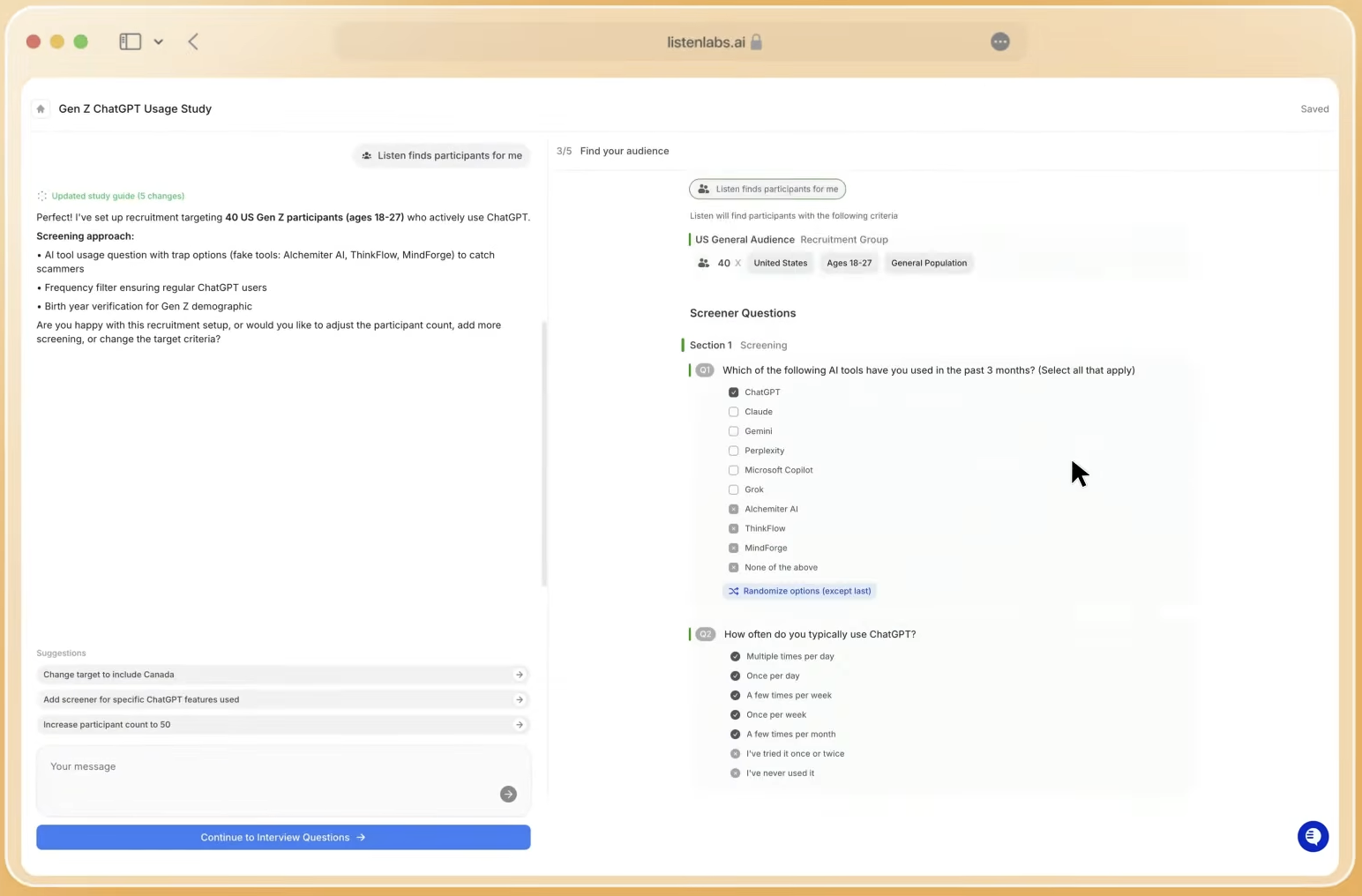
These structural delays have pushed teams to look for platforms that remove recruitment as a separate coordination step. Listen Labs integrates recruitment directly into the platform through Listen Atlas, an AI orchestration layer that matches and bids across its network of 30 million verified respondents spanning 45+ countries. Consumer panel self-serve recruitment on AI-native platforms in 2026 typically achieves turnaround times of two to 24 hours. Listen Labs’ dedicated recruitment operations team also handles niche audiences below 1% incidence rate, such as enterprise decision-makers, healthcare workers, and specialized consumer segments, without external vendor coordination. Teams can also bring their own participants at reduced cost.
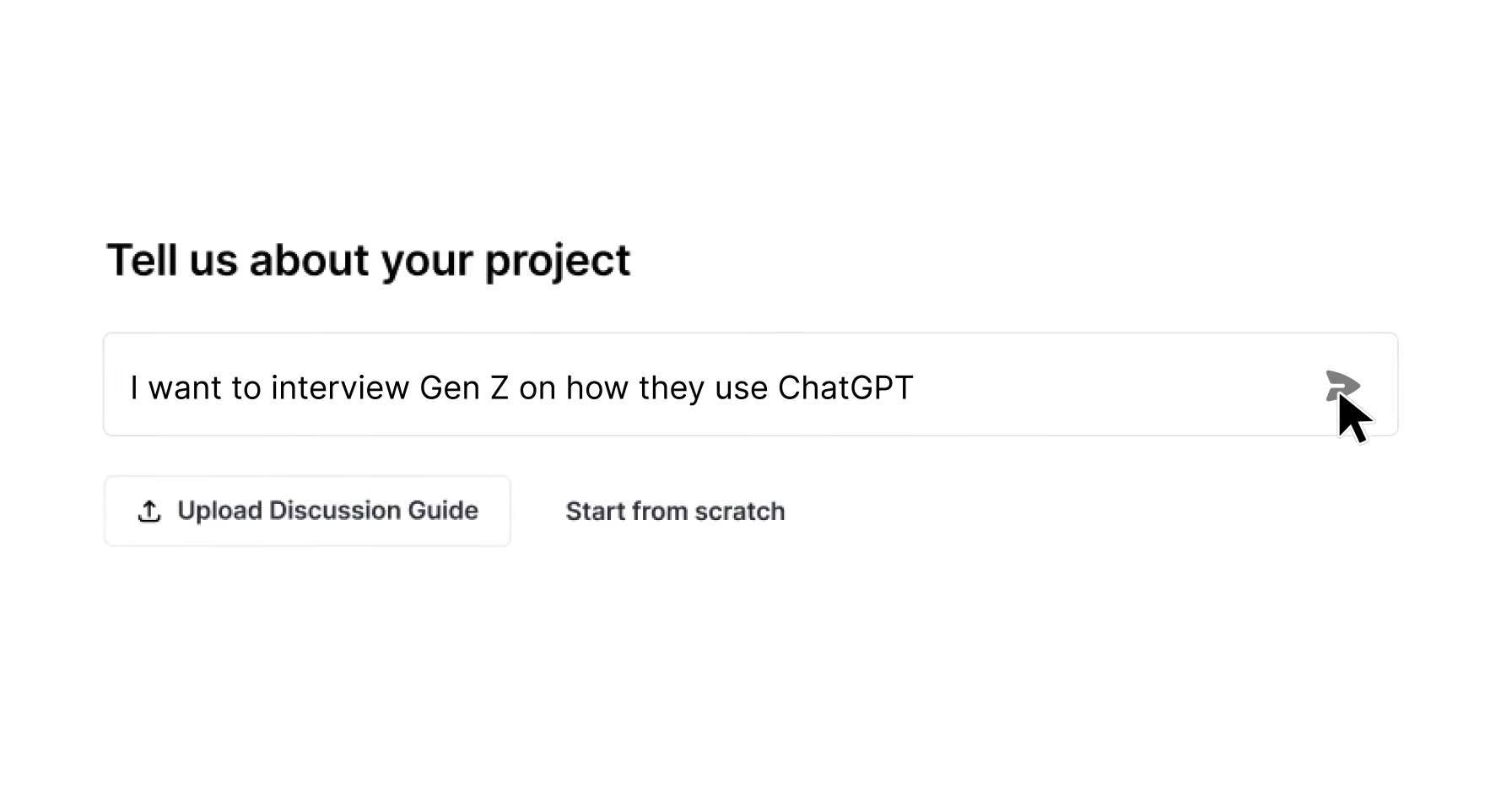
See how Listen Labs compresses setup and recruitment into a single workflow.
Moderation Style and Depth of Qualitative Insight
Recollective supports both asynchronous and live moderation within a single study. Its Conversational AI Task uses an AI moderator to conduct one-on-one, chat-based in-depth interviews at any scale and in any supported language. Researchers define objectives, and the system produces full transcripts, summaries, and indexed datasets. Live video IDIs and digital focus groups with up to 25 participants on video are also available, with Backroom observer collaboration and AI-generated transcripts. Journal Activities support longitudinal diary studies with repeated input over time. This hybrid architecture offers genuine flexibility, although the async-first design means depth per participant can vary based on engagement across extended study windows.
Discuss.io’s core architecture centers on live human-moderated video interviews and focus groups, with a secondary “Discuss Now” option for AI-led self-paced interviews. The platform’s AI layer, including Genie Experience Agents and Insights Agent, automates tasks and generates instant answers, yet live human moderation remains the primary research instrument. This model produces high-quality individual sessions when skilled moderators are available, but it does not scale horizontally. Three human researchers typically max out at roughly 30 to 45 qualitative sessions per week in 2026 because of moderator capacity limits.
Listen Labs conducts AI-moderated video interviews that run hundreds of personalized conversations at the same time. The AI probes dynamically based on each participant’s responses, mirroring the adaptive behavior of a trained human interviewer. Studies have shown that AI-moderated interviews can produce qualitative data with comparable richness to human-moderated interviews while enabling greater volume at lower cost. Listen Labs also layers Emotional Intelligence on top of interview data, analyzing tone of voice, word choice, and subconscious micro-expressions to surface emotions that transcripts alone miss. This capability is built on Ekman’s universal emotions framework and is available across 50+ languages.
Data Quality, Fraud Controls, and Panel Integrity
Participant fraud is a material risk in online qualitative research. Industry estimates suggest that 15 to 30 percent of online research respondents are fraudulent, including bots, professional survey-takers, or participants who misrepresent themselves to qualify. Even a small number of fraudulent participants in qualitative studies can distort thematic analysis and lead to incorrect conclusions because these studies rely on smaller, purposively selected samples.
Recollective does not operate a proprietary panel, so data quality largely depends on the external recruitment source a team selects. The platform offers AI-generated transcripts and session recordings that allow post-hoc review. Real-time fraud detection during fieldwork is not a native platform capability.
Discuss.io’s live moderation model provides a natural quality check because a human moderator can identify disengaged or misrepresenting participants during a session. This protection applies only to live sessions and does not extend to self-paced AI-led interviews or asynchronous formats.
Listen Labs addresses fraud at three layers that work together to remove bad actors. Quality Guard monitors every interview in real time across video, voice, content, and device signals to detect fraudulent responses, AI-generated scripts, and mismatched profiles as they occur. This real-time detection is reinforced by a participation cap that limits respondents to three studies per month, which removes professional survey-takers who might otherwise pass automated checks. The third layer operates at recruitment. Listen Atlas uses behavioral matching on intent and past actions rather than relying only on self-reported demographics, and a dedicated recruitment operations team adds human review before participants enter a study. This combination matters because open consumer panels with cash incentives see fraud rates of 10 to 30 percent in some studies. Listen Labs’ layered approach is designed to bring that rate to zero.
Analysis, Reporting, and Knowledge Reuse Across Studies
Recollective generates AI transcripts, summaries, and highlight reels from live sessions, and its Conversational AI Task produces indexed datasets from async interviews. Analysis beyond these outputs requires researcher effort. Tagging, theming, and synthesis remain manual or semi-manual. The platform does not include a native cross-study knowledge layer that aggregates findings across multiple projects over time.
Discuss.io’s Insights Agent generates instant answers from session data and supports post-session analysis. The platform’s three-stage workflow is designed to move from session to summary efficiently. Analysis depth, however, is bounded by what the live session captured, and cross-study synthesis is not a native capability.
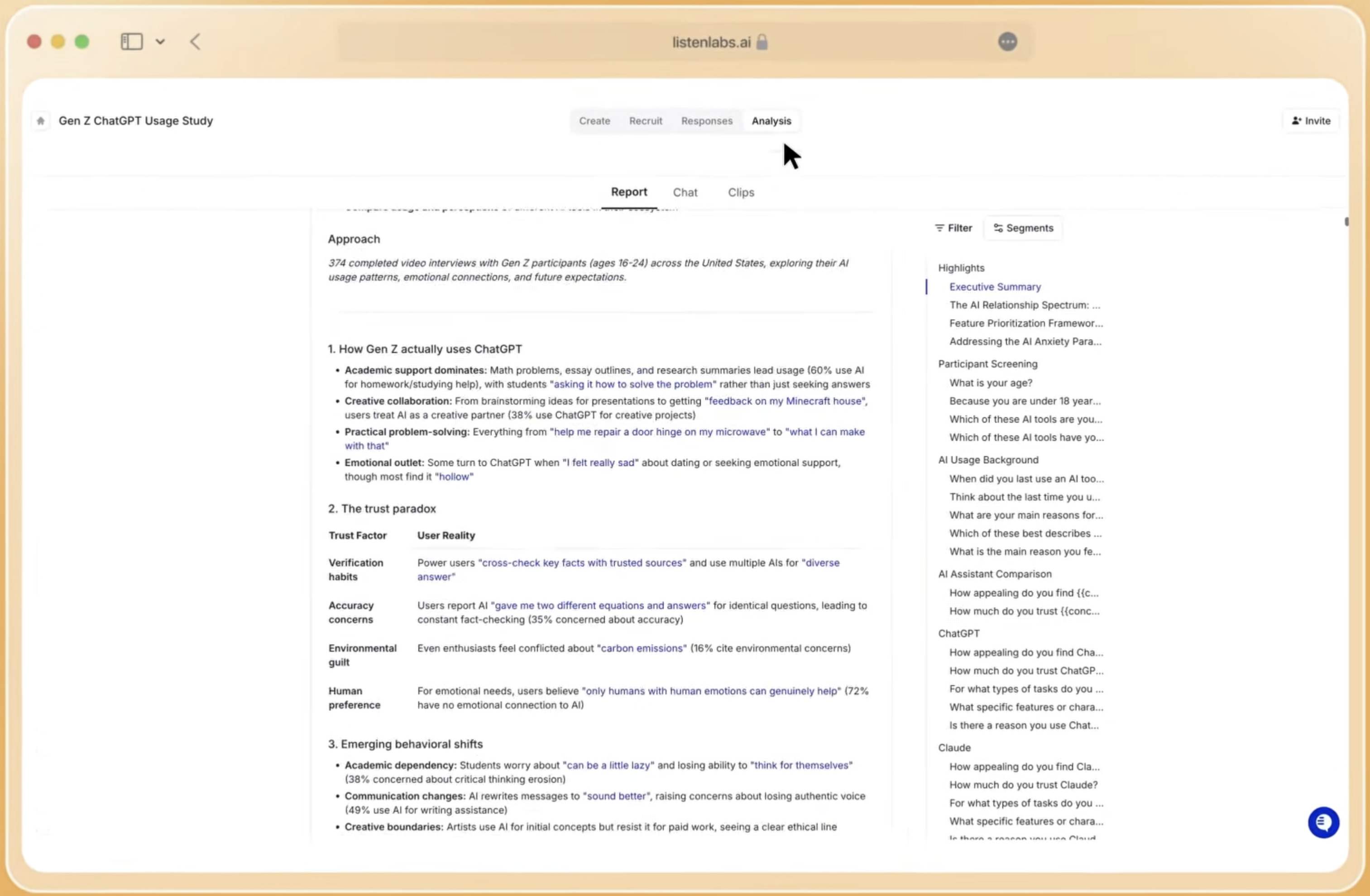
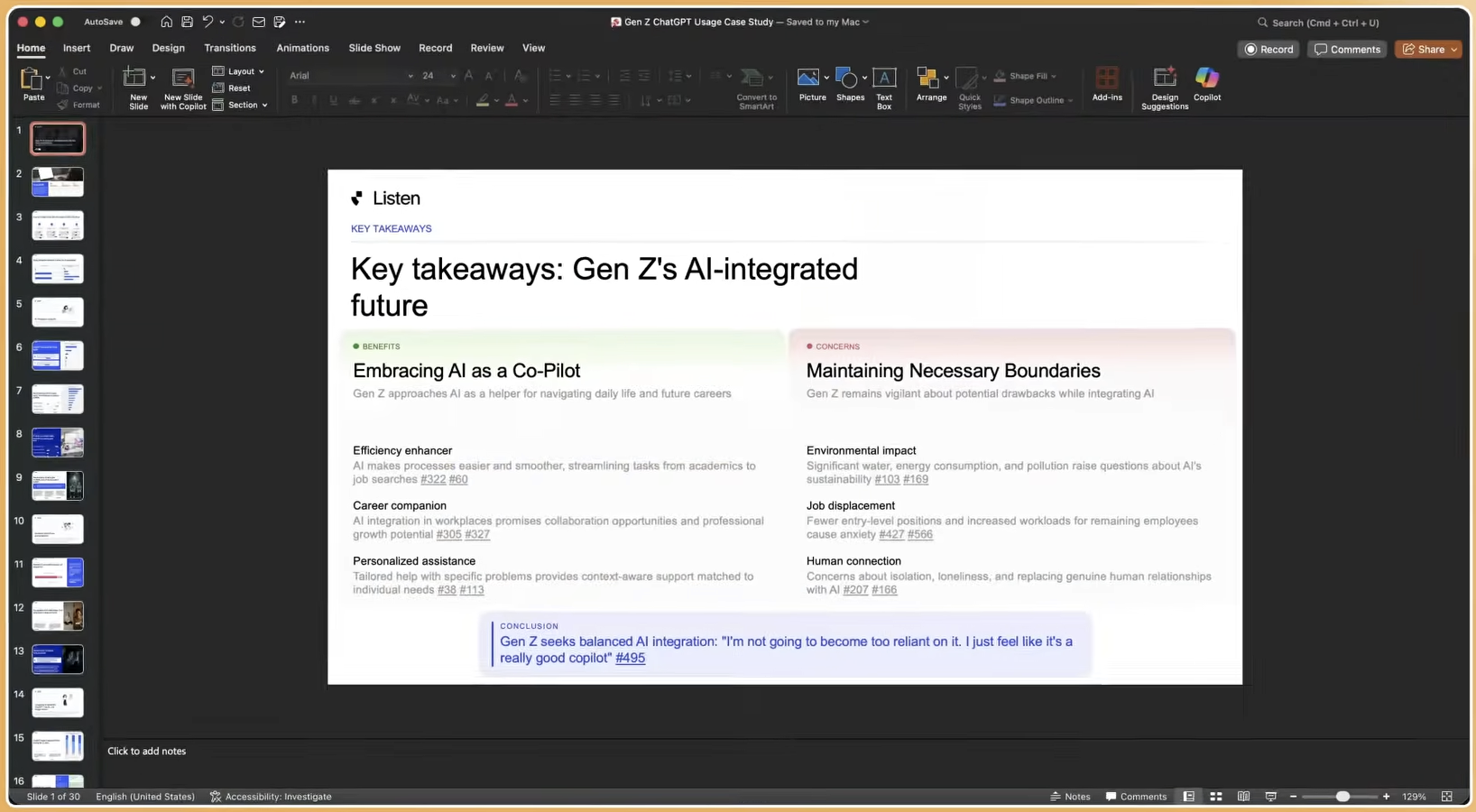
Listen Labs’ Research Agent processes all interview data automatically, identifying patterns, themes, and insights across hundreds of responses. The 2026 production baseline on AI-moderated platforms fell to 9.2 working days for a standard 30-interview qualitative study, an 84 percent reduction from the 2024 median of 31.4 working days. Listen Labs compresses this further. The Research Agent generates consultant-quality slide decks, memos, highlight reels, charts, and custom reports in under a minute. Mission Control serves as the organization’s source of truth across all studies, enabling cross-study queries and trend tracking so teams can answer questions from past research in seconds without digging through old reports.
Global Reach, Language Coverage, and Enterprise Governance
Discuss supports research across 100+ countries and offers Real-Time AI Translation for live interviews that instantly translates global language sessions into English with synchronized transcripts and speaker identification. The platform was cited as a Leader in The Forrester Wave: Experience Research Platforms, Q1 2026. Discuss maintains governance, privacy, and security controls designed for large organizations, although specific certification details are not publicly enumerated with the same granularity as some competitors.
Recollective supports multiple languages within its platform interface and Conversational AI Task, but its geographic reach is constrained by the external recruitment sources a team uses. Compliance certifications are available for enterprise procurement review, yet they are not a primary differentiator in Recollective’s positioning.
Listen Labs’ geographic reach spans the Americas, Europe, APAC, and MEA, with 100+ languages supported for interview moderation and automatic translation and transcription. Emotional Intelligence is available across 50+ languages. The platform holds SOC 2 Type II, GDPR, ISO 27001, ISO 27701, and ISO 42001 certifications, with enterprise SSO and 256-bit encryption. Customer data is never used for AI model training. Multi-market studies that traditionally take 10 to 16 weeks for 60 interviews across three markets can be completed in 8 to 12 business days for 300 interviews with AI-moderated parallel fieldwork across 50+ languages.
See how Listen Labs handles multilingual enterprise research programs end-to-end.
Scenario-Based Recommendations for Different Teams
Enterprise consumer insights teams running ongoing brand tracking, concept testing, or segmentation studies at scale face a core constraint. They need both depth and volume, but traditional platforms force a choice between them. Recollective’s async community model is useful for longitudinal engagement yet becomes limiting when speed and sample size matter because multi-week studies cannot easily compress into days. Discuss.io’s live moderation delivers strong session quality but hits a hard ceiling at scale since human moderators are the bottleneck and cannot run 200 interviews in parallel. Listen Labs removes this forced choice, making it the strongest fit for teams that need to multiply research output without increasing headcount. Its AI moderation, integrated recruitment, and automated reporting replace multiple vendors in a single workflow.
UX research leads who need to validate concepts or test prototypes within sprint cycles encounter a structural mismatch with both Recollective and Discuss.io when sample sizes must exceed 10 to 15 participants. Listen Labs supports screen sharing and usability testing with 50 to 100+ participants simultaneously, delivering findings within the sprint window.
Product managers and marketing leaders without dedicated research teams can rely on Listen Labs’ AI-assisted study design. They describe research goals in natural language, and the platform handles study design, recruitment, moderation, and analysis automatically. Neither Recollective nor Discuss.io is designed for self-serve use by non-researchers at this level of automation.
Agencies and consultancies working on client timelines measured in days rather than weeks benefit from Listen Labs’ sub-24-hour turnaround and global recruitment reach. Recollective’s community model and Discuss.io’s live scheduling model both introduce timeline dependencies that are difficult to compress for bespoke client engagements.
Operational Burden and Team Capacity
Platform selection in enterprise settings involves more than feature lists. Recollective requires teams to manage external recruitment relationships, onboard participants into the platform, and conduct manual or semi-manual analysis. Each step consumes researcher time and coordination. For teams already operating at capacity, this operational burden increases the research backlog instead of reducing it.
Discuss.io’s live moderation model requires moderator availability, session scheduling, and participant coordination. AI-moderated interviews remove human scheduling constraints, which allows qualitative research to reach global scale while maintaining authentic human-driven insights. For teams running continuous research programs across multiple markets, the scheduling overhead of a live-first platform is a structural constraint that does not disappear with better tooling. What these teams need instead is a platform that removes scheduling as a dependency entirely.
Listen Labs is designed to function as a force multiplier for existing research teams. A team running traditional four-week research cycles can complete roughly 12 to 13 studies per year. The same team running AI-moderated cycles can run more than 40 studies per year. The platform handles recruitment, moderation, analysis, and delivery, which frees researchers to focus on strategic interpretation rather than logistics.
Risks, Limitations, and Common Misconceptions
Async community platforms like Recollective can produce shallow data when activities lack sufficient probing structure. Participant engagement in longitudinal studies often declines over time. Without a moderation layer that adapts to individual responses, depth of insight depends heavily on how well the study guide was constructed upfront.
Live moderation platforms like Discuss.io carry the risk of moderator variability. As noted earlier, human moderators carry inherent bias risks that compound across large studies. Even skilled moderators can unconsciously react to answers they expect or want to hear, which affects consistency of follow-up questions and participant candor.
AI moderation also has documented limitations. A 2026 comparative study with Afro-descendant and Latine respondents found that AI-moderated interviews produced shallower data and weaker rapport. The primary risks of AI moderation include loss of nuanced emotional interpretation and reduced adaptive probing in ambiguous situations. Listen Labs addresses the emotional interpretation gap directly through its Emotional Intelligence layer, although teams conducting research on highly sensitive or culturally complex topics should include human review in their workflow design.
Overestimating automation is a common misconception. Teams sometimes assume that automated analysis removes the need for human judgment entirely, but that assumption does not match how these systems work. Automated analysis surfaces patterns and themes efficiently, handling the heavy lifting of processing hundreds of transcripts. Strategic interpretation remains a human responsibility. The researcher still decides which patterns matter for the business decision at hand. Listen Labs is designed to accelerate that interpretive process by handling data processing, not to replace the researcher’s judgment about what the findings mean.
Decision Checklist for Platform Selection
Use the following criteria to match platform options to your research program’s specific requirements:
- Speed requirement: If results are needed within 24 to 48 hours, only an AI-moderated platform with integrated recruitment can reliably deliver. Recollective’s async model and Discuss.io’s scheduling dependencies both introduce timeline variability.
- Sample size: If the study requires more than 20 to 30 interviews, human moderation at Discuss.io becomes a bottleneck. Recollective’s async model scales better but sacrifices conversational depth. Listen Labs runs hundreds of personalized interviews in parallel.
- Longitudinal or community research: Recollective’s insight community and diary study capabilities are purpose-built for ongoing participant engagement over months. This is a genuine differentiator for programs requiring repeated touchpoints with the same cohort.
- Fraud risk tolerance: If the study involves incentivized recruitment from open panels, real-time fraud detection is non-negotiable. Evaluate whether the platform operates its own verified panel or relies on third-party sourcing without quality controls.
- Multilingual and multi-market scope: Confirm language support at the interview moderation level, not just translation of outputs. Listen Labs supports 100+ languages natively, while Discuss.io’s real-time translation operates at the observer layer during live sessions.
- Analysis and reporting ownership: If the team lacks analyst capacity, automated deliverable generation is a requirement, not a nice-to-have. Assess whether the platform generates consultant-quality outputs or requires significant post-collection effort.
- Compliance requirements: Confirm SOC 2 Type II, GDPR, and ISO certifications match your organization’s procurement requirements before shortlisting.
- Emotional intelligence needs: For creative testing, concept comparison, or brand research where emotional response is the primary data point, evaluate whether the platform captures emotional signals beyond self-reported ratings.
Frequently Asked Questions
How long does each platform take to deliver results?
Recollective’s async model means fieldwork runs over days or weeks depending on study design, with analysis conducted after the activity window closes. Diary studies and insight communities are inherently longitudinal. Discuss.io’s live moderation model compresses fieldwork to the session window but requires scheduling coordination that typically adds days to the timeline. Analysis and reporting follow session completion. Listen Labs compresses the entire research cycle, from study design through recruitment, moderation, analysis, and deliverables, to under 24 hours for most study types because AI-moderated interviews run in parallel and the Research Agent generates outputs automatically.
Where do Recollective and Discuss.io source participants and how do they ensure quality?
Recollective does not operate a proprietary panel. Teams source participants externally and onboard them into the platform, so data quality depends on the recruitment source selected. Discuss.io offers participant recruitment through its network, with live moderation providing a natural quality check during sessions. Neither platform operates a real-time fraud detection system comparable to a purpose-built quality layer. Listen Labs sources participants through Listen Atlas, the AI orchestration layer introduced earlier, with Quality Guard monitoring every interview in real time across video, voice, content, and device signals. Participants are capped at three studies per month to eliminate professional survey-takers.
What are the key differences in moderation style between the two platforms?
Recollective offers both asynchronous activities and live video IDIs within a single study, plus a Conversational AI Task for chat-based AI-moderated interviews at scale. This hybrid architecture gives teams flexibility to combine methods. Discuss.io is built around live human moderation as the primary instrument, with AI-led self-paced interviews as a secondary option. Human moderation delivers high session quality but introduces moderator variability and scheduling constraints. Listen Labs’ AI moderation conducts adaptive, personalized video conversations that probe dynamically based on each participant’s responses, eliminating moderator variability while running hundreds of interviews simultaneously. Emotional Intelligence adds a layer of signal capture that neither Recollective nor Discuss.io offers natively.
How much analysis effort is required after data collection?
Recollective generates AI transcripts and summaries from live sessions and indexed datasets from its Conversational AI Task, but thematic synthesis and cross-study analysis require researcher effort. Discuss.io’s Insights Agent generates post-session summaries and supports analysis queries, but the depth of output is bounded by what the live session captured. Listen Labs automates the entire analysis workflow through its Research Agent, as described in the Analysis Workflow section above. The platform generates all deliverables automatically, so research teams do not need to perform manual theming or synthesis.
Which platform better supports multilingual research at enterprise scale?
Discuss.io supports research across 100+ countries and offers real-time AI translation for live interview observers, enabling English-language monitoring of multilingual sessions. Recollective supports multiple languages within its platform but relies on external recruitment for geographic reach. Listen Labs supports 100+ languages natively at the interview moderation level, so the AI conducts interviews in the participant’s language rather than translating outputs after collection. Emotional Intelligence is available across 50+ languages. With coverage across 45+ countries and full enterprise compliance certifications including SOC 2 Type II, GDPR, ISO 27001, ISO 27701, and ISO 42001, Listen Labs is designed for continuous global research programs without separate regional vendors.
Conclusion: How Listen Labs Removes Enterprise Trade-Offs
Recollective and Discuss.io each solve a specific problem well. Recollective’s async community and diary study capabilities support longitudinal research programs where repeated participant engagement matters. Discuss.io’s live human moderation delivers session quality for high-stakes individual interviews. Neither platform, however, was designed to remove the core constraint facing enterprise consumer insights teams in 2026: the forced choice between qualitative depth and quantitative scale, compounded by slow turnaround, fragmented workflows, and unreliable participant quality.
Listen Labs is built specifically to collapse that trade-off. AI-moderated video interviews conduct hundreds of personalized conversations simultaneously. Integrated recruitment from a 30 million verified respondent network removes the external vendor dependency. Quality Guard eliminates fraud in real time. Emotional Intelligence captures what participants feel, not just what they say. The Research Agent delivers consultant-quality outputs in under a minute. Mission Control builds institutional knowledge across every study. The result is a research cycle that takes hours, not weeks, and is trusted by Microsoft, Google, Procter & Gamble, Anthropic, Skims, and Nestlé.
Ready to run hundreds of AI-moderated interviews with emotional intelligence in under 24 hours? See it in action.