
Written by: Anish Rao, Head of Growth, Listen Labs | Last updated: August 6, 2026
Why integrated AI research beats a fragmented stack
- Fragmented stacks that pair User Interviews for recruitment with Discuss.io for moderation create workflow friction, coordination overhead, and quality leakage at every handoff.
- Traditional six-to-eight-week research cycles compress to under 24 hours when recruitment, AI-moderated interviews, and automated analysis run inside a single platform.
- Quality Guard and frequency caps reduce fraud rates that can reach 10 to 40 percent when participant data and session recordings live in disconnected systems.
- AI-moderated interviews deliver 98 percent participant satisfaction while scaling to hundreds of sessions simultaneously, removing the old depth-versus-scale constraint.
- Listen Labs replaces multiple vendor contracts with a single enterprise platform; see a live walkthrough of how teams at Microsoft, P&G, and Anthropic run research programs in less than 24 hours.
How long a User Interviews + Discuss.io study really takes
Recruitment is the single largest bottleneck in most programs. Scheduling conflicts between the recruiting platform and the video tool add more delay, followed by manual analysis once data finally lands. Traditional agency-based qualitative studies take four to six weeks to field, which makes them structurally incompatible with two-week sprint cycles or weekly campaign launches common in modern business decision cycles.
An integrated AI-first platform collapses this arc. Listen Labs compresses the entire research cycle, including study design, recruitment, AI-moderated interviews, analysis, and deliverables, to less than 24 hours. AI can schedule and conduct the interview, analyze the transcripts for themes, and generate quantitative insights from those interviews, which removes every manual handoff point that inflates the traditional timeline. When Anthropic needed to understand why Claude users were canceling, Listen Labs delivered more than 300 user interviews in 48 hours and surfaced churn drivers five times faster than prior methods.
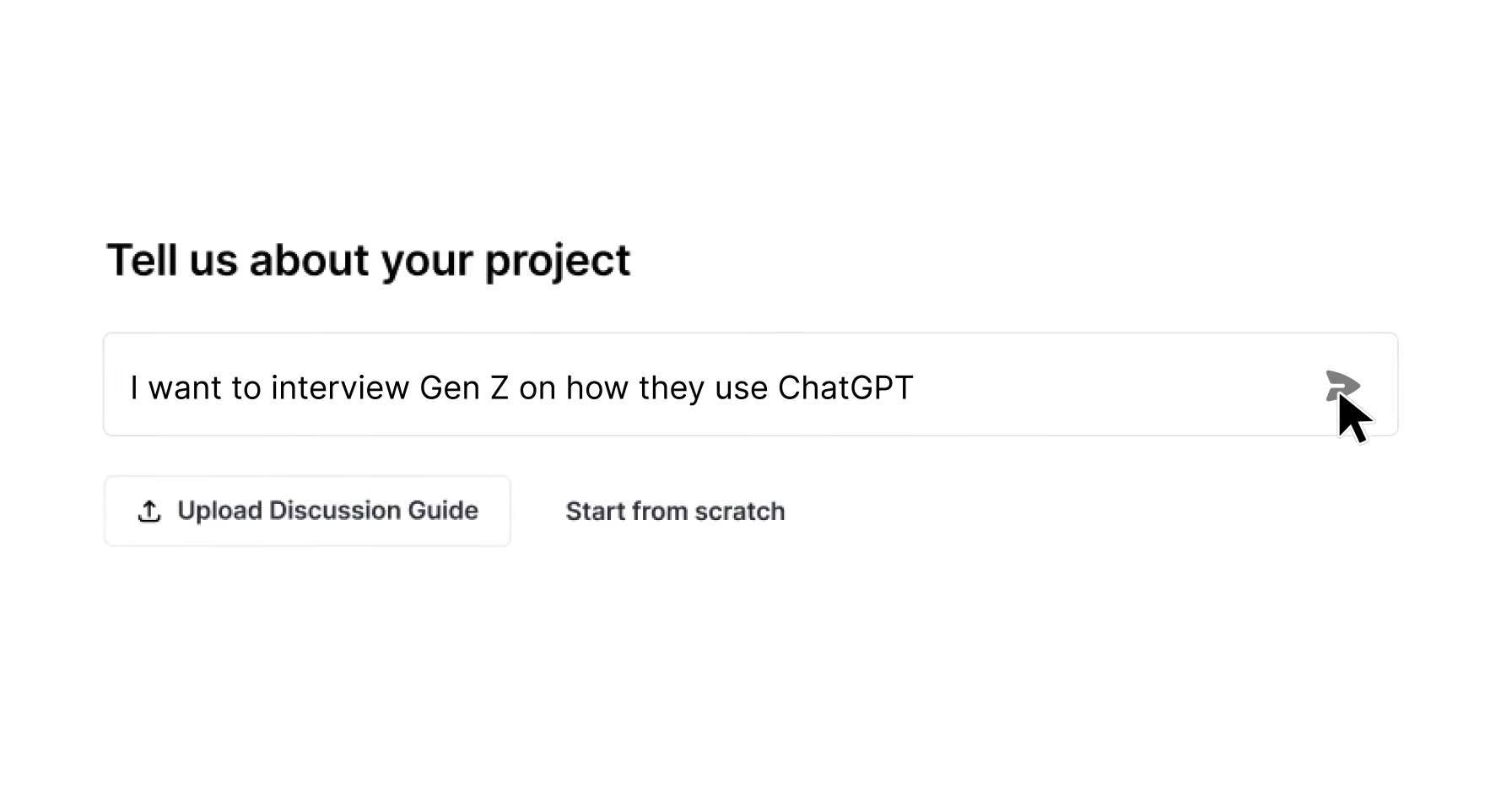
If your team runs on sprint timelines, see how Listen Labs compresses a six-week research cycle into less than 24 hours.
Where participant quality breaks down in split recruiting and video stacks
The handoff point between separate participant recruitment tools and moderated video interview platforms is where participant quality and study timing most often degrade for enterprise insights teams. Static pre-study screeners used in separate recruitment tools miss contradictions that only surface during actual interviews. Low-integrity respondents then consume budget before anyone notices.
Industry estimates place fraud rates between 10 and 40 percent of market-research participants, primarily in nonprobability surveys. Some categories attract even higher rates. In the 2025 State of User Research Survey, 54 percent of researchers reported facing challenges with participant quality and reliability. When quality signals live in disconnected systems, with screener data in one platform and session recordings in another, tracing a quality failure back to its source becomes a post-project debate rather than an embedded discipline.
Listen Labs addresses this through three reinforcing layers that work together to catch quality issues at different stages. Quality Guard monitors every interview in real time across video, voice, content, and device signals to detect fraud, low-effort responses, and AI-generated scripts as they happen. Frequency caps complement this real-time monitoring by preventing the same participants from appearing in more than three studies per month, which removes professional survey-takers who slip past initial screening. For hard-to-reach segments where automated screening may be insufficient, a dedicated recruitment ops team adds human review as a final quality gate. Because all three layers operate within a single platform, quality accountability never transfers between vendors.
How AI-moderated interviews keep depth while scaling past 15 participants
A skilled moderator can conduct roughly four to six interviews per day, allowing for around 30 to 45 sessions over a one to two week fielding window. Discuss.io’s human-dependent moderation model inherits this constraint directly.
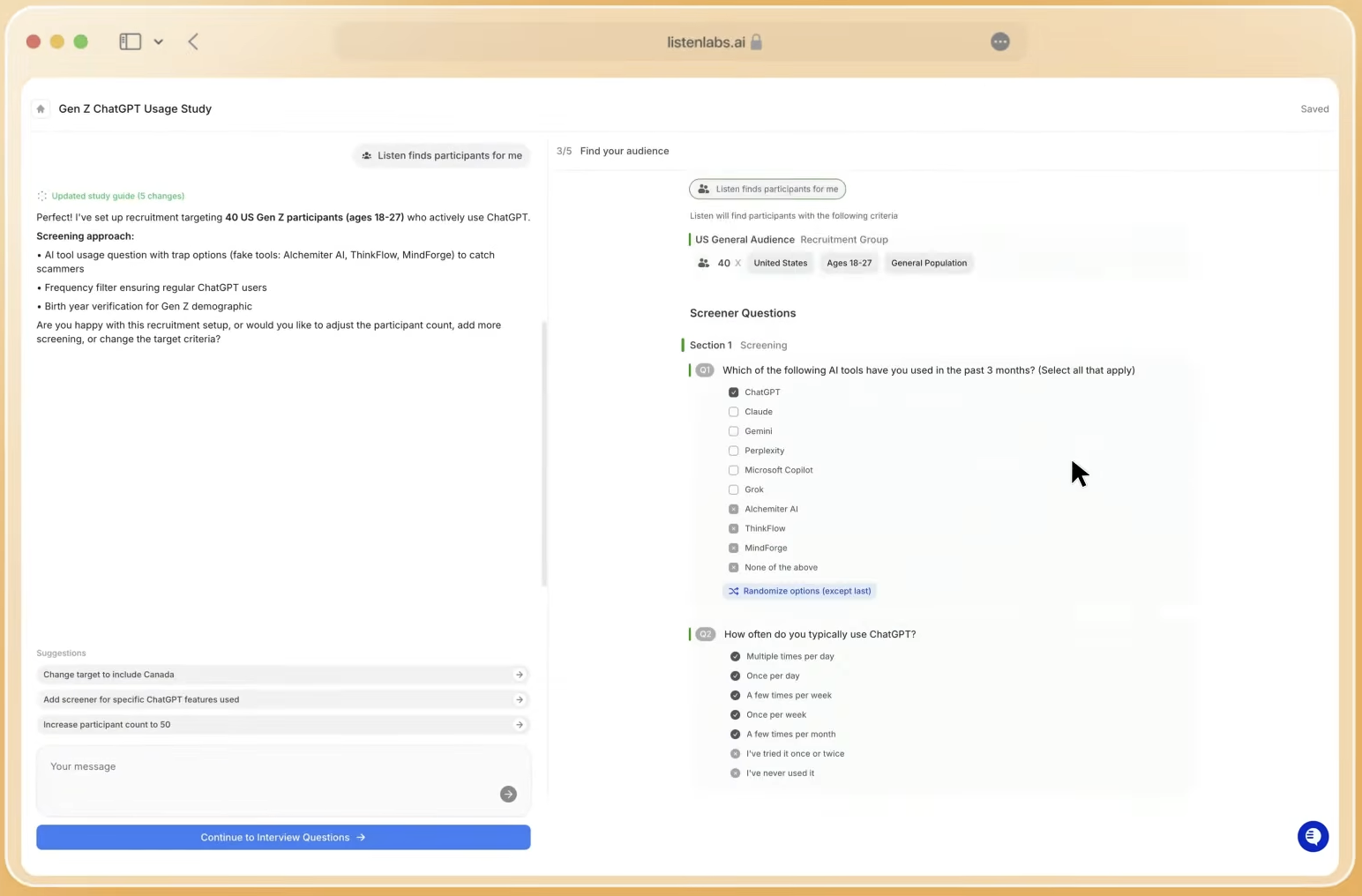
With qual-at-scale, the old trade-off between depth and scale is no longer a barrier. Listen Labs conducts hundreds of AI-moderated qualitative interviews simultaneously, and each conversation stays personalized and adaptive. The AI probes deeper on interesting or short answers the same way a trained human interviewer would. AI-moderated interviews on integrated platforms achieve 98 percent participant satisfaction rates while dynamically probing five to seven levels deep using laddering methodology, matching or exceeding human moderator quality without fatigue.
Transcripts alone miss a critical layer of signal. Listen Labs’ Emotional Intelligence analyzes tone of voice, word choice, and subconscious micro expressions using Ekman’s universal emotions framework across more than 50 languages. Every emotion label is traceable to the exact timestamp, verbatim quote, and reasoning behind it. Enterprise teams gain the emotional nuance that human-moderated sessions capture but rarely quantify at scale. P&G used this capability to surface where product claims felt exaggerated or unclear before market, delivering more than 250 interviews with quantified themes and verbatim proof in hours rather than weeks.
How fragmented tools inflate analysis and reporting effort
Scaling to dozens or hundreds of interviews creates a new bottleneck: analysis. Data integration, cleaning, and preparation consume 40 to 80 percent of data team time according to multiple studies across domains. A single 60-minute interview generates 8,000 to 10,000 words of transcript. Manually coding interviews and hundreds of open-ended survey responses can require substantial researcher time before synthesis even begins.
Fragmented multi-vendor research processes in biopharma lead to researchers spending 35 to 80 percent of their time locating, validating, reconciling, unifying, cleansing, or preparing data across disconnected sources. When analysis tools sit downstream of both the recruiting platform and the video platform, every export introduces a new opportunity for data loss or misattribution.
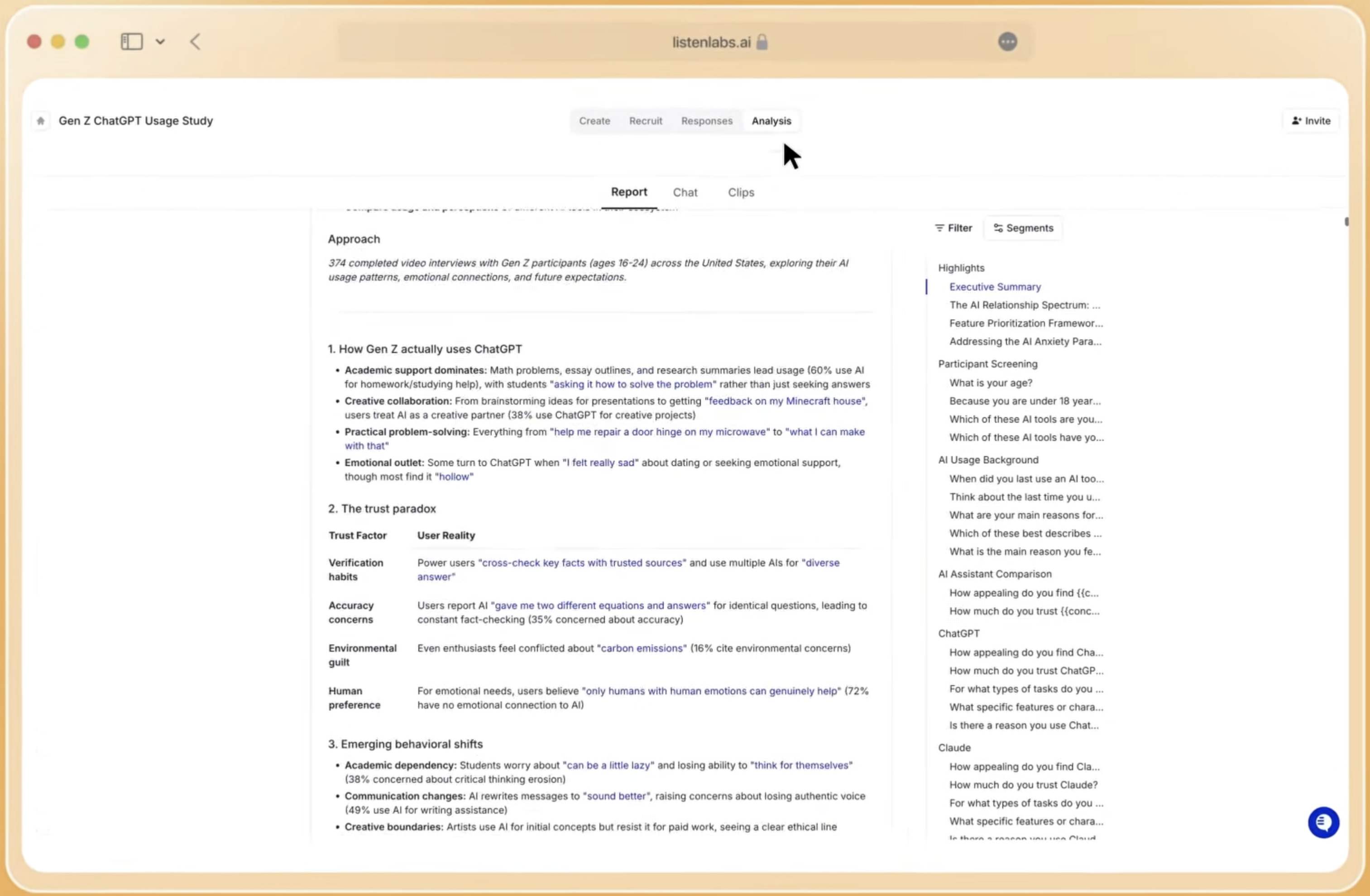
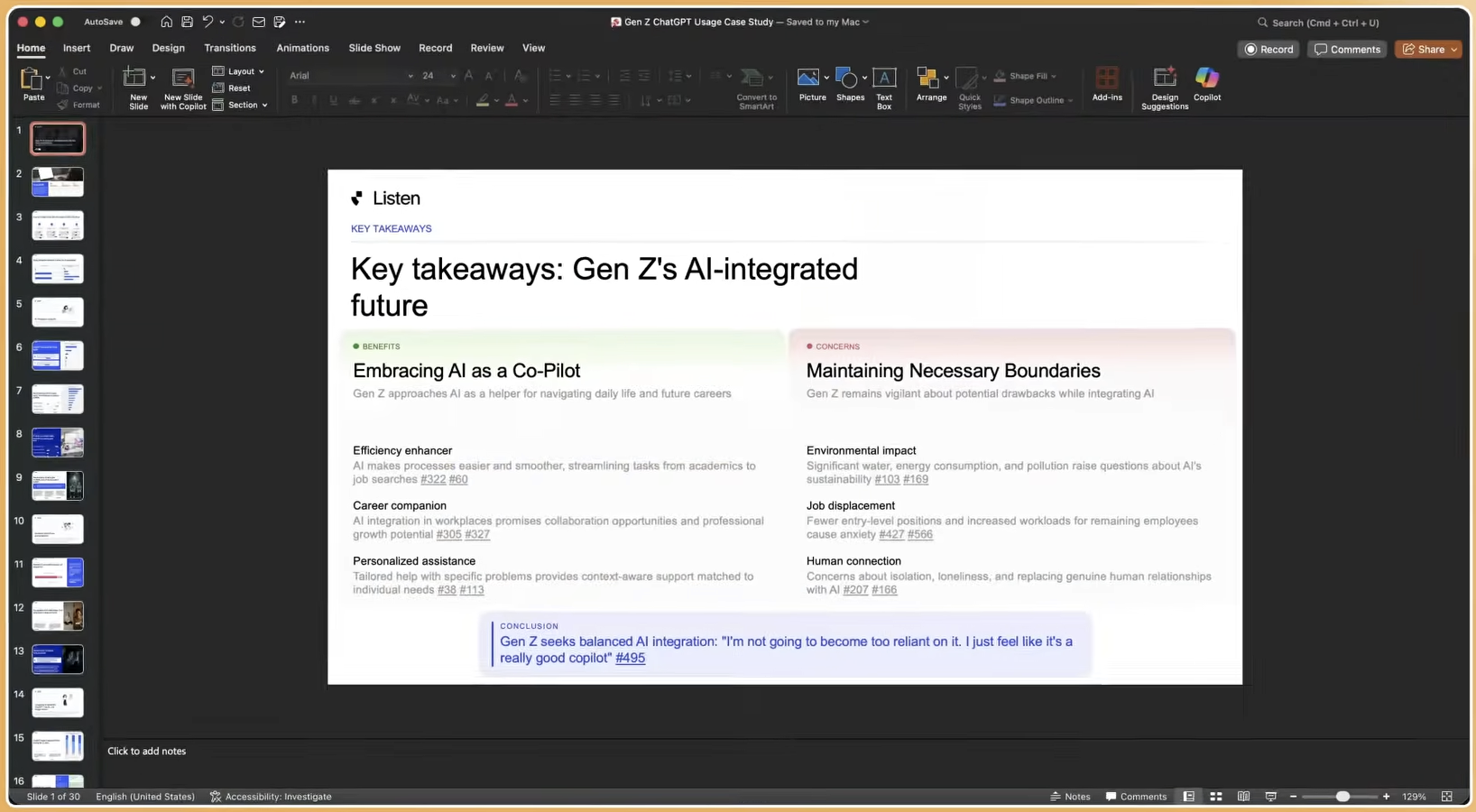
Listen Labs’ Research Agent processes all interview data within the same platform where interviews occur. It generates automated key findings, theme extraction, segmentation breakdowns, and one-click deliverables such as slide decks, memos, highlight reels, and statistical charts in under a minute. Every theme links back to traceable video clips and verbatim quotes, so stakeholders can inspect the evidence rather than accept a summary. Microsoft used this capability to collect global customer stories for its 50th anniversary celebration within a single day, and leadership described the speed and scale as transformative.
How separate vendors limit global and multilingual research
Global recruitment through separate tools often results in uneven quality standards across languages, markets, and interview formats for enterprise insights teams. Recruiting a verified B2B decision-maker in Germany through one platform and then transferring that participant to a separate video tool for moderation in German introduces consistency risk at every step. Screener translation, session delivery, and post-session analysis each become potential failure points.
Listen Labs supports more than 100 languages for interview moderation with automatic translation and transcription, covering over 45 countries across the Americas, Europe, APAC, and MEA. AI-moderated qualitative research runs in more than 50 languages with native-language moderation at a flat per-interview cost comparable to English studies and with comparable data quality. Because recruitment, moderation, and analysis all operate within a single platform, quality standards remain consistent regardless of market. Two-vendor stacks cannot match this structural advantage.
Teams that gain the most from replacing User Interviews + Discuss.io
Four organizational profiles gain the most from consolidating onto an integrated platform, and each faces a different version of the same core problem: fragmented tools that cannot keep pace with business velocity.
Enterprise consumer insights teams running five to thirty researchers face a growing backlog of internal requests from product, brand, and marketing stakeholders. The fragmented stack limits throughput to a handful of studies per quarter. An integrated platform multiplies output without proportional headcount increases. The same team can shift from completing two to three major studies per quarter to fifteen or more.
UX research groups at mid-to-large technology companies need faster feedback loops to keep pace with sprint cycles. Scheduling interviews with the right participants through a separate recruiting tool, then coordinating sessions through a separate video platform, adds logistical overhead that pushes research outside the sprint window entirely. Listen Labs removes scheduling friction and reduces no-show risk while enabling studies with 50 to more than 100 participants instead of five to ten.
Product and marketing teams without dedicated researchers need self-serve simplicity. Describing research goals in natural language and having the platform handle study design, recruitment, moderation, and analysis removes the methodology expertise barrier entirely. These teams can run rigorous qualitative work without hiring full-time researchers.
Agencies and consultancies with client timelines measured in days rather than weeks benefit from the combination of speed, global reach, and the ability to recruit niche audiences. Enterprise decision-makers, healthcare workers, and consumers below one percent incidence rate become reachable without managing multiple vendor relationships.
For all four profiles, change management stays straightforward. Listen Labs replaces two vendor contracts and multiple tool subscriptions with a single enterprise platform that holds SOC 2 Type II, GDPR, ISO 27001, ISO 27701, and ISO 42001 certifications. See how enterprise teams at Microsoft, Skims, and P&G run research programs on a platform that already meets strict security requirements.
Risks that never disappear in fragmented recruiting-plus-video stacks
Four structural risks persist regardless of which specific tools occupy each slot in a fragmented stack.
Professional-survey-taker bias. Some sample sourced from external providers can run as high as 70 percent poor-quality or fraudulent traffic. Commodity panels that serve multiple recruiting platforms simultaneously have no mechanism to enforce participation frequency limits across those platforms.
Loss of emotional nuance. Human-moderated sessions on video platforms capture emotional signals in the room but rarely quantify them systematically. When recordings and transcripts move to a separate analysis tool, the emotional layer is typically lost entirely and reduced to a moderator’s subjective field notes.
Accountability gaps. Combining separate recruitment tools with moderated video interview platforms creates a coordination tax from stitching multiple vendors together, which results in finger-pointing across vendors when handoffs break. No single vendor owns the outcome, so no single vendor is accountable for it.
Decision checklist for choosing integrated vs fragmented research tools
The following constraints map directly to platform choice. Teams can use this framework to assess their current situation before evaluating vendors.
- Timeline under two weeks: A fragmented stack cannot reliably deliver a complete qualitative study within a two-week sprint cycle. Recruitment alone typically consumes that window.
- Audience difficulty above general population: Hard-to-reach B2B segments, healthcare professionals, or consumers below one percent incidence rate require dedicated recruitment operations that most panel-only tools do not provide.
- Enterprise security requirements: Teams operating under SOC 2, ISO 27001, GDPR, or ISO 42001 mandates need a single vendor that holds all relevant certifications rather than assembling compliance documentation across multiple tools.
- Ongoing program volume above four studies per quarter: Teams running continuous research programs cannot absorb the coordination overhead of a fragmented stack at that frequency. The operational burden compounds with each additional study.
- Need for emotional signal capture: If the research objective requires understanding how participants feel, not just what they say, a platform with integrated emotional intelligence is necessary. Transcript-only tools cannot provide this.
- Global multi-market studies: Studies spanning more than two languages or markets require consistent moderation quality across all markets. Separate recruiting and video tools rarely guarantee this consistency.
- Institutional knowledge requirements: Teams that need to query findings across past studies require a unified repository. Fragmented stacks produce siloed outputs that cannot be cross-referenced without manual effort.
Frequently Asked Questions
How quickly can an integrated platform complete a 200-participant study that used to take six weeks?
Listen Labs completes a 200-participant qualitative study in less than 24 hours from study launch to final deliverables. The platform handles recruitment from its network of 30 million verified respondents, runs AI-moderated video interviews in parallel across all participants simultaneously, and generates automated theme analysis, slide decks, and highlight reels within the same session. Listen Labs removes the sequential bottlenecks that drive traditional six-week timelines described earlier by running recruitment, moderation, and analysis concurrently rather than in sequence. Recruitment, which is often the largest component of traditional cycle time, completes in 24 to 72 hours for most audience profiles on Listen Labs.
Can AI-moderated interviews reach B2B decision-makers at the same quality as human-moderated sessions on Discuss.io?
AI-moderated interviews can match and often exceed human-moderated quality for B2B audiences while adding structural advantages. Listen Labs’ AI moderator applies the same adaptive probing depth described earlier but with a critical advantage over human moderators: identical logic across every session without fatigue or drift. Question delivery remains consistent whether it is the first or the five-hundredth interview of a study. For hard-to-reach B2B segments, Listen Labs’ dedicated recruitment ops team partners with specialized networks including NewtonX to source enterprise decision-makers, engineers, and healthcare workers that commodity panels cannot reliably supply. The combination of verified recruitment and adaptive AI moderation produces B2B research that is both faster and more methodologically consistent than the human-moderated alternative.
What security certifications matter when moving from two vendors to one platform?
Enterprise research programs handling consumer data, employee data, or proprietary product information require a platform that holds SOC 2 Type II, GDPR compliance, ISO 27001 for information security management, ISO 27701 for privacy information management, and ISO 42001 for AI management systems. Listen Labs holds all five. Moving from two vendors to one also reduces the attack surface and simplifies compliance documentation. Instead of assembling security attestations from a recruiting platform and a video platform separately, procurement and legal teams review a single vendor’s certification package. Listen Labs also maintains 256-bit encryption and a policy of never using customer data for AI model training.
How long does migration from User Interviews and Discuss.io typically take?
Enterprise teams at companies over 100 employees begin with a demo and a pilot study, which typically runs within the first week of engagement. Because Listen Labs is an end-to-end platform rather than a point tool, there is no data migration in the traditional sense. Past studies conducted on other platforms remain in those platforms, while new studies launch directly on Listen Labs. Teams that bring their own participant lists can self-recruit at reduced cost from day one. The operational transition, including canceling separate recruiting and video subscriptions, follows naturally once the pilot confirms quality and speed benchmarks. Most enterprise teams complete the transition within one to two research cycles.
Conclusion: Replacing infrastructure that forced depth-versus-scale tradeoffs
The friction created by combining User Interviews with Discuss.io is not a product deficiency in either tool. It is a structural property of any fragmented stack. Handoff delays, participant quality gaps, emotional signal loss, and accountability diffusion are inherent to the architecture and do not disappear by tuning individual components.
Qual-at-scale uses AI to automate time-consuming aspects of qualitative research like recruiting, interviewing, and analysis, enabling deeper insights at larger scales without traditional barriers of cost and time. Listen Labs is the end-to-end platform that operationalizes this vision. It sources verified participants from a 30 million-person global network, conducts adaptive AI-moderated video interviews with emotional intelligence capture, and delivers consultant-quality reports, slide decks, and highlight reels in less than 24 hours. Listen Labs has run over one million AI-powered customer interviews for companies including Microsoft, Perplexity, and Sweetgreen, and enterprise teams at Anthropic, P&G, Skims, and Robinhood now use the platform to replace research cycles that previously took weeks.
The infrastructure constraint that forced researchers to choose between depth and scale for decades is now removable, not through methodological compromise but through architectural integration. See how Listen Labs replaces your fragmented stack with a single platform that delivers results in less than 24 hours.