
Written by: Anish Rao, Head of Growth, Listen Labs
Key Takeaways
- Meltwater GenAI Lens is a native AI visibility tracker that monitors brand mentions across major LLMs and delivers visibility scores, sentiment, and source attribution.
- Model coverage is broad, with full access tied to higher-tier plans and Lite subscribers receiving a narrower set of engines.
- GenAI Lens uses structured prompt sets that auto-generate up to 10 variations per prompt, and results refresh on a 24–48 hour cadence depending on package.
- Across major media intelligence suites, Meltwater and Cision currently lead in AI-engine coverage, while Brandwatch, Sprinklr, and Talkwalker offer narrower or more indirect AI monitoring.
- Listen Labs complements AI monitoring by revealing why customers think and feel what they do about a brand, adding qualitative depth that visibility dashboards cannot provide.
- Pricing and contract terms, including prompt allowances and auto-renewal rules, are central to evaluating a Meltwater deployment.
- All prompt-based AI monitoring tools share structural limits, so teams still need direct customer research to understand narrative formation.
What Meltwater GenAI Lens Actually Does
Meltwater launched GenAI Lens on July 29, 2025, positioning it as an industry-first tool for tracking brand representation inside AI-generated answers. The product sits natively within the Meltwater platform alongside media monitoring, social listening, and consumer intelligence. Users see brand presence across traditional media and AI outputs under a single login.
GenAI Lens produces four primary output types. It tracks cross-model visibility via a composite Visibility Score that combines mention rate, frequency, and prominence. It scores sentiment at both the response and entity level. It attributes sources and citations so teams can see which publications and journalists shape AI answers. It also benchmarks competitors across named LLMs. The platform’s Mira AI assistant summarizes narrative clusters and generates prioritized weekly action plans based on visibility data. An LLM Executive Report feature generates a branded PowerPoint summarizing visibility, sentiment, competitive positioning, and strategic recommendations. During its beta period, the report remains manual-only and cannot be automated or scheduled.
Which LLMs Meltwater GenAI Lens Tracks
GenAI Lens supports a wide range of widely used LLMs, and actual coverage depends on the customer’s plan. The full model set includes:
- ChatGPT (including ChatGPT 5)
- Google Gemini (Gemini 2.5 Flash and Gemini 2.5 Pro)
- Perplexity (Sonar Pro)
- Anthropic Claude (Claude Opus 4 and Opus 4.1)
- DeepSeek (R1)
- xAI Grok (Grok 3 and Grok 4)
- Meta AI Llama (Llama 4 Maverick)
- Google AI Overviews
- Google AI Mode
Lite plan subscribers receive a narrower set covering ChatGPT, Google AI Overviews, Google AI Mode, DeepSeek, and Perplexity. The full model set adds Claude, Gemini, Grok, Meta AI Llama, and Copilot coverage. Buyers should confirm which engines are active at their tier.
How AI Brand Monitoring Is Measured
GenAI Lens operates through structured prompt sets. Users create prompts organized by use case such as Brand Monitoring, Competitive Intelligence, Industry Trends, and Crisis Management. The platform automatically generates up to 10 prompt variations per prompt to increase depth and accuracy. Each variation counts toward the account’s total prompt allowance, so prompt design affects both methodology and cost.
Results appear approximately 10 to 20 minutes after prompt creation. They then refresh every 24 to 48 hours depending on the customer’s package. That cadence interacts with localization settings. A Target Country IP setting assigns a regional IP address when querying LLMs, which returns localized results. Without that setting, responses are globally scoped and cannot be filtered by region.
Prompt language compounds the localization effect. Writing a prompt in French while targeting France surfaces more French-language sources than writing the same prompt in English. Teams that care about regional nuance need to align IP settings, language, and refresh cadence.
Two important constraints apply to source attribution. DeepSeek and Meta AI Llama do not have web search capabilities, so they do not provide citations. Citation-related metrics are unavailable for these models in the Benchmarking tab. More broadly, this is point-in-time sampling of AI answers, not a continuous census of what AI believes. Prompt-based monitoring only measures the territory the company thought to map, and citation tracking shows which sources surfaced in a given answer but does not reveal which claim had the greatest influence or whether the citation was central or incidental to the response.
Competitive Positioning: Meltwater, Brandwatch, Sprinklr, Talkwalker, And Cision
Each major media intelligence platform approaches AI visibility tracking differently. The platforms diverge on three main axes: whether AI monitoring is native or added, how many engines they cover, and how deep source attribution goes.
Meltwater. GenAI Lens is native to the Meltwater platform rather than an added layer, so it integrates directly with existing social and media data. Meltwater’s GenAI Lens tracks eight AI answer engines: ChatGPT, Perplexity, Google AI Overviews, DeepSeek, Llama, Claude, Gemini, and Grok. Some coverage also lists Google AI Mode. The platform outputs a composite Visibility Score that combines mention rate, frequency, and prominence. Source attribution is granular. The Sources tab ranks which publications and journalists are most frequently cited in AI responses, and users can view journalist profiles, recent articles, and contact details directly from the platform. Sentiment is scored at both the full-response and per-entity level. The Benchmarking tab compares visibility scores across competitors and models in a single heat map view.
Brandwatch. Brandwatch’s AI-search coverage runs through Trajaan, a search intelligence platform acquired by parent company Cision. This structure makes AI visibility a separate, added layer rather than a feature built natively into Brandwatch’s core suite. Independent analysis describes Brandwatch’s AI monitoring position as partial coverage via indirect signals rather than reliable AI-generated mention tracking. The platform cannot reliably track direct queries to ChatGPT, Gemini, Perplexity, or Claude asking about a brand, the actual text of AI-generated responses, or platform-by-platform AI share of voice across LLMs.
Sprinklr. Sprinklr’s LLM Insights tracks how brands appear in AI-generated answers alongside social and media data, with real-time listening across 30+ channels. Sprinklr does not specify model coverage in Meltwater’s own competitive comparison. Sprinklr’s median annual contract of $127,490 is the highest of any tool in the category. Reviewer feedback on G2 notes that AI features are inconsistently useful in practice.
Talkwalker. Talkwalker is now Lumen by Talkwalker following Hootsuite’s 2024 acquisition. The platform added LLM Insights in January 2026, tracking four models: ChatGPT, Gemini, Claude, and Perplexity. This coverage is narrower than Meltwater’s eight-engine set. Lumen combines broad social and media monitoring with visual listening that detects brand mentions in images, video, and audio, including logos that never appear in accompanying text.
Cision. CisionOne added an AI Visibility Dashboard on July 14, 2026, tracking eight AI engines: ChatGPT, Gemini, Claude, Perplexity, Grok, DeepSeek, Google AI Overview, and Mistral. This engine count matches Meltwater’s eight-engine coverage. Cision’s median annual contract of $12,625 is roughly half of Meltwater’s $25,800 median, which makes it a lower-cost entry point for a comparable AI-engine count. Brandwatch is owned by Cision following a $450 million acquisition announced in February 2021, so Cision now operates both platforms.
Among the major platforms, Meltwater’s GenAI Lens and Cision’s AI Visibility Dashboard are the only tools in the category that name a comparable AI-answer engine count. Dedicated AI visibility platforms such as Profound, Otterly.ai, and Peec AI remain more specialized alternatives for buyers whose primary need is LLM tracking rather than broader media intelligence.
See how Listen Labs complements AI monitoring
How Much A Meltwater Subscription Typically Costs
Meltwater does not publish a fixed price list. A July 2026 pricing guide cites indicative U.S. annual starting ranges of $10,000/year for Starter, $25,000/year for Pro, and $120,000–$130,000/year for Enterprise, though the guide itself is internally inconsistent and neither figure should be treated as a quote. Actual pricing depends on modules selected, number of users, media channels covered, regions, and contract scope.
Contract terms shape the value equation. Meltwater’s standard contract term is 36 months with a 12-month minimum, invoiced annually in advance with net-14 payment terms, and requires written cancellation notice at least 60 days before term end to avoid auto-renewal at Meltwater’s then-standard price. GenAI Lens is typically offered as an add-on within the Meltwater platform, with availability varying by package. Additional prompts beyond the subscription allowance can be added for an extra cost.
The Limits Of AI Brand Monitoring
GenAI Lens tells you what AI says about your brand, but not why that narrative formed or what your customers actually think and feel. It reports the visible output of AI systems rather than the human beliefs that shaped those systems.
AI brand monitoring is a lagging indicator. A March 2025 Gartner forecast projects that by 2026, around 30% of brand perception will be shaped by generative AI content. The beliefs that feed those AI narratives originate with real people: customers, journalists, reviewers, and forum participants whose views were encoded into training data long before any monitoring dashboard existed. The dashboard measures the output of that process. It does not measure the belief formation itself.
Three structural limits apply to every prompt-based monitoring tool, including GenAI Lens. The first is scope. Prompt-based monitoring only measures the territory the company thought to map. A brand can lead AI share of voice while a competitor owns the perception that matters most to customers, and can receive a positive sentiment score while being described in a strategically undesirable way, such as “innovative but unreliable.”
The second limit is demand. AI visibility tools invent the questions and measure the answers: the demand side is manufactured by the tool, while only the supply side is genuinely observed. The prompt list functions as a synthetic panel rather than a picture of real usage.
The third limit is attribution. Citation tracking shows which sources surfaced in a given answer but does not reveal which claim had the greatest influence, whether the citation was central or incidental, or whether the author attribution is accurate. Teams see which URLs appear, but not which ideas truly shaped the model’s response.
Direct customer research serves as the leading indicator. Bain & Company found that about 80% of search users rely on AI summaries for at least 40% of their searches. The beliefs those AI summaries encode shape purchase decisions at scale. Teams that want to understand why those beliefs formed, and whether they match what actual customers think and feel, need to go directly to customers.
Where Listen Labs Fits In Your Stack
Listen Labs is an end-to-end AI research platform built for the problem AI brand monitoring cannot solve: understanding why customers think and feel what they do about your brand, your competitors, and your category.
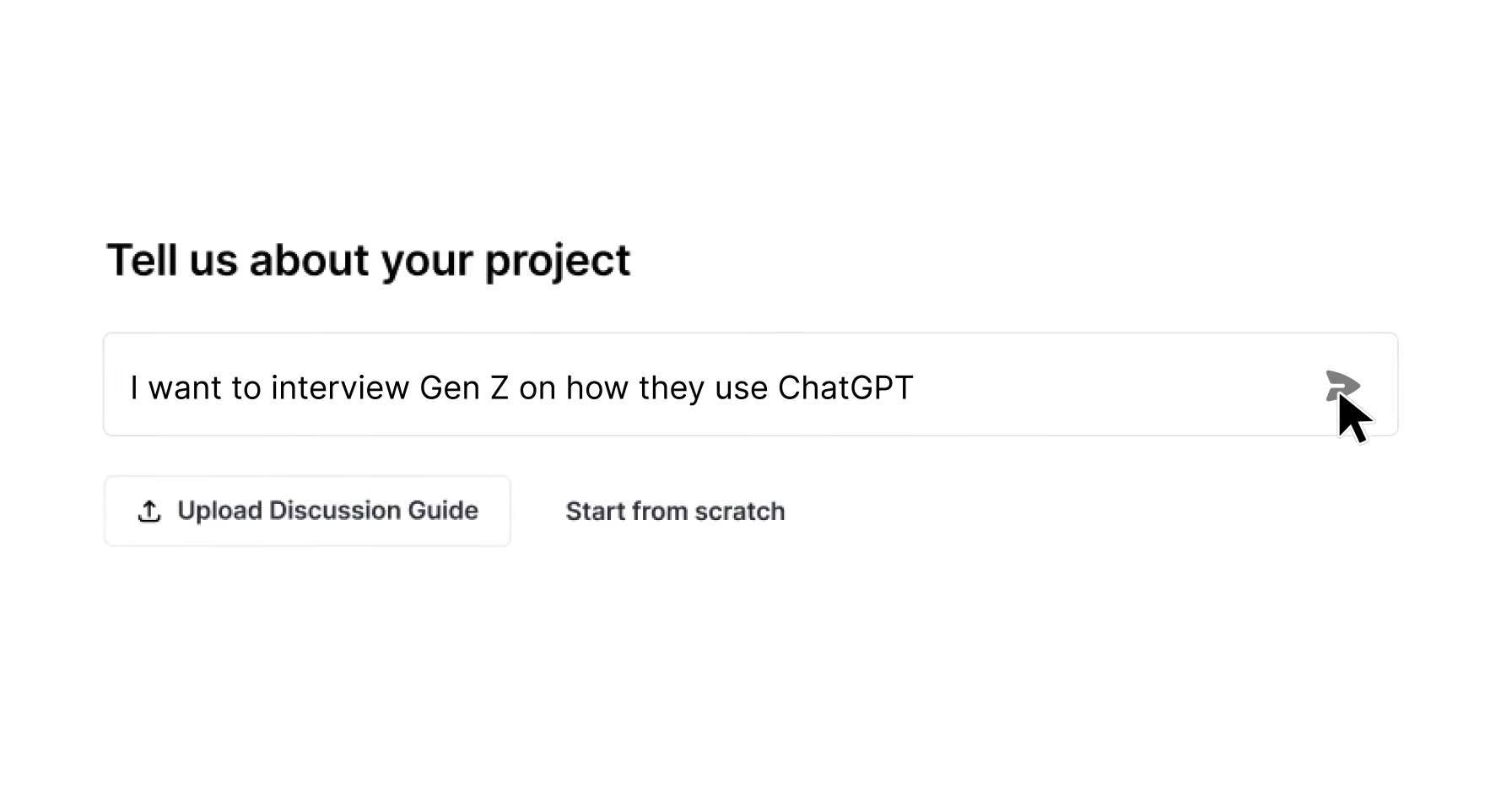
Listen Labs reveals what real people believe and why, going beyond the AI output that GenAI Lens tracks. The platform sources participants from its 50M+ verified respondent network across 45+ countries and 120+ languages. It conducts AI-moderated in-depth interviews with dynamic follow-up questions. It then delivers consultant-quality analysis and deliverables in less than 24 hours, compared with the 4–6 weeks a traditional research cycle often requires.
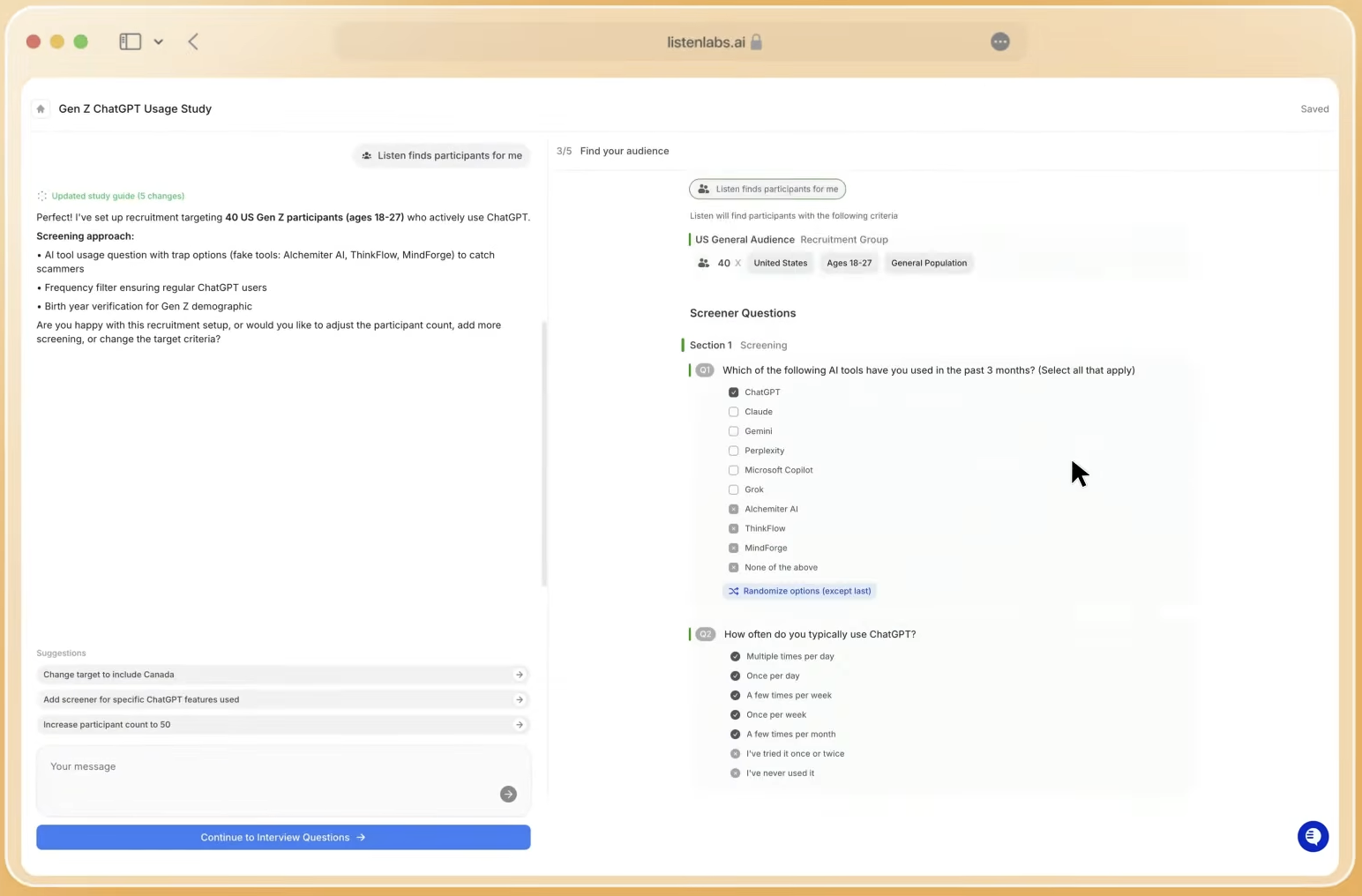
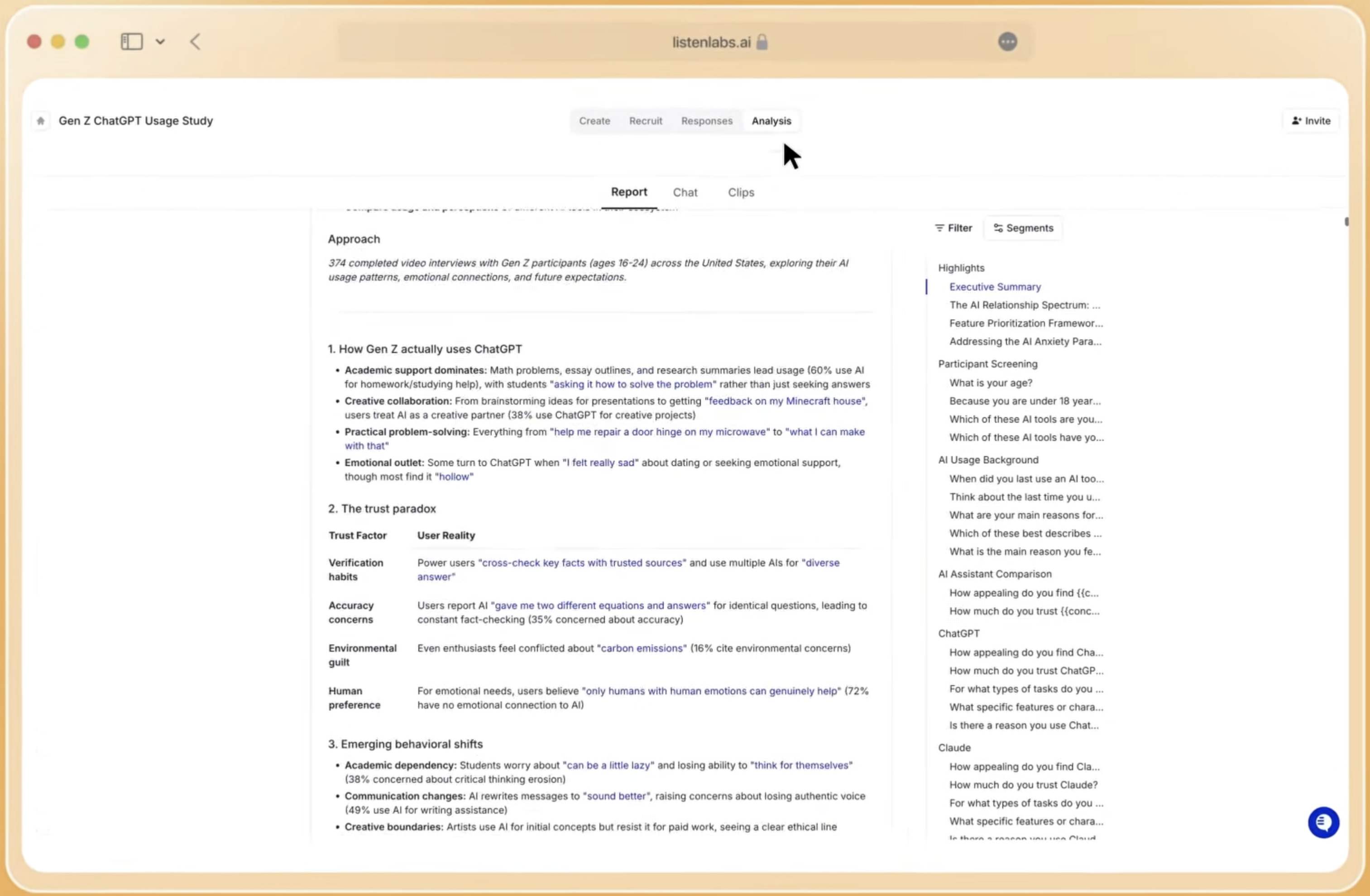
Four capabilities map directly to the brand research problem that AI monitoring surfaces but cannot explain. Emotional Intelligence analyzes tone of voice, word choice, and subconscious micro expressions to surface what people feel rather than only what they say. Built on Ekman’s universal emotions framework, it quantifies every emotion per question and traces it to the exact timestamp and verbatim quote behind it.
Listen Pulse is a conversational tracker that runs the same study wave after wave, pairing KPI movement with the qualitative “why” in the same instrument. The metric change and its explanation arrive together instead of weeks apart. Research Library lets teams query every study ever run in natural language, turning individual studies into a compounding intelligence system. AI-moderated interviews for brand research and creative testing let teams see how customers respond to brand narratives, campaigns, and positioning before those assets reach the market.
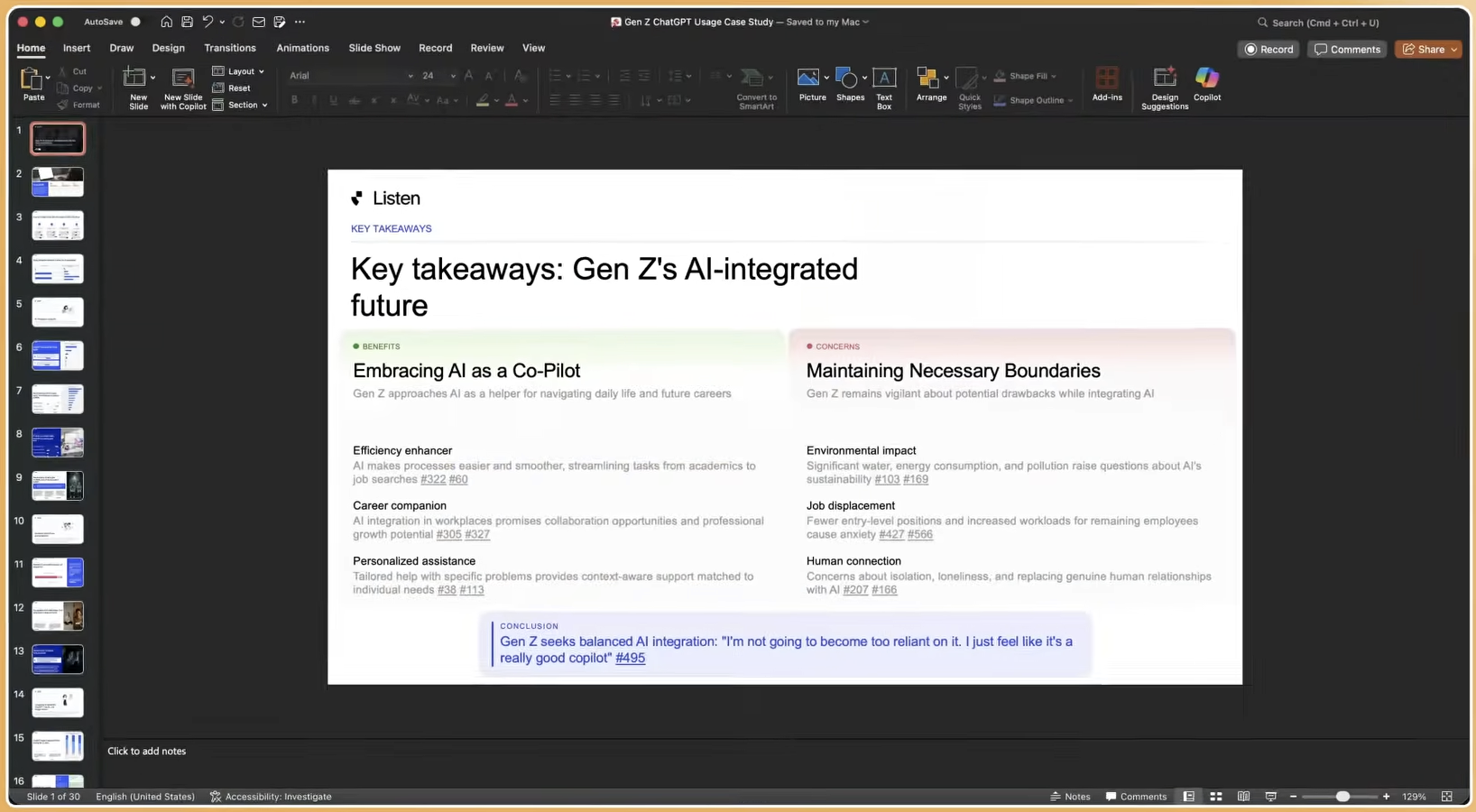
Microsoft used Listen Labs to collect global customer stories for its 50th anniversary within a single day. P&G used it to surface where product claims feel exaggerated or unclear before they reach market. Skims used it to validate campaign direction with thousands of high-income buyers overnight. Sweetgreen replaced months-long research cycles with days, scaling across 300+ US locations at one-third the cost.
When GenAI Lens shows that your brand is losing ground in AI answers, Listen Labs shows whether that shift reflects real changes in customer perception and what is driving it.
Run your first AI-moderated study
Demo Checklist: What To Ask A Meltwater Rep
Use this checklist before signing a Meltwater GenAI Lens contract:
- Which LLMs are tracked at my tier, and which require an upgrade to access?
- How frequently are prompts refreshed, and does the 24–48 hour cadence vary by model?
- How does the automatic prompt-variation logic described above count against my total prompt allowance?
- How does source attribution work for DeepSeek and Meta AI Llama, given that neither provides citations?
- When a model version changes (for example, GPT-4o to GPT-5), how are existing prompt sets re-validated, and who is responsible for maintaining them?
- What is included at each pricing tier, and what triggers an add-on cost?
- What is the exact contract length, minimum term, auto-renewal clause, and cancellation notice window?
- Are annual rate increases standard at renewal, and by how much?
- How does the Target Country IP setting work, and is it available at my tier?
- How does GenAI Lens data connect to actual customer research, and where do you recommend pairing it with qualitative studies?
Frequently Asked Questions
Who Competes With Meltwater?
Meltwater’s primary competitors in media intelligence and AI brand monitoring are Brandwatch (owned by Cision), Sprinklr, Talkwalker (now Lumen by Talkwalker, owned by Hootsuite), and Cision’s CisionOne platform. In the narrower AI visibility tracking category, dedicated platforms such as Profound, Otterly.ai, Peec AI, and Athena Intelligence also compete, typically at lower price points and with a more specialized focus on LLM monitoring rather than broader media intelligence.
Is Meltwater An AI Tool?
Meltwater is a media intelligence platform that has added AI capabilities, including GenAI Lens for LLM visibility tracking and Mira, a conversational AI assistant for analyzing listening data. It functions as a media monitoring and social listening platform with AI features layered on top. GenAI Lens is the component most directly focused on tracking AI-generated brand narratives across large language models.
How Much Does A Meltwater Subscription Cost?
See the pricing section above for indicative ranges and typical contract terms.
Is There A Meltwater Free Alternative?
Meltwater does not offer a self-serve free trial of its full platform. For AI visibility tracking specifically, lower-cost alternatives include Brand24’s AI Visibility add-on (plans starting at $199/month with a free trial), Otterly.ai (from $49/month), and Profound (from $200/month). These tools focus more narrowly on LLM monitoring and do not include Meltwater’s broader media monitoring, social listening, journalist database, or broadcast coverage. For teams whose primary need is LLM visibility rather than full media intelligence, these dedicated tools may offer sufficient coverage at a fraction of the cost.
Does Meltwater GenAI Lens Tell You Why AI Says Something About Your Brand?
No. GenAI Lens tells you what AI says about your brand, including which models mention it, how prominently, with what sentiment, and which sources were cited. It does not explain why that narrative formed or which customer beliefs or media patterns drove it. For a deeper explanation of these limits, see the section on the structural limits of AI brand monitoring above.
Conclusion: From Monitoring AI Output To Understanding Customers
Meltwater GenAI Lens is a genuinely useful AI visibility tracker. Its model coverage, noted earlier, is broad. It provides granular source attribution, integrates natively with Meltwater’s broader media intelligence platform, and gives brand and communications teams a structured way to track how AI narratives shift over time. For teams that need to know what AI says about their brand, it offers a credible option.
The core limit is structural and applies to any prompt-based monitoring tool. What AI says about your brand is downstream of what real people believe, including customers, journalists, reviewers, and forum participants whose views were encoded into training data before any dashboard existed. A visibility score tells you the output of that process. It does not tell you whether the narrative reflects your customers’ actual experience, which beliefs are driving it, or what would change it.
Listen Labs focuses on that deeper layer. It sources participants from a 50M+ verified respondent network, conducts AI-moderated in-depth interviews at scale, and delivers the qualitative understanding behind any metric movement in less than 24 hours at roughly a third of the cost of traditional research. When GenAI Lens shows that something has shifted in how AI describes your brand, Listen Labs shows whether your customers agree, why they feel that way, and what to do about it.
Book a demo with Listen Labs today