Written by: Anish Rao, Head of Growth, Listen Labs
Here are the key takeaways from this guide to AI-moderated pricing research.
Key Takeaways
- Traditional pricing surveys deliver demand curves without the reasoning behind them. 1:1 interviews provide depth but cap out at 20–30 conversations, which is too small for segment-level analysis.
- AI-moderated interviews combine quantitative price ladders such as Gabor-Granger and Van Westendorp with adaptive probing to capture both the demand curve and the reasoning behind every price reaction.
- Studies with 150–300 interviews per project, stratified across current customers, churned customers, and prospects, deliver statistically reliable willingness-to-pay data that can be cut by segment without collapsing into anecdote.
- Quality controls such as adaptive probing limits, emotional-signal capture, neutral price framing, and frequency caps keep AI-moderated pricing data valid and defensible to CFOs.
- Listen Labs is an end-to-end platform purpose-built to run this protocol at scale, delivering demand curves, emotional insights, and automated reporting for enterprise pricing decisions.
See AI-Moderated Pricing Research in Action
Why Pricing Research Often Breaks At Scale
Traditional pricing surveys produce a demand curve without explaining the reasoning behind it. Qualitative pricing interviews produce depth and typically require only five to eight respondents per segment—about 15 calls total for a simple self-serve or direct-to-consumer product—since 80–90% of content becomes repetitive after 5–8 people in a segment. Moderated 1:1 pricing interviews cap out at 20–30 conversations, a sample too small to cut by segment or persona without the cells collapsing into anecdote. By the time a traditional study finishes, the pricing decision has usually already been made.
The stakes are concrete. McKinsey’s analysis of the Global 1200 found that a 1% price improvement lifts operating profit by 8.7% on average. Michael Marn and Robert Rosiello, in the Harvard Business Review article “Managing Price, Gaining Profit,” calculated that a 1% improvement in price realization raises operating profit by 11.1% for the average S&P 1000 company, roughly three times the impact of an equivalent volume gain. For a $100 million business, a price off by just 5% leaves $5 million on the table every year.
Most teams have not tested their pricing in years. Price Intelligently (now part of Paddle) found the average SaaS company invests just 6–8 hours in pricing over its entire lifetime. OpenView’s 2024 SaaS Benchmarks reported that nearly 40% of SaaS companies had not revisited their pricing structure in the previous 18 months, while teams that review pricing regularly grow about 30% faster.
No vendor page or academic critique provides a named, step-by-step protocol that survives CFO scrutiny. This article does. For a broader look at the tools available, see The Best AI Tools For Pricing Research In 2026.
Explore Listen Labs for Pricing Research
Pricing Interview Protocol For AI-Moderated Research
The sequence below is a defensible protocol a pricing team can present to a CFO or VP. The AI moderator probes each answer and separates “I can’t afford it” from “it isn’t worth that much,” which are two different problems with different fixes. Intelligent probing generates responses roughly 3x longer than average.
- Current Solution And Actual Spend — What are you using today, and what does it cost? This anchors every subsequent price reaction to real budget context rather than hypothetical framing.
- Perceived Value And Outcome — What would breaking this workflow cost you? This establishes the value ceiling before any price is introduced.
- Price Sensitivity — How do you think about price for this category? This surfaces the mental model the buyer uses before any ladder begins.
- Acceptable Price Range — Van Westendorp-style range questions asked conversationally: at what price is the product too expensive, expensive but worth considering, a bargain, and suspiciously cheap.
- Reactions To Concrete Price Points — Gabor-Granger ladder where each yes raises the floor and each no lowers the ceiling until the ladder finds the most that person would pay.
- Package And Feature Tradeoffs — MaxDiff best/worst sets to prioritize what justifies a higher price, aggregated with a Hierarchical Bayes model into a ranking with no ties.
- Switching Threshold — What would make you switch from your current solution? This identifies the competitive floor below which the offer becomes irrelevant.
- Budget Authority — Who approves this purchase, and at what threshold? This maps the organizational approval dynamic that determines whether a stated willingness to pay can actually convert.
- Competitor Reference Prices — What alternatives are you comparing this to? This grounds stated price reactions in a competitive frame rather than a vacuum.
- Reasons For Rejecting Prices — Why did that price feel too high or too low? This step contains the actionable strategy that most pricing surveys skip entirely.
This sequence operates as more than a survey with a conversational wrapper. With qual-at-scale, the old trade-off between depth and scale no longer applies. The AI moderator runs this full sequence with hundreds of buyers simultaneously, and each interview stays personalized and adaptive. The next section explains when to use each pricing method within this protocol.
Gabor-Granger Vs. Van Westendorp In An AI-Moderated Interview
Gabor-Granger was developed in the 1960s by economists André Gabor and Sir Clive Granger, the latter a 2003 Nobel laureate in Economic Sciences, to analyze demand elasticity and identify price points that maximize revenue. It is a randomized sequential monadic technique. The moderator presents a starting price and asks a purchase question. If the respondent accepts, the price moves higher. If they refuse, it moves lower. This repeats until the respondent’s switching point is identified. Aggregating individual tipping points produces a demand curve and, when multiplied by price, a revenue curve whose peak is the optimal price point. Gabor-Granger is best suited when a price range is already known, the product already exists on the market, and the goal is to maximize revenue.
Van Westendorp was developed by Dutch economist Peter van Westendorp in 1976 and uses four open-ended price questions to map a population’s price sensitivity. It defines four key metrics from curve intersections: the Point of Marginal Cheapness (floor), the Point of Marginal Expensiveness (ceiling), the Optimal Price Point, and the Indifference Price Point. Van Westendorp is suited to exploratory phases for new products with no anchor price, because it discovers the acceptable range without predefined values. Its documented limitation is that it produces no demand curve or volume estimate, and its hypothetical framing biases results toward the point of minimum resistance.
MaxDiff with Hierarchical Bayes shows small best/worst sets and aggregates them into a ranking with no ties. It does not directly measure willingness to pay but isolates which features or benefits justify higher pricing. That makes it the right instrument for package and tier design after the price range is established.
Combining Van Westendorp and Gabor-Granger in a single study, using Van Westendorp first to define a price interval and Gabor-Granger to optimize within that range, maximizes insights. The AI-moderated advantage is that the moderator layers qualitative “why” onto each quantitative choice. After a MaxDiff ranking it asks, “You rated that feature highest. What makes it a buy?” Every score traces back to the people behind the number, in their own words. This method-comparison angle has zero coverage in the current SERP for AI-moderated pricing research.
For a deeper look at survey-based pricing instruments, see Best Survey Platforms For Pricing Research In 2026 and Monadic Price Testing Tools: A Pricing Research Guide.
How Many Interviews You Need For A Pricing Study
Most teams get directionally reliable willingness-to-pay signals from 30–50 interviews per segment, and stronger quantitative confidence at 100+ per segment. A full pricing study typically runs 150–300 interviews, a sample size that allows findings to be cut by segment, persona, and plan without cells becoming anecdotal. For statistically significant Gabor-Granger results, the general consensus minimum is 100 respondents, with 100–200 providing greater robustness. Gabor-Granger studies recommend 200–400 respondents, or a minimum of 50 respondents per price point for the monadic version.
Stratification matters as much as total sample size. Recruit across three groups: current customers who know your value, churned customers who know your limits, and evaluating prospects who know your alternatives. Interviewing only happy customers inflates willingness to pay; interviewing only prospects deflates it. Segment by plan, company size, and tenure. A total sample of 500 can be too thin if split across five segments, since each cell of 100 respondents may be insufficient for reliable subgroup analysis. The sample should be planned around the smallest subgroup intended for analysis rather than the total.
AI-moderated interviews remove moderation-capacity constraints, so recruiting becomes the binding constraint rather than moderator availability. Qual-at-scale is ideal when research requires large sample sizes or broad geographic reach, with AI tools engaging hundreds or thousands of participants remotely and asynchronously. Segment filters then let teams see how key audiences behave without fielding a new study. For a complete treatment of scale and methodology, see Scale AI Moderated Research: Complete Guide & Platform. Once you know the sample size you need, the next question is what the study will cost.
What An AI-Moderated Pricing Study Actually Costs
Headline per-interview fees are the wrong unit of comparison. Total study cost includes incentives, recruitment and panel fees, AI moderation, transcription, analysis, and reporting, and each component can dwarf the platform fee. Moderated 1:1 pricing interviews cost $75–$200 per participant in incentives alone and take 4–6 weeks for 20–30 sessions. Full-service conjoint studies typically cost $30,000–$100,000 and take 8–12 weeks. Consultant-led pricing studies run $50,000–$250,000 over 2–4 months.
Each AI-moderated interview costs approximately 20% of a human-moderated interview, based on market data from industry partners, with human moderators charging $200–$400 per hour. When evaluating AI-moderated pricing research platforms in 2026, published pricing for comparable tools includes User Evaluation at $8–9 per interview with own participants and $22–24 consumer recruited; Trooly at a flat $99 per interview for mainstream respondents and $199 per interview for hard-to-reach or niche audiences; UserCall with a Lite plan at $89/mo (or $899 yearly), a Core plan at $199/mo, and a Pro plan at $399/mo (or $3,999 yearly); and Fieldrun at €290/year. These figures are per-session fees only. Model total study cost, not per-session fee, to make a defensible comparison. For a full cost breakdown, see AI Customer Research Pricing: 2026 Models & Cost Breakdown and AI Qualitative Research Pricing: Complete 2026 Guide.
How To Keep AI-Moderated Pricing Data Valid
Interview design and quality controls determine whether AI-moderated pricing data is useful or useless. The failure modes below each have a concrete control.
- Out-of-Distribution Answers — Adaptive probing limits keep the moderator on-topic without fabricating follow-ups. AI moderation may introduce LLM hallucinations causing inappropriate follow-up questions or fabricated content that degrade data quality, requiring validation and human oversight. Because AI moderation can hallucinate, probing configuration should define the maximum number of AI follow-up questions per topic and explicit instructions for what conditions trigger specific probes.
- Loss Of Emotional Nuance — Participants sound more emotionally engaged when speaking to a live human moderator than to an AI moderator, with human-moderated interviews rated higher on speech-based valence, arousal, and dominance, while AI and static interviews are emotionally indistinguishable. Platforms built on Ekman’s universal emotions framework quantify emotion per question and trace every label to the exact timestamp and verbatim quote, which makes emotional signal capture auditable rather than impressionistic.
- Leading Probes On Price — Neutral price framing is required throughout. AI can accidentally amplify bias if the interview guide itself is biased. Replacing “What did you like about our affordable pricing?” with “How did the price compare to what you expected?” keeps the probe neutral. Every AI-generated follow-up should be evaluated against neutrality criteria before presentation.
- Professional-Respondent Contamination — Estimates suggest 15–30% of participants in unscreened online panels are professional respondents who have participated in 20 or more studies in the past year. Frequency caps that limit participants to no more than three studies per month, plus behavioral screening that matches on intent and past actions rather than relying solely on self-reported demographics, are the primary controls. Traditional screening fails because every screening innovation gets absorbed into the professional respondent playbook within months. Layered verification is required.
- Hypothetical Bias In Stated Prices — People systematically understate their willingness to pay by 15–30% in stated-preference research because there is no consequence to naming a low number. Weighting the reasons and competitive comparisons at least as heavily as the raw stated price numbers partially corrects for this. Researchers should review raw transcripts rather than relying only on AI summaries to catch cases where the AI summary oversimplified the participant’s meaning.
For a direct comparison of AI and human moderation on validity dimensions, see AI-Moderated vs Human Interviews: Enterprise Guide and AI-Moderated Interviews vs Traditional Methods at Scale.
AI-Moderated Vs. Human-Moderated Pricing Interviews
- Speaking Time: AI-moderated interviews elicited nearly twice the participant speaking time of static interviews (8.1 vs. 4.3 minutes) and more turns (30.5 vs. 8.3; all p<.001).
- Emotional Engagement: Participants sounded more emotionally engaged with a live human moderator; AI and static interviews were emotionally indistinguishable on speech-based valence, arousal, and dominance.
- Cost: As noted earlier, AI moderation costs about 20% of human moderation when human moderators charge $200–$400 per hour.
- Budget Efficiency: Holding research budget constant at approximately $5K per condition, AI moderation recovered significantly more customer needs than human moderation or static interviews.
- Candor Advantage: 32% of participants explicitly stated they feel less judged with AI moderation, which is directly relevant for budget and switching-threshold questions where social desirability bias is highest.
92% of participants report top comfort levels for both human and AI sessions, indicating that AI-moderated interviews maintain respondent comfort for pricing discussions. The candor advantage is largest precisely where pricing research needs it most. Willingness to pay, budget authority, and what customers actually spend today are among the areas where the AI interviewer candor advantage is largest.
How To Run AI-Moderated Interviews: A 7-Step Playbook covers the general interview execution process in detail.
Run Your First AI-Moderated Pricing Study
What To Evaluate In An AI-Moderated Pricing Platform
The AI-moderated interview platform market for pricing research in 2026 spans several distinct models. When evaluating an AI interviewer pricing research platform, total study cost, rather than per-session fee, is the correct comparison unit, because incentives, recruitment, and analysis can dominate the budget. As covered in the cost section, platform fees vary widely, so focus on the full study budget.
Beyond price, the evaluation criteria that determine whether a platform produces defensible pricing data are:
- Adaptive Probing Depth — Does the AI ask contextually relevant follow-ups, or does it rely on generic probes like “Tell me more”? A weak AI moderator relies on generic, repetitive probes that fail to connect to what the participant actually said.
- Gabor-Granger And Van Westendorp Support — Can the platform run a structured price ladder inside a conversational interview, not just as a static survey?
- Participant Quality Controls — Does the platform use behavioral matching, real-time fraud detection, and frequency caps, or does it rely on self-reported demographics?
- Emotional Signal Capture — Does the platform quantify emotional response per question and trace every label to a timestamp and verbatim quote?
- Automatic Data Cleaning — Does the platform handle inconsistent yes/no patterns, half-finished ladders, and buyers who would not purchase at any price, or does it leave that to the analyst?
- Panel Reach And Verification — Can the platform recruit current customers, churned customers, and evaluating prospects across the segments the study requires?
CleverX’s buyer guide recommends evaluating AI-moderated interview platforms on total study cost rather than headline per-interview pricing, because participant incentives and recruitment and analysis fees can dominate the budget. Running a paid pilot of $300–$500 on a real research topic, target audience, and analysis workflow before committing to a contract is recommended, because free demos use vendor-curated scenarios that hide fit problems.
Why Listen Labs Leads AI-Moderated Pricing Research At Scale
Listen Labs is the end-to-end AI research platform purpose-built for the protocol described in this article. Listen Labs has run over 1 million AI-powered customer interviews for companies including Microsoft, Perplexity, and Sweetgreen, and raised $69 million in a Series B funding round led by Ribbit Capital, with participation from Evantic, Sequoia Capital, Conviction, and Pear VC, achieving a valuation over $500 million as of January 2026.
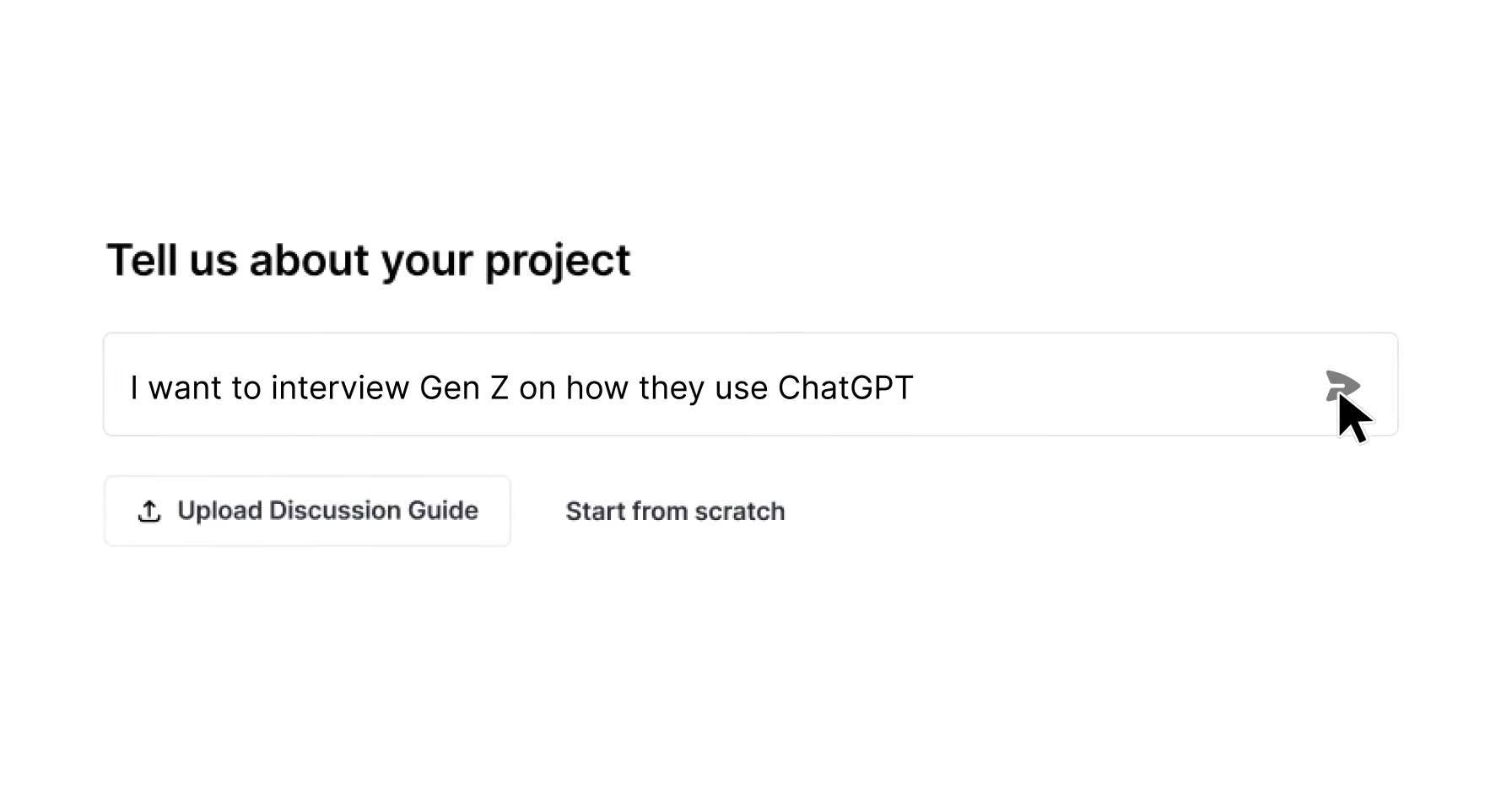
The platform’s pricing-specific capabilities address every step of the protocol above:
- Gabor-Granger Pricing Test — Runs a conversational price ladder inside studies teams already field and returns the demand curve plus the story driving it. Each yes raises the floor and each no lowers the ceiling. Buyers who would not purchase at any price stay in the count so demand is not artificially inflated. Inconsistent yes/no patterns are counted separately, and half-finished ladders are dropped.
- Contextual Follow-Up Questions — Separate affordability from perceived value and code answers into themes. The AI interviewer keeps probing to distinguish “I can’t afford it” from “it isn’t worth that much,” which are two very different problems with different fixes.
- Demand And Revenue Curves With Segment Filters — Show how key audiences behave on their own, without fielding a new study.
- MaxDiff With Hierarchical Bayes And Portfolio Optimization — Produces a ranking with no ties and finds the combination that wins the most customers. In one study, the top three by score won 51% of shoppers, while the optimized variety pack won 87%.
- Emotional Intelligence — Built on Ekman’s universal emotions framework, quantified per question and traceable to the exact timestamp and verbatim quote. Available across 50+ languages.
- Quality Guard — Real-time fraud detection with a three-studies-per-month participant cap, behavioral matching on intent and past actions, and reputation scoring that compounds across every interview.
- Recruitment From 50M+ Verified Respondents across 45+ countries and 120+ languages, including hard-to-reach segments such as enterprise decision-makers and consumers below 1% incidence rate.
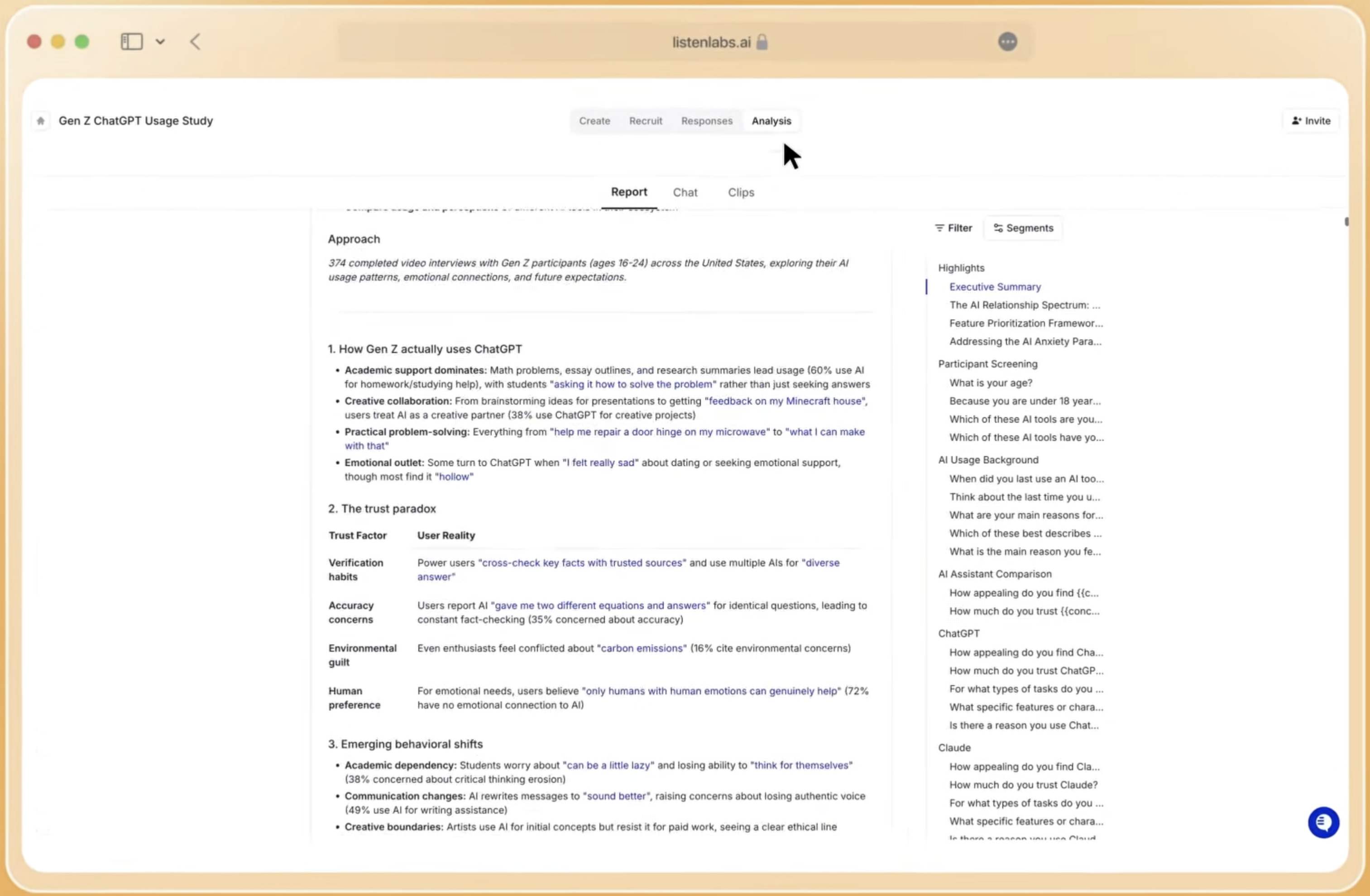
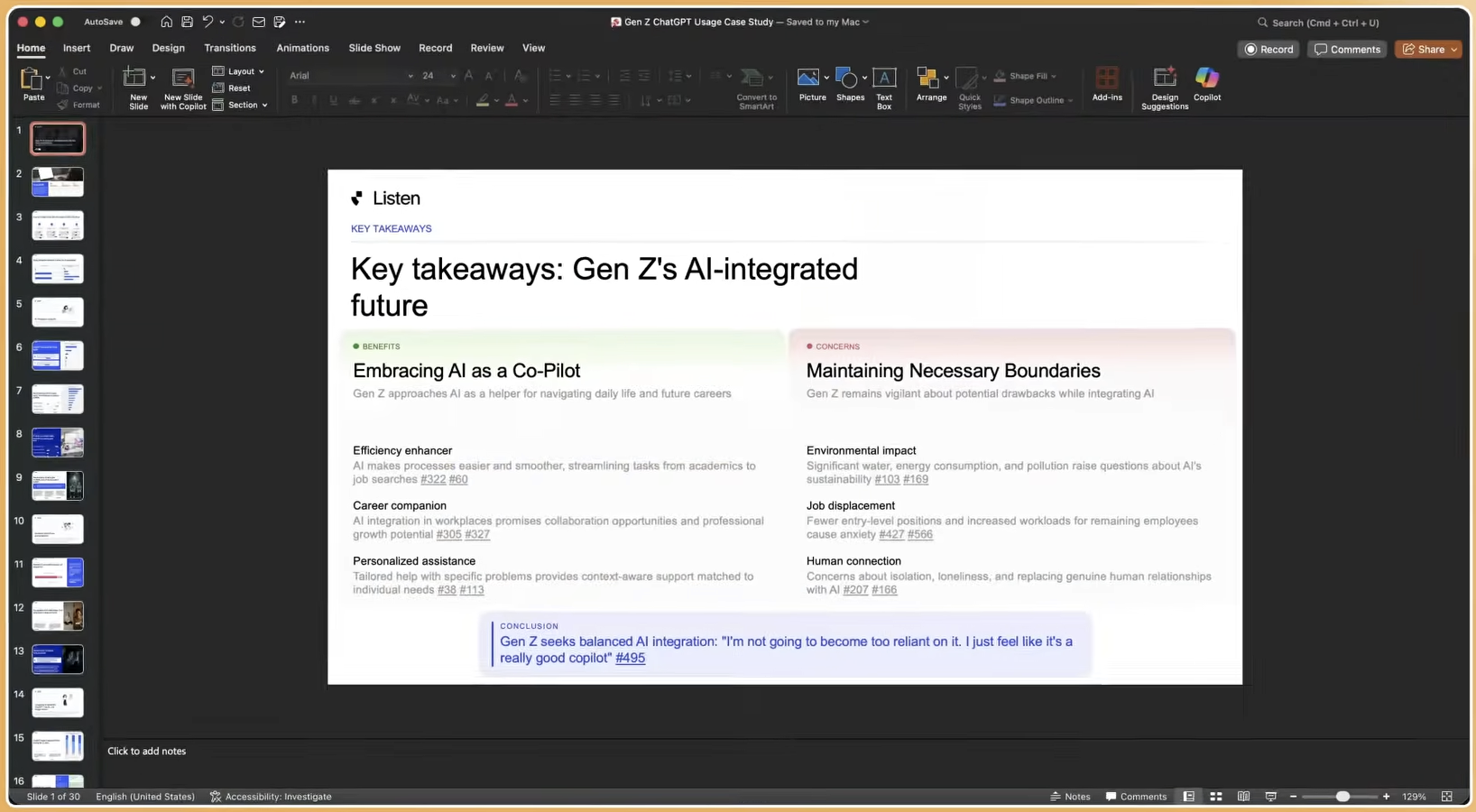
- Research Agent — Generates slide decks, memos, charts, and highlight reels in under a minute, so pricing findings reach the CFO in the format they need.
- White-Glove Support — An insights team of career researchers for complex pricing projects.
Enterprise proof points are documented at scale. Microsoft cut research wait time from weeks to hours and reached hundreds of users at one third of the cost. Anthropic now runs 100 studies in the time it previously took to run five or six. P&G delivered 250+ interviews with quantified themes and verbatim proof in hours. Sweetgreen scaled research across 300+ US locations at 5x the scale and one third the cost.
Explore Listen Labs’ Pricing Research Protocol
Frequently Asked Questions
How Do AI-Moderated Pricing Interviews Differ From Traditional Pricing Surveys?
Traditional pricing surveys give a demand curve without explaining the reasoning behind it. They present price questions in a fixed sequence with no ability to follow up on a respondent’s reasoning. AI-moderated pricing interviews layer qualitative probing onto each quantitative choice. After a buyer rejects a price, the AI asks what they were comparing it to, whether the issue is affordability or perceived value, and what would make the price feel fair. The result is both the demand curve and the reasoning behind every point on it, which is what a pricing strategy actually requires. The protocol also captures budget authority, switching thresholds, and competitor reference prices that a survey cannot reach.
How Many Interviews Does A Pricing Study Need?
As detailed in the sample size section, most teams get directionally reliable willingness-to-pay signals from 30–50 interviews per segment, while 100+ per segment provides stronger quantitative confidence. A full study typically runs 150–300 interviews across current customers, churned customers, and evaluating prospects. For Gabor-Granger specifically, the general consensus minimum is 100 respondents, with 100–200 providing greater robustness. With AI-moderated interviews, recruiting rather than moderator availability sets the upper bound on sample size.
How Do You Keep Willingness-To-Pay Data Valid?
Four controls address the primary failure modes. First, adaptive probing limits keep the moderator on-topic without fabricating follow-ups, and every AI-generated probe should be evaluated against neutrality criteria before presentation. Second, emotional-signal capture built on Ekman’s universal emotions framework quantifies emotion per question and traces every label to the exact timestamp and verbatim quote. Third, neutral price framing throughout the interview prevents leading probes from anchoring responses. Fourth, frequency caps that limit participants to no more than three studies per month, plus behavioral screening that matches on intent and past actions rather than relying solely on self-reported demographics, address professional-respondent contamination. Researchers should also review raw transcripts rather than relying only on AI summaries to catch cases where the summary oversimplified the participant’s meaning.
Does AI Moderation Lose Emotional Nuance?
Current-generation AI moderators are weaker than humans at reading facial expressions and tone in real time. A 2026 study by Deng, Liu, Toubia, and Jain found that participants sound more emotionally engaged with a live human moderator, with human-moderated interviews rated higher on speech-based valence, arousal, and dominance, while AI and static interviews are emotionally indistinguishable. Platforms built on Ekman’s universal emotions framework partially address this by quantifying emotion per question and tracing every label to the exact timestamp and verbatim quote.