
Written by: Anish Rao, Head of Growth, Listen Labs | Last updated: July 17, 2026
Key Takeaways
- Traditional human coding delivers deep interpretive rigor but is too slow and unscalable for enterprise teams running frequent studies.
- General-purpose LLMs like ChatGPT provide speed yet suffer from hallucinations, lack traceability, and miss critical audio-visual emotional signals.
- Legacy tools such as NVivo and ATLAS.ti offer structured codebooks and audit trails but remain text-only and cannot capture tone, micro-expressions, or emotional arcs.
- End-to-end AI platforms purpose-built for qualitative research reduce first-pass coding time by up to 70% while maintaining high consistency and identifying more relevant segments than manual methods.
- Listen Labs combines multimodal Ekman-based Emotional Intelligence, timestamp traceability, and automated workflows to compress weeks of analysis into hours. See how Listen Labs compresses weeks into hours.
Introduction
Qualitative researchers face a pivotal choice about how to analyze growing volumes of interviews and open-ended feedback. Enterprise teams need depth, speed, and scalability without sacrificing rigor or traceability. This article compares four approaches across eight dimensions: speed, scalability, emotional depth, traceability, consistency, participant quality, workflow integration, and data security.
What is the best AI to analyze qualitative data?
No single answer fits every research context. Evaluating these approaches across eight dimensions of performance exposes meaningful gaps in each.
Traditional human coding remains the methodological gold standard for interpretive depth. A single 60-minute interview produces a detailed transcript that takes several hours for an experienced analyst to code. A typical 20-interview study compresses into roughly 120 hours of manual coding. This extended timeline creates two quality risks. First, solo human coders can show variability in self-consistency, and inter-coder reliability can decline as fatigue builds over long coding sessions. Second, heavy cognitive load increases confirmation bias, so analysts unconsciously over-code evidence supporting early themes and under-code disconfirming evidence. On traceability and nuance, human coding excels. On speed, scalability, and operational burden, it fails enterprise teams running dozens of studies per quarter.
General-purpose LLMs such as ChatGPT or Claude used outside a purpose-built platform offer speed but introduce structural risks. Industry-standard LLMs can hallucinate in long-form answers on benchmarks like TruthfulQA. General-purpose models may begin hallucinating after processing multiple interview transcripts and can break down with larger volumes. Context-window truncation causes models to focus disproportionately on the beginning and end of inputs, silently omitting middle sections. There is no persistent taxonomy, no audit trail, and no participant quality control.
Legacy qualitative tools such as NVivo and ATLAS.ti provide structured codebooks and audit trails but remain text-only and manual in their core coding workflow. They do not capture tone, micro-expressions, or emotional arc. They also do not recruit participants, moderate interviews, or generate deliverables automatically, so teams still carry a heavy operational load.
End-to-end AI platforms purpose-built for qualitative research address all eight criteria at once. AI coding reduces first-pass coding time by up to 70%, maintains high self-consistency across a dataset, and identifies more relevant segments than manual coding on the same data. Adoption reflects this shift. The share of researchers using AI for qualitative analysis has grown rapidly, and most now cite AI-assisted analysis as a leading trend shaping user research.
Can ChatGPT do sentiment analysis?
ChatGPT can perform sentiment classification on small batches of text. General-purpose AI tools can process multiple open-ended responses per session using structured prompts, yet they often hit walls at scale because themes built in one session do not persist. Researchers must re-teach categorization frameworks each time. At 200 or more responses, analysis quality drops. At 5,000 or more responses, this approach becomes impractical.
The deeper limitation is architectural. General-purpose LLMs lose essential audio signals, including prosody, hesitation patterns, vocal intensity, pitch dynamics, and temporal rhythm, when audio is converted to text transcripts. This signal loss has direct consequences for sentiment accuracy. A participant saying “I am fine” with a tense voice and a furrowed brow registers identically to a genuinely satisfied response in a text-only system because the model has no access to the vocal or visual cues that reveal the true emotional state.
Research comparing AI tools against human-coded sentiment on Australian COVID-19 public health datasets has revealed differences in categorization approaches. Human analysts in that study identified an emergent “ambiguous” sentiment category for mixed or unclear emotional valence. Commercial AI tools limited to positive, negative, or neutral labels could not accommodate that nuance.
Listen Labs addresses these limitations with 50 or more years of in-house research expertise and tens of thousands of completed studies that ground its analysis engine. Its Research Agent links every insight directly to the underlying response data. This architecture eliminates the hallucination and traceability gaps that make general-purpose LLMs unreliable for enterprise qualitative work.
Is NVivo better than ChatGPT?
NVivo and ATLAS.ti offer structured coding frameworks, codebook management, and audit trails that ChatGPT cannot match. Manual coding in studies using ATLAS.ti has achieved high inter-coder reliability, and that level of rigor is real. The trade-off is time. Studies have shown that NLP-assisted coding can substantially reduce manual coding time while preserving structure.
ChatGPT offers speed but no persistent codebook, no audit trail, and no source-linked traceability. A market researcher reported that “ChatGPT literally just made stuff up that was not even in the surveys” even with only 12 responses. Neither NVivo nor ChatGPT captures multimodal emotional signals such as tone of voice, facial micro-expressions, or hesitation patterns, even though these cues often carry the most diagnostically valuable data in a qualitative interview.
Listen Labs’ Emotional Intelligence feature quantifies every emotion per question and concept, with every label traceable to the exact timestamp, verbatim quote, and AI reasoning behind it. A finding such as “joy at 0:42 linked to verbatim quote about ease of use” is auditable, reproducible, and directly actionable. Neither NVivo’s manual workflow nor ChatGPT’s generative output can deliver that level of precision at scale. The Research Agent then automates the full analysis workflow from raw data to stakeholder-ready deliverables, including charts, statistical tests, highlight reels, and branded slide decks.
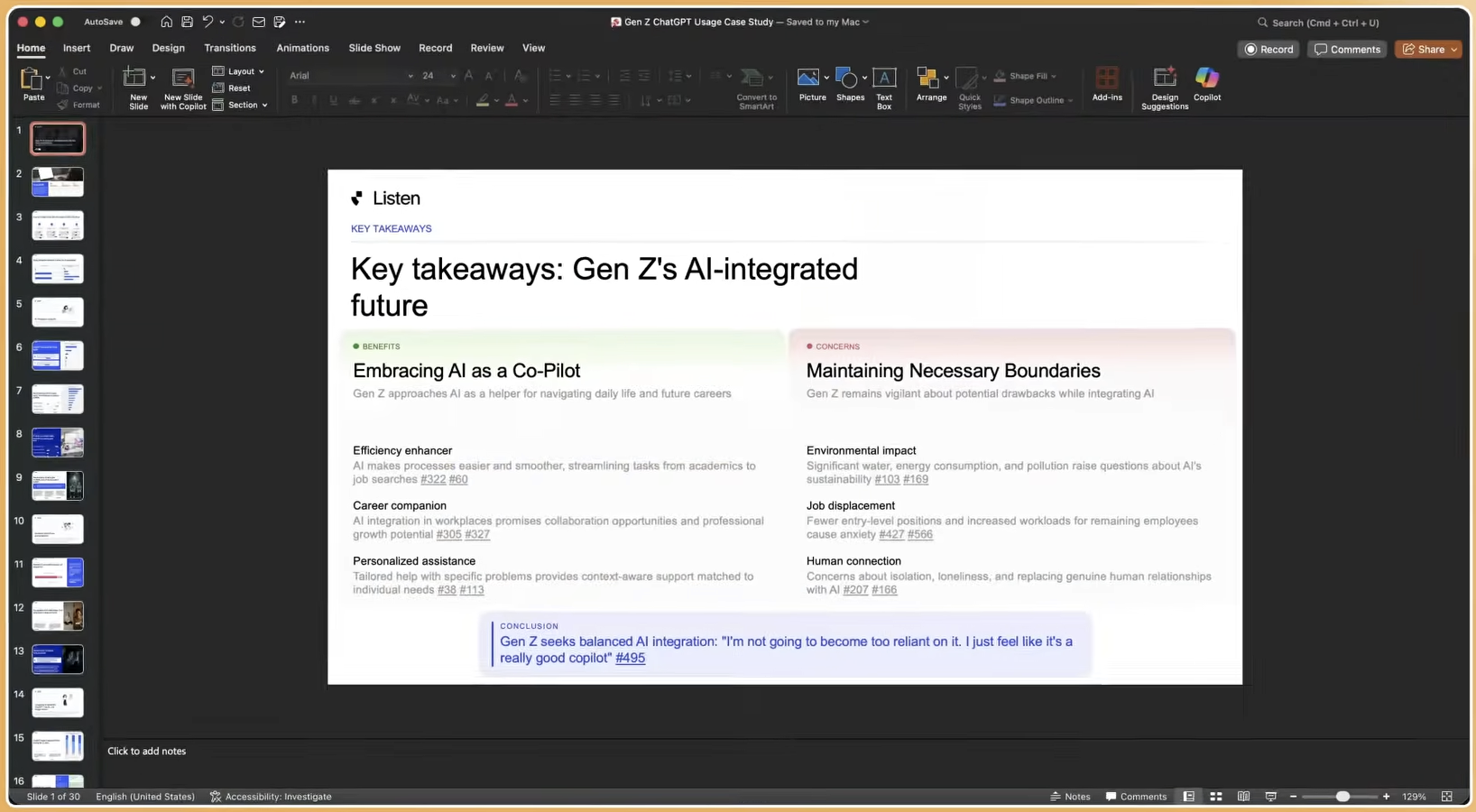
Request a demo showing timestamp-traceable emotion analysis applied to your research questions.
How Listen Labs Applies Multimodal Emotional Intelligence
Gaps in traditional coding, general-purpose LLMs, and legacy tools, especially around tone, micro-expressions, and emotional arc, require a different technical architecture. Listen Labs addresses these gaps with a multimodal approach that captures audio, visual, and textual signals at the same time.
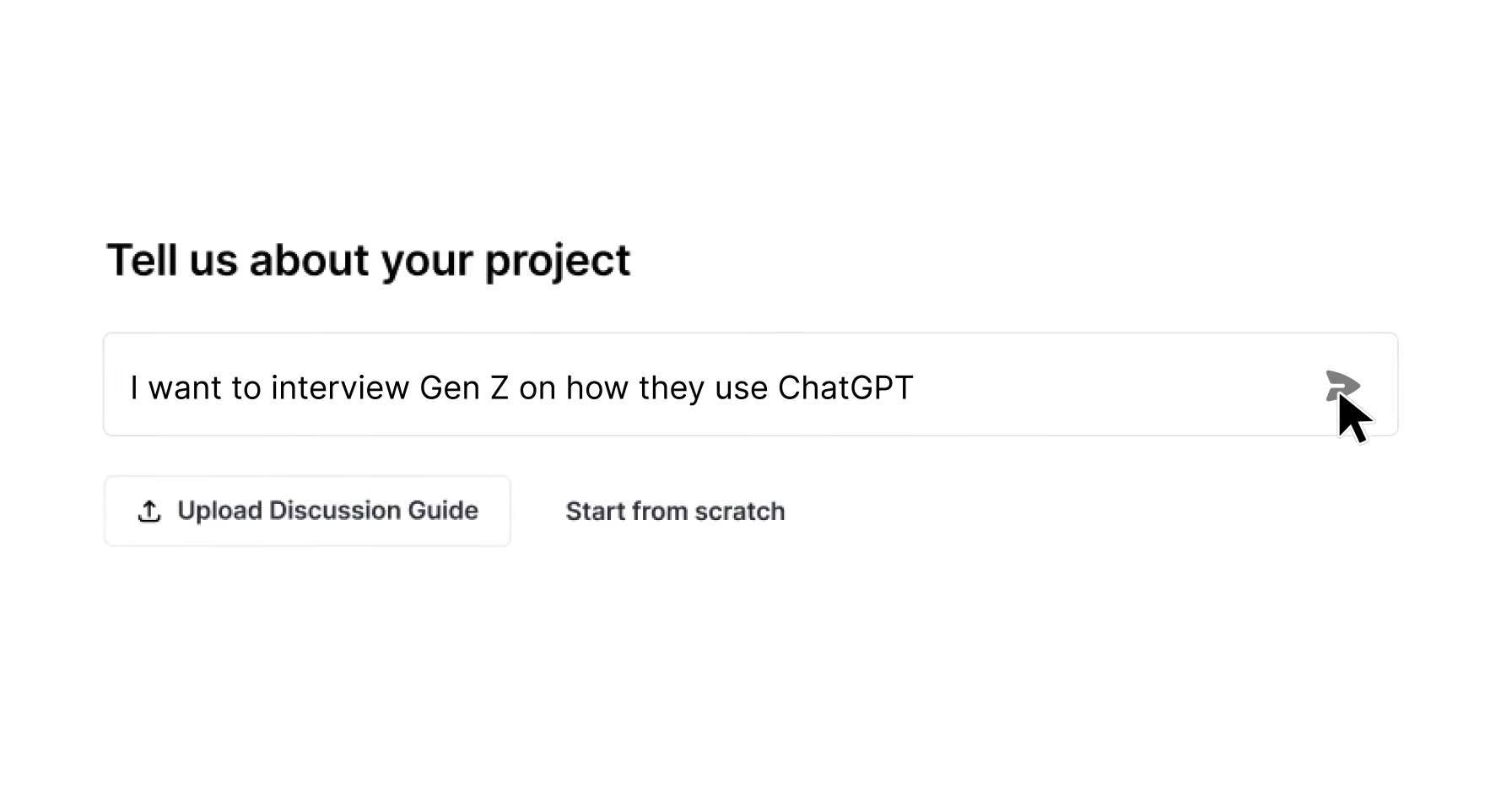
The workflow begins before the first interview. AI-assisted study co-design lets researchers describe goals in natural language and receive structured objectives, questions, and probing context in seconds. Participants come from a global network of more than 30 million verified respondents across over 45 countries, with Quality Guard monitoring every session in real time for fraud, low-effort responses, and repeat respondents.
During AI-moderated video interviews, the platform captures three simultaneous layers of signal. Emotional Intelligence analyzes tone of voice, word choice, and subconscious micro-expressions to surface emotions that transcripts alone miss. The scientific basis is Ekman’s universal emotions framework, the same standard used in clinical psychology and UX research, tracking anger, anticipation, disgust, fear, joy, sadness, trust, and surprise.
The research literature supports this multimodal approach. Multimodal emotion recognition systems that combine audio and visual features have achieved high accuracy on the RAVDESS dataset and outperform single-modality approaches. Adding cross-modal attention to text analysis improves binary sentiment accuracy, with further gains from incorporating facial expression signals. Multimodal sentiment analysis aligns with how humans process sentiment in real-world scenarios, integrating fine-grained signals from language, images, sound, and physiological cues.
Every emotion label in Listen Labs is traceable to its source. Researchers can query the Research Agent in natural language, such as “which concept triggered the most confusion among 35–44-year-old participants,” and receive a side-by-side emotional breakdown across stimuli, segments, and markets, with video clips of the most emotionally significant moments.
Enterprise Results and Data Security
Enterprise teams use Listen Labs to run more studies, reach more markets, and deliver insights faster. Microsoft used Listen Labs to collect global customer stories for its 50th anniversary celebration within a single day. The Director of Data Science at Microsoft noted, “I can reach out to hundreds of users at one third of the cost.” Anthropic’s team ran more than 300 user interviews in 48 hours to surface Claude churn drivers five times faster than previous methods, delivering a prioritized list of 10 “must-fix” items. Procter & Gamble used the platform to conduct more than 250 interviews with quantified themes and verbatim proof, shaping product and brand strategy in hours rather than weeks.
These results align with broader industry data. AI user research tools cut median time-to-insight by 84% between 2024 and 2026 for a standard 30-interview qualitative study, reducing it from 31.4 working days to 9.2 working days. Research agencies using AI-powered qualitative platforms can run more projects with the same team size and deliver insights while decisions are still in play.
On data security, Listen Labs holds SOC 2 Type II, GDPR, ISO 27001, ISO 27701, and ISO 42001 certifications. Customer data is never used for AI model training. Every insight links to its source response, creating a full audit trail for compliance and internal governance.
Despite these capabilities, AI-powered qualitative analysis does not fit every research context.
When AI Should Be Avoided
Highly sensitive topics such as clinical mental health disclosures, legally regulated subject matter, or studies where body language and emotional reactions are the primary research object still require primary human judgment. Full automation should be avoided for ambiguous, sensitive, or high-stakes cases that demand human nuance, as well as for novel theme discovery, sarcasm and irony, cultural nuance, and domain-specific jargon.
Listen Labs surfaces low-confidence segments for researcher review rather than forcing clean labels onto ambiguous data. The platform functions as a force multiplier for existing research teams, not a replacement. Researchers retain strategic interpretation, anomaly investigation, and final accountability for all deliverables.
Understanding when AI should be avoided is only half the picture. Teams also need a clear framework for choosing the right approach when AI is appropriate.
Decision Framework for Choosing a Qualitative Analysis Approach
Matching the right approach to a research goal depends on four variables: timeline, sample size, emotional depth required, and team capacity. The following scenarios illustrate how different combinations of these variables point to different solutions.
- 5–15 interviews, exploratory, no time pressure: Traditional human coding with NVivo or ATLAS.ti delivers the deepest interpretive rigor. Budget 4–6 hours of coding per interview.
- 20–50 interviews, moderate timeline, limited team capacity: AI-assisted coding on a purpose-built platform reduces analysis from weeks to days while maintaining traceability. Validate 15–20% of AI-coded segments manually.
- 50–300 or more interviews, fast turnaround, emotional depth required: An end-to-end platform with multimodal emotional intelligence becomes the only viable option. General-purpose LLMs cannot handle this volume reliably, and human coding cannot handle it within a business-relevant timeframe.
- Ongoing consumer insights program, multiple markets, continuous discovery: Listen Labs’ Mission Control serves as the organizational source of truth, enabling cross-study queries, trend tracking, and institutional knowledge building across every study ever run on the platform.
For enterprise teams bottlenecked by a growing research backlog, Listen Labs functions as a five to ten times multiplier on study output. The same headcount that previously ran 8–10 studies per quarter can run 40–80, with richer emotional data and faster deliverables at each step.
Schedule a workflow assessment to see how Listen Labs fits your team’s current research process and study volume.
Frequently Asked Questions
Will Listen Labs replace our research team?
Listen Labs is designed as a force multiplier for existing research teams, not a replacement. The platform automates the most time-intensive steps, including recruitment, moderation, transcription, coding, and first-pass analysis. Researchers can then redirect their time toward strategic interpretation, stakeholder communication, and study design. Teams using Listen Labs typically run five to ten times more studies per quarter at constant headcount, so the research function becomes more influential within the organization, not smaller.
How does Listen Labs ensure participant quality?
Three layers of protection work in combination to protect participant quality. First, Listen Labs only works with high-quality, non-commodity panel sources, avoiding professional survey-takers and incentive-optimized respondents. Second, Quality Guard monitors every interview in real time across video, voice, content, and device signals to detect fraud, low-effort responses, AI-generated scripts, and mismatched profiles. Participants are limited to three studies per month to reduce panel fatigue. Third, a dedicated recruitment operations team adds a human review layer and handles hard-to-reach segments including enterprise decision-makers, healthcare workers, and audiences below 1% incidence rate. Listen Atlas, the AI orchestration layer, matches participants on behavioral and intent data rather than self-reported demographics alone.
What pricing models does Listen Labs offer?
Listen Labs uses a subscription model. Enterprises pay for platform access, which includes a set number of studies and credits, and then spend credits per participant recruited. Credit cost varies based on audience difficulty, so general population studies cost fewer credits than niche or hard-to-reach audiences. Companies with more than 100 employees go through a demo and pilot process. Smaller organizations can access the self-serve platform directly. Organizations that bring their own participants pay fewer credits per respondent.
Does Listen Labs support multilingual qualitative analysis?
Yes. The platform supports more than 100 languages for conducting interviews, with automatic transcription and translation across all supported languages. Emotional Intelligence, including Ekman-based emotion quantification with timestamp-level traceability, is available across more than 50 languages. Listen Labs covers over 45 countries across the Americas, Europe, APAC, and MEA, which makes it suitable for multi-market consumer insights programs that require consistent methodology and comparable outputs across geographies.
Conclusion
Traditional human coding, general-purpose LLMs, and legacy qualitative tools each leave critical gaps in speed, traceability, emotional depth, or scalability that enterprise research teams cannot accept at today’s decision pace. A PLOS Digital Health study found that machine-assisted analysis can reduce total qualitative analysis time substantially, and that figure climbs further on purpose-built platforms with retrieval-grounded architectures. Listen Labs combines AI-moderated video interviews, a network of more than 30 million verified participants, real-time Quality Guard, and multimodal emotional analysis described above into a single end-to-end platform that compresses weeks of manual analysis into hours while preserving the methodological rigor that enterprise research demands. The result is not a smaller research team. The result is the same team running significantly more studies, with richer emotional data, and delivering insights before the business context changes. Explore a tailored Listen Labs demo for your organization.