Written by: Anish Rao, Head of Growth, Listen Labs
Key Takeaways
- Teams need to name the testing job first: early concept screen, price sensitivity measurement, or qualitative diagnosis.
- Methodology choice (monadic, sequential monadic, Van Westendorp, Gabor-Granger, MaxDiff) determines which tool category can run the study correctly.
- Survey panels deliver fast numbers but do not capture the reasoning behind price or concept reactions.
- AI-moderated interview platforms deliver both the demand curve and the qualitative “why” behind each data point in under 24 hours.
- Listen Labs serves teams that need concept validation and price sensitivity answered together at roughly one third of traditional research cost.
See How Listen Labs Runs Pricing Studies
Clarify Your Testing Job Before Choosing A Tool
Most teams buy the wrong tool category because they skip the step of naming the testing job before selecting a platform. The three distinct jobs are:
- Early concept screen identifies which concept earns a second look before resources are committed.
- Price sensitivity measurement reveals what buyers will actually pay, expressed as a demand curve rather than a single stated number.
- Qualitative diagnosis explains why a concept or price landed the way it did, which requires probing that a survey cannot deliver.
Two questions route the decision. First, consider product type. SaaS and subscription products have established market price anchors, which makes Gabor-Granger a viable starting point. Physical goods and CPG products often lack a price anchor, so Van Westendorp usually works better as the first step. Consumer apps sit in between, because the purchase decision is fast and emotional, and they often need both a demand curve and qualitative context.
Second, consider quant-versus-qual needs. Teams that need a defensible number for a pricing committee need a demand curve. Teams that need to understand why a concept failed need conversation-level probing. AI-moderated interview platforms can deliver both needs in a single study.
How Methodology Shapes Your Concept Testing Tool Choice
Each methodology answers a specific question and places specific constraints on the tool category that can execute it.
Monadic concept testing shows each respondent a single concept or price point in isolation. This approach removes comparison bias but requires a separate sample cell per concept. A monadic design requires roughly 200 respondents per concept cell, so testing six concepts monadically requires 1,200 completes. Survey panels execute monadic designs efficiently at scale. AI-moderated interview platforms make monadic pricing tests more affordable because the marginal cost of one more session drops sharply.
Sequential monadic concept testing shows each respondent multiple concepts one at a time in randomized order. This approach reduces total sample needs but introduces order effects and carryover risk. Sequential monadic designs break down when survey length exceeds roughly 30 questions, because concepts multiplied by metrics create fatigue. Four concepts across four metrics can work. Ten concepts across four metrics often produces unusable data because respondents stop reading by concept six.
Van Westendorp Price Sensitivity Meter asks four open-ended price questions to map an acceptable price range. It produces no demand curve or revenue estimate, and in its standard survey-based form it captures stated price thresholds without probing the reasoning behind them. A survey panel can run Van Westendorp in minutes, but it cannot ask a respondent what they were comparing against when they named $49 as “too expensive.” That competitive anchor often changes the pricing strategy and usually surfaces only in conversation.
Gabor-Granger measures purchase intent at specific predefined price points to build a demand curve and find the revenue-maximizing price. It requires researcher-defined price points and carries anchoring bias in its sequential form. The sequential version, where each respondent’s next price depends on their previous answer, is efficient but anchors the sample to the starting price. The monadic version avoids anchoring but requires 50–100 respondents per price point.
MaxDiff and conjoint force trade-offs across attributes to produce a ranking or feature-level willingness to pay. A full ranking exhausts respondents and a rating scale produces ties. MaxDiff resolves this by showing small sets and asking for best and worst, then aggregating with a Hierarchical Bayes model into a clean ranking with no ties. Conjoint analysis provides the most accurate method for feature-level willingness to pay but typically costs $30,000–$100,000 and takes 8–12 weeks on traditional platforms.
Choosing Between Monadic And Sequential Monadic Designs
Monadic testing works best for expensive or hard-to-reverse decisions such as tooling, print runs, or a brand name. It mirrors how customers actually meet a product, without rejected siblings beside it. The trade-off is cost, because testing six concepts monadically costs six times the fieldwork of testing one.
Sequential monadic testing is cheaper and faster. It breaks down once survey length exceeds roughly 30 questions, and later concepts suffer from fatigue and comparison bias regardless of randomization. For most early-stage concept screens with tight budgets, sequential monadic designs are defensible. For any decision that is difficult to reverse, monadic testing is the safer choice.
Choosing Between Van Westendorp And Gabor-Granger
Van Westendorp uses respondent-suggested prices and works better for new products with no price assumptions. It asks buyers to name their own thresholds rather than react to researcher-chosen points. Gabor-Granger requires predefined price points and works better for products with established market pricing, where the researcher already knows the plausible range.
Neither method tests price in competitive context because both ask respondents to evaluate a price in isolation. This structure explains why Van Westendorp results often break down in competitive markets where respondents default to abstract notions of value rather than real trade-off reasoning. A common and effective two-phase approach runs Van Westendorp first to find the acceptable range, then Gabor-Granger to find the revenue-maximizing point within it. Both can run in the same survey, adding 5–7 minutes total.
The Speed-Vs-Depth Trade-Off In Pricing Research
The classic pricing-test failure asks “would you pay $X?” in isolation. Hypothetical willingness-to-pay commonly exceeds actual willingness-to-pay by roughly 1.35 to three times because respondents face no consequence for their answer. A survey panel can run Van Westendorp and return a price range in hours. It cannot ask the respondent what they were comparing against when they named that number or separate “I can’t afford it” from “it isn’t worth that much.” These two problems require very different fixes.
The purchase-intent-plus-price-sensitivity-plus-WTP combination forms a strong design for a pricing study. It only produces actionable strategy when the reasoning behind each data point appears alongside the number. Traditional surveys capture what people do. Understanding why requires a conversation, and that why separates adequate customer research from outstanding research.
Listen Labs runs Gabor-Granger as a conversational price ladder. Each buyer sees a description of the product and decides whether they would buy it at a given price. Their answer sets the next price: higher after a yes, lower after a no. Each yes raises the floor and each no lowers the ceiling until the ladder finds the most that person would pay.
Once a buyer lands on a price, the AI interviewer probes to separate “I can’t afford it” from “it isn’t worth that much.” The system then codes those answers into recurring themes so individual anecdotes become measurable data.
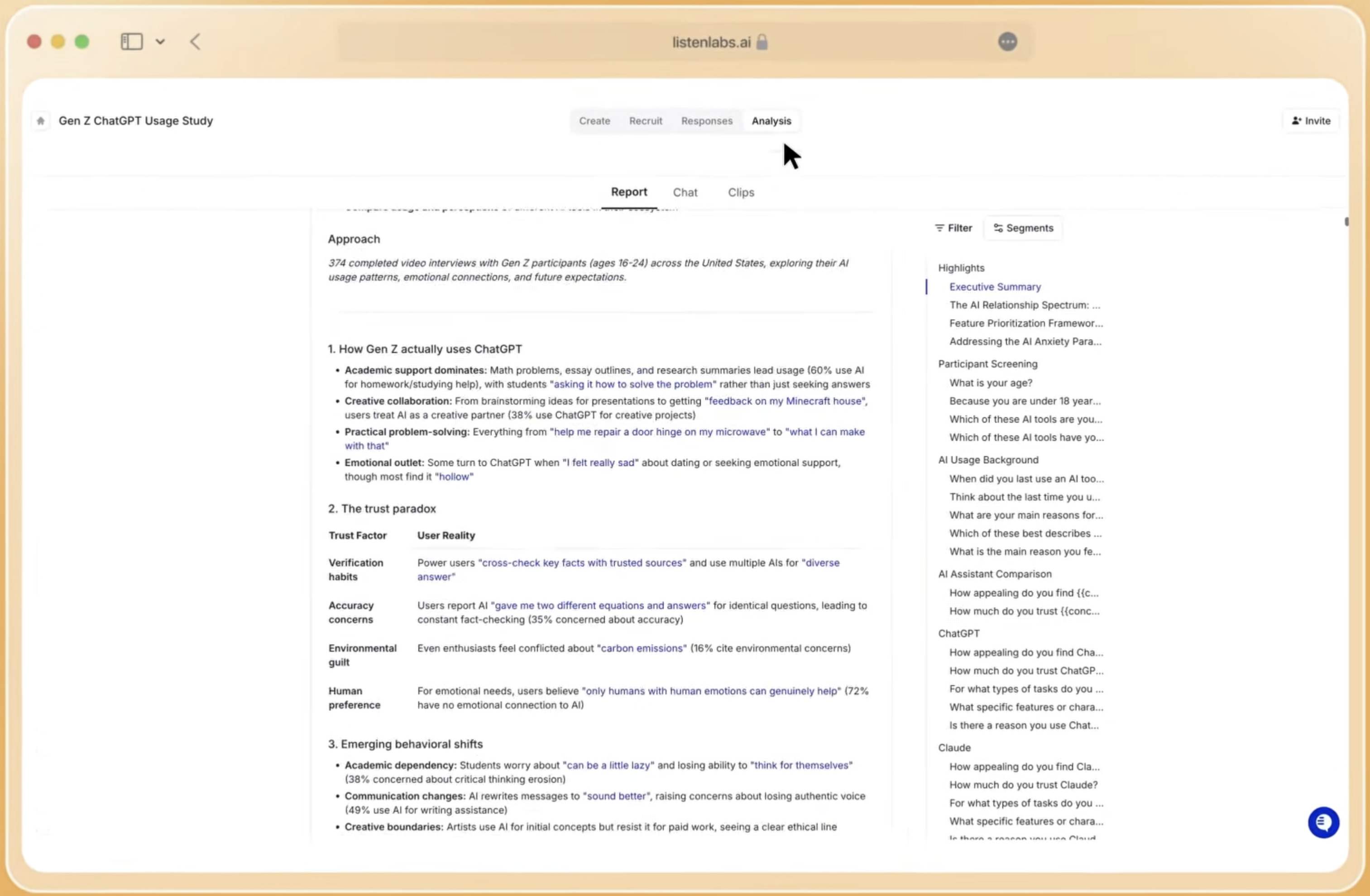
The output includes a demand curve, a revenue curve, segment filters, and coded themes behind each choice. Every point on the curve traces back to a real interview and clip. As Micky Malka, founder of Ribbit Capital, put it: “Listen is the best tool to understand the customer. Instead of having a bored person to ask the questions, this AI engine can engage with you, and modify the questions to go deeper.” Listen Labs has conducted over 1 million AI-moderated interviews.
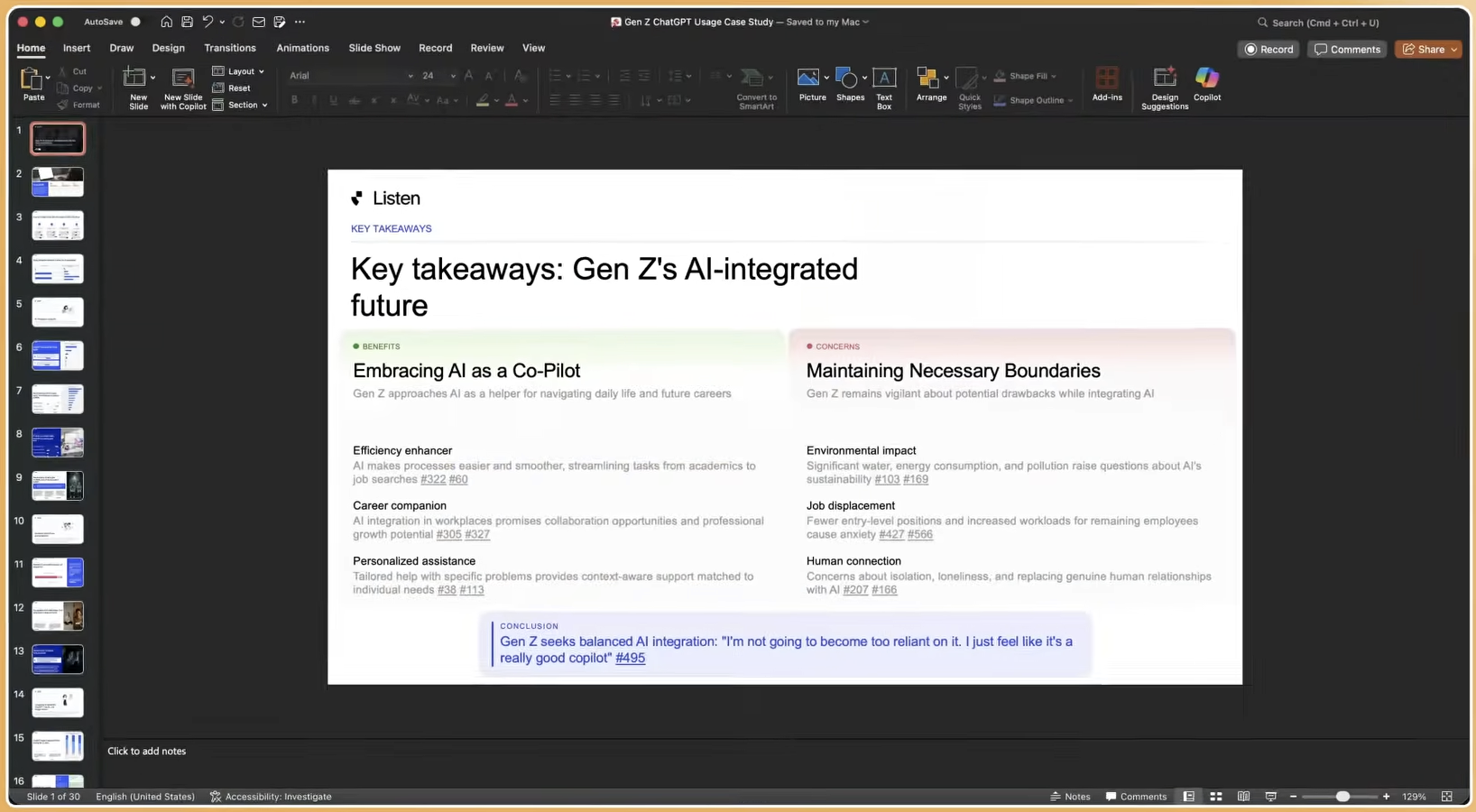
For a deeper look at how survey software compares for price sensitivity testing, Listen Labs has published a dedicated guide on the topic.
Explore A Live Pricing Study In Listen Labs
How Product Type Shapes Your Research Plan
Product type, testing job, and methodology work together to shape the right tool category. For SaaS and subscription products, teams often need to find the revenue-maximizing price tier and understand why buyers stall at a given price point. Gabor-Granger builds the demand curve, and Van Westendorp can run first if no price anchor exists. An AI-moderated interview platform such as Listen Labs can run both the demand curve and the reasoning in one study.
For physical goods and CPG products, teams usually need to establish an acceptable price range before tooling and validate packaging concepts alongside price. Van Westendorp helps find the range. A monadic concept test evaluates packaging, and MaxDiff supports feature or variant prioritization. Survey panels can run Van Westendorp at scale. An AI-moderated interview platform becomes essential when the “why” behind the price range matters.
For consumer apps, teams often need to screen concepts early, test freemium-to-paid conversion price, and diagnose drop-off reasoning. Sequential monadic designs work for early screening. Gabor-Granger sets the conversion price. Qualitative probing explains drop-off. Listen Labs can deliver all three jobs in sequence, with a demand curve, segment filters, and coded themes in a single workflow.
When A Managed Service Beats Self-Serve Software
Self-serve AI-moderated interview platforms fit most concept and pricing studies. They are faster, cheaper, and more flexible than managed research services for standard testing jobs. A managed service or consultancy earns its place when the study design is genuinely complex. Examples include multi-market conjoint with competitive simulation, pricing research for a regulated category, or a study that requires custom recruitment of audiences below 1% incidence rate.
This distinction matters because managed services often reintroduce the same timeline problem that AI-moderated platforms were built to solve. A full-service pricing consultancy typically charges $50,000–$200,000 per study with 6–10 week timelines. Listen Labs occupies a different position. For complex pricing projects, Listen Labs offers white-glove support from an insights team with 50+ years of combined research experience. It remains a single platform rather than a services engagement.
Teams get the methodological rigor of a career research team and the speed of an AI-moderated platform. They no longer have to choose between the two.
For a comparison of AI-moderated concept testing platforms and a guide to monadic price testing tools, Listen Labs has published dedicated resources on both topics.
Talk With The Listen Labs Research Team
Frequently Asked Questions About Running These Studies
How Fast Can A Rapid Concept And Pricing Test Run?
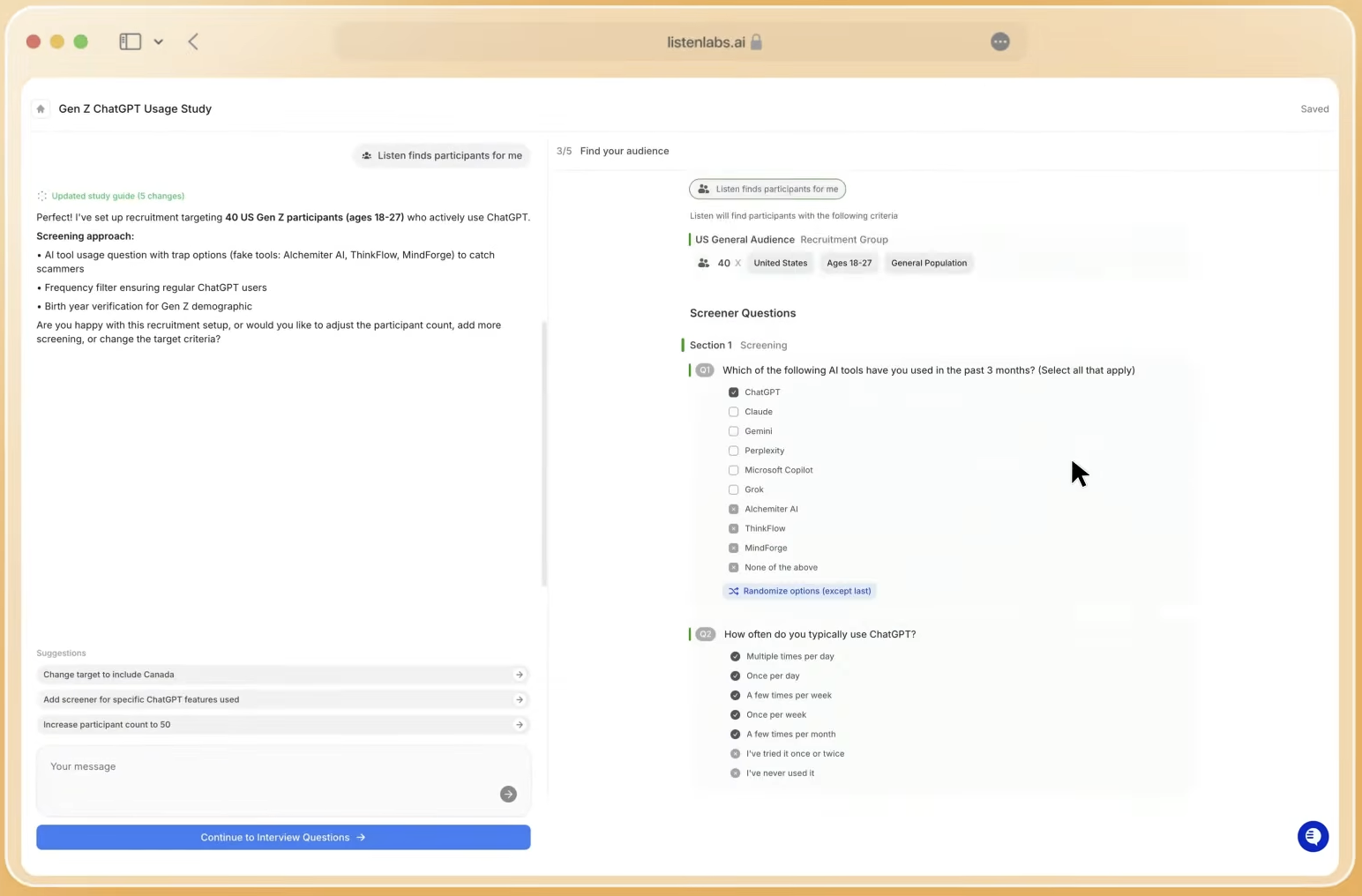
Listen Labs compresses the research cycle from 4–6 weeks to less than 24 hours. The platform handles study design, participant recruitment from a global network of 50M+ verified respondents, AI-moderated interviews, automated analysis, and delivery of reports and highlight reels within that window. For niche or hard-to-reach audiences, recruitment becomes the real bottleneck. Listen Labs’ dedicated recruitment ops team handles sourcing for audiences below 1% incidence rate, including enterprise decision-makers, healthcare workers, and specialized consumer segments.
How Do You Ensure Participant Quality?
Listen Labs applies three layers of protection. First, the platform works exclusively with high-quality, non-commodity panel sources, avoiding professional survey-takers. Second, Quality Guard uses real-time AI monitoring across video, voice, content, and device signals to detect fraud, low-effort responses, AI-generated scripts, and mismatched profiles. Third, a dedicated recruitment ops team adds a human review layer, and participants are limited to three studies per month to reduce panel fatigue and repeat respondents. Behavioral matching runs on intent and past actions, not just self-reported demographics.
Does An AI Moderator Actually Probe, Or Just Read The Guide?
The Listen Labs AI moderator adapts in real time. It generates responses three times longer than average through intelligent probing. The moderator follows up on short or interesting answers the way a trained human interviewer would, rather than advancing to the next scripted question. In pricing research, this means the moderator probes contradictions in the moment. If a buyer says a price is “too high” but their stated budget suggests otherwise, the moderator pursues that gap rather than accepting the surface answer. With Visual Insights enabled, the moderator also adapts to observed on-screen behavior and catches say-do gaps mid-session.
Can Listen Labs Run Multilingual Pricing Research?
Listen Labs supports 120+ languages for interview moderation and covers 45+ countries across the Americas, Europe, APAC, and MEA. Automatic translation and transcription are built into the platform. A pricing study that previously required in-country moderators in six markets can now run from a single discussion guide, with the AI handling language localization at the session level. Emotional Intelligence analysis is available across 50+ languages, capturing tone of voice, word choice, and micro-expressions alongside the verbal response.
Conclusion: Match Your Question To The Right Tool Category
The tool follows the methodology, and the methodology follows the question being asked. A survey panel can run Van Westendorp and return a price range in hours, but it cannot ask what the respondent was comparing against or separate affordability objections from value objections. A full-service research agency can run conjoint analysis with competitive simulation, but it often takes 6–10 weeks and costs multiples of what an AI-moderated platform charges. AI-moderated interview platforms close this gap by delivering the demand curve and the reasoning behind it while running the right methodology for the testing job.
As noted in the Key Takeaways, Listen Labs is built for teams that need concept and pricing answers together. Platforms like Listen Labs layer on auto-recruiting, transcription, sentiment tagging, and insight summarization so teams jump from question to findings in hours, not weeks. Over 1 million AI-moderated interviews have been conducted on the platform, serving enterprises including Microsoft, Procter & Gamble, Skims, Sweetgreen, and Nestlé.
Start Your Next Concept Or Pricing Study